
Goldman Sachs(GS)

Search documents
高盛称英国国债将无视政治风险 2026年有望表现强劲
Xin Lang Cai Jing· 2026-02-16 11:47
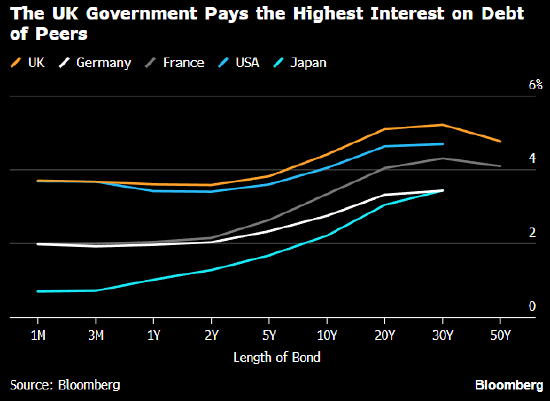
高盛策略师预测,受英国央行降息推动,2026年英国国债将上涨,政府借贷成本将降至2024年以来最低 水平。 该行欧洲高级市场策略师George Cole表示,基准10年期英国国债收益率预计将到今年底达到4%。他认 为,40个基点的降幅基于通胀回落促使英央行采取行动,其影响将盖过政治风险引发的担忧。 Cole在致客户报告中称,"尽管英国风险溢价和政治不确定性可能在即将举行的地方选举期间持续居高 不下,但我们认为有利的宏观环境将推动国债收益率走低。" 由于顽固通胀使英国央行决策者在降息方面保持谨慎,英国的借贷成本高于其他国家。投资者还担心该 国的财政状况,本月早些时候,由于首相基尔·斯塔默面临被迫下台的风险,而潜在接替者可能会寻求 更多借款,英国国债收益率一度飙升。 Cole表示,随着5月地方选举临近,政治不确定性持续存在,预计斯塔默领导的工党将表现不佳,这可 能使风险溢价维持在较高水平。不过,他指出,这些波动平均仅推动债券收益率上升30个基点,且此类 波动通常持续时间较短。 由于顽固通胀使英国央行决策者在降息方面保持谨慎,英国的借贷成本高于其他国家。投资者还担心该 国的财政状况,本月早些时候,由于首相基尔·斯塔 ...


高盛:鉴于第四季度增长稳健,泰国央行或将维持利率不变
Jin Rong Jie· 2026-02-16 07:42
高盛经济学家在一份报告中写道,鉴于泰国第四季度增长势头稳健,泰国央行在第一季度可能会维持政 策利率不变。第四季度GDP同比增长2.5%,增幅高于第三季度的1.2%。这些经济学家称:"最新公布的 数据明显好于预期,超过了平均预期,甚至超过了我们1.8%的预测上限。"展望未来,受项目储备强劲 等因素推动,泰国的投资势头可能保持强劲。高盛维持其对泰国央行在第一季度将维持利率不变、然后 在第二季度降息的预期。 ...
高盛:日本国债收益率曲线不再反映国家风险溢价
Jin Rong Jie· 2026-02-16 06:39
高盛分析师在一份报告中称,当前的日本国债收益率曲线不再包含任何"国家风险溢价"。他们称,10年 至30年期国债部分现已回归合理价值,而2年至10年期国债收益率曲线仅比合理水平陡峭10-15个基点。 他们称,"不确定性的消除本身可能就足以消除一些长端风险溢价"。然而,这些分析师称,上周的价格 走势"似乎已经超出了这单一因素的影响,让市场更倾向于相信政府和日本央行有能力解决'不良'的财 政尾部风险"。 ...
华尔街重回“镀金时代”:六大行掌门人年薪均超4000万
Hua Er Jie Jian Wen· 2026-02-15 23:16
Core Viewpoint - The compensation for CEOs of major U.S. banks has returned to pre-financial crisis levels, with annual total pay exceeding $40 million, surpassing records set in 2006 and 2021 [1][2]. Group 1: CEO Compensation Trends - The annual total compensation for CEOs of the six largest U.S. banks has reached or exceeded $40 million, marking a significant increase compared to previous years [1][2]. - Bank of America CEO Brian Moynihan's compensation rose by 17% year-over-year to $41 million, while Citigroup CEO Jane Fraser's pay increased by 22% to $42 million [1][2]. - Goldman Sachs CEO David Solomon's 2025 compensation is set at $47 million, the highest among peers, reflecting a 21% increase [2]. Group 2: Profitability and Performance - The rise in CEO compensation is directly linked to improved industry profitability, with top U.S. financial institutions reporting their largest annual profits since 2021 [3]. - Increased activity in trading, lending, and mergers and acquisitions has contributed to enhanced performance and bonus pools [3]. Group 3: Governance and Retention Strategies - Some pay increases signal governance confidence, such as Citigroup's raise for Jane Fraser, viewed as a vote of trust from the board after years of underperformance [4]. - Goldman Sachs' compensation discussions focus on retention, with significant bonuses aimed at keeping key executives amid competition from private equity investors [4]. - Compensation structures often include stock-based payments, aligning executive interests with those of shareholders [4]. Group 4: Shareholder Sentiment and Cost Concerns - Despite some opposition, CEO compensation plans generally pass shareholder votes without major obstacles [5]. - There is growing scrutiny on costs and compensation, particularly with the rise of artificial intelligence, leading to increased questioning of how banks will manage expenses while pursuing revenue growth [5]. - Investors are likely to monitor both the return of high salaries and the emphasis on cost control in upcoming earnings seasons and compensation votes [5].


该买还是该卖?金价刚暴跌又暴涨!国内金店连夜调价,每克涨了二三十元
Sou Hu Cai Jing· 2026-02-15 17:17
Core Viewpoint - The recent fluctuations in gold prices are primarily driven by the release of the U.S. Consumer Price Index (CPI) data, which has influenced market expectations regarding interest rate cuts by the Federal Reserve, leading to a significant rebound in gold prices after a period of volatility [3][6]. Group 1: Market Reactions - On February 14, 2026, gold prices in China saw significant increases, with Chow Sang Sang's price rising to 1551 RMB per gram, up 27 RMB from the previous day, and Lao Miao Gold increasing to 1565 RMB per gram, up 36 RMB [5]. - The international futures market reacted sharply, with April gold futures closing at $5063.80 per ounce, a 2.33% increase, and March silver futures at $77.27 per ounce, up 2.10% [4]. - The fluctuations in gold prices are closely tied to the movements in the international market, with domestic pricing reflecting changes in global gold prices almost immediately [4][5]. Group 2: Influencing Factors - The primary factors influencing gold prices include geopolitical risks, market expectations regarding central bank policies, particularly the Federal Reserve, and speculative trading activities [7][8]. - Geopolitical tensions, especially in the Middle East, have heightened demand for gold as a safe-haven asset, providing a solid support base for prices [7]. - The expectation of interest rate cuts, particularly following the soft CPI data, has reduced the opportunity cost of holding gold, making it more attractive to investors [7][8]. Group 3: Institutional Perspectives - Major investment banks, including JPMorgan and Deutsche Bank, have increased their holdings in gold ETFs, indicating a bullish outlook on gold despite recent volatility [8][9]. - Research reports from various banks have raised their price targets for gold by the end of 2026, with Deutsche Bank setting a target of $6000 per ounce and JPMorgan raising it to $6150 per ounce, citing ongoing demand from central banks and geopolitical risks [9]. - UBS has provided a scenario analysis suggesting that if geopolitical risks escalate, gold prices could reach $7200 per ounce, while maintaining current monetary policies could see prices drop to around $4600 [9]. Group 4: Changing Valuation Logic - The traditional correlation between gold prices and U.S. Treasury yields is weakening, with a growing emphasis on gold's monetary attributes as a store of value amid changing geopolitical dynamics [10][11]. - The total value of global gold reserves is now comparable to that of U.S. Treasury debt, indicating a significant shift in gold's role within the global financial system [11].



Goldman Sachs delivers contrarian take on the economy
Yahoo Finance· 2026-02-15 16:33
Economic Outlook - Goldman Sachs CEO David Solomon expresses optimism about the economic backdrop for 2026, citing strong fiscal support, significant AI-driven capital investment, and a favorable business environment [1][6] - Solomon notes that strategic activity is increasing, with businesses considering large deals and IPO discussions gaining momentum, indicating a shift from recent negative economic sentiment [2] Consumer Activity - Bank of America CEO Brian Moynihan reports that January activity was nearly 5% higher than the previous year, with spending rising across various income brackets, reflecting consumer optimism [3][4] Banking Sector Performance - Major banks, including Goldman Sachs and JPMorgan, have demonstrated resilience by maintaining fee growth, protecting margins, and effectively managing credit risk despite economic challenges [7][8] - Goldman Sachs' recent quarterly earnings report shows a strong performance, with earnings per share (EPS) of $14.01, exceeding expectations of $11.65, although revenue of $13.5 billion fell short of the expected $13.9 billion [11] Revenue Breakdown - Goldman Sachs experienced a significant impact from its exit from the Apple Card business, with Platform Solutions revenue declining to -$1.68 billion due to a $2.26 billion markdown related to the Apple Card portfolio sale [12] - Despite this, Global Banking & Markets revenue increased by 22% year-over-year to $10.4 billion, with investment banking fees rising by 25% to $2.58 billion, and equities also up by 25% to $4.31 billion [12]
华尔街重回“镀金时代”:六大行掌门人年薪均超4000万,刷新08年危机后上限
Hua Er Jie Jian Wen· 2026-02-15 12:18
Core Viewpoint - The compensation for CEOs of major U.S. banks has returned to pre-financial crisis levels, with annual total pay exceeding $40 million, surpassing records set in 2006 and 2021 [1][2]. Group 1: CEO Compensation Trends - The annual total compensation for CEOs of the six largest U.S. banks has reached or exceeded $40 million, marking a significant increase compared to previous years [1][2]. - Bank of America CEO Brian Moynihan's compensation rose by 17% year-over-year to $41 million, while Citigroup CEO Jane Fraser's pay increased by 22% to $42 million [1][2]. - Goldman Sachs CEO David Solomon's 2025 compensation is set at $47 million, the highest among peers, reflecting a 21% increase [2]. Group 2: Industry Profitability and Performance - The rise in CEO compensation is directly linked to improved industry profitability, with top U.S. financial institutions reporting their largest annual profits since 2021 [3]. - Increased activity in trading, lending, and mergers and acquisitions has contributed to the enhanced performance and bonus pools for banks [3]. Group 3: Governance and Retention Strategies - Some compensation increases signal governance intentions, such as Citigroup's raise for Jane Fraser, viewed as a vote of confidence from the board after years of underperformance [4]. - Goldman Sachs' compensation discussions focus on retention, with significant bonuses aimed at keeping key executives amid competition from well-funded private equity investors [4]. Group 4: Shareholder Sentiment and Cost Concerns - Although there has been some opposition to executive compensation plans among shareholders, these plans typically pass without major obstacles during voting [5]. - There is a growing focus on costs and compensation within the industry, particularly as concerns rise over employee and technology investments driven by artificial intelligence [6]. - Investors are likely to monitor the dual aspects of "high salary returns" and "cost control" in upcoming earnings seasons and compensation votes [6].
影响万亿资本的市场叙事争夺:一边是“AI颠覆一切”,一边是“AI回报不够”
华尔街见闻· 2026-02-15 10:56
Core Viewpoint - The current global market is experiencing a rare period of "high noise and high velocity," making it difficult for even seasoned traders to navigate [2] - The core anxiety in the market stems from two opposing narratives regarding AI, leading to significant volatility and risk transfer [3][8] Group 1: Market Dynamics - The S&P 500 index has stalled around the 7000-point mark this year, indicating underlying tensions despite a seemingly calm surface [3] - Goldman Sachs' "AI leaders vs. laggards" trade saw its largest single-day gain recently, primarily driven by short-selling of "laggards" [3] - There is a notable shift in global capital allocation, with increasing funds flowing into non-U.S. markets as the U.S. market narrative becomes more complex [5] Group 2: Regional Market Performance - The South Korean KOSPI index has doubled since the end of 2024, recently achieving its best weekly performance in five years, driven by corporate value enhancement plans and strong earnings expectations [6] - The MSCI Korea index has risen 28% year-to-date in USD terms, with Goldman Sachs raising its KOSPI target to 6400 points based on impressive earnings growth and attractive valuations [12] - Japan's Nikkei index has recently increased by 5%, indicating a shift in market dynamics where a stronger yen and lower interest rates are not hindering stock market performance [16] Group 3: Investment Strategies - The current market environment is characterized by contradictory signals, making investment decisions particularly challenging [6] - There is a rare phenomenon of simultaneous buying of cyclical assets and defensive assets, indicating uncertainty in market sentiment [6] - Hedge funds have shown remarkable resilience, with macro discretionary funds accumulating significant profit buffers, suggesting a favorable environment for active management strategies [14]

影响万亿资本的市场叙事争夺:一边是“AI颠覆一切”,一边是“AI回报不够”
美股IPO· 2026-02-15 04:09
当前全球市场正处于一个罕见的"高噪音、高流速"时期,其混乱程度令即便是最资深的交易员也感到困惑。高盛对冲基金业务主管 Tony Pasquariello 直言,除了全球金融危机或新冠疫情等重大创伤期外,很难回忆起市场环境如此"极度开放"且难以预测的时刻。 他在最新的报告中发出警告:没人真正知道这一切将如何收场。 市场核心的焦虑源于两种截然相反的AI叙事正在激烈博弈: 一方面,市场认为人工智能带来的颠覆性风险正在延长,这导致了 对"受害者"板块的猛烈抛售;而另一方面,投资者又开始质疑AI资本支出的回报率是否足够理想。 这种内在的张力导致了剧烈的波 动——只要市场感知到边际上的AI风险,抛售便会变得异常猛烈。 目前标普500指数今年以来在7000点关口前止步不前,未能实现突破,指数平静的表面之下暗流涌动。高盛的"AI领跑者与落后者"配 对交易在上周创下了历史上最大的单日涨幅,但这主要是由做空"落后者"所驱动的。这种"先开火再瞄准"的做空情绪,正在软件等核 心板块引发剧烈的叙事波动和风险转移。 市场正陷入"AI颠覆一切"与"AI回报不够"的双重叙事博弈:前者引发对软件等"受害者"的恐慌性抛售(估值腰斩),后者则加剧 ...

AI Displacement and Tightening Labor Markets Cloud Global Economic Outlook
Stock Market News· 2026-02-15 03:38
Group 1 - The traditional white-collar career path is under threat from automation, with 37% of organizations planning to replace early-career roles with Artificial Intelligence, indicating a significant shift in the entry-level job market [2][8] - Goldman Sachs reported a record low intern acceptance rate of 0.7% from a pool of 360,000 applicants, making it more competitive than admission to most Ivy League universities [3][8] - Chinese equities are facing a deteriorating earnings outlook, with skepticism regarding the ability of Lunar New Year spending to sustain market recovery, particularly affecting major tech companies like Alibaba and Tencent [4][8] Group 2 - Young Americans are increasingly engaging in side gigs as a response to an uncertain labor market, reflecting a generational shift in employment perspectives and the decline of traditional 9-to-5 job stability [5][8]
