Goldman Sachs(GS)

Search documents
Goldman Sachs Lets AI Agents Do Accounting and Compliance Work
PYMNTS.com· 2026-02-06 19:47
Core Insights - Goldman Sachs is implementing autonomous AI agents using Anthropic's Claude model to automate key accounting, compliance, and operational finance functions [1][5] - The initiative reflects a growing trend in corporate finance where firms are exploring productivity-enhancing AI platforms while managing associated risks [2][5] Company-Specific Developments - Goldman Sachs has collaborated with Anthropic engineers for six months to develop AI agents capable of performing complex, rule-based tasks beyond basic coding [3] - The AI agents are currently being tested for transaction reconciliation, trade accounting, and client onboarding, which are traditionally labor-intensive tasks [4] Industry Trends - The deployment of agentic AI at Goldman Sachs is part of a broader movement towards automation in the finance sector, with CEO David Solomon emphasizing generative AI as a key component of a long-term strategy to manage workforce growth and improve internal processes [5] - Other financial institutions, such as Citi, are also investing in internal AI platforms to streamline workflows and maintain control over sensitive data [10] CFO Perspectives - A significant number of CFOs are already utilizing AI in finance functions, with 45% reporting its use in structured, rules-based areas like cash flow tracking and compliance [11] - Many CFOs view AI as a tool for visibility and advisory, with 52% open to AI recommending adjustments in liquidity and payment timing, though human oversight remains crucial in high-risk scenarios [12] - Interest in agentic AI is rising, with 70% of enterprise CFOs expressing strong interest in its application for financial planning and analysis [13]



道琼斯工业平均指数首次突破50000点大关
Xin Lang Cai Jing· 2026-02-06 19:37
Core Viewpoint - The Dow Jones Industrial Average has surpassed the 50,000 points milestone for the first time, indicating strong market performance and investor confidence [1] Company Performance - Nvidia's stock increased by over 7%, reflecting positive market sentiment and strong demand for its products [1] - Caterpillar's shares rose by more than 6%, suggesting robust performance in the industrial sector [1] - Goldman Sachs and JPMorgan both saw their stock prices rise by over 4%, indicating strong financial sector performance [1] - Disney and IBM experienced stock increases of over 3%, highlighting positive developments in the entertainment and technology sectors [1] - UnitedHealth, Walmart, and Cisco all had stock price increases of over 2%, demonstrating resilience in the healthcare, retail, and technology industries [1]


Goldman Sachs teams up with Anthropic to automate banking tasks with AI agents, CNBC reports
Reuters· 2026-02-06 19:00
Core Insights - Goldman Sachs is collaborating with technology startup Anthropic to create AI-powered agents that will automate various internal functions within the bank [1] Company Developments - The partnership with Anthropic signifies Goldman Sachs' commitment to leveraging artificial intelligence to enhance operational efficiency [1] - The initiative aims to expand the range of tasks that can be automated, indicating a strategic move towards integrating advanced technology in banking operations [1]
Goldman Sachs builds AI agents with Anthropic to automate core banking work
Invezz· 2026-02-06 12:05
Core Insights - Goldman Sachs is intensifying its efforts in generative AI by collaborating with the AI startup Anthropic to develop autonomous agents aimed at automating labor-intensive processes within the bank [1] Group 1: Company Initiatives - The partnership with Anthropic signifies Goldman Sachs' commitment to leveraging advanced AI technologies to enhance operational efficiency [1] - The focus on automating process-heavy work indicates a strategic move to streamline operations and reduce costs [1] Group 2: Industry Trends - The collaboration reflects a broader trend in the financial services industry where firms are increasingly adopting AI solutions to improve productivity and service delivery [1] - Generative AI is becoming a critical component in transforming traditional banking operations, highlighting the industry's shift towards technology-driven solutions [1]

Goldman Sachs is tapping Anthropic's AI model to automate accounting, compliance roles
CNBC· 2026-02-06 10:16
Core Insights - Goldman Sachs is collaborating with AI startup Anthropic to develop AI agents aimed at automating various roles within the bank, specifically in trade accounting and client onboarding [1][2] - The development of these agents is in the early stages, with expectations to significantly reduce the time required for these essential functions [2] - CEO David Solomon announced a multi-year plan to reorganize the bank around generative AI, while also aiming to limit headcount growth despite increasing revenues from trading and advisory services [3] Company Developments - Goldman Sachs has embedded engineers from Anthropic to co-develop autonomous agents for specific banking functions [1] - The AI agents are envisioned as digital co-workers for complex and process-intensive roles within the firm [2] - The bank's strategy reflects a broader trend in the investment banking sector, where firms are adapting to advancements in AI technology [3] Market Context - The announcement comes amid significant updates from Anthropic, which have influenced market dynamics, leading to selloffs among software firms and their credit providers [4]

连续八天抛售后,高盛交易台提示:卖盘基本出清,软件股正在筑底
Hua Er Jie Jian Wen· 2026-02-06 07:37
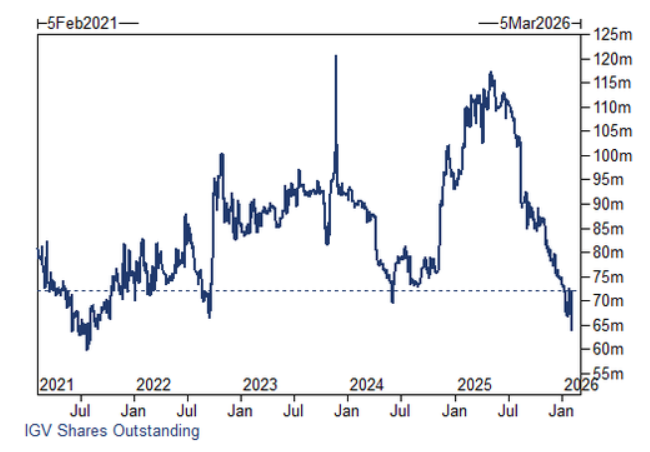
Core Insights - Goldman Sachs' trading desk has observed signs of a market bottom following a significant sell-off in software stocks, with institutional investors beginning to attempt bottom-fishing, indicating that the current historical adjustment may be nearing its end [1][4] Group 1: Market Activity - Software stocks have experienced a 15% drop over the past week, totaling a 29% decline from last September's peak [1] - The IGV software ETF has seen record trading volumes, with over 85 million shares traded since Tuesday, marking a significant increase in market activity [1][2] - The trading desk noted that the IGV's circulating shares have reached a near five-year low, suggesting that selling pressure has largely cleared [1][2] Group 2: Institutional Behavior - Institutional buyers began entering the IGV ETF on Wednesday and Thursday, with a 12% increase in circulating shares on Wednesday, the largest single-day increase in 2023 [4] - Morgan Stanley reported that retail investors net bought $1.7 billion, with $1.3 billion in ETFs and $435 million in individual stocks, indicating a return of bottom-fishing capital [6] Group 3: Market Sentiment - The Goldman Sachs derivatives trading desk noted a shift in market sentiment, with clients selling put options to realize profits, suggesting that the current sell-off may be coming to an end [3] - Despite the observed technical signals of a market bottom, Goldman Sachs' strategy department remains cautious about the long-term outlook for the software industry, drawing parallels to the newspaper industry during the early 2000s and the tobacco industry in the late 1990s [7]
华尔街有多悲观?高盛直接把“软件”类比“报纸”
美股IPO· 2026-02-06 03:52
Core Viewpoint - Goldman Sachs compares the current software industry to the newspaper industry disrupted by the internet in the early 2000s and the tobacco industry facing regulatory challenges in the late 1990s, indicating a fundamental skepticism about the long-term growth and profitability of the software sector [1][2][3] Group 1: Market Sentiment and Valuation - The software sector has seen a significant decline, with a 15% drop in one week and a cumulative retreat of 29% from its September 2025 peak, driven by fears of AI impacting software business models [5] - The forward P/E ratio for the software sector has decreased from approximately 35 times at the end of 2025 to around 20 times, marking the lowest level since 2014 [7] - Despite the apparent return to rational valuation, the underlying assumptions driving these valuations are collapsing, as the market anticipates significant downgrades in future growth and profitability [8][10] Group 2: Earnings Stability and Historical Comparisons - Historical cases, such as the newspaper industry from 2002 to 2009, show that stock prices did not bottom out until earnings expectations stabilized, not merely when valuations appeared cheap [11] - Similar patterns were observed in the tobacco industry during the late 1990s, where stock prices remained under pressure despite significant valuation compression until regulatory uncertainties were resolved [12] - Goldman Sachs concludes that even if short-term earnings reports show resilience, they do not negate the long-term risks posed by AI [13] Group 3: Investment Shifts and Defensive Sectors - There is a noticeable shift in market preference away from "AI risk" towards sectors perceived as more stable, such as industrials, energy, chemicals, transportation, and banking [14][15] - Hedge funds have significantly reduced their exposure to the software sector, while large mutual funds began systematically underweighting software stocks since mid-last year [15] - Certain sub-sectors, such as vertical software and companies with proprietary data and clear industry barriers, may still offer defensive characteristics against AI disruption [16]

华尔街有多悲观?高盛直接把“软件”类比“报纸”
Hua Er Jie Jian Wen· 2026-02-06 01:56
Group 1 - The core viewpoint of the article is that Wall Street's fear of AI's impact on software stocks has reached an extreme, with Goldman Sachs comparing the current software industry to the newspaper industry of the early 2000s and the tobacco industry of the late 1990s, indicating a fundamental doubt about the long-term growth and profitability of the software sector [1][2][7] - Goldman Sachs reports that software stocks have become the center of the AI impact narrative, experiencing a 15% drop in one week and a cumulative decline of 29% from their September 2025 peak, with their "AI risk exposure basket" down 12% year-to-date [2][3] - The report emphasizes that the current market discussions are not just about profit downgrades but whether the software industry is facing a long-term decline similar to that of the newspaper industry [2][4] Group 2 - Despite a significant drop in software stock valuations, Goldman Sachs highlights that the underlying assumptions behind these valuations are collapsing, with current profit margins and expected revenue growth still at their highest levels in 20 years, significantly above the S&P 500 average [3][5] - The forward P/E ratio for the software sector has decreased from approximately 35 times at the end of 2025 to around 20 times currently, marking a low not seen since 2014 [5][6] - Historical cases, such as the newspaper industry from 2002 to 2009, show that stock prices did not bottom out until profit expectations stabilized, not merely when valuations appeared cheap [4][7] Group 3 - There is a noticeable shift in market preference away from "AI risk" towards sectors perceived as less impacted by AI, such as industrials, energy, chemicals, transportation, and banking [8][9] - Funds have significantly reduced their exposure to software stocks, with hedge funds cutting back while large mutual funds began systematically underweighting software stocks since mid-last year [8][9] - The report indicates that while the overall sentiment is cautious, some sub-sectors still show defensive characteristics, but stability in profit expectations is crucial for stock price recovery [9][11]
T. Rowe Price: Goldman Sachs Partnership Helps This High-Yield Dividend Aristocrat
Seeking Alpha· 2026-02-05 15:10
I've been researching companies in-depth for over a decade, from commodities like oil, natural gas, gold and copper to tech like Google or Nokia and many emerging market stocks, which I believe could help me provide useful content for readers. After writing my own blog for about 3 years, I decided to switch to a value investing-focused YouTube channel, where I researched hundreds of different companies so far. I would say my favorite type of company to cover are metals and mining stocks, but I am comfortabl ...

一文读懂:华尔街“抛AI”妖风祸从何来?
Xin Lang Cai Jing· 2026-02-05 13:15
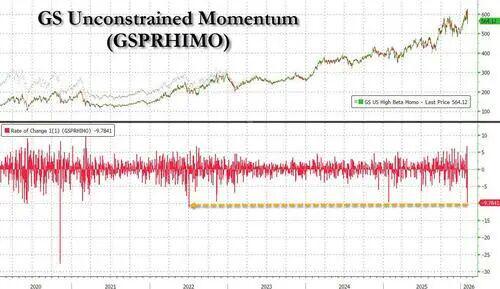
(来源:创业板观察) 自2022年年中以来,动量交易员曾以足以让沃伦·巴菲特感到汗颜的夏普比率统治着市场。然而周三, 这一切几乎遭遇了全线崩盘——他们蒙受了载入史册的损失。 动量交易简单说来就是"买入最近涨得最好的,卖出涨得最差的"。而根据业内的统计,高盛的"高贝 塔"或无约束动量组合(GSPRHIMO)刚刚创下了自2022年以来表现最糟糕的一天,超过了去年1月 Deepseek风暴之后的AI抛售潮。高贝塔股通俗而言就是指那些波动比大盘更剧烈的股票。 如果说,周二市场的跌幅源于软件股因人工智能颠覆风险引发的"投降式"抛售,那么周三的疲软则更集 中于基本面因素与仓位调整,使得大盘指数的变动相对于底层发生的剧烈动荡,显得具有欺骗性的平 稳。 这印证了高盛分析师Lee Coppersmith在上周末文章中的发现,即美股表面平静之下正波涛汹涌。统计显 示,标普500指数成分股平均的1周实际波动率,与整体标普500指数波动率之比在上周四刚刚达到6.88 ——处于2023年以来的第99个百分位。 来源:市场资讯 换句话说,标普500指数成分股的平均波动幅度大约是大盘指数的7倍,这就是为什么近几个交易日部分 个股的异动显得 ...