Luckin Coffee(LKNCY)

Search documents
县城精品咖啡馆 , 靠春节“续命”
3 6 Ke· 2026-02-22 01:51
Core Insights - The article discusses the challenges faced by independent coffee shops in small towns, particularly in the context of rising competition from larger chain brands like Starbucks and Luckin Coffee, which have begun to dominate the market [2][3][9]. Group 1: Market Dynamics - The coffee market in China has seen significant growth, with the market size exceeding 380 billion yuan in 2021, and independent coffee shops initially thrived due to a lack of competition [6][18]. - In 2023, the growth rate of the coffee market in small towns surged to 66.68%, contrasting with the stagnation in first-tier cities, indicating a shift in consumer behavior and market dynamics [18][19]. - Major brands like Luckin Coffee and Starbucks are aggressively expanding into lower-tier cities, increasing competition for independent coffee shops [19][20]. Group 2: Consumer Behavior - Consumers in small towns are increasingly drawn to coffee shops for social and recreational purposes rather than as a daily necessity, making it difficult for independent shops to secure repeat customers [22]. - The average price of coffee in these shops, ranging from 30 to 40 yuan, does not align well with the average spending habits of local consumers, who often prefer cheaper alternatives [22][15]. Group 3: Operational Challenges - Independent coffee shops face high operational costs, including rent and employee wages, which can lead to financial strain, especially during off-peak seasons [10][11]. - Many independent coffee shop owners rely heavily on the revenue generated during the Chinese New Year holiday to sustain their businesses throughout the year, highlighting the seasonal nature of their income [12][18]. Group 4: Competitive Strategies - Some independent coffee shop owners are exploring alternative business models, such as collaborating with local communities or leveraging social media to enhance their visibility and customer loyalty [25]. - The article notes that while some independent shops struggle, others with established customer bases have managed to thrive despite the influx of larger brands [25].



万店巨头再打9.9元价格战,“中国版肯德基”杀入红海市场
创业邦· 2026-02-18 01:08
Core Viewpoint - The introduction of the "9.9 yuan" coffee monthly card by Wallace, a fast-food brand, is a strategic move to attract customers and increase sales frequency, amidst ongoing price wars in the coffee market [6][10]. Group 1: Company Overview - Wallace, founded in 2001, is known for its low-priced Western fast food, primarily targeting lower-tier cities in China, and has over 19,000 stores, making it a significant player in the market [4][8]. - The company has faced challenges, including food safety issues and a low profit margin of 2.88% in 2024, prompting a strategic shift to improve operational efficiency [10]. Group 2: Market Context - The coffee market has seen intense competition, with brands like Luckin and Kudi previously engaging in aggressive pricing strategies, leading to a "coffee war" that has influenced consumer expectations [6][19]. - The introduction of low-priced coffee options by fast-food chains is part of a broader trend to enhance customer experience and increase average transaction values [6][19]. Group 3: Strategic Implications - Wallace's "9.9 yuan" coffee monthly card aims to leverage low pricing as a means to drive traffic to its core fast-food offerings, similar to strategies employed by McDonald's and KFC [16][19]. - However, the sustainability of such low-price strategies is questioned, as they may lead to low customer loyalty and potential harm to brand value in the long term [19].



餐饮茶饮集体涨价,为啥大家都放弃了低价策略?
Bei Jing Ri Bao Ke Hu Duan· 2026-02-17 07:46
Group 1 - The core point of the article is the collective price increase in the restaurant and beverage market, which marks a shift from the previously dominant low-price strategy [1][3] - Major brands like KFC and McDonald's have recently raised prices, with KFC adjusting delivery prices by an average of 0.8 yuan while keeping dine-in prices unchanged [1][2] - Other brands such as Nayuki, Luckin Coffee, and others are also increasing prices, typically by 1-2 yuan, to balance costs and profits [1][2] Group 2 - The abandonment of low-price strategies is attributed to rising operational costs, particularly in raw materials, with fresh fruit prices increasing by 4.4% as of December 2025 [5][7] - The competitive landscape in the restaurant and beverage market has intensified, with new brands emerging and consumer demand shifting towards quality and experience, necessitating increased investment in product innovation [7][8] - Price increases are seen as a necessary response to cost pressures and market competition, but companies must also focus on establishing sustainable profit models rather than relying solely on price wars [8][10] Group 3 - The risk of collective price increases lies in potential strategic disagreements among leading companies, which could lead to market disruption if a major player opts to maintain lower prices [10] - If a brand like Mixue Ice City maintains low prices while others raise theirs, it could attract consumers away from mid-tier brands, creating a market divide [10]

Luckin Coffee to Announce Fourth Quarter and Full Year 2025 Financial Results on February 26, 2026
Globenewswire· 2026-02-12 12:00
Core Viewpoint - Luckin Coffee Inc. is set to release its fourth quarter and full year 2025 financial results on February 26, 2026, before the U.S. market opens [1] Group 1: Financial Results Announcement - The financial results will be discussed in a conference call scheduled for February 26, 2026, at 8:00 am Eastern Time [1] - The conference call will be accessible via multiple dialing options for participants in different regions [2] Group 2: Company Overview - Luckin Coffee has established a technology-driven retail network aimed at providing high-quality, convenient, and affordable coffee products [3] - Founded in 2017 and based in China, the company aspires to build a world-class coffee brand integrated into daily life [3]
「半小时200单」,蜜雪冰城、瑞幸头部品牌「杀入」地铁站
36氪· 2026-02-12 10:18
Core Insights - The article discusses the increasing trend of beverage brands, particularly coffee and tea, establishing outlets in subway stations, highlighting the convenience for commuters and the potential for high sales volume [4][22][24]. Group 1: Market Trends - Numerous beverage brands, including Luckin Coffee and Manner, are rapidly entering subway stations, with Luckin planning to open at least 30 stores in Suzhou by 2026 and 200 stores in Tianjin over the next three years [6][14]. - Subway coffee shops can achieve significant sales, with reports indicating that some locations can sell up to 200 cups in just half an hour during peak hours [8][27]. - The consumer demographic in subway stations primarily consists of white-collar workers aged 25 to 40, who have strong purchasing power and a preference for instant gratification [32]. Group 2: Competitive Landscape - As price wars cool down, convenience is becoming a key competitive factor, with brands focusing on high-traffic locations to capture commuter demand [36][37]. - The number of tea and coffee shops in China has reached approximately 400,000 and 220,000 respectively, leading to intense competition in traditional retail spaces [43]. - Subway commercial spaces are seen as a new frontier for brands, offering lower rent and less competition compared to saturated urban retail areas [46]. Group 3: Strategic Insights - Brands are increasingly recognizing the value of subway stations as stable and predictable consumer touchpoints, allowing for seamless integration into commuters' routines [48][50]. - Recent policy changes in cities like Tianjin are facilitating the establishment of commercial outlets in subway systems, further enhancing the attractiveness of these locations for beverage brands [51]. - The evolution of consumer convenience is shifting from mere accessibility to creating seamless experiences along daily commuting routes, emphasizing the importance of convenience in beverage retail [53][54].

瑞幸拿出“进村”计划:供销社成了它的新跳板
Hua Er Jie Jian Wen· 2026-02-12 09:57
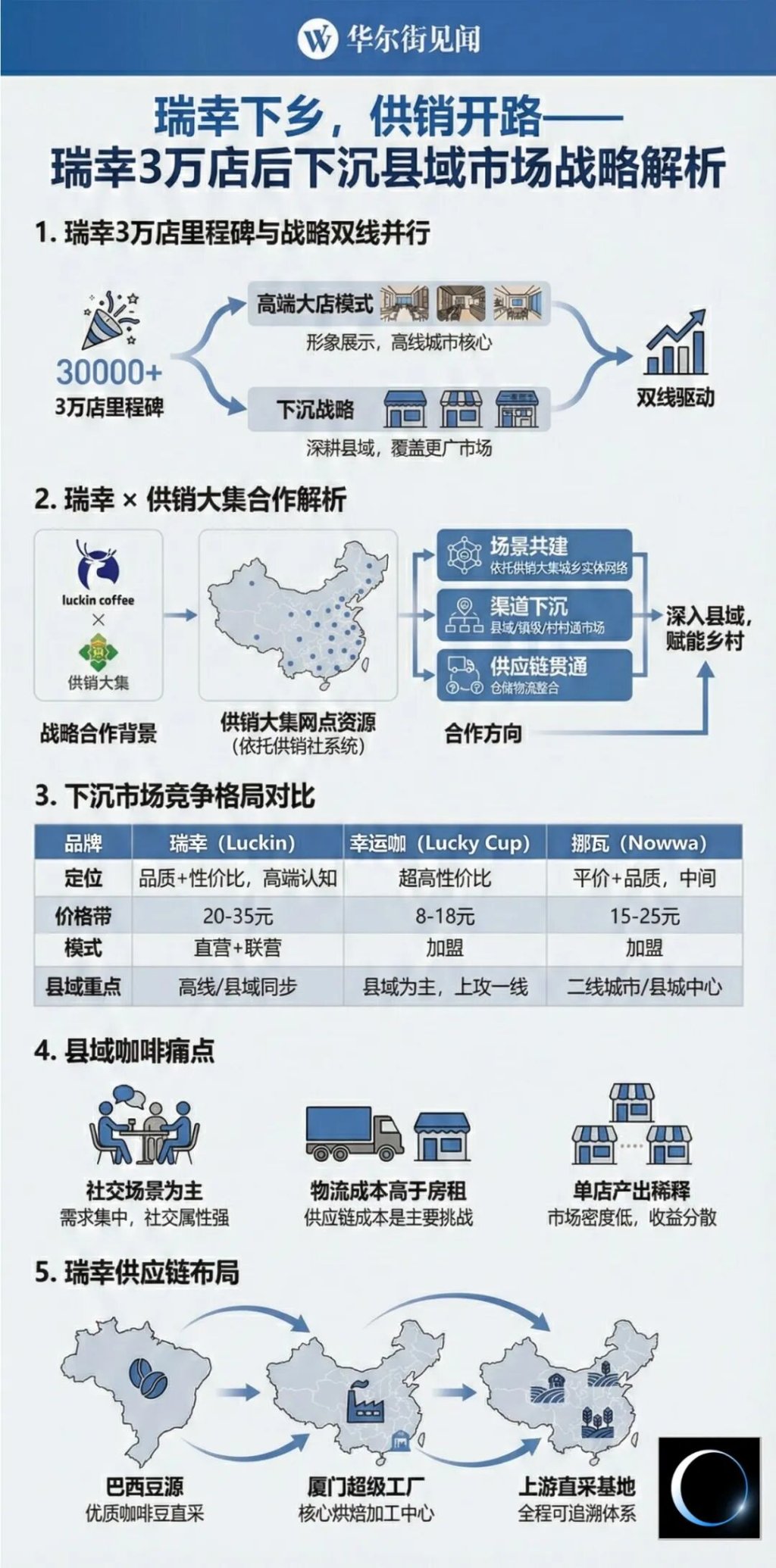
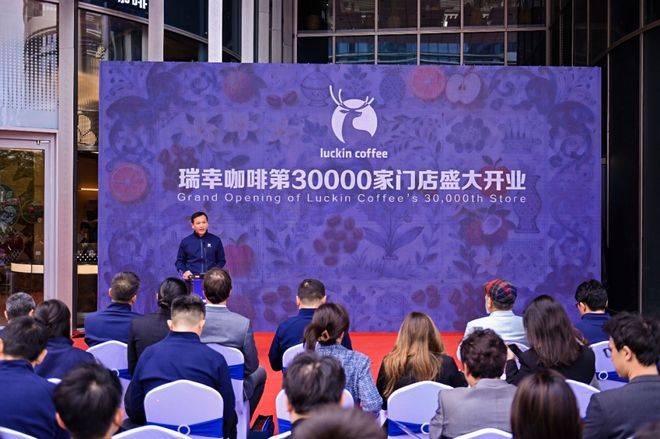
Core Insights - Luckin Coffee has rapidly expanded to 30,000 stores in just one and a half years, significantly raising the bar for coffee market scale in China [1] - The company is shifting its strategy by opening high-end flagship stores, indicating a move towards a "big store model" to capture social demand and fill gaps in the "slow scene" market [2] - Luckin Coffee is focusing on penetrating the low coffee penetration county markets through a strategic partnership with the Supply and Marketing Cooperative Group, leveraging its extensive network [3] Expansion Strategy - Luckin Coffee's new "Origin Flagship Store" spans 420 square meters and features semi-automatic machines and specialized menus, showcasing a high-end positioning [2] - The company has entered 1,550 county-level cities, covering over 80% of county areas, with more than 7,400 stores in these regions [17] - The expansion from 20,000 to 30,000 stores has primarily involved increasing store density in existing provinces rather than entering new cities [12] Competitive Landscape - The competitive landscape is evolving, with new entrants like Lucky Coffee and Nova Coffee joining the market, indicating that the low-tier market still has untapped potential [8] - The partnership with Supply and Marketing Cooperative Group is seen as a strategic move to enhance resource integration and achieve efficient market penetration [10] - The competition in county markets is intensifying, with brands like Lucky Coffee and Gu Ming establishing strong footholds [18] Supply Chain and Operational Efficiency - Luckin Coffee is enhancing its supply chain capabilities by securing high-quality coffee bean sources and expanding its production capacity, including a new factory in Xiamen with an annual roasting capacity of 55,000 tons [26][27] - The company aims to build a comprehensive supply chain system to maintain cost advantages while competing in the county market [28] - The collaboration with Supply and Marketing Cooperative Group focuses on three dimensions: co-building coffee spaces, channel penetration, and supply chain integration [10] Market Dynamics - The shift towards county markets is driven by the need for growth as urban markets become saturated [11] - The coffee consumption landscape in lower-tier cities is different, with social interactions being a key driver rather than just a need for caffeine [21] - The pricing strategy may need to adapt to local market conditions, moving away from extreme low pricing to enhance the perceived value of the coffee experience [23]
瑞幸,驶入新航道
Sou Hu Cai Jing· 2026-02-11 14:45
Core Insights - Luckin Coffee has officially opened its 30,000th store in Shenzhen, marking a significant milestone as the first domestic coffee brand in China to surpass this number, indicating a robust growth trajectory in the coffee consumption market [1][3] - The company has established a vast network covering 94% of provincial-level administrative regions in China, with over 1,000 stores in key cities such as Beijing, Shanghai, Guangzhou, Shenzhen, and Chengdu [3] Expansion and Market Strategy - The choice of Shenzhen for the flagship store reflects strategic considerations, as it is a core city in the Guangdong-Hong Kong-Macao Greater Bay Area, aiming to become a global economic center [3] - The extensive store network not only enhances brand visibility but also serves as a market educator, introducing coffee to a broader audience and increasing national awareness of coffee consumption [5] Supply Chain and Product Development - The "Origin Flagship Store" spans 420 square meters and emphasizes a strategic upgrade in professional quality, global supply chain, and sustainability [7] - Luckin Coffee has developed a direct sourcing system from key coffee-producing regions, including Brazil, Ethiopia, and Yunnan, to ensure quality and unique flavor profiles [7][10] Sustainability and Innovation - The flagship store adheres to international green building standards and aims to set a benchmark for sustainable practices in the coffee retail sector [10] - The introduction of the "Taste of Origin" series and the use of award-winning coffee beans from Yunnan showcase the company's commitment to high-quality, locally sourced products [9][10] Global Market Aspirations - Luckin Coffee is expanding its presence internationally, with stores in Singapore, Malaysia, and the United States, aiming to create a world-class Chinese coffee brand [12][14] - The company seeks to reshape the global coffee supply chain by leveraging China's large and rapidly growing coffee consumption market, thus influencing upstream production and trade dynamics [14]
3万店叩关全民咖啡时代,瑞幸的本土生长启示录
新浪财经· 2026-02-11 11:07
Core Viewpoint - Luckin Coffee has successfully transformed the coffee consumption landscape in China, achieving a milestone of 30,000 stores by focusing on accessibility, affordability, and quality, thus redefining coffee as a daily necessity rather than a luxury item [2][4][40]. Group 1: Market Context - Before Luckin's emergence, the Chinese coffee market was perceived as elitist, with a significant barrier between high-end brands and ordinary consumers [5][6]. - The market was dominated by international brands that maintained high prices and limited access for new entrants, creating an uneven playing field [6][7]. - Luckin Coffee's entry disrupted this status quo, challenging the established norms and offering a new approach to coffee consumption [8][9]. Group 2: Business Model and Strategy - Luckin's strategy focuses on scale, affordability, and a robust supply chain, allowing it to penetrate the market effectively [11][12]. - The company emphasizes convenience with a network of stores designed to be easily accessible, integrating coffee into daily life across various locations [11][12]. - By offering coffee at a price point of 9.9 yuan, Luckin has effectively lowered the barrier for consumers, making quality coffee accessible to a broader audience [15][16][19]. Group 3: Quality and Supply Chain - Luckin maintains high quality by directly sourcing coffee beans from global production areas, ensuring control over the supply chain and product quality [20][31]. - The company has established partnerships with key coffee-producing countries, such as Brazil and Colombia, to secure high-quality beans and maintain consistent supply [31][32]. - The integration of a digital supply chain enhances operational efficiency, allowing for real-time monitoring and optimization of processes from bean roasting to store delivery [35][36]. Group 4: Consumer Engagement - Luckin understands the emotional needs of young consumers, positioning coffee as a comforting and accessible beverage rather than a status symbol [12][14][24]. - The brand's marketing strategy focuses on relatable messaging, making coffee a part of everyday life rather than an exclusive experience [14][24]. - By prioritizing value over price, Luckin has cultivated a loyal customer base that appreciates quality without the burden of high costs [19][24]. Group 5: Future Outlook - With its extensive network and innovative supply chain, Luckin is poised to expand beyond China, aiming to establish itself as a global coffee brand [36][41]. - The company's success serves as a model for local brands, demonstrating that understanding consumer needs and maintaining quality can lead to significant market breakthroughs [40][41]. - Luckin's journey reflects a broader trend of local brands redefining industries through innovation and deep market understanding [42].

亮剑浦江:网络法治在上海的生动实践
Xin Lang Cai Jing· 2026-02-11 08:50
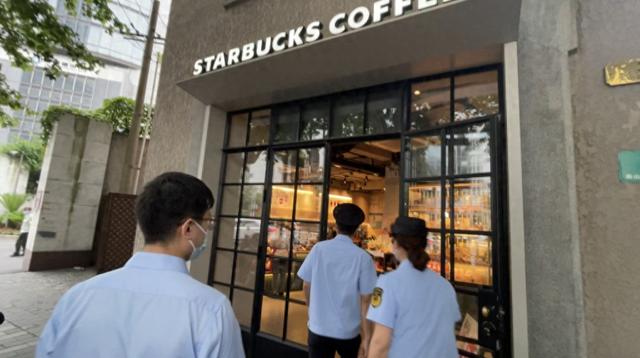
Core Viewpoint - The "Liangjian Pujiang" initiative in Shanghai aims to enhance personal information protection through legal enforcement, addressing the challenges posed by digital technology in daily life [1][9]. Group 1: Initiative Overview - The "Liangjian Pujiang" personal information protection enforcement action was launched in June 2023, focusing on consumer scenarios that frequently collect personal data [2][4]. - The initiative has evolved over three years, with 2023 focusing on "small cuts" in daily life, 2024 targeting typical scenarios, and 2025 aiming for ecological construction in governance [1][19]. Group 2: Enforcement Actions - The initiative identified eight consumer scenarios with significant data collection issues, including QR code dining, parking payments, and children's education [2][4]. - Major coffee chains like Starbucks were targeted for frequent data collection practices, leading to compliance training and guidance from regulatory bodies [5][6]. Group 3: Legal Framework and Governance - The implementation of the Personal Information Protection Law in 2021 marked a new phase in legal governance, with Shanghai establishing a scene-based governance model [9][10]. - The initiative has created a governance framework that includes collaboration among various departments, breaking down silos for effective enforcement [11][12]. Group 4: Innovative Solutions - The introduction of the "Pure Code" for parking payments allows users to pay without providing personal information, demonstrating innovative governance thinking [13][14]. - The initiative emphasizes a balanced approach to sensitive data collection, advocating for minimal use and maximum transparency [15][16]. Group 5: Long-term Mechanisms - The "Liangjian Pujiang" initiative has transitioned from a special action to a sustainable governance model, establishing a closed-loop enforcement process [19][20]. - By 2025, the initiative aims to solidify its achievements through continuous legal guidance and compliance resources for businesses [20][21].
奶茶行业流行“搭快船”出海?
Sou Hu Cai Jing· 2026-02-11 05:16
Core Viewpoint - The article discusses the strategic partnership between Cha Bai Dao and SG Mart in Singapore, highlighting the brand's approach to international expansion through localized strategies and partnerships to enhance market entry efficiency [1][4]. Group 1: Cha Bai Dao's International Strategy - Cha Bai Dao began its overseas journey in 2024, opening its first store in Seoul, South Korea, strategically located in the affluent Gangnam district to target mainstream local consumers rather than just the Chinese community [2]. - The brand has rapidly expanded its international presence, covering over 20 stores across more than ten countries, including South Korea, Thailand, Australia, Singapore, Spain, France, and the United States, within two years [2]. - The partnership with SG Mart is seen as a pragmatic move to leverage SG Mart's established local network and logistics, facilitating a quicker market entry for Cha Bai Dao in Singapore [5]. Group 2: Market Dynamics and Competitors - Other beverage brands, such as Ba Wang Cha Ji, are also pursuing aggressive international strategies, with Ba Wang Cha Ji forming a joint venture in Thailand to gain access to local market insights and distribution channels [6]. - The article notes that the trend of forming strategic partnerships to enhance market entry efficiency is not unique to Chinese brands, as global giants like Starbucks have also adopted similar strategies in their expansion efforts [7]. - The overall landscape of the beverage industry is witnessing a surge in international expansion, with numerous brands, including Mi Xue Bing Cheng and Luckin Coffee, rapidly increasing their overseas store counts [15][18]. Group 3: Challenges and Considerations - Despite the aggressive expansion, brands face significant challenges in local market adaptation, including understanding consumer preferences and establishing efficient supply chains [16][18]. - The competition in overseas markets is intensifying, with many brands entering the same regions, leading to potential market saturation and price wars [18]. - Successful international expansion requires not only opening stores but also achieving deep localization in product offerings, supply chain management, and brand positioning to resonate with local consumers [19].