
SAIC MOTOR(600104)

Search documents
上汽集团(600104.SH):子公司拟投资设立上海尚颀尚成二号私募投资基金合伙企业(有限合伙)
Ge Long Hui A P P· 2026-02-13 08:47
Core Viewpoint - SAIC Motor Corporation is deepening its innovation transformation by integrating "new productive forces" represented by artificial intelligence into industrial upgrades [1] Group 1: Investment and Fund Establishment - SAIC's wholly-owned subsidiary, SAIC Jin控, plans to establish a private equity investment fund named Shanghai Shangqi Shangcheng No. 2, in collaboration with several partners [1] - The total initial subscription amount for the fund is set at RMB 2.5 billion, with SAIC Jin控 contributing RMB 1 billion, holding a 40% share [1] Group 2: Focus Areas of Investment - The fund will focus on key areas such as solid-state batteries, full-stack electronic architecture, digital chassis, and domestic chip production to meet the demand for domestic substitution in critical components [1] - Additionally, the fund aims to actively invest in cutting-edge technologies including artificial intelligence, embodied intelligence, and computing power chips [1] Group 3: Background of Investment Partner - Shangqi Capital, established in 2012, specializes in private equity investments within the automotive industry ecosystem [1] - The firm has invested in over 200 quality enterprises across three main directions: intelligent and automotive-grade semiconductors, electrification, and industrial chain transformation [1] - Shangqi Capital has successfully seen 32 of its portfolio companies go public [1]

上汽集团(600104) - 上汽集团关于子公司投资设立上海尚颀尚成二号私募投资基金合伙企业(有限合伙)的公告
2026-02-13 08:45
上海汽车集团股份有限公司 关于子公司投资设立上海尚颀尚成二号私募投资基 金合伙企业(有限合伙)的公告 本公司董事会及全体董事保证本公告内容不存在任何虚假记载、误导性陈述或者重大遗 漏,并对其内容的真实性、准确性和完整性承担法律责任。 证券代码:600104 证券简称:上汽集团 公告编号:临 2026-006 重要内容提示: 投资标的名称:上海尚颀尚成二号私募投资基金合伙企业(有限 合伙)(以市场监督管理局核准变更的名称为准,以下简称"合伙企 业"或"基金") 投资金额:上海汽车集团股份有限公司(以下简称"上汽集团"或 "公司")全资子公司上海汽车集团金控管理有限公司(以下简称"上 汽金控")拟与上海国投先导集成电路私募投资基金合伙企业(有限 合伙)(以下简称"国投先导")、湖南省金芙蓉产业引导基金合伙企 业(有限合伙)(以下简称"湖南金芙蓉")、上海国孚领航投资合伙 企业(有限合伙)(以下简称"国孚领航")、浙江浙商八婺专精股权 投资基金合伙企业(有限合伙)(以下简称"浙商八婺")、上海浦东 引领区国泰君安科创一号私募基金合伙企业(有限合伙)(以下简称 "国君科创")、嘉兴颀先企业管理合伙企业(有限合伙)(以 ...
观察|1月车市三把“王座”全部易主
Guang Zhou Ri Bao· 2026-02-13 03:15
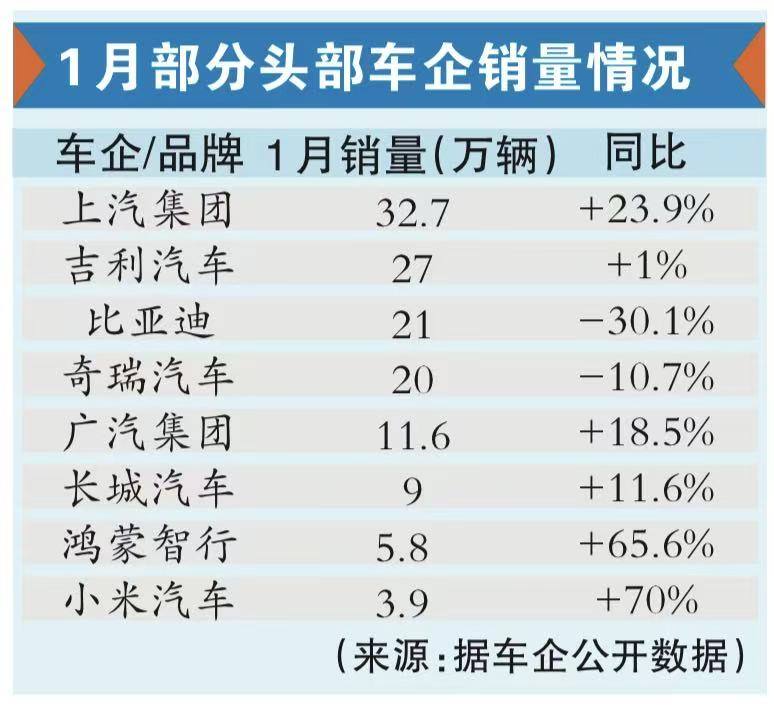
Core Insights - The January sales figures indicate a significant shift in the competitive landscape of the Chinese automotive market, with traditional giants like SAIC and Geely reclaiming leadership positions, while BYD's dominance is challenged [1][3][4] Group 1: Sales Performance - SAIC Group achieved sales of 327,000 vehicles in January, marking a year-on-year increase of 23.9% [2][4] - Geely Automotive sold 270,100 vehicles, a year-on-year growth of 1%, surpassing BYD to become the top-selling domestic brand [2][4] - BYD's sales fell to 210,000 vehicles, experiencing a significant year-on-year decline of 30.1% [2][4] - New energy vehicle sales for SAIC reached 85,000 units, growing by 39.7% [4] - The overall automotive production and sales in January were 2.45 million and 2.346 million units, respectively, with a slight year-on-year production increase of 0.01% [7] Group 2: New Players and Market Dynamics - The new energy vehicle segment saw a reshuffling, with Hongmeng Zhixing leading the new force with 57,915 units sold, a remarkable year-on-year increase of 65.6% [6] - Xiaomi Automotive followed closely with over 39,000 units sold, achieving a year-on-year growth of approximately 70% [6] - The previous leaders in the new force segment, such as Leap Motor, have seen a decline, with their sales dropping to 32,059 units [6] Group 3: International Market Growth - The overseas market is identified as a key growth area for automotive companies, with January exports reaching 681,000 vehicles, a year-on-year increase of 44.9% [7] - Exports of new energy vehicles doubled to 302,000 units, highlighting the importance of global expansion for competitive advantage [7]



中国汽车:市场反馈及行业预期下调 -1 月季节性表现弱于往常,且物料成本通胀加剧-China Automobiles_ Marketing feedback & lowering estimates for the sector on weaker-than-usual Jan seasonality with BOM cost inflation
2026-02-13 02:18
Summary of Conference Call Notes on the Automotive Industry Industry Overview - **Industry**: Automotive, specifically focusing on electric vehicles (EVs) and new energy vehicles (NEVs) in China - **Current Market Sentiment**: Investor positioning in the automotive sector is underweight as of early 2026, with concerns about demand and cost inflation impacting outlooks [1][2] Key Points 1. Industry Volume Trajectory - **January 2026 Performance**: Domestic passenger vehicle retail volume decreased by 20% month-over-month (mom), compared to a 14% decrease in January 2024 [3] - **Market Expectations**: Anticipation of continued volume decline into February 2026, attributed to the Chinese New Year holiday and reduced stimulus effects [3] - **Future Outlook**: Expected recovery in consumer demand starting March 2026, coinciding with new product launches from BYD and the Beijing Auto Show [3] 2. Raw Material and Memory Cost Inflation - **Cost Increases**: Year-to-date increases in commodity prices (lithium, copper, aluminum) range from 27% to 85% year-over-year [4][18] - **Impact on BOM Costs**: Estimated average increase in Bill of Materials (BOM) costs for EVs is approximately Rmb4,000, leading to a gross margin decline of 2.0% and a net margin decline of 1.7% [4][11] - **OEM Negotiations**: OEMs are negotiating cost-sharing with suppliers, but are expected to absorb 100% of memory cost increases [4] 3. Potential Policy Stimulus - **Government Support Expectations**: Investors anticipate additional government support if demand remains weak, including subsidies for Level 3 vehicles and domestic chip usage [7] - **Economic Contribution**: Passenger vehicles accounted for about 5% of GDP in 2025, indicating the sector's significance to the economy [7] 4. Sensitivity Analysis on Costs - **Margin Concerns**: Rising raw material and memory costs are raising concerns about potential margin impacts for OEMs [8] - **Cost Pass-Through Assumptions**: Analysis assumes a 50/50 cost pass-through ratio for battery and metals, while memory costs are fully absorbed by OEMs [9][12] 5. Target Price Adjustments - **Price Target Reductions**: Target prices for covered OEMs and suppliers have been cut by up to 12% due to weaker demand and higher costs, with average estimates lowered by approximately 16% [2][24] - **Specific Company Adjustments**: - **BYD**: Target price reduced from Rmb144 to Rmb137 due to weaker delivery volumes and higher BOM costs [25] - **Li Auto**: Target price reduced from US$27 to US$24, reflecting lower sales and higher costs [25] - **XPeng**: Target price reduced from US$25 to US$22, driven by weaker sales and pricing pressures [25] - **NIO**: Target price reduced from US$7.0 to US$6.6, impacted by BOM cost inflation [25] 6. Long-term Projections - **Revenue and Net Income Changes**: Projections for revenue and net income have been adjusted downward for several companies, reflecting anticipated market conditions through 2030 [24][30] Additional Insights - **Investor Concerns**: There is a growing concern among investors regarding the sustainability of margins in light of rising costs and competitive pressures [8] - **Market Dynamics**: The automotive sector is facing significant challenges from both internal cost pressures and external market conditions, necessitating close monitoring of policy developments and consumer demand trends [7][8] This summary encapsulates the critical insights from the conference call, highlighting the automotive industry's current challenges and future outlook.



800现金流ETF汇添富(563680)开盘跌1.42%
Xin Lang Cai Jing· 2026-02-13 01:41
Group 1 - The 800 Cash Flow ETF managed by Huatai-PineBridge opened at 1.317 yuan, experiencing a decline of 1.42% [1] - Major holdings in the ETF include China National Offshore Oil Corporation (CNOOC) down 2.93%, SAIC Motor Corporation down 0.14%, and China Aluminum Corporation down 1.82% [1] - The ETF's performance benchmark is the CSI 800 Free Cash Flow Index, with a return of 33.50% since its inception on April 30, 2025, and a return of 5.17% over the past month [1]




上汽集团取得无级变速器速比控制方法及装置专利
Jin Rong Jie· 2026-02-13 00:27
上海汽车工业(集团)有限公司,成立于1996年,位于上海市,是一家以从事汽车制造业为主的企业。 企业注册资本2174917.5737万人民币。通过天眼查大数据分析,上海汽车工业(集团)有限公司共对外 投资了43家企业,参与招投标项目16次,财产线索方面有商标信息10条,专利信息750条,此外企业还 拥有行政许可19个。 声明:市场有风险,投资需谨慎。本文为AI基于第三方数据生成,仅供参考,不构成个人投资建议。 财经频道更多独家策划、专家专栏,免费查阅>> 天眼查资料显示,上海汽车集团股份有限公司,成立于1984年,位于上海市,是一家以从事汽车制造业 为主的企业。企业注册资本1149527.7504万人民币。通过天眼查大数据分析,上海汽车集团股份有限公 司共对外投资了56家企业,参与招投标项目5000次,财产线索方面有商标信息1456条,专利信息5000 条,此外企业还拥有行政许可588个。 国家知识产权局信息显示,上海汽车集团股份有限公司、上海汽车工业(集团)有限公司取得一项名 为"一种无级变速器的速比控制方法及装置"的专利,授权公告号CN117167475B,申请日期为2022年5 月。 ...
汽车视点 | 上汽实现高质量“开门红” 1月销量同比增长超两成
Zhong Guo Jin Rong Xin Xi Wang· 2026-02-12 05:04
Core Insights - SAIC Motor Corporation achieved significant sales growth in January, with wholesale vehicle sales reaching 327,000 units, a year-on-year increase of 23.9%, and retail sales hitting 363,000 units, leading the domestic automotive industry [1][2] - The company is the only automaker in China to surpass 300,000 units in sales for January, indicating a strong start to 2026 and confirming the success of its strategic transformation [1][2] Sales Performance - The sales data for January shows that SAIC's self-owned brands and new energy vehicles are the main drivers of growth, with self-owned brands accounting for 65.3% of total sales, a 7.3 percentage point increase from the same period in 2025 [5][7] - New energy vehicle sales reached 85,000 units, marking a 39.7% year-on-year increase, solidifying SAIC's position in the top tier of the industry [5][7] Strategic Initiatives - SAIC has been focusing on a multi-faceted strategy that includes deepening reforms, technological innovation, cross-industry collaboration, and overseas operations, which has led to a clear technical label for its vehicle matrix [1][8] - The company has invested over 180 billion yuan since 2021 in emerging sectors like AI and high-end manufacturing, fostering a collaborative ecosystem that enhances its core automotive business [12][10] Product Development - SAIC's MG brand has seen significant success, with the MG4 model achieving sales of over 10,000 units monthly, supported by advanced technologies like semi-solid batteries and integrated battery chassis [8][10] - Upcoming models include the LS9 Hyper from the high-end brand Zhiji, which features industry-first four-wheel steering technology, aiming to set new benchmarks in vehicle handling [12][13] Market Expansion - The overseas market has shown robust growth, with January sales exceeding 105,000 units, a year-on-year increase of over 50%, particularly in Europe where the MG brand has maintained its position as the top-selling Chinese brand for eleven consecutive years [7][8] - SAIC's "Glocal" strategy emphasizes transitioning from merely exporting products to exporting value chains, enhancing its global competitiveness [7][8] Customer Engagement - SAIC is enhancing customer experience through initiatives like the "Understanding Cars Better" campaign, which offers comprehensive services across its brands, aiming to build long-term trust with customers [14][17]

中国车企在澳大利亚市场逆势大涨77%!究竟是如何做到的?
Zhong Guo Qi Che Bao Wang· 2026-02-12 02:57
Core Insights - Chinese automotive brands are significantly increasing their presence in the Australian market, with a notable growth in sales and market share, indicating a shift in the local automotive landscape [1][2][4] Group 1: Market Performance - In January, the Australian automotive market saw sales of 87,753 vehicles, a slight increase of 0.1% year-on-year, with Chinese vehicles becoming the second-largest source of cars in Australia, showing a year-on-year sales increase of 68.6% [1][2] - Chinese automotive companies achieved a market share of 22.4% in Australia, surpassing Korean brands and marking a significant change in the market structure [2][4] Group 2: Product Quality and Consumer Perception - The quality of Chinese automotive products has improved significantly, with advancements in durability, configuration, and cost-effectiveness, altering consumer perceptions in Australia [2][4] - Chinese brands are now recognized for their high safety ratings, with multiple models receiving ANCAP five-star certifications, indicating international standards in safety performance [4] Group 3: Competitive Strategies - Chinese automotive companies leverage a strategy of "high value at low cost," offering vehicles that are 10%-20% cheaper than competitors while maintaining comparable quality and technology [5] - The introduction of electric and hybrid models has positioned Chinese brands as key players in the Australian market, aligning with local consumer preferences for sustainable options [4][5] Group 4: Localization Efforts - Chinese automotive brands are focusing on localizing their operations in Australia, enhancing after-sales service networks to compete with established Japanese brands [6][7] - Collaborations with local dealers to build charging infrastructure and provide home charging solutions are part of the strategy to alleviate consumer concerns regarding electric vehicle charging [6][7] Group 5: Future Challenges and Strategies - To sustain growth, Chinese brands need to optimize their supply chains and establish regional parts centers to improve service efficiency [7] - Building consumer trust requires ongoing efforts in marketing and brand development, including local sponsorships and tailored marketing strategies to resonate with Australian consumers [7][8]
1月车市燃油车销量“抬头”多款车型价格降幅高于30%
Mei Ri Jing Ji Xin Wen· 2026-02-12 02:35
Core Viewpoint - The domestic automotive market is witnessing a shift as fuel vehicles are increasingly adopting intelligent features to compete with electric vehicles, driven by consumer demand for smart driving capabilities and the rising market share of electric vehicles [1][5]. Group 1: Market Trends - Consumers are showing a preference for fuel vehicles equipped with advanced intelligent configurations, leading to a notable change in purchasing behavior [1]. - The new Honda Fit, dubbed the "people's supercar," sold out its initial 3,000 units within 20 days, indicating a strong demand for competitively priced fuel vehicles [2]. - Many fuel vehicle models have seen price reductions of 30% to 40%, with some luxury models experiencing even greater discounts [2][3]. Group 2: Sales Performance - In January, fuel vehicle sales showed significant growth, with SAIC Group selling 242,000 units, a year-on-year increase of 19.19% [6]. - Geely's fuel vehicle sales reached 134,400 units in January, with over 100,000 units coming from the "Chinese Star" series [6]. - GAC Toyota also reported positive sales growth in January, with the Camry model achieving a 17% year-on-year increase [6]. Group 3: Strategic Initiatives - The "Oil-Electricity Co-Intelligence" strategy has been adopted by major automakers, aiming to enhance the competitiveness of fuel vehicles by integrating smart technologies [5][6]. - Companies like FAW-Volkswagen plan to launch multiple new models equipped with intelligent cockpit and driving assistance systems by 2026, showcasing the potential for fuel vehicles to be equally intelligent [6][7]. - The top five brands in the fuel vehicle market have increased their market share from 29% in 2020 to 37% in 2025, indicating a strengthening of leading brands in the sector [7].
众捷汽车:已经与全球新能源汽车龙头比亚迪、长城汽车、上汽集团等建立了直接的业务合作关系
Ge Long Hui· 2026-02-11 14:37
Core Viewpoint - The company, Zhongjie Automotive, has established significant relationships with major multinational automotive parts suppliers and is actively expanding its presence in the domestic new energy vehicle market [1] Group 1: Major Clients - The company's primary clients include well-known multinational Tier 1 automotive parts suppliers such as Mahle, Modine, Hanon, Marelli, and ContiTech [1] - The products supplied by the company cover a wide range of international automotive brands, including Mercedes-Benz, BMW, Audi, Porsche, Volkswagen, Skoda, Ferrari, Maserati, Fiat, Tesla, Rivian, Canoo, Ford, General Motors, Chrysler, Dodge, Renault, Citroën, Volvo, Jaguar, Land Rover, Toyota, Subaru, Honda, Nissan, Mazda, Suzuki, Hyundai, Kia, MAN, DAF, Scania, and Iveco [1] Group 2: Domestic Market Expansion - The company is actively expanding into the domestic new energy vehicle market and has established direct business cooperation with leading global new energy vehicle manufacturers such as BYD, Great Wall Motors, and SAIC Motor [1]
