SAIC MOTOR(600104)

Search documents
自由现金流ETF中证全指(561080)跌1.55%,半日成交额840.67万元
Xin Lang Cai Jing· 2026-02-05 03:44
Group 1 - The Freedom Cash Flow ETF CSI All Index (561080) closed down 1.55% at 1.330 yuan with a trading volume of 8.4067 million yuan [1] - Major holdings in the ETF include China National Offshore Oil Corporation (CNOOC) down 1.12%, SAIC Motor up 0.14%, Gree Electric Appliances down 0.33%, COSCO Shipping Holdings up 0.07%, Muyuan Foods down 0.15%, Aluminum Corporation of China down 6.77%, TCL Technology down 0.61%, Baosteel down 1.52%, Great Wall Motors up 1.06%, and Chint Electric down 4.14% [1] - The ETF's performance benchmark is the CSI All Index Free Cash Flow Index, managed by Huaan Fund Management Co., Ltd. The fund has returned 35.06% since its inception on April 23, 2025, and 7.11% over the past month [1]




1月车市观察:第一名卖了27万辆,但真正的故事在海外
3 6 Ke· 2026-02-05 03:05
Core Viewpoint - The automotive market is currently experiencing a sales downturn, particularly in the electric vehicle (EV) segment, due to a combination of factors including a shift in vehicle purchase tax policy and seasonal demand fluctuations [1][3][4]. Market Performance - In January, nationwide retail sales of passenger vehicles reached 1.794 million units, reflecting a year-on-year decline of 12.1% and a month-on-month drop of 31.9% [3]. - The performance of major automotive brands showed a pattern of "year-on-year differentiation and month-on-month decline," with domestic brands benefiting from their EV offerings while facing pressure from the tax policy change [3][4]. Domestic Brand Performance - Geely Auto topped domestic sales in January with 270,200 units sold, achieving a year-on-year growth of 1% and a month-on-month increase of 14% [5]. - SAIC Group reported sales of 327,400 units, a year-on-year increase of 23.9%, while its domestic brand sales reached 214,000 units, up 39.6% year-on-year [6]. - GAC Group's sales were 116,600 units, marking an 18.47% year-on-year increase, with its domestic brands showing explosive growth [6]. Joint Venture Brands - Major joint venture brands like GAC Toyota and SAIC General saw a recovery in January, with GAC Toyota selling 63,600 units, a nearly 10% year-on-year increase [9][11]. - SAIC General's sales reached 51,000 units, up 8.2% year-on-year, driven by strong performance in its EV and export segments [11][12]. Export Growth - The overseas market has emerged as a significant growth driver for domestic automakers, with many companies reporting export growth rates exceeding 40% [13][14]. - Chery Group exported 119,600 units in January, a 48.1% year-on-year increase, maintaining its position as the top exporter in China [14]. - Geely's overseas sales reached 60,500 units, reflecting a staggering year-on-year growth of 121% [16]. Industry Trends - The overall trend indicates that by 2026, China's automotive export volume is expected to reach 7.4 million units, with EV exports projected to exceed 30% of total exports [17].




上汽大众发布2025年成绩单,新一年将密集投放新能源车型
Xin Lang Cai Jing· 2026-02-04 13:44
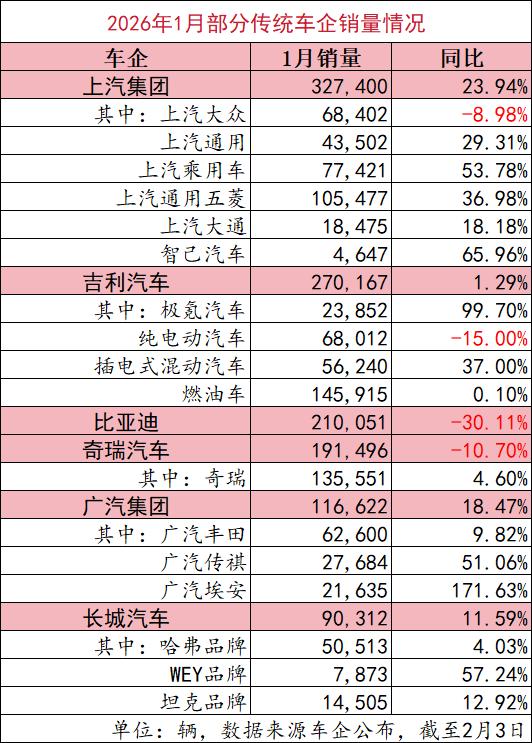
Core Insights - SAIC Volkswagen aims to achieve a total sales target of 1.06 million units by 2025, with the Volkswagen brand entering the "million club" as a single joint venture brand [2] - The company is focusing on both fuel and electric vehicle markets, positioning 2025 as a critical year for strategic transformation [5] Group 1: Sales and Market Position - The company expects a steady increase in market share for fuel vehicles to 8.7% by 2025, with classic models like Passat, Lavida, and Tiguan maintaining their leading positions [5] - The Pro versions of models equipped with advanced driving assistance systems, such as the Teramont and Passat, achieved annual sales of nearly 122,000 units, more than three times the previous year's figures [5] - The new Audi A5L Sportback, launched in August 2025, has sold nearly 13,000 units, making it the first fuel vehicle to apply Huawei's intelligent driving technology [5] Group 2: Electric and Hybrid Vehicle Strategy - SAIC Volkswagen's product lineup in the new energy sector includes pure electric, hybrid, and range-extended technologies, with the ID. ERA series set to launch in November 2025 [6] - The first model of the ID. ERA series, the ID. ERA 9X, is positioned as a "German flagship SUV" [6] Group 3: Service and Customer Experience - The company is prioritizing service quality in 2025, with plans to add 100 new authorized dealer locations, bringing the total to over 1,000 [8] - SAIC Volkswagen has introduced a digital service model called "One Customer, One Group" and offers a lifetime warranty policy for vehicles [10] - The Volkswagen brand achieved dual championships in sales and after-sales service satisfaction in the 2025 China Automotive Industry Customer Satisfaction Index [10] Group 4: Future Product Launches - Looking ahead to 2026, SAIC Volkswagen plans to enter a rapid product launch cycle, with seven new energy models expected, covering various power forms [11] - The ID. ERA 9X is anticipated to launch in 2026, while the second Audi model, the E7X, is set to debut at the Beijing Auto Show in the first half of 2026 [11] Group 5: Market Environment and Strategy - The competitive landscape in the Chinese automotive industry is shifting from price competition to value-based competition, which SAIC Volkswagen aims to leverage through its strong position in fuel vehicles and accelerated new energy layout [13]
开年狂飙,上汽1月销售32万,同比大涨超两成,全矩阵新品蓄势待发
Xin Lang Cai Jing· 2026-02-04 12:22
以亮眼业绩率先实现"开门红" 与2026年整体车市略显平淡的开局相比,上汽集团可谓开启了"狂飙模式"。 乘联会发布的数据显示,2026年1月,狭义乘用车零售规模约180万辆,环比下降20.4%,同比仅微增0.3%。新能源零售量预计80万辆左右,渗透率约 44.4%,较去年同期有所回落。 在这样的背景之下,上汽集团以亮眼业绩率先实现"开门红":整车销售达32.7万辆,同比劲增23.9%,成为当前行业唯一突破30万销量规模的企业,用硬 核数据奠定市场引领地位。 这份成绩的取得并非偶然,而是依托于2025年全年两位数增长的坚实基础。据上汽集团业绩预告,2025年全年归属净利润预计盈利90亿元至110亿元,同 比增幅达438%到558%。亮眼表现既延续高质量发展的强劲势头,更印证企业智电转型与战略改革的深度成效,为2026年全面发力打响关键一枪。 多维度发力迎开年大捷 上汽集团开年销量的高速增长,并非单点突破,而是自主品牌、新能源领域、海外市场三大板块的全域协同发力,更是企业"技术+用户"双轮驱动战略深 度落地的必然结果。 自主板块成为此次增长的核心主力,1月销量达21.4万辆,同比增长39.6%,占公司销量比重升至 ...
15家A股上市车企2025年业绩预告出炉:乘用车企仅上汽、长城盈利,这家商用车企预计净利增长15倍
Mei Ri Jing Ji Xin Wen· 2026-02-04 11:39
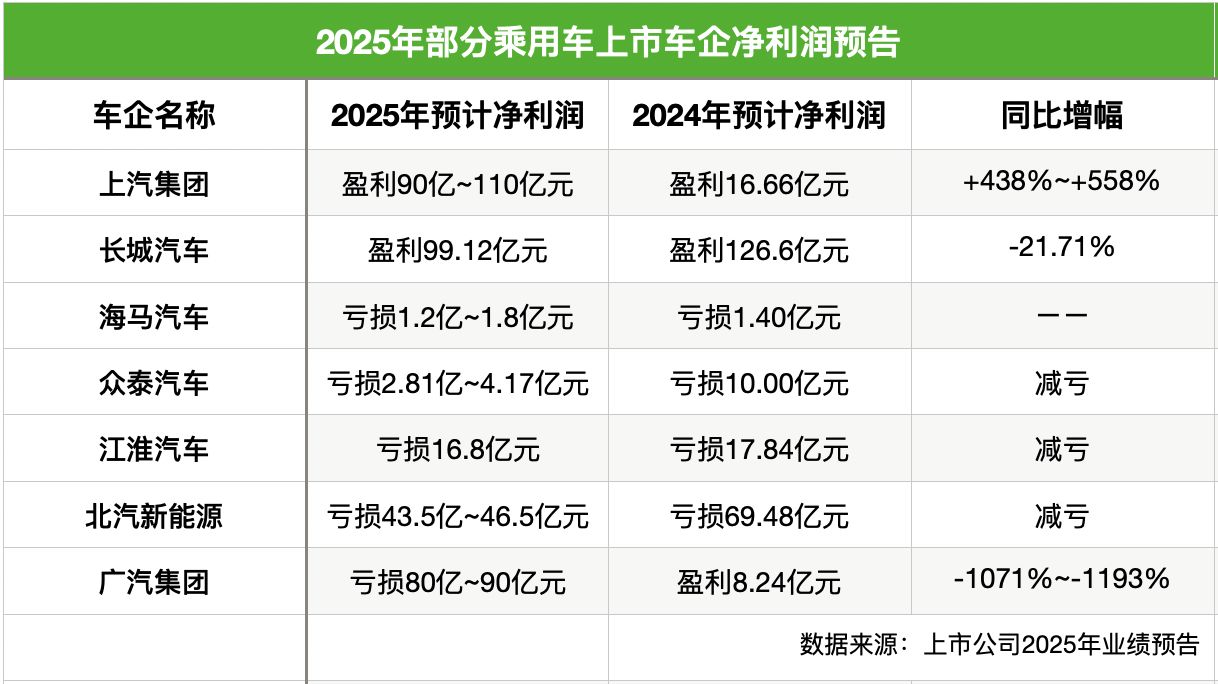
Core Viewpoint - The automotive industry is facing significant profitability challenges, with many companies reporting losses for 2025, particularly in the passenger vehicle sector, while some commercial vehicle manufacturers show improved profitability [1][10]. Passenger Vehicle Companies - Among the seven passenger vehicle companies, only SAIC Motor and Great Wall Motors are expected to be profitable in 2025, with SAIC Motor projecting a net profit of approximately 9 billion to 11 billion yuan, a substantial increase of 438% to 558% compared to 2024 [3][4]. - Great Wall Motors anticipates a net profit of about 9.912 billion yuan for 2025, representing a decline of 21.71% from 2024 [4]. - Other companies like Haima, Zotye, and GAC Group are expected to incur losses, with GAC Group projecting a net loss of 8 billion to 9 billion yuan, a drastic drop of 1071% to 1193% compared to the previous year [5][6]. Commercial Vehicle Companies - The commercial vehicle sector shows a more favorable outlook, with five out of eight companies expected to be profitable in 2025 [1][7]. - Beiqi Foton is projected to achieve a net profit of approximately 1.33 billion yuan, a significant increase of 1551% compared to 2024 [8][9]. - Other companies like Xiamen Jinlong and Zhongtong Bus also expect profit growth, driven by increased sales in overseas markets [9]. Industry Trends and Challenges - The overall automotive industry is experiencing pressure on profitability, with a sales profit margin of only 4.1%, significantly lower than the average of 5.9% for downstream industrial enterprises [12]. - The industry is facing rising costs, particularly in raw materials, which are squeezing profit margins [12]. - A shift towards a "value war" rather than a price war is emerging, as companies seek to maintain brand value and reasonable profits [13]. - The automotive service market is expected to become a crucial profit pool, potentially matching the manufacturing sector by 2030, highlighting the need for companies to diversify their revenue streams [13][14].


A股2025年业绩预告收官!券商、有色金属迎来红利期,地产、光伏承压,AI引领新质生产力
Jin Rong Jie· 2026-02-04 11:32
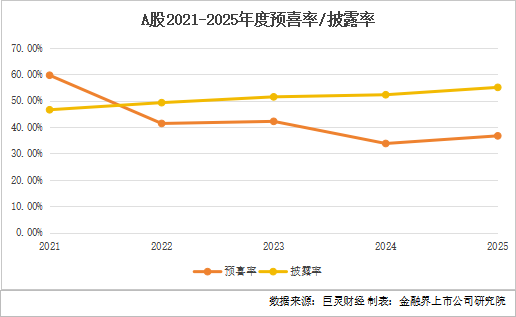
随着2025年度A股上市公司业绩预告披露正式收官,中国经济新旧动能加速转换的图景也愈发清晰。巨灵财经数据显示,截 至2026年1月30日,A股5352家上市公司中(剔除上市未满一年公司),共有2963家发布了2025年年报、快报或业绩预告, 披露率达55.36%。其中,1069家公司实现预喜(含预增、略增、扭亏、续盈),预喜率为36.08%,较2024年的33.38%实现 小幅回升,盈利态势逐步回暖。 从整体数据来看,2025年A股行业分化态势尤为突出。非银金融、有色金属等行业表现亮眼,盈利增速显著;房地产、光伏 等传统行业则深陷调整期,持续承受业绩压力;而以半导体、通信设备为代表的新质生产力相关板块,更是迎来业绩爆发 期。这种行业增减的鲜明对比,不仅直观反映了各行业景气度的差异,更清晰展现出中国经济正逐步摆脱传统要素依赖模 式,向创新驱动的高质量发展稳步迈进。 非银金融、有色金属领衔,优势赛道表现亮眼 从各行业具体表现来看,2025年预喜率排名前五的行业分别是非银金融、有色金属、美容护理、汽车和公用事业。这些行业 凭借自身核心优势或行业周期红利,跻身业绩预喜的核心阵营,其中非银金融板块的集体预增表现最为突出 ...





乘用车板块2月4日涨1.81%,北汽蓝谷领涨,主力资金净流入9.88亿元
Zheng Xing Xing Ye Ri Bao· 2026-02-04 08:49
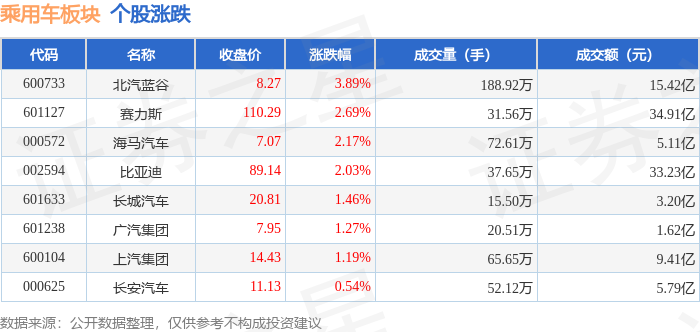
Group 1 - The passenger car sector increased by 1.81% compared to the previous trading day, with Beiqi Blue Valley leading the gains [1] - The Shanghai Composite Index closed at 4102.2, up 0.85%, while the Shenzhen Component Index closed at 14156.27, up 0.21% [1] - Major stocks in the passenger car sector showed varying performance, with Beiqi Blue Valley closing at 8.27, up 3.89%, and BYD at 89.14, up 2.03% [1] Group 2 - The net inflow of main funds in the passenger car sector was 988 million yuan, while retail investors saw a net outflow of 541 million yuan [1] - The fund flow data indicates that BYD had a main fund net inflow of 457.1 million yuan, but a retail net outflow of 219 million yuan [2] - Beiqi Blue Valley experienced a main fund net inflow of 200 million yuan, with retail investors showing a net outflow of 11.07 million yuan [2]



重仓新能源的车厂们
投中网· 2026-02-04 07:13
Core Viewpoint - The Chinese automotive market in January 2026 is characterized by a stark contrast, with most automakers experiencing negative growth, particularly in the new energy vehicle (NEV) sector, highlighting the importance of having a diversified product lineup that includes both fuel and electric vehicles [5][6][7]. Sales Performance Summary - In January, the retail sales of passenger cars are expected to reach 1.8 million units, a month-on-month decline of 20.4%, with NEV sales around 800,000 units, marking a penetration rate drop to 44.4%, nearly 10 percentage points lower than the peak at the end of 2025 [6][7]. - Traditional automakers like SAIC, Geely, and GAC Toyota reported stable sales due to their dual strategy of offering both fuel and NEVs, with SAIC's total sales reaching 327,400 units, a year-on-year increase of 23.94% [10][11]. - Geely's total sales were 270,167 units, with fuel vehicles contributing significantly to its performance, while BYD faced a 30.11% decline in NEV sales, indicating the challenges faced by companies heavily reliant on NEVs [12][15]. Market Dynamics - The differentiation in sales performance among automakers is attributed to their strategic choices, particularly the presence of a fuel vehicle base, which enhances resilience against market fluctuations [9][19]. - The demand for fuel vehicles surged during the pre-Spring Festival period, as consumers preferred mature technology and the convenience of fuel vehicles for long-distance travel, further supported by the limited impact of policy changes on fuel vehicles [19][20]. Export Growth - Exports have become a crucial support for many leading automakers, with companies like Chery and SAIC reporting significant increases in overseas sales, indicating a dual strategy of maintaining domestic stability while expanding globally [17][18]. Future Outlook - The current market conditions signal a shift from policy-driven growth to market-driven dynamics, emphasizing the need for automakers to maintain a balanced portfolio of fuel and NEVs to navigate future uncertainties [22]. - Companies that can effectively manage their fuel vehicle base while rapidly advancing in the NEV sector are likely to emerge as market leaders, while those focusing solely on NEVs may face greater risks during market fluctuations [21][22].



研报掘金丨开源证券:维持上汽集团“买入”评级,各品牌持续推新、海外销量有望高增
Ge Long Hui· 2026-02-04 06:40
格隆汇2月4日|开源证券研报指出,上汽集团发布1月产销快报,实现整车销量32.74万辆,同比 +23.94%。其中新能源车销量8.54万辆,同比+39.73%;出口及海外基地销量10.45万辆,同比+51.68%。 除春节偏晚影响因素外,销量高增也体现公司转型结果逐步显现。各子公司中,上汽智己、乘用车分公 司、五菱、通用表现较为突出,1月销量同比分别增长65.96%、53.78%、36.98%、29.31%。维持公司 2025-2027年业绩预测,预计2025-2027年归母净利润为107.2/136.8/172.0亿元,当前股价对应PE为 15.1/11.8/9.4倍,鉴于各品牌持续推新、海外销量有望高增,维持"买入"评级。 ...
重仓新能源的车厂,1月大多数都很惨
3 6 Ke· 2026-02-04 01:48
2026年开年1月的中国车市,用"冰火两重天"形容再贴切不过。 过去三天,不少车企都发布了1月份的销量业绩,可以说绝大多数车企都挂上了负增长的标签,特别是一些头部新能源车企,其1月销量波动更 为严峻。 乘联会数据显示,全月乘用车零售预计180万辆,环比下滑20.4%,同比仅微增;新能源零售销量可能达80万辆左右,渗透率降至44.4%,较 2025年底的峰值跌落近10个百分点。 在这场开年"寒流"中,车企阵营分化彻底拉满,拥有庞大燃油车基盘的大多数车企稳如泰山,而绝大多数单押新能源的品牌集体承压,新势力 内部更是有人狂欢有人落寞。 透过这份成绩单,我们似乎可以发现中国市场越来越明显的竞争逻辑,那就是即便新能源是未来发展的大趋势,但"双腿走路才稳"的路径愈加 清晰。 燃油车托底者稳,单押新能源者惨,出口是重要支撑 1月的销量数据,像一面放大镜,照出了不同车企战略选择的最终结果。核心分化点清晰明了,即是否拥有燃油车基本盘,直接决定了企业在市 场波动中的抗风险能力。 以吉利、上汽、广汽丰田为代表的传统车企,凭借"燃油+新能源"双线布局,在1月交出了最稳健的答卷。 上汽集团1月销量32.74万辆,同比增长23.94%, ...