
SAIC MOTOR(600104)

Search documents
上汽集团:1月销售32.7万辆,同比增长23.9%
Xin Lang Cai Jing· 2026-02-02 08:34
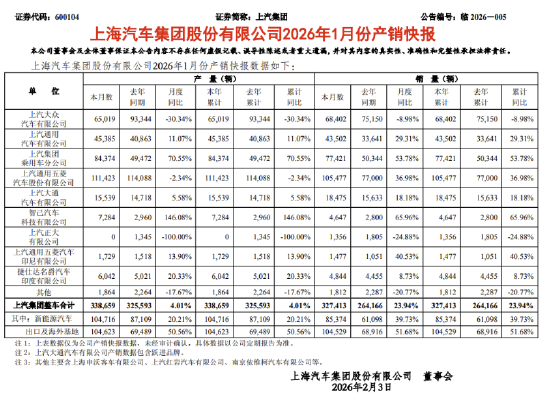
其中新能源汽车产量10.47万辆,同比增20.21%,销量85374辆,同比增39.73%;出口及海外基地产量 10.46万辆,同比增50.56%,销量10.45万辆,同比增51.68%。 | | | | | 产 量(铜) | | | | | | 师 量(铜) | | | | --- | --- | --- | --- | --- | --- | --- | --- | --- | --- | --- | --- | --- | | ਦੀ 位 | 本月整 | 走年 | 月度 | 本年 | 麦年 | 愿计 | 本月數 | 走年 | 月度 | 五年 | 是非 | 累计 | | | | 同期 | 同比 | 聚计 | 累计 | 同比 | | 同期 | 同比 | 累计 | 累计 | 同比 | | 上汽大众 | 65,019 | 93.344 | -30.34% | 65,019 | 93,344 | -30.34% | 68,402 | 75,150 | -8.98% | 68,402 | 75,150 | -8.98% | | 汽车有限公司 | | | | | | | | | | | | | | 上汽通用 | 45, ...


上汽集团(600104) - 上汽集团2026年1月份产销快报
2026-02-02 08:00
证券代码:600104 证券简称:上汽集团 公告编号:临 2026-005 上海汽车集团股份有限公司2026年1月份产销快报 本公司董事会及全体董事保证本公告内容不存在任何虚假记载、误导性陈述或者重大遗漏,并对其内容的真实性、准确性和完整性承担法律责任。 上海汽车集团股份有限公司2026年1月份产销快报数据如下: | | | | | 产 量(辆) | | | | | 销 | 量(辆) | | | | --- | --- | --- | --- | --- | --- | --- | --- | --- | --- | --- | --- | --- | | 单 位 | 本月数 | 去年 | 月度 | 本年 | 去年 | 累计 | 本月数 | 去年 | 月度 | 本年 | 去年 | 累计 | | | | 同期 | 同比 | 累计 | 累计 | 同比 | | 同期 | 同比 | 累计 | 累计 | 同比 | | 上汽大众 汽车有限公司 | 65,019 | 93,344 | -30.34% | 65,019 | 93,344 | -30.34% | 68,402 | 75,150 | -8.98% | 68,40 ...
上汽集团:1月新能源汽车销量同比增39.73%
Di Yi Cai Jing· 2026-02-02 07:58
上汽集团公告,2026年1月整车产量33.87万辆,同比增4.01%;销量32.74万辆,同比增23.94%。其中新 能源汽车产量10.47万辆,同比增20.21%,销量85374辆,同比增39.73%;出口及海外基地产量10.46万 辆,同比增50.56%,销量10.45万辆,同比增51.68%。 ...
上汽集团(600104.SH)1月份整车合计销量32.74万辆
智通财经网· 2026-02-02 07:54
智通财经APP讯,上汽集团(600104.SH)披露2026年1月份产销快报,1月份上汽集团整车合计产量33.87 万辆,同比增长4.01%;整车合计销量32.74万辆,同比增长23.94%。 ...
上汽集团:1月整车销量32.74万辆,同比增长23.94%
Xin Lang Cai Jing· 2026-02-02 07:44
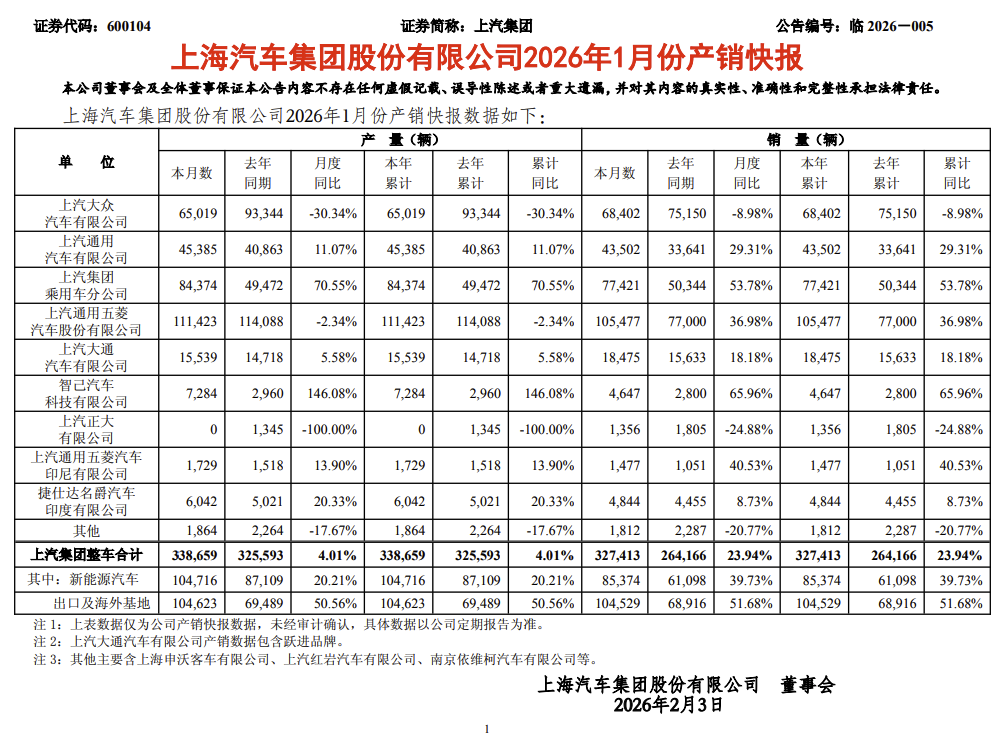
2月2日,上汽集团公告,2026年1月公司整车销量为32.74万辆,同比增长23.94%。其中,新能源汽车销量为8.54万辆,同比增长39.73%;出口 及海外基地销量为10.45万辆,同比增长51.68%。 证券代码:600104 证券简称:上汽集团 公告编号:临 2026-005 上海汽车集团股份有限公司2026年1月份产销快扑 本公司董事会及全体董事保证本公告内容不存在任何虚假记载、误导性陈述或者重大遗漏。并对其内容的真实性、准确性和党整性承担法律责任。 上海汽车集团股份有限公司2026年1月份产销快报数据如下: | 席 位 | | | | 产 量(辆) | | | | | | 销 量(辆) | | | | --- | --- | --- | --- | --- | --- | --- | --- | --- | --- | --- | --- | --- | | | 本月数 | 去年 | 月度 | 本年 | 去年 | 累计 | 本月数 | 去年 | 月度 | 本年 | 去年 | 累计 | | | | 同期 | 同比 | 累计 | 累计 | 同比 | | 同期 | 同比 | 累计 | 累计 | 同比 | ...
上汽集团:2026年1月整车产量、销量同比双增长
Xin Lang Cai Jing· 2026-02-02 07:44
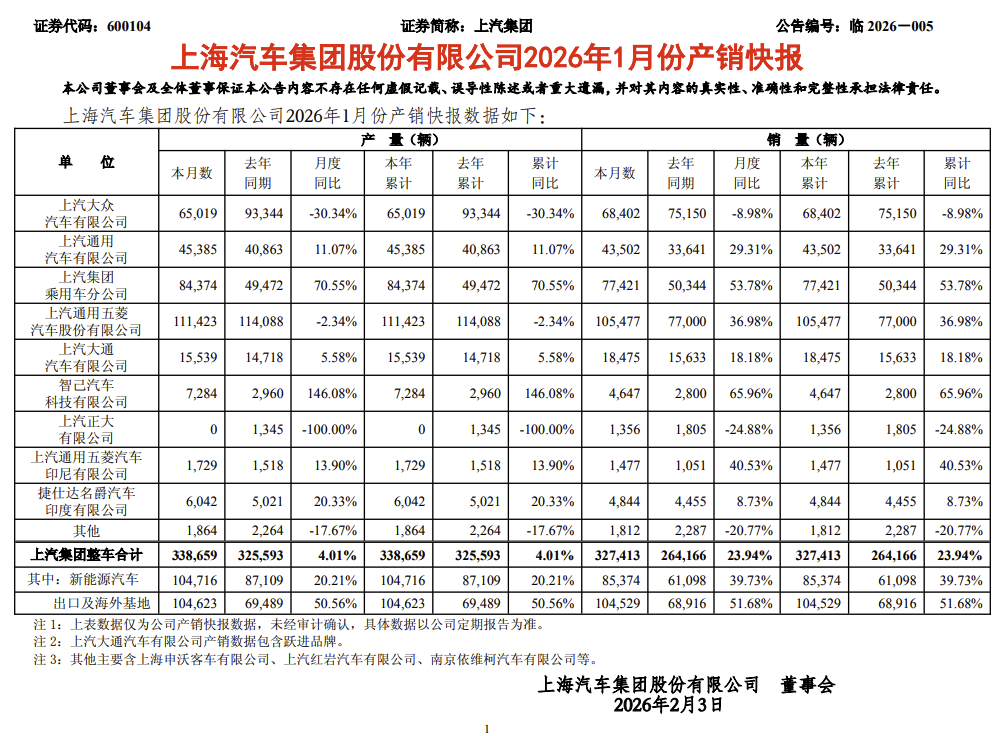
上汽集团公告称,发布2026年1月产销快报。整车合计产量338.659辆,同比增4.01%;销量327.413辆,同比增23.94%。旗下各子公司有不同表 现,如上汽大众产量65,019辆,同比降30.34%,销量68,402辆,同比降8.98%;上汽集团乘用车分公司产量84,374辆,同比增70.55%,销量 77.421辆,同比增53.78%。新能源汽车产量和销量同比分别增长20.21%、39.73%;出口及海外基地产量和销量同比分别增长50.56%、 51.68%。 | 用 位 | | | | 产 量(辆) | | | | | | 销 量(辆) | | | | --- | --- | --- | --- | --- | --- | --- | --- | --- | --- | --- | --- | --- | | | 本月数 | 去年 | 月度 | 本年 | 去年 | 累计 | 本月数 | 去年 | 月度 | 本年 | 去年 | 累计 | | | | 同期 | 同比 | 累计 | 累计 | 同比 | | 同期 | 同比 | 累计 | 累计 | 同比 | | 上汽大众 | 65,019 | 93,34 ...
1月批售32.7万辆,上汽集团销量同比增长23.9%
Jing Ji Guan Cha Wang· 2026-02-02 07:19
分板块看,自主品牌销量21.4万辆,同比增长39.6%,在集团整体销量中的占比提升至65.3%,较上年同 期提高7.3个百分点。其中,上汽乘用车销量7.7万辆,同比增长53.8%;上汽大通销量1.8万辆,同比增 长18.2%;上汽通用五菱销量10.5万辆,同比增长37%。 新能源业务继续扩张。1月,上汽新能源车销量8.5万辆,同比增长39.7%。其中,上汽乘用车新能源销 量2.8万辆,同比大幅增长;上汽通用新能源销量0.6万辆,同比增长超过3倍;上汽通用五菱新能源销量 3.6万辆,成为集团新能源的重要组成部分。 海外市场延续高增长。1月,上汽海外销量10.5万辆,同比增长51.7%。其中,MG品牌在欧洲市场1月交 付近2.6万辆,同比增长约15%,海外业务对集团整体销量的拉动作用进一步显现。 经济观察网2月2日,上汽集团(600104)披露2026年1月产销数据。1月,上汽整车批售32.7万辆,同比 增长23.9%;终端零售36.3万辆,批发与零售规模均位于行业前列,延续去年以来的回升态势。 ...
开门红!上汽集团1月销售32.7万辆,同比大涨23.9%
2 1 Shi Ji Jing Ji Bao Dao· 2026-02-02 07:11
南方财经2月2日电,上汽集团发布1月销量数据,继去年全年整车销量实现同比两位数增长后,2026年 上汽集团再迎市场开门红:1月实现整车批售32.7万辆,同比增长23.9%,终端零售36.3万辆,批发、零 售销量规模双双领跑国内汽车行业,经营质量持续向新向好。其中,上汽自主品牌销售21.4万辆,同比 增长39.6%;新能源车销售8.5万辆,同比增长39.7%;海外市场销售10.5万辆,同比增长51.7%。 ...
从李亚鹏嫣然医院到大企业,可持续公益到底有多难?阿里、腾讯、万科、宁德时代等巨头给出不同模式
Mei Ri Jing Ji Xin Wen· 2026-02-01 05:54
Core Viewpoint - The article discusses the challenges and strategies of corporate philanthropy in China, highlighting the need for sustainable models that integrate social responsibility into business operations. It emphasizes that relying solely on a few individuals for charitable efforts is not sustainable in the long run [1][2]. Group 1: Corporate Philanthropy Models - Five main types of corporate philanthropy are identified among the top 50 companies in China: 1. **Participation by Everyone**: Companies like Tencent encourage public involvement through low-barrier donation options, such as the "Fenfen Donation" program, which has engaged 400 million users by the end of 2024 [2][3]. 2. **Technical or Industrial Support**: Companies like CATL engage in rural revitalization through initiatives that support local agriculture, such as the "I Have an Acre of Land" program, which has reclaimed 280 acres of wasteland [3][4]. 3. **Establishment of Charitable Trusts/Funds**: Many companies, including Vanke, have set up foundations that have collectively invested over 1 billion yuan in various social causes by the end of 2024 [4]. 4. **Creating Charity IPs**: Notable examples include Ping An's Hope Primary Schools, which have supported over 31,000 students and trained over 20,000 rural teachers [4][5]. 5. **Direct Charitable Donations**: This straightforward approach remains a primary method for many companies, although it is seen as less sustainable [4][5]. Group 2: Sustainability of Philanthropic Models - Among the five models, "Technical or Industrial Support" is considered the most sustainable, as it aligns social needs with business capabilities, allowing for a synergy between social and commercial value [5][6]. - Establishing charitable trusts or funds is also viewed as sustainable, as it allows for independent management of social issues, facilitating long-term planning [5][6]. - The "Participation by Everyone" model enhances brand image and is well-suited for platform companies like Tencent, while the "Charity IP" model maximizes brand benefits [5][6]. Group 3: Challenges in Corporate Philanthropy - Companies face significant challenges in creating sustainable philanthropic models, including the need for strategic integration of philanthropy into business operations and the establishment of a culture that promotes ongoing participation [11][12]. - The lack of dedicated personnel in many corporate foundations raises concerns about the effectiveness and management of charitable initiatives [8][9]. - A comprehensive approach to philanthropy is necessary, requiring professional management processes and a clear understanding of social issues to ensure long-term impact [12][13]. Group 4: Financial Contributions and Impact - In 2024, corporate donations accounted for 983 billion yuan, representing 74.21% of total charitable contributions in China, underscoring the critical role of businesses in philanthropy [8]. - Notable large donations include BYD's commitment of 3 billion yuan to education and significant stock donations from individuals supporting educational institutions [8][9]. - The article highlights the diverse forms of donations, including cash, stocks, and services, reflecting a growing trend in corporate philanthropy [8].




带电量提升能支撑多少国内动力装机增速?
Changjiang Securities· 2026-01-31 13:46
Investment Rating - The industry investment rating is "Positive" and maintained [7] Core Insights - The penetration rate of domestic new energy passenger vehicles has reached 55%, and future sales growth is expected to slow down. However, the increase in battery capacity is anticipated to significantly impact demand, with a projected double-digit growth in battery demand for passenger vehicles by 2026 [2][4] - The domestic new energy passenger vehicle market has entered a consumption-driven growth phase since the end of 2020, with penetration rates increasing from around 10% to an expected 55% by the end of 2025. This growth is accompanied by a slowdown in sales growth due to a higher base [4][17] - The increase in battery capacity is expected to support the growth of battery installations, with single-vehicle battery capacity projected to rise from 52.8 kWh in April 2025 to 61.2 kWh by December 2025 for EVs, and from 23.3 kWh to 33.7 kWh for PHEVs during the same period [4][18] Summary by Sections Market Trends - The market for new energy passenger vehicles is projected to see a slight decline in total vehicle numbers, while new energy vehicles are expected to achieve small single-digit growth due to increased penetration rates. Battery capacity per vehicle is expected to increase by approximately 7%-8%, supporting a battery installation growth rate of around 12% [6][34] Policy and Economic Factors - Positive factors for battery capacity enhancement include changes in the old-for-new policy, which sets a subsidy cap at 8% of the vehicle price in 2026, and changes in purchase tax standards that require PHEVs to have a pure electric range of 100 kWh to qualify for tax exemptions [5][23] - The trend towards larger batteries in range-extended and plug-in hybrid vehicles is expected to continue, addressing consumer concerns about range anxiety and enhancing the perception of electric vehicles' convenience and cost-effectiveness [24] Product Development - Major manufacturers are launching new models with increased battery capacities. For instance, BYD and Geely are introducing models with capacities ranging from 20.79 kWh to 36.62 kWh for their 2026 versions [27][30] - The introduction of large-capacity EVs and PHEVs is expected to further enrich the market, with new models like the Wanjie M9 and NIO ES9 expected to have battery capacities around 100 kWh [31][33]



