
wanhua(600309)

Search documents
【转|太平洋化工&新材料-26年度策略】“反内卷”催化周期复苏,“新经济”拉动新材料成长
远峰电子· 2026-01-14 12:46
Investment Highlights - The article highlights the increasing trend of industry consolidation driven by recent mergers and acquisitions among leading companies, indicating a clear upward trajectory in industry concentration [2] - The chemical industry is expected to experience a recovery in 2026, supported by improving supply-demand dynamics, macroeconomic stability during the 14th Five-Year Plan, and the impact of new technologies such as AI and robotics on demand for new materials [39][40] 2025 Chemical Industry Review and 2026 Outlook 1.1 2025 Industry Review: Clear Differentiation - As of December 12, 2025, the basic chemical industry outperformed the market with a 32.16% increase in the CITIC Basic Chemical Index, compared to a 6.59% increase in the CITIC Oil and Petrochemical Index [3][6] 1.2 2025 Industry Review: Sub-industry Differentiation - Among 39 sub-industries, 38 saw increases, with potassium fertilizer leading at +85.87% and refining lagging at -8.99% [6] 1.3 Energy Chemical Products Review and 2026 Outlook - Oil prices have significantly decreased, with WTI and Brent averaging $65.05 and $68.36 per barrel respectively in 2025, down from $76.10 and $80.11 in 2024 [8] 1.4 Supply-Demand Dynamics Improvement: Capacity Expansion Slowing - Fixed asset investment in the chemical industry decreased by 7.9% year-on-year from January to October 2025, indicating a slowdown in capacity expansion [13] 1.5 Supply-Demand Dynamics Improvement: Demand Side Stabilization Expected - The basic chemical industry achieved revenue of 676.5 billion yuan in Q3 2025, reflecting a 5.32% year-on-year increase [18] 1.6 Supply-Demand Dynamics Improvement: Capital Expenditure and Construction Projects - Capital expenditure in the basic chemical industry fell by 1.17% year-on-year in Q3 2025, indicating a trend of reduced investment [22] 1.7 Revenue and Profit Situation: Revenue Growth of 2.87% in 2025 - The basic chemical industry saw a revenue increase of 2.87% in the first three quarters of 2025, with 14 out of 33 sub-industries reporting growth [25] 1.8 Revenue and Profit Situation: Profit Growth of 5.61% in 2025 - The industry recorded a profit increase of 5.61% in the first three quarters of 2025, with notable growth in sectors like pesticides and membrane materials [27] 1.9 Capital Expenditure and Construction Projects: Capacity Expansion Slowing - Capital expenditure in the basic chemical sector decreased by 9.07% year-on-year in the first three quarters of 2025, indicating a slowdown in capacity expansion [29] 1.10 Oil and Petrochemical Industry Revenue and Construction Projects - The oil and petrochemical industry reported a revenue of 19,037 billion yuan in Q3 2025, a decline of 4.67% year-on-year [33] 1.11 Strategic Emerging Industries Development Direction - The focus for 2026 will be on quality improvement in the chemical industry, with an emphasis on new materials and technologies [37] Chemical Cycle Products: "Anti-Internal Competition" Catalyzing Cycle Recovery 2.1 Petrochemical Refining: Oil Price Stabilization - Oil prices are expected to stabilize around $60 per barrel, benefiting refining margins and improving profitability for domestic refineries [42][45] 2.2 Pesticides: Industry Outlook Improving - The pesticide industry is expected to see gradual improvement in market conditions as raw material prices stabilize [48][50] 2.3 Potash: Resource Endowment Supporting Industry Stability - The potash industry is characterized by a concentrated global supply chain, ensuring food security [52][56] 2.4 Phosphate: Favorable for Integrated Resource Companies - The phosphate industry is expected to benefit from stable demand in agriculture and the growth of new energy sectors [59][62] 2.5 Civil Explosives: Steady Growth Supported by Demand - The civil explosives industry is projected to grow steadily due to stable demand from infrastructure projects [64][66] 2.6 Fluorochemicals: Growth Potential in High-Value Applications - The fluorochemical industry is expected to benefit from increasing demand for high-value applications in various sectors [71][74] 2.7 Soda Ash: Tight Supply-Demand Balance - The soda ash industry is expected to maintain a tight supply-demand balance, with limited new capacity expected [81][83] 2.8 Titanium Dioxide: Industry Recovery Anticipated - The titanium dioxide industry is expected to recover as supply constraints and environmental regulations drive consolidation [86][89] Chemical New Materials: "New Economy" Driving Growth 3.1 Electronic Chemicals: Accelerating Domestic Substitution - The semiconductor materials market is projected to grow, with domestic companies making strides in replacing imported products [91][93]




万华化学1月14日现1笔大宗交易 总成交金额2334.51万元 溢价率为-3.86%
Xin Lang Cai Jing· 2026-01-14 10:07
第1笔成交价格为74.80元,成交31.21万股,成交金额2,334.51万元,溢价率为-3.86%,买方营业部为招 商证券股份有限公司深圳前海大道证券营业部,卖方营业部为招商证券股份有限公司深圳前海大道证券 营业部。 炒股就看金麒麟分析师研报,权威,专业,及时,全面,助您挖掘潜力主题机会! 1月14日,万华化学收跌1.22%,收盘价为77.80元,发生1笔大宗交易,合计成交量31.21万股,成交金 额2334.51万元。 责任编辑:小浪快报 进一步统计,近3个月内该股累计发生2笔大宗交易,合计成交金额为2627.56万元。该股近5个交易日累 计下跌5.04%,主力资金合计净流入3679.34万元。 ...
万华化学今日大宗交易折价成交31.21万股,成交额2334.51万元
Xin Lang Cai Jing· 2026-01-14 09:33
1月14日,万华化学大宗交易成交31.21万股,成交额2334.51万元,占当日总成交额的0.7%,成交价74.8 元,较市场收盘价77.8元折价3.86%。 | 交易日期 | 证券简称 | 证券代码 | 成交价(元) 成交金额(万元) 成交量(*) 买入营业部 | | | | 卖出营业部 | 是否为专场 | | --- | --- | --- | --- | --- | --- | --- | --- | --- | | 026-01-14 | 万华化学 | 600309 | 74.8 2334.51 | 31.21 | 發音量發酵與鬼鬼 | 發覺是和醫與鬼園 | | ко | ...

万华化学烟台乙烯一期装置复产
Zhong Guo Hua Gong Bao· 2026-01-14 06:55
Core Viewpoint - Wanhua Chemical Group Co., Ltd. has announced the resumption of its ethylene phase I facility at the Yantai industrial park after completing a raw material diversification upgrade aimed at optimizing production efficiency [1] Group 1 - The ethylene phase I facility, with a capacity of 1 million tons per year, was shut down for upgrades on June 3, 2025 [1] - The upgrade allows for a flexible feedstock approach, enabling the switch between ethane and propane as raw materials [1] - The facility has successfully completed the raw material transformation and is now producing qualified products from ethane cracking [1]
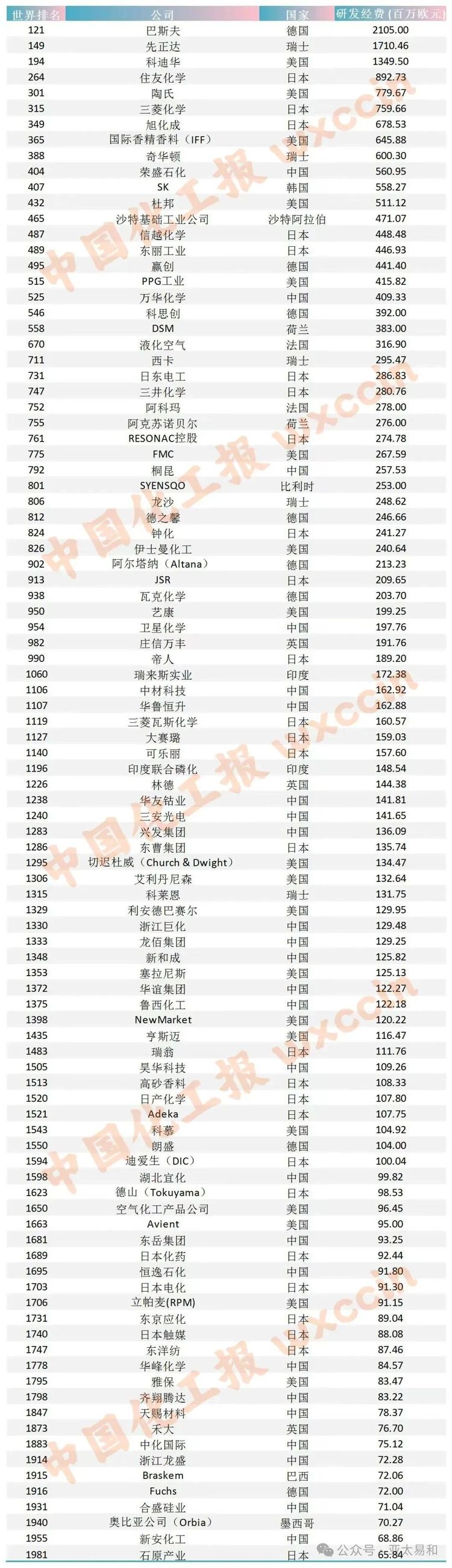
巴斯夫、三菱化学、万华化学等上榜全球研发投入2000强
Zhong Guo Hua Gong Bao· 2026-01-14 06:26
Core Insights - The European Commission released the "2025 EU Industrial R&D Investment Scoreboard" report, highlighting that 25 Chinese chemical companies are among the top 2000 global industrial R&D investors [1] - The total R&D investment of the top 2000 companies is projected to reach €144.6 billion in 2024, accounting for over 90% of global corporate R&D investment [1] Group 1: R&D Investment Rankings - BASF leads the chemical industry with an annual R&D investment of €2.1 billion, ranking 121st overall [1][3] - Syngenta follows with €1.71 billion, ranking 149th, while Corteva ranks 194th with €1.35 billion [1][3] - The top ten chemical companies by R&D investment include Sumitomo Chemical, Dow, Mitsubishi Chemical, Asahi Kasei, IFF, and Firmenich [1] Group 2: Country Distribution - Japan has the highest number of chemical companies on the list with 27, followed by China with 25, the USA with 19, Germany with 8, and Switzerland with 5 [1] - The report indicates that the USA has 674 companies in the top 2000, while China has 581, and the EU and Japan contribute 318 and 192 companies, respectively [1]


石化化工行业AI+进展点评:政策指引推动AI+转型,三大路径驱动化工企业智能化落地
EBSCN· 2026-01-14 06:22
Investment Rating - The report maintains an "Overweight" rating for the basic chemical industry [1] Core Insights - The chemical and new materials industry is set to drive the comprehensive "AI + manufacturing" transformation, as outlined in the State Council's policy document released in August 2025, which aims for deep integration of AI across six key sectors by 2027 [3][4] - The focus for the petrochemical industry is on "quality improvement and efficiency enhancement" through AI, utilizing large models and digital twin technologies to optimize various processes [5] - The report identifies three main pathways for chemical companies to implement AI: self-developed large models, third-party model integration, and investment in AI startups [13][14] Summary by Sections Policy Guidance - The State Council's document emphasizes the necessity for AI integration in the chemical industry, marking it as a compulsory aspect for achieving high-quality development [3] - The Ministry of Industry and Information Technology's implementation opinions further detail goals for AI technology and its application in manufacturing by 2027 [4] AI Empowerment in Petrochemical Industry - AI's role in the petrochemical sector focuses on enhancing operational efficiency and safety through predictive maintenance and process optimization [5] - The establishment of high-quality data sets and infrastructure is crucial for supporting AI applications in the industry [5] AI Empowerment in New Materials Industry - The new materials sector aims to leverage AI for deep integration in research and development, enhancing capabilities in material design and synthesis [5] Implementation Pathways - **Self-Developed Large Models**: Companies like China National Petroleum Corporation (CNPC) and China National Offshore Oil Corporation (CNOOC) are developing proprietary AI models to enhance their operational capabilities [9][10] - **Third-Party Model Integration**: WanHua Chemical collaborates with Huawei Cloud to implement AI solutions for predictive maintenance and operational efficiency [11] - **Investment in AI Startups**: Companies like Qicai Chemical are investing in AI startups to accelerate innovation in materials science [12][13] Investment Recommendations - The report suggests focusing on leading companies that excel in data utilization and AI integration, such as CNPC, Sinopec, and WanHua Chemical [14] - Attention is also drawn to companies involved in new materials and fine chemicals, which are expected to benefit significantly from AI-driven R&D advancements [14]



抢出口潮席卷锂电全产业链,供给端持续收紧叠加需求激增,碳酸锂王者归来开启能源金属上涨新周期
Xin Lang Cai Jing· 2026-01-13 11:27
Group 1 - Ganfeng Lithium is a global leader in the lithium industry, with a comprehensive resource layout covering spodumene, salt lakes, and clay, and its lithium carbonate production capacity is among the top in the industry [1] - Tianqi Lithium controls the world's largest spodumene mine, Greenbushes, with a self-sufficiency rate of 100%, and its full industry chain layout enhances profitability amid rising lithium carbonate prices [2] - Salt Lake Industry holds the largest lithium resource in China at the Qarhan Salt Lake, with a low extraction cost of 30,000 to 40,000 yuan per ton, and plans to reach a production capacity of 40,000 tons of lithium carbonate by 2025 [3] Group 2 - Zangge Mining has a significant advantage in the Tibetan salt lake resource layout, with a planned capacity of 50,000 tons per year and a self-sufficiency rate exceeding 80% [4] - Shengxin Lithium Energy owns Asia's largest hard rock lithium mine and has a long-term supply agreement with CATL, ensuring stable sales amid rising lithium prices [5] - Rongjie Co. focuses on lithium resource development and processing, optimizing its mining technology to enhance resource utilization and reduce costs [6] Group 3 - Tibet Mining has exclusive mining rights to the Zabuye Salt Lake, one of Asia's largest lithium salt lakes, which provides a cost advantage as lithium carbonate prices rise [7][8] - Yahua Group ranks second in lithium extraction from lepidolite in A-shares, with an annual capacity of 45,000 tons, and has established long-term partnerships with several battery manufacturers [9] - Zhongmin Resources has a strong presence in both spodumene and salt lake lithium extraction, actively expanding overseas projects to enhance market competitiveness [10] Group 4 - Jiangte Motor, located in Yichun, known as "Asia's Lithium Capital," has a lepidolite extraction capacity of 30,000 tons per year and holds proprietary low-cost extraction technology [11] - Xizang City Investment has lithium carbonate reserves of 3.9 million tons from two salt lakes, utilizing a low-cost extraction method that positions it well for profit during price increases [12] - Yongxing Materials focuses on lithium salt production and has a diversified supply chain that allows it to respond quickly to market changes [13] Group 5 - Huayou Cobalt is a global leader in cobalt products and has developed an integrated supply chain for nickel, cobalt, and lithium resources, ensuring stable supply for battery materials [14] - Hanrui Cobalt has a synergistic business model for cobalt and lithium, ensuring raw material self-sufficiency and benefiting from the growth of the lithium battery industry [15] - Tengen Cobalt focuses on the research, production, and sales of cobalt and lithium products, maintaining stable sales through partnerships with leading battery manufacturers [16] Group 6 - Luoyang Molybdenum is the second-largest cobalt producer globally and is actively expanding its lithium resource layout, benefiting from the growth in lithium battery demand [17] - Greeenmei is a leader in battery recycling, achieving over 95% recovery rates and integrating lithium resource recovery into its business model [18] - Northern Rare Earth is the largest supplier of light rare earths and is diversifying into lithium and other energy metals, leveraging its resource advantages [19] Group 7 - Jinli Permanent Magnet has advanced technology that reduces the use of heavy rare earths and is expanding into lithium-related energy metal businesses [20] - Wanhua Chemical is actively involved in the lithium battery materials sector, providing chemical support for lithium carbonate production and benefiting from the growing demand in the lithium battery industry [21] - China Aluminum is leveraging its mining experience to develop lithium resources, ensuring quality and reducing operational costs amid rising lithium prices [22] Group 8 - Jiangxi Copper is expanding into lithium and cobalt, utilizing its mining expertise to enhance its energy metal business [23] - Huayu Mining is focusing on lithium resource development in Tibet, leveraging its regional advantages to enhance its lithium salt processing projects [24] - Shengda Resources is actively acquiring lithium resources and enhancing its energy metal business through strategic partnerships [25] Group 9 - Boqian New Materials, while primarily focused on nano-level metal powder materials, is involved in the lithium battery sector and is expected to see significant profit growth by 2026 [26] - Yongshan Lithium focuses on lithium salt product development and has optimized its production processes to enhance product quality and efficiency [27] - Dazhong Mining is transitioning into the lithium sector, utilizing its mining expertise to explore and develop lithium resources [28] Group 10 - Jinyuan Co. is transforming into the lithium battery sector, focusing on lithium resource development and processing through strategic acquisitions [29] - Weiling Co. is extending its business into the lithium battery supply chain, providing equipment and technical support for lithium mining and processing [30] - Tianhua Super Clean is deeply engaged in lithium battery materials, with a strong production capacity and established relationships with leading battery manufacturers [31]





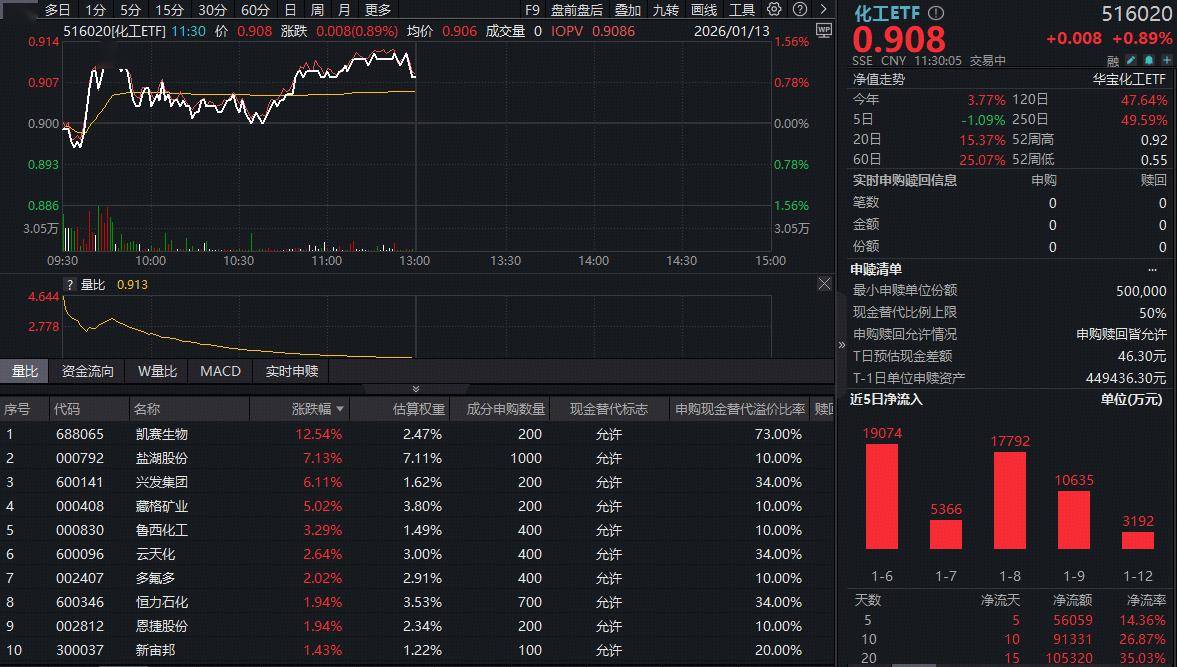
攻势又起!化工ETF开盘猛拉1.56%,机构高呼“行业重估”在即!
Xin Lang Cai Jing· 2026-01-13 04:18
Group 1 - The chemical sector is regaining momentum, with the chemical ETF (516020) showing a maximum intraday increase of 1.56% and closing up 0.89% [1] - Key stocks in the sector include Kasei Bio, which surged by 12.54%, and Salt Lake Co., which rose by 7.13% [1] - Recent data indicates that the chemical ETF has seen a net subscription of 560 million yuan over the last five trading days and over 910 million yuan in the last ten trading days [3] Group 2 - The Producer Price Index (PPI) for December 2025 decreased by 1.9% year-on-year, with a month-on-month increase of 0.2%, marking three consecutive months of growth [3] - The chemical industry is expected to undergo a revaluation, as its current profitability does not match its industry position, with potential recovery in profitability anticipated [3] - The chemical sector is at a new starting point for supply-demand rebalancing, influenced by policies aimed at reducing competition and advancements in AI and robotics [3] Group 3 - The chemical ETF (516020) tracks the CSI sub-sector chemical industry index, with nearly 50% of its holdings in large-cap stocks like Wanhua Chemical and Salt Lake Co. [4] - Investors can also access the chemical sector through the chemical ETF linked funds (Class A 012537/Class C 012538) for more efficient exposure [4]

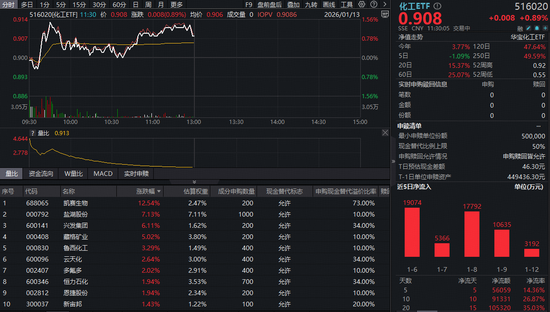
ETF午盘资讯|攻势又起!化工ETF(516020)开盘猛拉1.56%,机构高呼“行业重估”在即!
Sou Hu Cai Jing· 2026-01-13 03:53
Group 1 - The chemical sector is experiencing a rebound, with the chemical ETF (516020) showing a significant increase, reaching a maximum intraday gain of 1.56% and closing up by 0.89% [1] - Key stocks in the sector include Kasei Bio, which surged by 12.54%, and Salt Lake Co., which rose by 7.13%, among others [1][2] - Recent capital inflow into the chemical sector has been strong, with the chemical ETF accumulating a net subscription of 560 million yuan over the last five trading days and over 910 million yuan in the last ten days [2] Group 2 - The Producer Price Index (PPI) for industrial products decreased by 1.9% year-on-year in December 2025, with a month-on-month increase of 0.2%, indicating a narrowing decline compared to the previous month [3] - The chemical industry is expected to undergo a revaluation, as its industry position and profit levels do not align, with potential recovery in profitability anticipated [3] - The chemical sector is at a new starting point of supply-demand rebalancing, influenced by policies aimed at reshaping competition and advancements in new production capabilities [3] Group 3 - The chemical ETF (516020) tracks the CSI segmented chemical industry theme index, with nearly 50% of its holdings concentrated in large-cap leading stocks, providing an opportunity for investors to capitalize on strong performers [4] - Investors can also access the chemical ETF through linked funds, enhancing investment efficiency in the chemical sector [4]


省级对高耗能行业实施差异化电价征求意见稿发布,或为反内卷开拓新思路,化工行业ETF易方达(516570)低费率投资工具备受关注
Sou Hu Cai Jing· 2026-01-13 02:24
Core Viewpoint - The recent policy proposal from the Shaanxi Provincial Development and Reform Commission regarding differentiated electricity pricing for high-energy-consuming industries is gaining attention, indicating a new policy direction for these sectors [1] Industry Policy - The proposed policy includes charging higher electricity fees for restricted and eliminated capacities in industries such as electric stone and caustic soda, which, although not yet implemented, provides a new approach to address overcapacity in high-energy-consuming sectors [1] - The high-energy-consuming chemical sub-industries are currently at the bottom of the cycle, with only leading companies that own self-sufficient power plants achieving excess profits [1] Industry Trends - The introduction of the "Petrochemical Industry Steady Growth Work Plan (2025-2026)" is expected to enhance technological innovation capabilities, expand new market and application demands, and allow for scientific regulation of the supply side, accelerating the transformation and upgrading of the petrochemical industry [1] - Capital expenditure in the chemical sector is nearing its end, with ongoing construction projects declining for three consecutive quarters year-on-year, alongside the elimination of outdated facilities and the deepening of "anti-involution" policies, leading to a significant improvement in the marginal supply side [1] - By Q3 2025, the overall ROE of the petrochemical industry index is expected to slightly rebound to 10.1%, indicating a clearer bottoming trend, while the price-to-earnings ratio remains around the central level of the past decade, making the valuation of the sector worth noting [1] Related Products - The E Fund Chemical Industry ETF (516570) offers a bundled investment in leading companies in the oil, petrochemical, and basic chemical industries, closely aligning with the "dumbbell strategy" in the petrochemical sector, while also including high dividend and high growth components [2] - The management and custody fees for the E Fund Chemical Industry ETF are 0.15% and 0.05% per year, significantly lower than similar ETF products in the petrochemical sector, effectively reducing cost expenditures for investors and providing a higher cost-performance ratio for exposure to the favorable development opportunities in the petrochemical industry [2]