
huahaipharm(600521)

Search documents
华海药业(600521) - 浙江华海药业股份有限公司关于“华海转债”预计触发转股价格向下修正的提示性公告
2025-08-08 09:47
| | | 浙江华海药业股份有限公司 本公司董事会及全体董事保证本公告内容不存在任何虚假记载、误导性陈述或 者重大遗漏,并对其内容的真实性、准确性和完整性承担个别及连带责任。 重要内容提示: 关于"华海转债"预计触发转股价格向下修正的提示性公告 ●根据《上海证券交易所上市公司自律监管指引第 12 号——可转换公司债券》 规定,"上市公司应当在预计触发转股价格修正条件的 5 个交易日前及时披露提示 性公告。"自 2025 年 7 月 26 日至 2025 年 8 月 8 日,公司股票在连续 30 个交易日 中已有 10 个交易日的收盘价低于当期转股价格的 80%,预计触发转股价格向下修 正条件。若触发条件,公司将于触发条件当日召开董事会审议决定是否修正转股价 格,并及时履行信息披露义务。 一、可转债上市发行概况 根据中国证券监督管理委员会《关于核准浙江华海药业股份有限公司公开发行 可转换公司债券的批复》(证监许可[2020]2261 号),公司于 2020 年 11 月 2 日公 开发行了 1,842.60 万张可转换公司债券(以下简称"可转债"),每张面值 100.00 元,发行总额 184,260.00 万 ...

医药生物行业今日净流出资金52.39亿元,药明康德等16股净流出资金超亿元
Sou Hu Cai Jing· 2025-08-07 08:41
沪指8月7日上涨0.16%,申万所属行业中,今日上涨的有18个,涨幅居前的行业为有色金属、美容护 理,涨幅分别为1.20%、0.99%。跌幅居前的行业为医药生物、电力设备,跌幅分别为0.92%、0.74%。 医药生物行业位居今日跌幅榜首位。 | 代码 | 简称 | 今日涨跌幅(%) | 今日换手率(%) | 主力资金流量(万元) | | --- | --- | --- | --- | --- | | 688166 | 博瑞医药 | -5.70 | 3.89 | 23275.85 | | 002173 | 创新医疗 | 10.01 | 30.10 | 22618.18 | | 000710 | 贝瑞基因 | 5.26 | 23.64 | 20015.67 | | 300289 | 利德曼 | 20.02 | 21.71 | 17141.65 | | 002022 | 科华生物 | 9.96 | 12.63 | 15290.70 | | 300981 | 中红医疗 | 19.99 | 8.06 | 11833.89 | | 300760 | 迈瑞医疗 | 1.09 | 0.60 | 11395.45 | | 00 ...



创新药概念下跌1.41%,主力资金净流出191股
Zheng Quan Shi Bao Wang· 2025-08-07 08:40
截至8月7日收盘,创新药概念下跌1.41%,位居概念板块跌幅榜前列,板块内,千红制药跌停,华海药 业、亚太药业、康弘药业等跌幅居前,股价上涨的有36只,涨幅居前的有润都股份、海辰药业、粤万年 青等,分别上涨9.98%、7.22%、6.19%。 今日涨跌幅居前的概念板块 | 概念 | 今日涨跌幅(%) | 概念 | 今日涨跌幅(%) | | --- | --- | --- | --- | | 稀土永磁 | 3.24 | 减肥药 | -1.70 | | 脑机接口 | 2.69 | CRO概念 | -1.66 | | 高压氧舱 | 2.56 | 创新药 | -1.41 | | 太赫兹 | 1.65 | 仿制药一致性评价 | -1.34 | | 血氧仪 | 1.62 | 重组蛋白 | -1.29 | | 存储芯片 | 1.40 | 中船系 | -1.28 | | MCU芯片 | 1.18 | 阿尔茨海默概念 | -1.18 | | 无线耳机 | 1.08 | 特钢概念 | -1.02 | | 汽车芯片 | 1.02 | 细胞免疫治疗 | -1.02 | | DRG/DIP | 1.00 | PET铜箔 | -0.99 ...

仿制药一致性评价概念下跌1.34%,主力资金净流出104股
Zheng Quan Shi Bao Wang· 2025-08-07 08:39
截至8月7日收盘,仿制药一致性评价概念下跌1.34%,位居概念板块跌幅榜前列,板块内,千红制药跌 停,华海药业、亚太药业、联环药业等跌幅居前,股价上涨的有18只,涨幅居前的有润都股份、海辰药 业、*ST苏吴等,分别上涨9.98%、7.22%、4.63%。 今日涨跌幅居前的概念板块 | 概念 | 今日涨跌幅(%) | 概念 | 今日涨跌幅(%) | | --- | --- | --- | --- | | 稀土永磁 | 3.24 | 减肥药 | -1.70 | | 脑机接口 | 2.69 | CRO概念 | -1.66 | | 高压氧舱 | 2.56 | 创新药 | -1.41 | | 太赫兹 | 1.65 | 仿制药一致性评价 | -1.34 | | 血氧仪 | 1.62 | 重组蛋白 | -1.29 | | 存储芯片 | 1.40 | 中船系 | -1.28 | | MCU芯片 | 1.18 | 阿尔茨海默概念 | -1.18 | | 无线耳机 | 1.08 | 特钢概念 | -1.02 | | 汽车芯片 | 1.02 | 细胞免疫治疗 | -1.02 | | DRG/DIP | 1.00 | PET铜箔 | ...


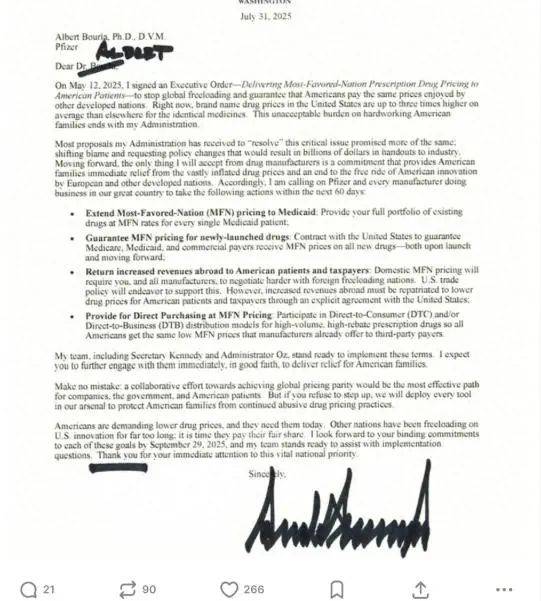
特朗普逼跨国药企砍价:哪些中国企业获益?
Hu Xiu· 2025-08-03 05:34
Core Viewpoint - The article discusses the significant price disparity of prescription drugs in the U.S. compared to other developed countries, leading to new policies aimed at price control and the potential impact on multinational pharmaceutical companies and emerging markets [1][2]. Group 1: U.S. Drug Pricing Policies - U.S. prescription drug prices are 2-3 times higher than those in other developed countries, with some innovative drugs priced at 10 times higher than in China [1] - New policies require pharmaceutical companies to provide "most favored nation pricing" to U.S. Medicare, sign contracts for price locking, renegotiate overseas prices to "repatriate profits," and promote direct sales for price transparency [1][2] - The Pharmaceutical Research and Manufacturers of America (PhRMA) criticized these policies, claiming they would undermine U.S. innovation [1][2] Group 2: Multinational Pharmaceutical Companies' Strategies - Companies like Johnson & Johnson, Pfizer, and Merck are adopting multi-faceted strategies to balance profits and compliance, including adjusting global pricing strategies [3] - Some companies are lowering prices in the U.S. while increasing prices in other markets to maintain profit margins, with AstraZeneca already announcing price reductions for certain drugs in the U.S. [3][4] - To offset profit losses, companies may raise prices in emerging markets like China, where the annual treatment cost for PD-1 drugs is approximately 1.16 million yuan, ten times higher than in China [4] Group 3: Cost Optimization Strategies - Cost reduction is a core objective, leveraging China's low-cost advantages, where biopharmaceutical R&D costs are 1/5 to 1/10 of those in the U.S. [5] - Pfizer has signed over $1 billion in CDMO orders with Chinese companies to transfer some biopharmaceutical production to China, reducing production costs by 30% [5][6] - Companies are also transferring non-core technologies to China to avoid tariffs and lower costs, such as Pfizer's collaboration with Chinese firms to establish PD-1 production bases [6][7] Group 4: Legal and Policy Maneuvering - Industry associations and pharmaceutical companies are using legal and political avenues to resist new policies, with PhRMA planning to appeal to the WTO regarding the "most favored nation pricing" requirement [10] - They are lobbying Congress, arguing that foreign price controls could reduce U.S. R&D investment by $10 billion annually [10] Group 5: Opportunities and Challenges for Chinese Companies - Chinese companies are positioned to benefit from accelerated domestic substitution, with local biosimilars gaining price advantages [11] - CDMO businesses are expanding, with WuXi Biologics reporting a 144% year-on-year increase in CDMO revenue in the first half of 2025 [12] - Chinese pharmaceutical companies are also achieving breakthroughs in international markets through licensing agreements, with total upfront payments reaching $2.329 billion in the first half of 2025 [13] Group 6: Beneficiary Companies - Companies in the biosimilar sector, such as Innovent Biologics and Antengene, are expected to gain market share as multinational firms raise prices in China [16] - WuXi Biologics is recognized as a leading global CDMO, while other companies like Eastone and Hengrui are also expanding their CDMO projects [17] - Chinese firms that have established production facilities in India and Southeast Asia, like Huahai Pharmaceutical, are likely to benefit from reduced reliance on the U.S. market [19]


“反内卷”主线扩散 光伏、快递板块表现活跃
Shang Hai Zheng Quan Bao· 2025-08-01 18:50
Market Overview - On the first trading day of August, the A-share market experienced overall weakness, with major sectors such as oil and petrochemicals, semiconductors, and non-bank financials adjusting, leading to declines in the three major stock indices [2] - The Shanghai Composite Index closed at 3559.95 points, down 0.37%; the Shenzhen Component Index closed at 10991.32 points, down 0.17%; and the ChiNext Index closed at 2322.63 points, down 0.24% [2] - The total trading volume in the Shanghai and Shenzhen markets was 15,983 billion yuan, a decrease of over 3,300 billion yuan compared to the previous trading day [2] Solar Equipment Sector - The solar equipment sector showed strong performance, with the Shenwan Solar Equipment Index closing up 2.60%, leading all secondary industries [3] - Companies such as Jiejia Weichuang and Shuangliang Energy reached the daily limit [3] - The Ministry of Industry and Information Technology recently issued a special energy-saving inspection task list for the polysilicon industry for 2025, requiring local authorities to implement and report results by September 30 [3] - According to China International Capital Corporation (CICC), this move is aimed at optimizing the supply side of the industry and may lead to the exit of backward production capacity, particularly affecting the upstream polysilicon segment [3] Express Delivery Sector - The express delivery sector also performed actively, with the Shenwan Logistics Index rising by 1.53% [3] - Companies such as YTO Express, Shentong Express, and Yunda Holdings saw increases of over 6%, while other stocks like Debang Logistics also followed suit [3] - On July 29, the State Post Bureau held a meeting with express delivery companies to address issues related to "involution" competition and promote high-quality industry development [4] Innovative Drug Sector - The innovative drug sector remained active, with stocks like Weikang Pharmaceutical hitting a 20% daily limit, and companies such as Anglikang and Guizhou Bailin recording consecutive gains [5] - Recent announcements from companies like Haizike and Huahai Pharmaceutical regarding new drug applications have contributed to the sector's momentum [5] - According to Dongfang Securities, the global innovative drug field is shifting from "Made in China" to "Created in China," with domestic pharmaceutical companies enhancing their international competitiveness [5] Dividend and Resource Sectors - Looking ahead to August, the strategy team at Industrial Securities suggests focusing on dividend sectors and resource industries for investment opportunities [6] - Historical data indicates that the first half of August typically sees fewer companies disclosing semi-annual results, leading to a higher success rate for small-cap stocks [6] - As the month progresses and companies begin to report earnings, larger-cap stocks with earnings certainty are expected to gain more attention, particularly in resource sectors like coal and petrochemicals [6]



创新药概念反复走强 众生药业等多股涨停
news flash· 2025-08-01 01:47
Core Viewpoint - The innovative drug concept has shown strong performance recently, with several companies experiencing significant stock price increases, indicating a positive market sentiment towards the sector [1] Group 1: Stock Performance - Companies such as Zhongsheng Pharmaceutical, Lianhuan Pharmaceutical, Xintian Pharmaceutical, and Fuyuan Pharmaceutical have reached their daily price limits [1] - Other companies like Anglikang, Rejing Bio, Kexing Pharmaceutical, and Yuekang Pharmaceutical have seen stock price increases exceeding 5% [1] Group 2: Regulatory Approvals - On July 31, Haizhi Pharmaceutical announced that its innovative drug HSK3486 (环泊酚注射液) has received acceptance for its FDA listing application [1] - On the same day, Huahai Pharmaceutical reported that its subsidiaries Huao Tai and Huabo Bio's dual-target drug HB0043, aimed at IL-17A and IL-36R, has received clinical trial approval from the National Medical Products Administration [1]





2025年版基孔肯雅热诊疗方案发布;人福医药实际控制人发生变更
Mei Ri Jing Ji Xin Wen· 2025-07-31 23:18
Group 1: Public Health Response - The 2025 version of the Chikungunya fever diagnosis and treatment plan has been released to enhance the standardized treatment level across various medical institutions in China [1] - The release reflects China's heightened vigilance towards imported infectious diseases, as there is currently no vaccine available for the virus [1] Group 2: Company Control Changes - Renfu Pharmaceutical announced a change in its actual controller to China Merchants Group, following the completion of board restructuring and control acquisition [2] - This change is expected to stabilize the company's governance structure and promote resource integration [2] Group 3: Drug Development and Approvals - Huahai Pharmaceutical's HB0043, a dual-target antibody drug, has received clinical trial approval, marking it as the first of its kind targeting IL-17A and IL-36R [3][4] - CS231295 from Microchip Biotech has received FDA approval for clinical trials, showcasing its potential in treating brain tumors due to its ability to penetrate the blood-brain barrier [4] - Shuyou Shen has obtained a summary report for BDB-001 injection, demonstrating significant clinical advantages in reducing steroid dosage for ANCA-associated vasculitis [5]


2025年版基孔肯雅热诊疗方案发布;人福医药实际控制人发生变更丨医药早参
Mei Ri Jing Ji Xin Wen· 2025-07-31 23:13
Group 1 - The National Health Commission and the National Administration of Traditional Chinese Medicine released the 2025 version of the Chikungunya fever diagnosis and treatment plan to enhance standardized treatment levels [1] - The new treatment plan reflects China's heightened vigilance towards imported infectious diseases, as there is currently no vaccine available for the virus [1] Group 2 - Renfu Pharmaceutical announced a change in its actual controller to China Merchants Group, with China Merchants Biomedical controlling approximately 4.34 billion shares, accounting for 26.62% of the total share capital [2] - The change in control is expected to stabilize the company's governance structure and promote resource integration [2] Group 3 - Huahai Pharmaceutical's HB0043, the world's first dual-target antibody drug targeting IL-17A and IL-36R, has received clinical trial approval from the National Medical Products Administration [3] - HB0043 shows stronger efficacy than monoclonal antibodies in various animal disease models, indicating its potential for treating autoimmune diseases [3] Group 4 - Microchip Biotech received FDA approval for the clinical trial of CS231295, a selective AuroraB inhibitor for treating advanced solid tumors, highlighting its ability to penetrate the blood-brain barrier [4] - The approval signifies a differentiated innovation capability in the field of brain tumor treatment, where most drugs struggle to cross the blood-brain barrier [4] Group 5 - Shutaishen obtained a summary report for the I/II phase clinical study of BDB-001 injection for ANCA-associated vasculitis, showing significant clinical advantages in steroid reduction and complete remission rates [5] - The company plans to advance to phase III clinical trials to further validate the clinical benefits for AAV patients [5]

浙江华海药业股份有限公司关于下属子公司获得药物临床试验许可的公告
Zhong Guo Zheng Quan Bao - Zhong Zheng Wang· 2025-07-31 23:13
Core Viewpoint - Zhejiang Huahai Pharmaceutical Co., Ltd. has received approval from the National Medical Products Administration for the clinical trial of its drug HB0043, which targets pyogenic hidradenitis [1][2]. Drug Basic Information - Drug Name: Injectable HB0043 - Indication: Pyogenic Hidradenitis - Dosage Form: Injectable Sterile Powder - Application: Clinical Trial - Applicants: Shanghai Huatai Biopharmaceutical Co., Ltd. and Huabo Biopharmaceutical Technology (Shanghai) Co., Ltd. [1] Additional Drug Information - In May 2025, Huatai received approval from New Zealand's Medicines and Medical Devices Safety Authority to conduct Phase I clinical trials for HB0043 in New Zealand [1]. - The total R&D investment in the project has reached approximately RMB 69.09 million [3]. Drug Mechanism and Advantages - HB0043 is a recombinant humanized IgG1 bispecific antibody that targets both IL-17A and IL-36R, demonstrating high binding and blocking activity [3]. - Compared to monoclonal antibodies, HB0043 shows stronger efficacy in inhibiting cytokine-induced inflammation and fibrosis through dual blockade of IL-17A and IL-36R [3]. - It has proven superior efficacy in various animal disease models, including atopic dermatitis, idiopathic pulmonary fibrosis, diabetic nephropathy, and neutrophilic asthma [3]. - HB0043 is the first bispecific drug targeting IL-17A and IL-36R globally, potentially overcoming the limitations of existing single-target therapies [4].