FYG,FUYAO GLASS(600660)

Search documents
超六成汽车零部件公司业绩同比快增
Zheng Quan Ri Bao· 2025-10-28 23:54
Core Viewpoint - The automotive parts industry in A-shares is experiencing positive growth, with over 60% of the 129 listed companies reporting a year-on-year increase in net profit for the first three quarters of 2025, driven by the recovery of the global automotive market and the rise of new energy vehicles [1] Group 1: Industry Performance - 73 listed companies in the automotive parts sector achieved both revenue and net profit growth in the first three quarters of this year, with some companies like Wuhu Fushai Technology and Chengdu Xiling Power Technology reporting net profit growth exceeding 100% [1] - The demand for new energy vehicles is a key factor driving the positive performance of automotive parts companies, with Jiangsu Bojun Industrial Technology reporting steady growth in main business revenue due to increased orders in the new energy vehicle sector [2] - In September, new energy vehicle production and sales reached 1.617 million and 1.604 million units, respectively, marking year-on-year increases of 23.7% and 24.6% [2] Group 2: Technological Transformation - The intelligent transformation of the industry is contributing to new growth, with Zhejiang Shibao reporting a 35.44% year-on-year increase in revenue, benefiting from trends in electrification, intelligence, and globalization [3] Group 3: Expansion into Robotics - Automotive parts companies are increasingly focusing on emerging fields such as robotics, with Ningbo Fangzheng Automotive Mould signing a strategic cooperation agreement to develop deep-sea robot components [4] - Zhejiang Rongtai Electric Equipment has made significant investments in humanoid robotics, acquiring stakes in companies to establish a foundation in precision transmission and intelligent equipment [4] - Jin Guo Co. is exploring the application of its "Avatar Ni Microalloy Material" in emerging fields like embodied intelligent robots, with plans for mass production by the end of the year [4] Group 4: Industry Synergies - The production of automotive parts and robotics shares technological similarities, allowing for rapid technology transfer during product development [5] - The established supply chain management capabilities and customer resources of automotive parts companies provide a natural advantage for entering the robotics sector [6] - Expanding into robotics can reduce reliance on the automotive industry, mitigate cyclical risks, and enhance long-term growth potential [6]



已披露上市公司三季报显示 超六成汽车零部件公司业绩同比快增
Zheng Quan Ri Bao Zhi Sheng· 2025-10-28 17:08
Core Viewpoint - The automotive parts industry in A-shares is experiencing positive growth, driven by the recovery of the global automotive market and the increasing popularity of new energy vehicles, with over 60% of listed companies reporting a year-on-year increase in net profit for the first three quarters of 2025 [1] Group 1: Industry Performance - As of the latest reports, 129 listed companies in the automotive parts sector have disclosed their Q3 results, with 80 companies showing a year-on-year increase in net profit [1] - Companies such as Zhejiang Jingu Co., Ltd. and Fuyao Glass Industry Group Co., Ltd. reported both revenue and net profit growth in the first three quarters of this year, with 8 companies achieving a net profit growth rate exceeding 100% [1] - The demand for new energy vehicles is a key factor driving the positive performance of automotive parts companies, with significant increases in orders and revenue reported by companies like Jiangsu Bojun Industrial Technology Co., Ltd. [2] Group 2: Technological Transformation - The industry's shift towards intelligent transformation is contributing to new growth, as seen in Zhejiang Shibao Co., Ltd., which reported a 35.44% year-on-year increase in revenue, benefiting from trends in electrification and globalization [3] Group 3: Expansion into Robotics - Automotive parts companies are increasingly focusing on emerging fields such as robotics, with several companies entering strategic partnerships to develop robotic components for various applications [4] - Zhejiang Rongtai Electric Equipment Co., Ltd. has made significant investments in humanoid robotics, acquiring stakes in companies to enhance its capabilities in precision transmission and intelligent equipment [4] - The move into robotics is seen as a way to reduce dependence on the automotive sector and mitigate industry cycle risks, while also providing opportunities for growth and transformation [5]

深度 | 汽车玻璃行业专题-天幕之后,去向何方【国信汽车】
车中旭霞· 2025-10-27 14:38
Core Viewpoints - The automotive glass market is rapidly evolving, with a significant focus on panoramic roofs, which are expected to reach a penetration rate of 37% by 2030, representing a market space of 34 billion yuan [12][44]. - The development of automotive glass is driven by three main pain points: heat insulation, privacy, and interaction, leading to innovations in heat-insulating, dimmable, and display-grade glass [2][3][12]. Group 1: Heat Insulation - Heat-insulating glass is currently in the 1-N stage, with two main solutions: physical sunshades and chemical coatings. The latter, using silver ion LOW-E films, can block over 98% of UV rays and reduce interior temperatures by 7-8°C [4][50][63]. - The market for heat-insulating glass is expanding, with prices around 1500 yuan per vehicle, making it increasingly accessible even for lower-priced models [63][38]. Group 2: Dimmable Glass - Dimmable glass addresses privacy concerns and is in the 0-1 stage, with various technologies like PDLC, EC, and LC. PDLC is the most cost-effective and widely produced, while EC offers superior dimming capabilities [5][67][69]. - The market for dimmable glass is projected to grow significantly, with estimates reaching 14 billion yuan by 2030, driven by the adoption of high-cost-performance solutions like PDCLC [12][70]. Group 3: Display-Grade Glass - Display-grade glass is still in the early stages of mass production but holds great potential for future applications, integrating with vehicle screens and enhancing user interaction [6][40]. - Innovations in display-grade glass include transparent mini-LED and Micro LED technologies, which could transform the way information is presented within vehicles [6][40]. Group 4: Market Trends - The penetration rate of panoramic roofs in vehicles is increasing, with a notable rise in models priced above 100,000 yuan, where the configuration rate is significantly higher [24][27]. - The automotive glass market is expected to see a shift towards more integrated solutions, with companies like Fuyao Glass leading the way in technology and market share [12][44][63].


福耀玻璃系列四十二-Q3业绩稳健增长,管理层平稳过渡【国信汽车】
车中旭霞· 2025-10-27 14:38
Core Viewpoint - The company reported a year-on-year increase of 14% in net profit attributable to shareholders for Q3 2025 [3]. Financial Performance - In the first three quarters of 2025, the company achieved revenue of 33.3 billion yuan, up 18% year-on-year, and net profit attributable to shareholders of 7.1 billion yuan, up 29% year-on-year. In Q3 2025 alone, revenue was 11.9 billion yuan, a 19% increase year-on-year and a 3% increase quarter-on-quarter, with net profit of 2.3 billion yuan, a 14% increase year-on-year but a 19% decrease quarter-on-quarter [4][10]. - The gross margin for Q3 2025 was 37.9%, showing a year-on-year decrease of 0.88 percentage points and a quarter-on-quarter decrease of 0.59 percentage points. The net profit margin was 19.06%, down 0.8 percentage points year-on-year and 5.0 percentage points quarter-on-quarter [5][19]. - The company's core profit margin for the first three quarters of 2025 was 22.28%, an increase of 1.14 percentage points year-on-year [6]. Management and Governance - The company announced a leadership transition aimed at optimizing governance structure and promoting sustainable development. Founder Mr. Cao Dewang stepped down as chairman, with his son Mr. Cao Hui taking over the role. Mr. Cao Hui has been the vice chairman since 2015, ensuring a smooth transition [7][32]. Industry Trends - The automotive glass industry is expected to enter a new growth phase driven by the increasing integration of smart technologies. The average area of automotive glass per vehicle has exceeded 4 square meters, with significant potential for smart upgrades. Companies like Xiaomi, NIO, and BYD are pushing for the adoption of coated and adjustable glass [8]. - The company holds a competitive advantage due to its scale, high automation, vertical integration, and cost efficiency. In 2024, the company maintained a global market share of over 36%, outperforming domestic automotive production by 4 percentage points [9][14]. Product Development and Market Position - The company is actively expanding its production capacity in Fuzhou, Anhui, and North America, which is expected to initiate a new capacity cycle and enhance its market share [9][34]. - The price of automotive glass per square meter has increased from 174 yuan in 2020 to 229 yuan in 2024, with a compound annual growth rate (CAGR) of 7.0%. The company forecasts a CAGR of over 7% for the value of glass per vehicle from 2025 to 2027 [9]. Raw Material and Cost Management - The company benefits from a decline in the price of key raw materials, such as heavy soda ash, which has decreased to around 1,300 yuan per ton in Q3 2025, down from 1,600-2,200 yuan per ton in the previous year [24]. - The management expense ratio decreased by 0.7 percentage points year-on-year to 14.16% in Q3 2025, with fluctuations in sales, management, and R&D expenses [29]. Future Outlook - The company is well-positioned to benefit from the growing demand for high-value-added products, with a focus on smart and adjustable glass technologies. The market for automotive glass is expected to grow significantly, with the global automotive glass market projected to reach 124.6 billion yuan by 2026 [42]. - The company has invested heavily in R&D, with annual expenditures exceeding 4% of revenue, leading to significant advancements in core technologies and a growing proportion of high-value products in its sales [48].

二代接班,宗馥莉错失的“时间窗口”
3 6 Ke· 2025-10-27 12:08
Core Viewpoint - The transition of leadership in Chinese family-owned businesses, exemplified by Fuyao Glass's new chairman, reflects broader challenges in succession planning and the need for modernization in the face of evolving market conditions [1][2]. Group 1: Leadership Transition - Fuyao Glass announced the succession of 55-year-old Cao Hui as the new chairman, taking over from his father, Cao Dewang, after 36 years in the company [1]. - The transition is seen as a response to the challenges faced by many family-owned businesses in China, particularly as founders age and the market becomes more competitive [1][2]. - The phenomenon of succession is common among the approximately 3 million family-controlled small and medium-sized enterprises in China, many of which were established in the 1990s and are now facing leadership transitions [1]. Group 2: Challenges of Succession - The difficulties in succession are not merely financial but involve complex social relationships that blend tradition, legal authority, performance, and personal charisma [2]. - The concept of "power dynamics" in succession is critical, as successors must navigate existing power structures and establish their authority [5][12]. - Many second-generation leaders face the challenge of overcoming the "cognitive barriers" established by their predecessors, which can hinder their ability to implement change [5][12]. Group 3: Market Evolution and Business Model Transformation - The shift towards digitalization and new business models is essential for the survival of traditional manufacturing firms, which must adapt to online channels and smart manufacturing technologies [1][6]. - Successful transitions often involve a symbolic "patricide," where successors must challenge and redefine the legacy of their predecessors to establish their own leadership [6][11]. - The emergence of new business areas, particularly in e-commerce and digital marketing, provides opportunities for second-generation leaders to innovate without the constraints of traditional practices [9][10]. Group 4: Case Studies and Examples - The case of Wang Xiaolong taking over at Laoxiangji illustrates a successful transition where the new leader implemented digital management strategies and sought inspiration from international practices [8]. - The experience of companies like Wahaha highlights the difficulties faced by successors in navigating entrenched power structures and the need for a clear vision to drive transformation [5][6]. - The rise of brands like Yuanqi Forest demonstrates the potential for innovation in traditional sectors, emphasizing the importance of adapting to market trends while maintaining operational efficiency [10].
汽车零部件板块10月27日涨0.58%,标榜股份领涨,主力资金净流出14.95亿元
Zheng Xing Xing Ye Ri Bao· 2025-10-27 08:25
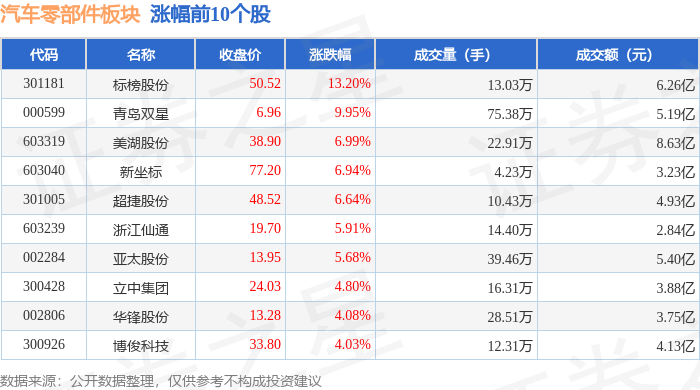
Market Overview - The automotive parts sector increased by 0.58% compared to the previous trading day, with BiaoBang Co., Ltd. leading the gains [1] - The Shanghai Composite Index closed at 3996.94, up 1.18%, while the Shenzhen Component Index closed at 13489.4, up 1.51% [1] Top Gainers in Automotive Parts Sector - BiaoBang Co., Ltd. (301181) closed at 50.52, up 13.20% with a trading volume of 130,300 shares and a transaction value of 626 million [1] - Qingdao Double Star (000599) closed at 6.96, up 9.95% with a trading volume of 753,800 shares [1] - MeiHu Co., Ltd. (603319) closed at 38.90, up 6.99% with a trading volume of 229,100 shares [1] - New Coordinate (603040) closed at 77.20, up 6.94% with a trading volume of 42,300 shares [1] - Zhengdu Co., Ltd. (301005) closed at 48.52, up 6.64% with a trading volume of 104,300 shares [1] Top Losers in Automotive Parts Sector - WanAn Technology (002590) closed at 13.92, down 5.18% with a trading volume of 368,300 shares [2] - Wanliyang (002434) closed at 9.41, down 4.66% with a trading volume of 501,500 shares [2] - Shenglong Co., Ltd. (603178) closed at 21.86, down 4.46% with a trading volume of 423,000 shares [2] Capital Flow Analysis - The automotive parts sector experienced a net outflow of 1.495 billion in main funds, while retail funds saw a net inflow of 819 million [2] - The sector's overall capital flow indicates a mixed sentiment among institutional and retail investors [2] Individual Stock Capital Flow - New Spring Co., Ltd. (603179) had a main fund net inflow of 173 million, while retail funds saw a net outflow of 208 million [3] - Zhongtai Automobile (000980) experienced a main fund net inflow of 98.38 million, but both retail and speculative funds had net outflows [3] - MeiHu Co., Ltd. (603319) had a main fund net inflow of 90.39 million, with retail funds experiencing a net outflow of 6446.47 million [3]



福耀玻璃涨2.01%,成交额5.83亿元,主力资金净流入4526.44万元
Xin Lang Zheng Quan· 2025-10-27 05:30
Core Viewpoint - Fuyao Glass has shown a positive stock performance with a year-to-date increase of 14.87% and a recent rise of 2.01% on October 27, 2023, indicating strong market interest and financial health [1][2]. Financial Performance - For the period from January to September 2025, Fuyao Glass reported a revenue of 33.302 billion yuan, representing a year-on-year growth of 17.62%, and a net profit attributable to shareholders of 7.064 billion yuan, which is an increase of 28.93% compared to the previous year [2]. - The company has distributed a total of 35.683 billion yuan in dividends since its A-share listing, with 13.701 billion yuan distributed over the last three years [3]. Shareholder Information - As of September 30, 2025, the number of shareholders for Fuyao Glass decreased to 85,700, a reduction of 8.07% from the previous period, while the average number of circulating shares per person increased by 8.79% to 23,375 shares [2]. - The second-largest circulating shareholder is Hong Kong Central Clearing Limited, holding 398 million shares, which increased by 24.511 million shares from the previous period [3]. Stock Market Activity - On October 27, 2023, Fuyao Glass's stock price was 68.58 yuan per share, with a trading volume of 583 million yuan and a turnover rate of 0.43%, leading to a total market capitalization of 178.976 billion yuan [1]. - The stock has experienced a 4.59% increase over the last five trading days, a 4.02% decrease over the last 20 days, and a 22.71% increase over the last 60 days [1]. Business Overview - Fuyao Glass specializes in the design, production, and sales of automotive-grade float glass and automotive glass, with its main business revenue composition being 91.10% from automotive glass, 14.43% from float glass, and 10.51% from other sources [1]. - The company is categorized under the automotive industry, specifically in automotive parts and body accessories, and is associated with various concept sectors including special glass and automotive components [1].
汽车行业双周报(2025/10/10-2025/10/23):今年前三季度新能源汽车产销量超过1100万辆-20251024
Dongguan Securities· 2025-10-24 09:10
Investment Rating - The report maintains an "Overweight" rating for the automotive industry, expecting the industry index to outperform the market index by over 10% in the next six months [51]. Core Insights - In the first three quarters of 2025, China's new energy vehicle (NEV) production and sales exceeded 11 million units, with a year-on-year growth rate of over 30% [47][48]. - The automotive industry has shown strong growth, with September production reaching 3.276 million units, a year-on-year increase of 17.1%, and sales at 3.226 million units, up 14.9% year-on-year [47][48]. - The NEV sales penetration rate reached 46.1%, indicating robust demand and market acceptance [47][48]. Industry Data Tracking - In September, China's automotive production was 3.276 million units, with a month-on-month increase of 16.4% and a year-on-year increase of 17.1% [19][22]. - Automotive sales in September were 3.226 million units, reflecting a month-on-month increase of 12.9% and a year-on-year increase of 14.9% [19][22]. - Exports for the first nine months reached 4.95 million units, a year-on-year increase of 14.8%, with NEV exports alone growing by 89.4% to 1.758 million units [47][48]. Industry News - The Ministry of Industry and Information Technology is soliciting opinions on the mandatory national standard revision plan for vehicle factory certificates, aiming to enhance product safety and information transparency [34]. - The China Passenger Car Association reported that the cumulative production of power and other batteries reached 1,122 GWh in the first nine months, a year-on-year increase of 44% [34]. - NIO's internal meeting emphasized the necessity of achieving profitability in Q4 2025, focusing on marketing, supply chain stability, and timely delivery of high-quality software [40]. Investment Recommendations - The report suggests focusing on companies enhancing brand competitiveness through smart technology, such as BYD (002594) and Seres (601127) [47][48]. - It also highlights the potential of the smart driving industry chain, recommending companies like Fuyao Glass (600660) and Joyson Electronics (600699) [47][48]. - Additionally, it points to Yutong Bus (600066) as a beneficiary of the "old-for-new" policy in the new energy bus sector [47][48].




港股异动 | 正力新能(03677)再跌超8% 近六个交易日跌超25% 近日宣布配股筹资超5亿港元
智通财经网· 2025-10-24 02:54
Core Viewpoint - Zhengli New Energy (03677) has experienced a significant decline in stock price, dropping over 25% in the last six trading days, with a current price of 9.02 HKD and a trading volume of 62.77 million HKD [1] Group 1: Company Actions - Zhengli New Energy announced a placement of 45.92 million shares at a price of 10.98 HKD per share, representing a discount of approximately 7.89% from the closing price on October 16 [1] - The net proceeds from the placement are expected to be around 500 million HKD, with approximately 70% allocated for the construction, equipment purchase, and preparatory expenses related to the second phase of the new production facility in Changshu [1] - About 10% of the proceeds will be used for the construction of a solid-state battery pilot line, another 10% for research and development activities, and the remaining 10% for working capital and general corporate purposes [1] Group 2: Industry Context - Fuyao Glass announced that its founder, Cao Dewang, has submitted a resignation report from the position of chairman, with the board electing Cao Hui as the new chairman [1] - Zhengli New Energy was established and is controlled by two former vice presidents of Fuyao Glass, Cao Fang and Chen Jicheng, with Cao Fang being the sister of Fuyao Glass's founder [1] - Fuyao Glass is recognized as the largest automotive glass supplier globally, possessing a vast customer base among major automotive manufacturers [1]
曹晖接任福耀董事长后首发声:坚定“为中国人做一片属于自己的玻璃”初心
Zheng Quan Shi Bao Wang· 2025-10-23 10:56
Core Viewpoint - The recent leadership transition at Fuyao Glass, with Cao Hui taking over as chairman, is seen as a strategic move to enhance the company's governance and sustainable development, while maintaining its commitment to producing high-quality automotive glass for the global market [2][3]. Group 1: Leadership Transition - Cao Hui officially assumed the role of chairman of Fuyao Glass on October 16, 2023, succeeding his father, Cao Dewang, who remains on the board as a director [2]. - The leadership change is viewed positively by institutions, with Huatai Securities noting that Fuyao has become a global leader in automotive glass under the previous chairman's guidance [3][4]. Group 2: Strategic Collaboration - During a recent meeting between Fuyao Group and BAIC Group, both parties discussed collaboration paths in response to the automotive industry's transformation trends [4]. - A strategic cooperation agreement was signed between BAIC's subsidiary, Hainachuan, and Fuyao Group, focusing on material supply, technology collaboration, and supply chain integration to enhance competitiveness [4]. Group 3: Market Reaction - Following Cao Hui's appointment, Fuyao Glass's stock price initially dropped by approximately 5%, but rebounded with over 3% gains on the following days, recovering all losses [4].