Shede Spirits (600702)

Search documents
舍得酒业入选“2025中国企业ESG百强”榜单
Xin Lang Cai Jing· 2026-01-13 05:48
Group 1 - The core viewpoint of the article emphasizes the growing importance of ESG (Environmental, Social, and Governance) as a key metric for high-quality corporate development and a vital link between corporate value and social value [1][2] - The "2025 China Enterprise ESG Top 100" list was released by Sina Finance, evaluating over 5,000 A-share listed companies and mainland enterprises listed in Hong Kong using 18 industry ESG evaluation models and over 150 ESG indicators [1][2] - The list serves as a benchmark for industry development and provides valuable decision-making references for investors [1][2] Group 2 - Shede Liquor was recognized for its significant contributions in the ESG field, ranking 97th on the "2025 China Enterprise ESG Top 100" list [2][9] - The publication of the list is seen as an authoritative acknowledgment of the sustainable development practices of the listed companies, highlighting that ESG is now a necessary component of corporate strategy rather than just an added benefit [2][9] - Companies are encouraged to integrate ESG principles deeply into their strategic planning, operations, and supply chain collaboration to achieve a balance between commercial and social value [2][9] Group 3 - The top-ranked companies in the ESG list include major players such as China Construction Bank, China Mobile, and Agricultural Bank of China, all receiving a five-star rating [4][5] - The list features a diverse range of industries, including finance, telecommunications, and technology, indicating a broad commitment to ESG practices across sectors [4][5][6]



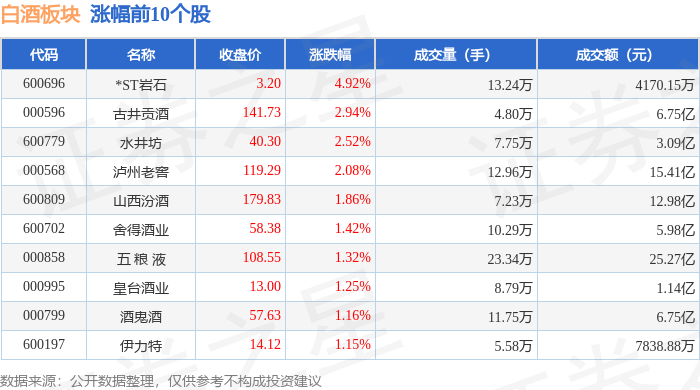
白酒板块1月12日涨0.79%,*ST岩石领涨,主力资金净流入4.03亿元
Zheng Xing Xing Ye Ri Bao· 2026-01-12 09:04
Core Viewpoint - The liquor sector experienced a rise of 0.79% on January 12, with *ST Rock leading the gains, while the Shanghai Composite Index rose by 1.09% and the Shenzhen Component Index increased by 1.75% [1] Group 1: Market Performance - The closing price of *ST Rock was 3.20, with a gain of 4.92% and a trading volume of 132,400 shares, amounting to 41.70 million yuan [1] - Gujing Gongjiu closed at 141.73, up 2.94%, with a trading volume of 48,000 shares and a transaction value of 675 million yuan [1] - Luzhou Laojiao closed at 119.29, increasing by 2.08%, with a trading volume of 129,600 shares and a transaction value of 1.54 billion yuan [1] Group 2: Capital Flow - The liquor sector saw a net inflow of 403 million yuan from main funds, while retail investors experienced a net outflow of 29.32 million yuan [1] - Wuliangye had a main fund net inflow of 267 million yuan, but retail funds saw a net outflow of 87.06 million yuan [2] - Luzhou Laojiao recorded a main fund net inflow of 85.62 million yuan, with retail funds experiencing a net outflow of 34.07 million yuan [2]




预见2026|白酒经历更艰难一年后,消费者和场景重构刚刚开始
Di Yi Cai Jing Zi Xun· 2026-01-08 08:13
Core Insights - The white liquor industry is experiencing a significant downturn, with 2025 being particularly challenging due to rational consumption and ongoing anti-corruption efforts, prompting companies to reassess their market strategies [1][4] Group 1: Market Conditions - Many liquor businesses, including those in Tianjin, reported losses in 2025, with sales figures dropping significantly compared to previous years, indicating a severe market contraction [2][4] - The average retail price of major liquor brands has decreased by 30% in 2025, with 99% of premium liquor prices falling [3][4] - The industry is facing a deep adjustment period, with many companies experiencing double-digit declines in revenue and net profit in the third quarter of 2025 [4] Group 2: Changes in Business Strategy - Liquor companies are shifting their focus from traditional sales models to consumer-centric approaches, emphasizing supply-demand matching and price balance [6][8] - There is a notable trend of companies avoiding long-term contracts with suppliers to mitigate financial risks associated with unsold inventory [3][4] - New growth models are emerging, with companies like Moutai and Fenjiu focusing on consumer engagement and exploring new consumption scenarios [6][7] Group 3: Consumer Behavior and Preferences - The demand for liquor is declining, particularly in corporate gifting and festive occasions, leading to increased competition and pressure on distributors [3][5] - The industry is witnessing a shift towards lower-alcohol products and innovative offerings to attract younger consumers and diversify market reach [7][8] - The implementation of new regulations against wasteful consumption has further altered drinking scenarios, compelling companies to adapt their strategies [7][8]




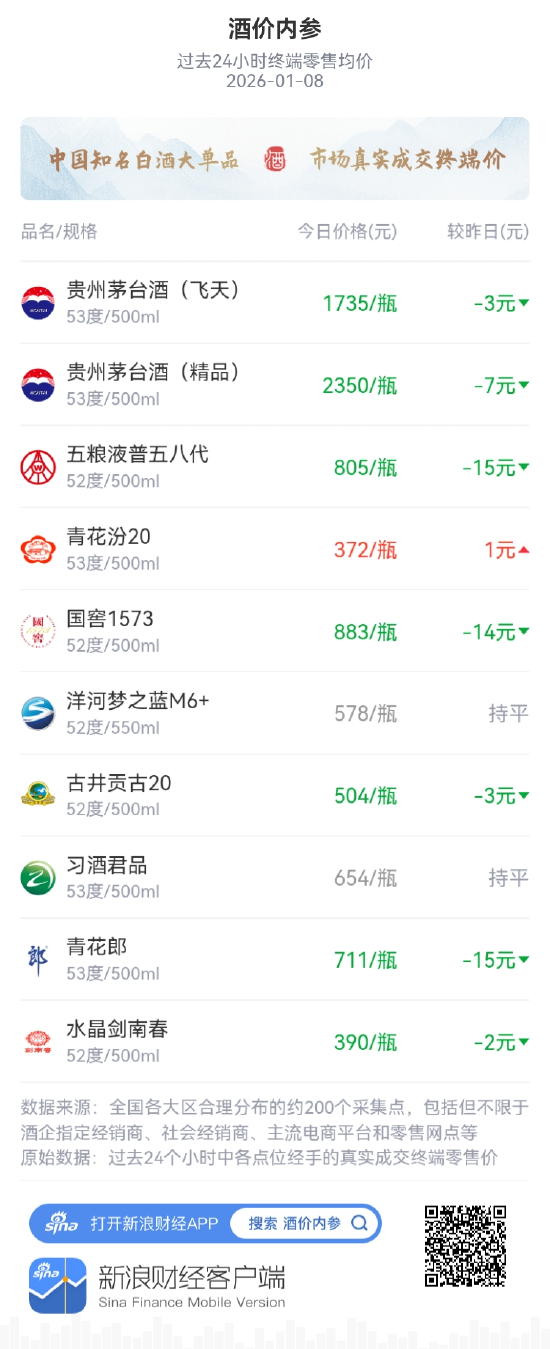
酒价内参1月8日价格发布 青花郎环比下跌15元/瓶
Xin Lang Cai Jing· 2026-01-08 01:25
Core Insights - The core viewpoint of the news is that the Chinese liquor market, particularly the top ten liquor products, has experienced a significant decline in retail prices, indicating a downward pressure on the market and a lack of confidence among consumers [1][6][7]. Price Trends - The average retail price of the top ten liquor products dropped to 8,982 yuan on January 8, down 58 yuan from the previous day, marking the lowest point since November 18 of the previous year [1][6]. - Seven out of the ten products saw price declines, with notable drops including Wuliangye (down 15 yuan) and Qinghua Lang (down 15 yuan) [7][9]. - Other products that experienced price reductions include Guojiao 1573 (down 14 yuan), boutique Moutai (down 7 yuan), and others with smaller declines [7][10]. Market Sentiment - The overall market is characterized by a widespread decline, reflecting insufficient confidence among consumers and investors [7][8]. - Only one product, Qinghua Fen 20, saw a slight increase of 1 yuan, while others remained stable [7][9]. Data Collection Methodology - The data for the liquor price reference is sourced from approximately 200 collection points across various regions, including designated distributors, social distributors, major e-commerce platforms, and retail outlets, ensuring a comprehensive and objective representation of market prices [2][7]. ESG Rankings - Five liquor companies were included in the "2025 China ESG Top 100" list published by Sina Finance, with rankings as follows: Kweichow Moutai (27th), Wuliangye (53rd), Gujing Gongjiu (74th), Shanxi Fenjiu (89th), and Shede Jiuye (97th) [2][7]. - The rankings are based on a comprehensive evaluation of ESG performance among over 5,000 A-share listed companies and Hong Kong-listed mainland enterprises, aiming to promote sustainable development in the industry [2][7].
酒价内参1月8日价格发布 精品茅台价格下跌7元/瓶
Xin Lang Cai Jing· 2026-01-08 01:25
Core Insights - The core viewpoint of the news is that the Chinese liquor market, particularly the top ten liquor products, has experienced a significant decline in retail prices, indicating a downward pressure on the market and a lack of confidence among consumers [1][6]. Price Trends - The average retail price of the top ten liquor products has decreased, with a total price of 8982 yuan for a bundled sale, down 58 yuan from the previous day, marking a new low since November 18 of the previous year [1][6]. - Seven out of the ten products have seen price declines, with notable drops including Wuliangye (down 15 yuan/bottle) and Qinghua Lang (down 15 yuan/bottle) [7][1]. - Other products such as Guojiao 1573 and premium Moutai also experienced price reductions of 14 yuan and 7 yuan per bottle, respectively [7][1]. Market Sentiment - The overall market is characterized by a broad decline, reflecting insufficient confidence among consumers, as indicated by the simultaneous price drops of leading brands and core products [7][1]. Data Collection Methodology - The data for the liquor price reference is sourced from approximately 200 collection points across various regions, including designated distributors, social distributors, mainstream e-commerce platforms, and retail outlets, aiming to provide objective and traceable market price data [2][7]. ESG Rankings - Five liquor companies were included in the "2025 China ESG Top 100" list published by Sina Finance, with rankings as follows: Kweichow Moutai (27th), Wuliangye (53rd), Gujing Gongjiu (74th), Shanxi Fenjiu (89th), and Shede Jiuye (97th) [2][7]. - The rankings are based on a comprehensive evaluation of ESG performance among over 5,000 A-share listed companies and Hong Kong-listed mainland enterprises, utilizing 18 industry-specific ESG evaluation models [2][7].

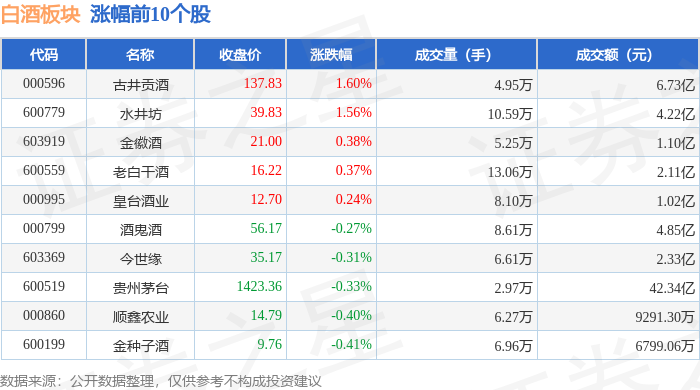
白酒板块1月7日跌0.47%,*ST岩石领跌,主力资金净流出2.44亿元
Zheng Xing Xing Ye Ri Bao· 2026-01-07 08:58
Core Viewpoint - The liquor sector experienced a decline of 0.47% on January 7, with *ST Rock leading the drop, while the Shanghai Composite Index rose by 0.05% and the Shenzhen Component Index increased by 0.06% [1]. Group 1: Market Performance - The closing prices and performance of key liquor stocks showed mixed results, with Guizhou Moutai at 1423.36 yuan (-0.33%), and Wuliangye at 107.52 yuan (-0.60%) [1][2]. - The total net outflow of main funds from the liquor sector was 244 million yuan, while retail investors saw a net inflow of 437.07 thousand yuan [2]. Group 2: Trading Volume and Value - Guizhou Moutai had a trading volume of 29,700 hands and a transaction value of 4.234 billion yuan, while Wuliangye had a trading volume of 123,100 hands and a transaction value of 1.326 billion yuan [1][2]. - The trading volume for the liquor sector was highlighted, with notable transactions including Luzhou Laojiao at 93,700 hands and a transaction value of 1.102 billion yuan [2]. Group 3: Fund Flow Analysis - Guizhou Moutai saw a main fund inflow of 76.40 million yuan, while *ST Rock experienced a main fund outflow of 4.17 million yuan [3]. - The fund flow analysis indicated that retail investors contributed positively to some stocks, such as Tianyoude Liquor, which had a retail net inflow of 121.59 thousand yuan [3].


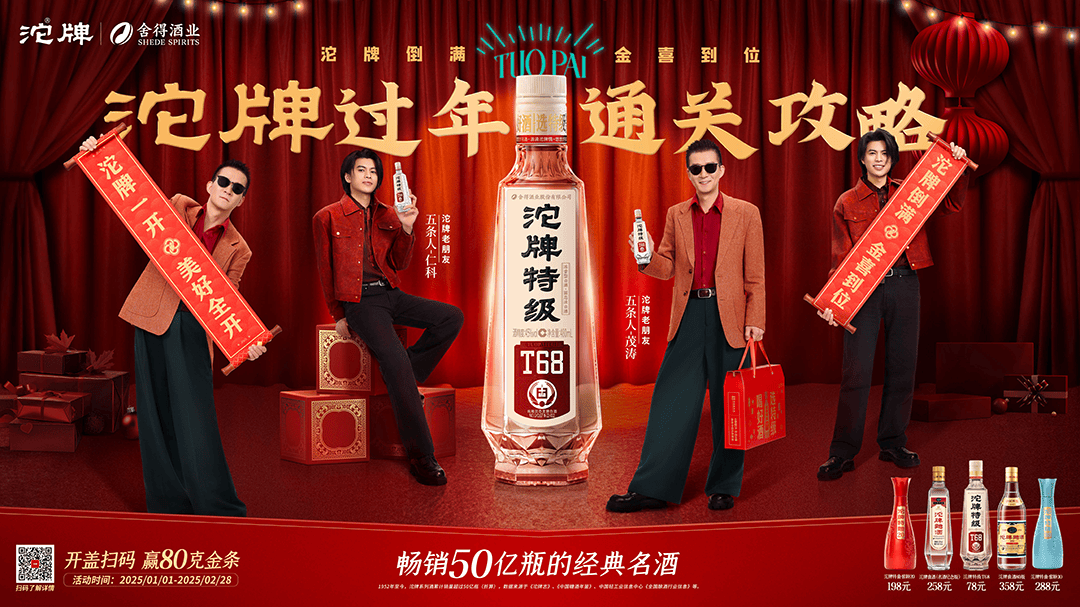
沱牌携手五条人花式送出“过年通关攻略”,点燃新春消费热情
Sou Hu Cai Jing· 2026-01-06 10:28
Core Insights - Tuo Pai, a renowned national liquor brand, is actively engaging in innovative marketing strategies during the Spring Festival, signaling market growth and showcasing confidence in its development [2][21] Marketing Strategies - Tuo Pai has partnered with the popular rock band "Wu Tiao Ren" to create a creative short film titled "Tuo Pai Spring Festival Strategy" and a new music MV "You You Le New Year," enhancing emotional connections with consumers [3][4] - The collaboration focuses on addressing contemporary social challenges faced during the Spring Festival, providing practical and entertaining solutions through music [4][8] Brand Engagement - The reimagined classic song "You You Sui Yue" by Wu Tiao Ren has resonated with audiences, evoking nostalgia and reinforcing Tuo Pai's brand identity [6][11] - Tuo Pai is launching a "Jiu Zhuo Ge Shen Challenge" on Douyin to interact with consumers and create a festive atmosphere, running until February 15 [8][19] Cross-Industry Collaborations - Tuo Pai has collaborated with Didi Chuxing for the "Home is Happiness Year" campaign, offering consumers chances to win discounts and benefits, effectively linking the brand to the emotional value of returning home during the Spring Festival [9][11] - The brand's partnerships with various platforms, including Douyin and Didi, are expected to enhance its visibility and consumer engagement [17][19] Sales and Distribution - Tuo Pai is implementing a comprehensive marketing strategy that includes online promotions on platforms like JD, Tmall, and Douyin, as well as offline events in over 30 cities, aiming to boost sales during the festive season [11][19] - The introduction of special products, such as the "Tuo Pai Qu Jiu·Snake Year Commemorative Wine," caters to gifting needs during the Spring Festival, enhancing market penetration [13][19] Brand Positioning - Tuo Pai's marketing efforts during the Spring Festival reflect its strong brand identity and growth potential, positioning it favorably in the competitive liquor market [21]
2025年第53周:酒行业周度市场观察
艾瑞咨询· 2026-01-06 00:03
Industry Environment - The liquor industry is undergoing a channel transformation, with traditional inventory strategies failing and instant retail emerging as a new opportunity. Leading companies like Moutai and Luzhou Laojiao are exploring online channels and new models such as "live streaming + instant fulfillment" [3] - The scattered liquor market is expected to grow from 80 billion yuan in 2024 to over 100 billion yuan in 2025, driven by companies like Gujing Gongjiu and Kuozi Jiao, which are targeting young consumers with experiential and diverse product offerings [5] - The competition in the liquor industry is shifting towards "value deepening," with companies focusing on product reconstruction and cultural resonance to meet the demands of younger and female consumers [6] Market Trends - The trend of low-alcohol liquor is gaining traction, with major brands like Wuliangye and Gujing Gongjiu launching new products to cater to younger consumers' preferences for lower alcohol content. The low-alcohol market is projected to reach 57 billion yuan by 2025 [7] - The white liquor market is experiencing a shift from "face consumption" to "substance consumption," with a focus on quality and experience rather than just brand prestige [9][14] - The scattered liquor market is becoming a new growth area, with brands leveraging community consumption and flexible pricing strategies to attract consumers [20][21] Sales and Marketing Strategies - Companies are increasingly focusing on enhancing bottle opening rates to address high inventory levels and declining consumption. Some brands have reported significant increases in opening rates through targeted marketing strategies [15] - The concept of "user co-creation" is emerging as a key strategy for brands to engage consumers and enhance brand loyalty, with companies like Wuliangye and Fenjiu exploring new ways to connect with their audience [16][17] - The wedding market is seeing a resurgence, with a 30% increase in wedding events in certain regions, although overall liquor consumption at these events is declining due to economic pressures [19] Brand Dynamics - Moutai is facing challenges with declining prices and inventory buildup, prompting the company to optimize its product structure and marketing strategies to attract younger consumers [12][14] - The introduction of new products and collaborations, such as the partnership between Water Well and actor Tony Leung, is aimed at enhancing brand image and connecting with consumers on an emotional level [26][34] - The rise of health-oriented products, particularly in the health liquor segment, is attracting younger female consumers, with brands like Jinjiu successfully tapping into this demographic [36] Future Outlook - The liquor industry is expected to continue evolving, with a focus on digital transformation and the integration of AI technologies to enhance operational efficiency and consumer engagement [37] - The scattered liquor market is projected to exceed 100 billion yuan, indicating a significant shift in consumer preferences towards more affordable and accessible options [20][21] - The industry is likely to see a continued emphasis on quality and value, as brands adapt to changing consumer demands and market conditions [22][29]



2025白酒年度事件大盘点:告别高增长,行业挑战下的变革与新机
Sou Hu Cai Jing· 2025-12-31 14:12
Core Insights - The Chinese liquor industry is entering an adjustment phase in 2025, facing challenges such as the "ban on alcohol," rising inventory pressure, and declining profits, yet opportunities for growth are emerging through innovation and market expansion [2][4]. Policy Impact - A strict "ban on alcohol" policy was introduced, prohibiting public officials from consuming alcohol during workdays and even at home gatherings, with severe penalties for violations [2][4]. - This policy aims to curb corruption and address public health concerns related to alcohol consumption [4]. Digital Transformation - Leading liquor companies are advancing their digital transformation from isolated upgrades to comprehensive collaborative development, with initiatives like the first "lighthouse factory" by Luzhou Laojiao and 5G-connected factories by Shede [5]. - The Ministry of Industry and Information Technology has released guidelines for digital transformation in the liquor industry, with companies actively contributing to industry mapping [5]. ESG Practices - ESG efforts among listed liquor companies have shifted from compliance to value creation, with companies like Zhenjiu Li Du setting ambitious carbon neutrality goals and achieving high water recycling rates [7]. - Companies are integrating ESG principles into performance assessments and utilizing blockchain for product traceability [7]. Market Dynamics - The liquor market is experiencing severe inventory issues, with major companies implementing supply control measures and channel reforms to reshape pricing structures [8][10]. - In the first three quarters of 2025, liquor exports reached $704 million, a 5.3% increase year-on-year, indicating a growing international market [8][10]. Young Consumer Trends - The younger generation is increasingly favoring low-alcohol and flavored beverages, with participation rates among Gen Z rising from 66% in 2023 to 73% in 2025 [12]. - Major companies are launching low-alcohol products to cater to this demographic, with Wuliangye and Luzhou Laojiao leading the way [12]. Personnel Changes - The liquor industry is undergoing significant personnel changes, with over 20 companies experiencing nearly 30 key position shifts, indicating a trend towards younger management [14][16]. - The new management is expected to focus on refined operations and innovation to navigate industry pressures [16]. Financial Performance - In the first nine months of 2025, only two companies, Kweichow Moutai and Shanxi Fenjiu, reported positive net profit growth, while the average profit of 20 liquor companies fell by 39.2% [18]. - The average inventory turnover days for these companies surged to 1456.29 days, marking a significant increase from the previous year [18]. Health-Oriented Products - The health-oriented liquor market is gaining traction, with sales of functional products like Jinjian's red label liquor increasing by 50% in the first half of the year [20]. - However, the market faces challenges such as product homogeneity and compliance risks, with a projected market size exceeding 58 billion yuan [22]. Price Fluctuations - Moutai's price fell below the official guidance price of 1499 yuan per bottle in December 2025, raising concerns about future price trends [22]. - Following a price drop, Moutai's wholesale prices rebounded due to supply control measures and increased market demand during the peak season [24].
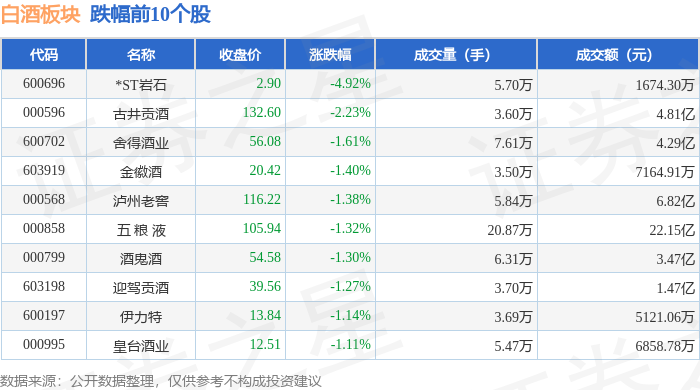
白酒板块12月31日跌1.01%,*ST岩石领跌,主力资金净流出15.73亿元
Zheng Xing Xing Ye Ri Bao· 2025-12-31 08:59
Core Viewpoint - The liquor sector experienced a decline of 1.01% on December 31, with *ST Yanshi leading the drop, while the overall market showed mixed results with the Shanghai Composite Index up by 0.09% and the Shenzhen Component Index down by 0.58% [1] Liquor Sector Performance - The closing prices and percentage changes for key liquor stocks are as follows: - *ST Yanshi: 2.90, -4.92% - Gujing Gongjiu: 132.60, -2.23% - Shede Manye: 56.08, -1.61% - Quanwei Jiu: 20.42, -1.40% - Luzhou Laojiao: 116.22, -1.38% - Wuliangye: 105.94, -1.32% - Zhisi Cha: 54.58, -1.30% - Yingjia Gongjiu: 39.56, -1.27% - Yilite: 13.84, -1.14% - Huangtai Jiuye: 12.51, -1.11% [1] Capital Flow Analysis - The liquor sector saw a net outflow of 1.573 billion yuan from main funds, while retail investors contributed a net inflow of 712 million yuan [1] - The detailed capital flow for selected stocks indicates: - Gujing Gongjiu: Main net inflow of 5.437 million yuan, retail net inflow of 2.302 million yuan - *ST Yanshi: Main net outflow of 4.866 million yuan, retail net inflow of 4.265 million yuan - Other stocks like Jinzhongzi Jiu and Kuozi Jiao experienced significant net outflows from main and retail funds [2]