
BOB(601169)

Search documents
北京银行:本行目前经营情况正常,各项业务稳健开展
Zheng Quan Ri Bao· 2026-01-20 13:37
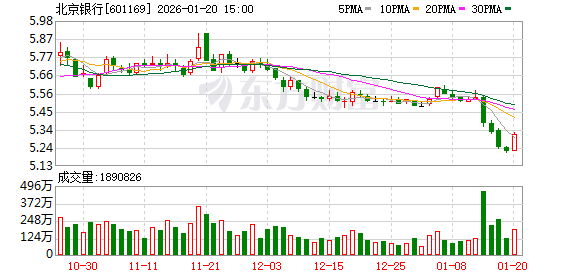
证券日报网讯 1月20日,北京银行在互动平台回答投资者提问时表示,近期本行股价走势与银行板块整 体走势基本一致,主要受行业周期性调整以及市场情绪波动等多重因素影响。本行严格按照《证券法》 《上市公司信息披露管理办法》等法律法规及监管要求,真实、准确、完整、及时、公平地履行信息披 露义务,不存在应披露而未披露的重大信息。本行目前经营情况正常,各项业务稳健开展。本行高度重 视市值管理工作,将持续坚持稳健经营,以良好的经营业绩回报广大投资者。 (文章来源:证券日报) ...


头部城商行换帅!关文杰出任北京银行党委书记
2 1 Shi Ji Jing Ji Bao Dao· 2026-01-20 12:29
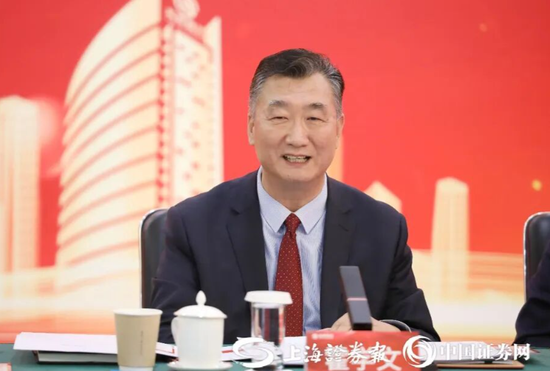
即将卸任的霍学文出生于1965年9月,已年满60周岁。霍学文熟悉经济金融工作,在学界、政界和业界 均有任职经验。霍学文早期曾在南开大学经济学院任教,后进入中国证监会工作。2001年11月,他出任 中共北京市委金融工委副书记,并先后担任北京市国资委副主任、北京市发展改革委副主任、北京市地 方金融监督管理局(北京市金融工作局)局长等职。2022年2月,霍学文调任北京银行党委书记,2022 年3月被选举为北京银行董事长。 公开简历显示,关文杰出生于1970年10月,硕士学位,高级会计师。到任北京银行之前,关文杰任北京 农商银行党委书记、董事长,并曾担任华夏银行副行长、行长。 近几年,北京银行资产规模从2022年的3万亿元左右增长至2025年三季度末的约4.9万亿元,居国内城市 商业银行前列。同时,北京银行持续深化科技金融、绿色金融、普惠金融等特色业务,并积极推进数字 化转型。目前,北京银行正式进入到以价值创造为根本导向的数字化转型2.0阶段,即全面数字化经营 阶段,加快实现全数据驱动、全客群细分、全渠道整合、全产品适配、全策略闭环,着力建设国际一流 的数字银行。 关文杰拥有30余年的银行从业经验,其职业生涯起步于建 ...
信用卡分期纳入贴息支持范围,年贴息比例1%
2 1 Shi Ji Jing Ji Bao Dao· 2026-01-20 12:00
Core Viewpoint - The recent upgrades to multiple loan interest subsidy policies signal a shift in government strategy from relying solely on large-scale infrastructure investment to a more balanced approach that encourages consumer spending and reduces financing costs for micro and small enterprises [1][4]. Group 1: Policy Upgrades - The Ministry of Finance has optimized existing interest subsidy policies for personal consumption loans, service industry loans, and equipment upgrade loans, extending their terms to the end of 2026 [1]. - The personal consumption loan subsidy now includes credit card installment payments, with an annual subsidy rate of 1% [3]. - The subsidy cap for new service industry loans has increased from 1 million to 10 million yuan per borrower [6]. Group 2: Support for Micro and Small Enterprises - A new interest subsidy policy for micro and small enterprises has been introduced, targeting key industry chains and their upstream and downstream sectors [11]. - The subsidy for eligible fixed asset loans for micro and small enterprises will be 1.5% annually, with a maximum loan amount of 50 million yuan per borrower [12]. Group 3: Expanded Coverage and Financial Institutions - The range of financial institutions eligible to provide these subsidies has been expanded to include city commercial banks, rural cooperative financial institutions, foreign banks, and consumer finance companies [4][7]. - The policy aims to enhance the accessibility of financial services in rural and grassroots markets, thereby stimulating consumption [4]. Group 4: Specific Sector Support - The updated policies now include support for digital, green, and retail sectors, alongside the previously established eight categories [6][7]. - The equipment upgrade loan subsidy has been raised to 1.5%, covering a wider range of sectors including high-end, intelligent, and green technologies [8].




关文杰出任北京银行党委书记
Xin Lang Cai Jing· 2026-01-20 11:44
记者从知情人士处获悉,北京银行在1月20日下午召开会议,关文杰被任命为北京银行党委书记。按照 惯例,履行完相关程序后,他或将出任北京银行董事长。(上证报) ...
关文杰拟任北京银行党委书记
Xin Lang Cai Jing· 2026-01-20 09:03
来源:金融人事Co 2026年开年伊始,头部城商行北京银行即传出换帅消息。 银行人事获悉,北京农商行董事长关文杰将调任北京银行,拟任党委书记;北京银行原党委书记、董事 长霍学文或将到龄退休。 1月20日,政协北京市第十四届委员会常务委员会第十八次会议召开,同意增补霍学文等47名同志为政 协北京市第十四届委员会委员。 霍学文,汉族,内蒙古赤峰人,1986年、1989年、1996年分别获南开大学经济学学士学位、硕士学位、 博士学位;2006年获中国人民大学法学博士学位,研究员、高级政工师、副教授。 霍学文于2022年2月任北京银行党委书记,2022年3月至今担任北京银行董事长。在进入北京银行之前, 其曾先后工作在南开大学经济学院、国务院证券委员会、证监会政策研究室国际调研处、国际合作部国 际合作处、中共北京市委金融工委、北京市国资委、北京市发展改革委、北京市地方金融监督管理局 (包括北京市金融工作局)。 关文杰,1970年10月出生,硕士学位,正高级会计师,现任北京农商银行党委书记、董事长。 他早年在中国建设银行青岛市分行从事财会工作,后历任华夏银行青岛分行计划财务部总经理、副行 长、行长,调任华夏银行总行会计部 ...
财政部连发多份重要文件,事关贷款贴息、民间投资贷款担保等 一揽子政策全文公布
Sou Hu Cai Jing· 2026-01-20 09:03
Group 1 - The core viewpoint of the news is the implementation of a financial subsidy policy for equipment renewal loans to support businesses in reducing financing costs and promoting effective investment [3][4][5] - The policy includes a 1.5% interest subsidy on fixed asset loans for equipment renewal projects, applicable for a maximum of two years, and is effective until December 31, 2026 [3][4] - The scope of support has been expanded to include various sectors such as construction, aviation, digital technology, and green energy, emphasizing high-end, intelligent, and digital equipment updates [4][6] Group 2 - A total of 26 banks are designated as eligible for processing the interest subsidy loans, including major national banks and several regional banks [4][5] - The subsidy process has been optimized to include a "pre-allocation + settlement" method, streamlining the application and approval process for banks and provincial financial departments [5][6] - The policy aims to enhance the experience of businesses by ensuring timely communication regarding subsidy payments through modern technology [6][7] Group 3 - The policy for small and micro enterprises includes a 1.5% interest subsidy on fixed asset loans, with a maximum loan amount of 50 million yuan, effective from January 1, 2026 [8][9] - The targeted sectors for this subsidy include new energy vehicles, medical equipment, and various service industries, aiming to stimulate investment and production [9][10] - The operational mechanism involves a "total-to-total" model for coordination between financial institutions and fiscal departments to ensure efficient processing of subsidy funds [11][12] Group 4 - The service industry loan subsidy policy has been extended until December 31, 2026, with an increased maximum loan amount of 10 million yuan and a 1% interest subsidy for one year [16][17] - New sectors such as digital, green, and retail have been added to the support scope, enhancing the policy's relevance to current economic trends [17][18] - The funding allocation process has been refined to improve efficiency and reduce redundancy in the approval process [18][19] Group 5 - A special guarantee plan for private investment has been introduced with a total quota of 500 billion yuan over two years, aimed at supporting small and micro enterprises [22][24] - The plan includes risk-sharing mechanisms where banks bear at least 20% of the loan risk, while the government guarantee fund covers up to 80% [24][25] - The initiative encourages innovative financing models and aims to enhance the capital strength of the government guarantee fund to support private investments effectively [26][27]






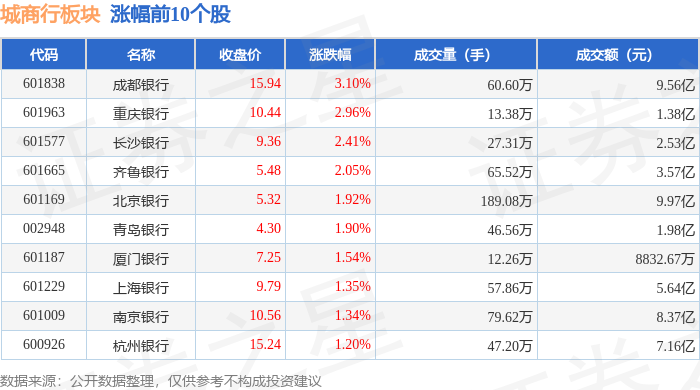
城商行板块1月20日涨1.35%,成都银行领涨,主力资金净流入2.66亿元
Zheng Xing Xing Ye Ri Bao· 2026-01-20 08:56
Core Insights - The city commercial bank sector experienced a rise of 1.35% on January 20, with Chengdu Bank leading the gains [1] - The Shanghai Composite Index closed at 4113.65, down 0.01%, while the Shenzhen Component Index closed at 14155.63, down 0.97% [1] Stock Performance - Chengdu Bank (601838) closed at 15.94, up 3.10% with a trading volume of 606,000 shares and a transaction value of 9.56 billion [1] - Chongqing Bank (601963) closed at 10.44, up 2.96% with a trading volume of 133,800 shares and a transaction value of 138 million [1] - Other notable performers include: - Changsha Bank (601577): closed at 9.36, up 2.41% [1] - Qilu Bank (601665): closed at 5.48, up 2.05% [1] - Beijing Bank (601169): closed at 5.32, up 1.92% [1] - Qingdao Bank (002948): closed at 4.30, up 1.90% [1] - Xiamen Bank (601187): closed at 7.25, up 1.54% [1] - Shanghai Bank (601229): closed at 9.79, up 1.35% [1] - Nanjing Bank (601009): closed at 10.56, up 1.34% [1] - Hangzhou Bank (600926): closed at 15.24, up 1.20% [1] Capital Flow - The city commercial bank sector saw a net inflow of 266 million from institutional investors, while retail investors experienced a net outflow of 42.84 million [1] - Detailed capital flow for selected banks includes: - Shanghai Bank (601229): net inflow of 1.051 billion from institutional investors, with net outflows from retail and speculative investors [2] - Hangzhou Bank (600926): net inflow of 90.48 million from institutional investors, with significant outflows from retail and speculative investors [2] - Nanjing Bank (601009): net inflow of 26.57 million from institutional investors, with outflows from retail investors [2] - Other banks also showed varying levels of net inflows and outflows [2]


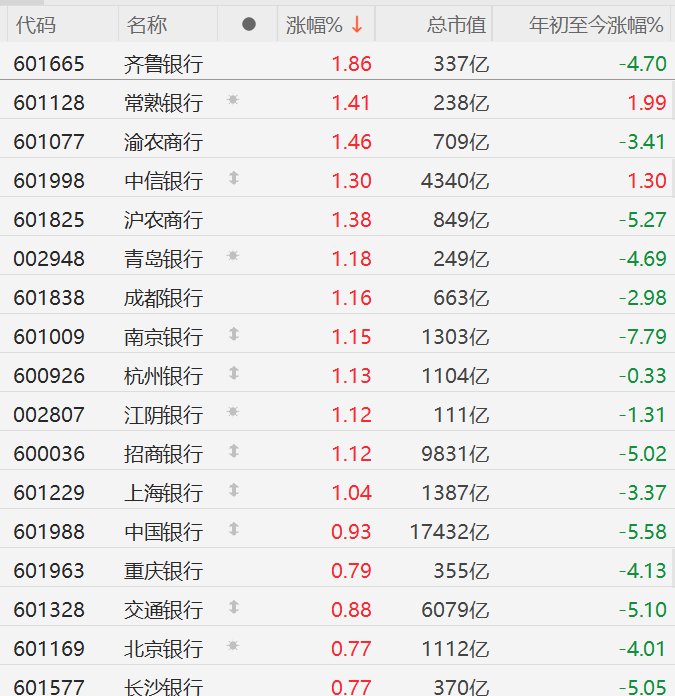
银行股逆势普涨,齐鲁银行涨近2%
Ge Long Hui· 2026-01-20 03:06
Group 1 - The A-share market saw a significant increase in bank stocks, with Qilu Bank rising nearly 2% and several other banks, including Changshu Bank and Chongqing Rural Commercial Bank, increasing by over 1% [1] - The total market capitalization of Qilu Bank is 33.7 billion, while Changshu Bank has a market cap of 23.8 billion [2] - Year-to-date performance shows that Qilu Bank has decreased by 4.70%, while Changshu Bank has increased by 1.99% [2] Group 2 - Other banks that experienced gains include Yunnan Rural Commercial Bank (1.46%), CITIC Bank (1.30%), and Shanghai Bank (1.04%) [2] - The total market capitalization of CITIC Bank is 434 billion, and it has a year-to-date performance of 1.30% [2] - Despite the gains, many banks still show negative year-to-date performance, such as Shanghai Bank (-3.37%) and China Bank (-5.58%) [2]



银行资负跟踪20260119:降准降息还有空间
GF SECURITIES· 2026-01-19 04:26
Investment Rating - The industry investment rating is "Buy" [3] Core Viewpoints - The report indicates that there is still room for further cuts in reserve requirement ratios and interest rates, with a focus on structural monetary policy support for high-quality economic development [15][19] - The central bank has implemented a reduction of 0.25 percentage points in various structural monetary policy tool rates, signaling a supportive monetary policy stance [15][19] - The report emphasizes the importance of timing for future policy implementations, particularly in relation to government bond issuance peaks and the maturity schedule of high-interest bank deposits [15] Summary by Sections 1. Monetary Policy Adjustments - The report notes a reduction of 0.25 percentage points in structural monetary policy tool rates, with a focus on supporting key areas through increased re-lending [15] - Future attention is directed towards December economic data and January LPR [22] 2. Central Bank Dynamics and Market Rates - The central bank conducted a total of 9,515 billion yuan in 7-day reverse repos at an interest rate of 1.40%, with a net injection of 9,741 billion yuan [16] - The report highlights that the funding rates remained stable, with expectations of slight increases due to tax payments and government bond net repayments [16] 3. Bank Financing Tracking - The report indicates that the total outstanding amount of interbank certificates of deposit (CDs) is 19.09 trillion yuan, with an average issuance rate of 1.65% [20] - The report also notes that there were no commercial bank bond issuances during the period, with a total outstanding commercial bank bond size of 3.38 trillion yuan [20]

负债端稳定,存单提价换量压力不大:存单周报(0112-0118)-20260118
Huachuang Securities· 2026-01-18 14:06
1. Report Industry Investment Rating No information provided in the content. 2. Core View of the Report - The pressure on CDs to "increase prices for volume" is relatively controllable, and there's no need to overly worry about banks' liability - side. Despite a significant increase in CD maturities this week and short - term fluctuations in capital prices, CDs did not "increase prices for volume", indicating a strong continuation of long - term bank deposits after maturity. The current capital frictions are mainly short - term, such as new share subscriptions on the Beijing Stock Exchange and delayed reverse repurchase placements. The central bank actively smoothed out capital fluctuations, and CDs are expected to fluctuate around 1.65% with limited price - increasing pressure [2][46]. 3. Summary According to the Table of Contents Supply: Net financing declines, and the term structure lengthens - This week (January 12 - January 18), CD issuance was 553.58 billion yuan, with a net financing of - 254.88 billion yuan (compared to - 153.30 billion yuan from January 5 - January 11). The issuance proportion of state - owned banks decreased from 19% to 18%, while that of joint - stock banks increased from 11% to 14%, city commercial banks from 44% to 57%, and rural commercial banks from 7% to 9%. The 1M CD issuance proportion dropped from 26% to 8%, while the 3M, 6M, and 9M proportions increased. The weighted issuance term of CDs lengthened to 7.70 months (previously 7.45 months) [2][5]. - Next week (January 19 - January 25), the maturity scale will decline to 681.57 billion yuan, a weekly reduction of 123.80 billion yuan. Maturities are mainly concentrated in state - owned, joint - stock, and city commercial banks. In terms of term, the 3M, 6M, and 1Y CDs have higher maturity amounts, at 163.34 billion yuan, 174.02 billion yuan, and 266.28 billion yuan respectively [2][5]. Demand: Small and medium - sized banks and insurance companies are the main secondary - market allocators, and the primary - market subscription rates vary - In the secondary market, large - scale banks had a net purchase of 26.76 billion yuan this week, small and medium - sized banks had a net purchase of 97.621 billion yuan, wealth management shifted from a net sale of 2.412 billion yuan to a net purchase of 10.777 billion yuan, and money market funds' net sales increased from 57.166 billion yuan to 137.391 billion yuan [2][14]. - In the primary market, the overall market subscription rate (15DMA) decreased from 88% to 87%. Among different institutions, the subscription rate of city commercial banks increased from 81% to 82%, that of joint - stock banks decreased from 89% to 84%, and that of state - owned banks remained at 91% [2][14]. Valuation: The primary - market pricing of CDs shows a divergent trend, and most of the secondary - market pricing declines - In primary - market pricing, the weighted issuance rate of 1Y state - owned bank CDs remained around 1.62%. Specifically, the 1M variety decreased by 9bp, the 3M increased by 3bp, the 6M increased by 1bp, and the 9M and 1Y remained unchanged. The 1Y - 3M term spread of joint - stock banks decreased by 5bp, at the 9% historical quantile. The 1Y credit spread between city commercial banks and joint - stock banks widened from 8.88BP to 9.46BP, at around the 12% quantile, while that between rural commercial banks and joint - stock banks narrowed from 16.17BP to 7.33BP, also around the 12% quantile [2][17]. - In secondary - market yields, most yields of AAA - rated CDs declined. The 1M, 6M, 9M, and 1Y varieties each decreased by 1BP compared to last week, the 3M remained unchanged, and the 1Y remained at the 2% historical quantile since 2019. The 1Y - 3M term spread of AAA - rated CDs remained at the 11% historical quantile [2][29]. Comparison: The spread between CDs and treasury bonds widens - The spread between the 1Y AAA - rated CD yield and the DR007:15DMA capital spread narrowed from 12.32BP to 8.91BP, and the spread with the R007:15DMA capital spread narrowed from 1.56BP to - 0.52BP. The 1Y treasury bond yield decreased by 4.63BP, and the spread between CDs and treasury bonds widened from 34.38BP to 38.26BP, with the quantile rising to around 39%. The spread between CDs and China Development Bank bonds narrowed from 5.46BP to 3.08BP, with the quantile dropping to around 2%. Additionally, the spread between AAA medium - and short - term commercial paper and CDs widened from 6.13BP to 7.36BP, with the quantile rising to around 34% [2][34].