
SHCI(601225)

Search documents
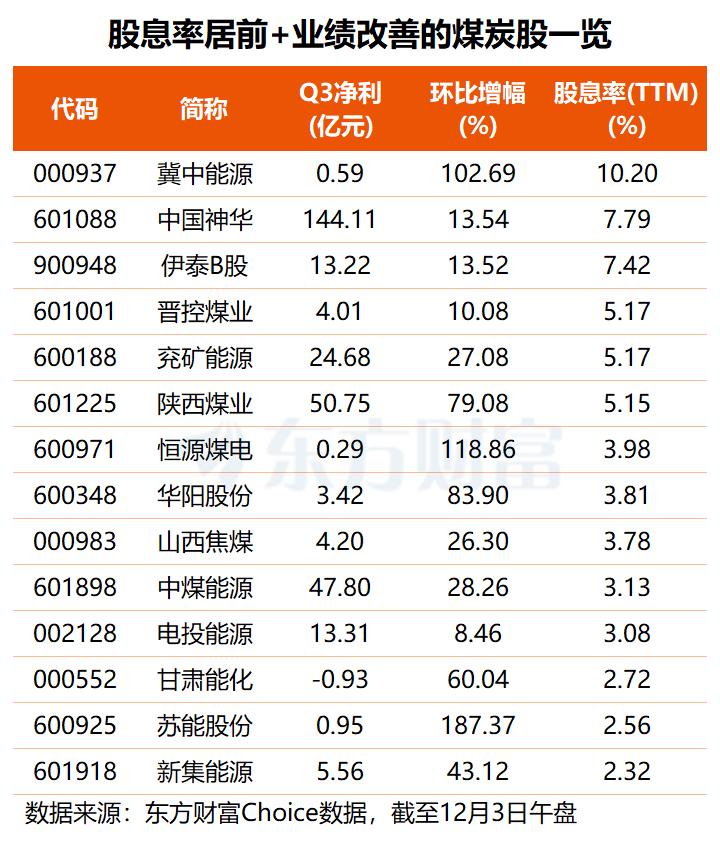
煤炭板块业绩改善+高股息名单揭晓
2 1 Shi Ji Jing Ji Bao Dao· 2025-12-17 23:29
Core Viewpoint - The coal prices have risen unexpectedly since the fourth quarter, with October thermal power generation increasing by 7.3% year-on-year, and inventory levels remaining lower than the same period last year, indicating a strong demand outlook for the coal sector into 2026 [1] Group 1: Industry Outlook - The coal price is expected to maintain a steady yet strong trend towards the end of the year and into 2026, driven by seasonal demand increases starting from late November [1] - The coal industry is entering a "dividend + cycle" phase, with high-quality coal companies benefiting from resource endowments and cost advantages, leading to robust profitability and high cash flow [1] - The anticipated exit of over 100 million tons of pre-approved production capacity by 2026 will lead to a contraction in domestic supply, while demand for thermal coal is expected to rebound [1] Group 2: Investment Strategy - Investment strategies suggested by Zhongtai Securities include focusing on high-dividend, low-valuation coal stocks, particularly those with strong dividend attributes [1] - Companies with growth in production capacity and significant profit elasticity should be prioritized, especially those showing resonance between alpha and beta [1] - Attention should be given to coking coal stocks that are expected to reverse from difficulties, as coal prices stabilize and profitability improves [1] Group 3: Performance Metrics - Among coal stocks, 22 have a dividend yield (TTM) exceeding 2%, with Jizhong Energy leading at 10.20%, followed by China Shenhua and Pingmei Shenma, both above 7% [1] - Despite a decline in performance for most coal stocks in the first three quarters, 14 stocks showed a quarter-on-quarter net profit increase in Q3, with SuNeng Co. nearly doubling its net profit [2][3] - Notable performers in Q3 include Jizhong Energy with a net profit of 0.59 billion and a 102.69% increase, and China Shenhua with a net profit of 144.11 billion and a 13.54% increase [3]




陕煤集团在全省科技工作者创新创业大赛中获多个奖项
Xin Lang Cai Jing· 2025-12-17 14:19
(来源:陕煤集团) 近日,由陕西省科学技术协会、省发展改革委等多部门联合主办的2025年陕西省科技工作者创新创业大赛圆满落幕。陕煤集团所属企业主导和参与的14项 创新项目获奖,陕煤集团科技信息部获评优秀组织单位。 此次获奖项目涵盖煤炭开采、化工新材料等多个领域,其中,小保当矿业"5-6m煤层大采高工作面年产20Mt柔性生产系统"获一等奖,技术研究院"液态电 石掺配除尘灰定制球团原位反应增产电石新技术"等4个项目获二等奖,榆林化学"新能源制氢耦合可降解材料原料制备技术开发"等9个项目获三等奖,彰 显了集团在核心技术领域的创新实力。 近年来,陕煤集团始终把科技创新工作放在高质量发展全局的核心位置,在煤炭、电力、化工等产业中深化技术革新与模式创新,突破关键核心技术壁 垒,推动产业体系向智能化、高端化、绿色化转型。通过构建以企业为主导的"产学研用"协同创新体系,打造科研攻关"研发—中试—工业化"全生命周期 闭环机制,形成"研究院出技术、产业基地做转化"高效协同模式,加速技术成果从实验室走向生产线、从样品变成产品。在高端聚烯烃、煤焦油基航空航 天油品、高强高模碳纤维等领域,突破多项"卡脖子"技术。同时,以"赛马机制"培 ...



陕西煤业:12月16日召开董事会会议
Mei Ri Jing Ji Xin Wen· 2025-12-17 09:29
Group 1 - The company, Shaanxi Coal and Chemical Industry Co., Ltd. (SH 601225), announced the convening of its fourth fifth board meeting via telecommunication on December 16, 2025, to review the proposal for appointing a new deputy general manager [1] - For the first half of 2025, the company's revenue composition is as follows: coal mining accounts for 87.68%, electricity for 8.69%, others for 3.26%, and railway transportation for 0.37% [1] - As of the report date, the market capitalization of Shaanxi Coal is 207.2 billion yuan [1]
陕西煤业(601225) - 陕西煤业股份有限公司四届五次董事会决议公告
2025-12-17 08:15
证券代码:601225 证券简称:陕西煤业 公告编号: 2025-044 陕西煤业股份有限公司 第四届董事会第五次会议决议公告 本公司董事会及全体董事保证本公告内容不存在任何虚假记载、误导性陈述 或者重大遗漏,并对其内容的真实性、准确性和完整性承担法律责任。 一、董事会会议召开情况 陕西煤业股份有限公司(以下简称"公司")第四届董事会第五次会议通知于 2025 年 12 月 10 日以书面方式送达,会议于 2025 年 12 月 16 日以通讯表决方式召开。会 议应参加表决的董事 7 名,实际表决的董事 7 名。本次会议的召开程序及出席董事人 数符合《中华人民共和国公司法》等法律、法规和公司《章程》的规定。 二、董事会会议审议情况 经与会董事一致同意,会议形成决议如下: 1、通过《关于聘任公司副总经理的议案》。 同意聘任乔少波先生担任公司副总经理,任期自本次董事会审议通过之日起至第 四届董事会届满之日止。 赞成票:7 票,反对票:0 票,弃权票:0 票。 本议案已经提名委员会审议通过。 赞成票:7 票,反对票:0 票,弃权票:0 票。 2、通过《关于制定公司经理层成员 2025 年度目标责任书的议案》。 同意 ...
煤炭开采行业11月数据全面解读:生产、进口继续回落,11月煤价上行
Guohai Securities· 2025-12-16 11:15
Investment Rating - The report maintains a "Recommended" rating for the coal mining industry [1] Core Insights - The coal mining industry is experiencing a mixed supply and demand scenario, with production and imports declining, while coal prices are on the rise due to seasonal demand and supply constraints [14][21] - The report highlights the resilience of major coal companies, emphasizing their strong cash flow and profitability, which positions them well for future growth despite market fluctuations [14] Supply Side Summary - Coal production in November 2025 was 430 million tons, a year-on-year decrease of 0.5%, but the decline was less severe than in October [20][21] - Coal imports fell by 19.87% year-on-year in November, with a total of 44.05 million tons imported, reflecting supply chain disruptions and high base effects from the previous year [9][28] - Overall coal supply in November showed a year-on-year decline of 2.3%, but the rate of decline narrowed compared to October [28] Demand Side Summary - The demand for coal is being negatively impacted by a 4.2% year-on-year decline in thermal power generation in November, contrasting with a 7.3% increase in October [10][29] - Chemical and metallurgical sectors are showing positive contributions to coal consumption, with chemical industry coal usage increasing by 8.22% year-on-year [12][41] Inventory Summary - Power plants are replenishing their coal inventories, with significant increases noted in November, while upstream coal inventories remain low [13][14] - The inventory levels for coking coal are also rising but are still considered low overall [13] Price Summary - The average price of thermal coal at northern ports rose to 822 RMB per ton in November, reflecting a month-on-month increase of 10% [13] - The report anticipates that coal prices may stabilize due to seasonal demand and supply adjustments, despite the ongoing fluctuations [14] Investment Recommendations - The report suggests focusing on robust coal companies such as China Shenhua, Shaanxi Coal and Chemical Industry, and others, which are expected to perform well in the current market environment [15][14] - It highlights the investment value of coal stocks due to their high dividends and cash flow characteristics, recommending a strategic approach to investing in the sector [14]




海通国际:AI缺电瓶颈日益突出 关注全球能源格局下煤炭资产价
智通财经网· 2025-12-16 06:19
Group 1 - The core viewpoint is that domestic coal prices have shifted from an upward trend to a rational decline since November, with future price stability dependent on winter demand, particularly if temperatures drop unexpectedly in December and January, potentially increasing residential electricity demand and coal consumption by power plants [1] - The report suggests that the global energy landscape indicates that coal's role as a stabilizing force is unlikely to change in the short term, recommending a focus on long-term opportunities in the power sector [1] - The challenges facing the U.S. electricity system include high demand driven by AI and extreme weather, which complicates the goals of decarbonization, reliability, and cost efficiency, creating a "trilemma" that may require a shift away from decarbonization to meet reliability and cost demands [1] Group 2 - As of December 12, 2025, the price of Q5500 coal at Huanghua Port is 763 RMB/ton, down 38 RMB/ton (-4.7%) from the previous week, with domestic supply stable and imports continuing to decline [2] - The price of main coking coal at Jingtang Port remains stable at 1650 RMB/ton, with expectations for improved demand despite the seasonal downturn [3] - The total inventory of coking coal across three ports is 3.01 million tons, with a utilization rate of 73.16% for coking enterprises with inventories over 200,000 tons [4] Group 3 - The report recommends focusing on key companies in the sector, including China Shenhua Energy (601088.SH, 01088), Shaanxi Coal and Chemical Industry (601225.SH), and China Coal Energy (601898.SH, 01898), while also keeping an eye on Yanzhou Coal Mining (600188.SH, 01171) and Jinneng Holding [5]
海通国际证券行业跟踪报告
Haitong Securities International· 2025-12-15 10:04
Investment Rating - The report maintains a positive investment outlook on the coal sector, recommending a focus on key players such as China Shenhua Energy, Shaanxi Coal and Chemical Industry, and China Coal Energy, while also keeping an eye on Yanzhou Coal Mining and Jinneng Holding [3][4]. Core Insights - The coal sector has reached a cyclical bottom in Q2 2025, with a reversal in supply-demand dynamics and sufficient release of downward risks [1]. - Coal prices have recently entered a rational decline after a period of increase, with future price stability dependent on winter demand [3][4]. - The report highlights the ongoing global energy challenges, particularly in the U.S., where electricity supply issues are exacerbated by rising demand driven by AI and extreme weather [3][4]. Summary by Sections Coal Price Tracking - As of December 12, 2025, the price of Q5500 coal at Huanghua Port is 763 RMB/ton, down 38 RMB/ton (-4.7%) from the previous week [5][6]. - The price of Q5000 coal at Huanghua Port is 662 RMB/ton, down 39 RMB/ton (-5.6%) [5][6]. - Inventory levels have increased across major ports, with Qinhuangdao's inventory rising to 7.3 million tons, up 480,000 tons (7.0%) [19][20]. Coking Coal Data Tracking - The price of main coking coal at Jingtang Port remains stable at 1650 RMB/ton, while other grades have seen slight declines [36]. - The average price of primary metallurgical coke at major domestic ports is 1686 RMB/ton, down 55 RMB/ton (-3.2%) [61]. Global Coal Market Dynamics - The offshore price of Newcastle Q5500 coal has decreased by 8 USD/ton (-8.8%), making domestic coal more cost-effective compared to imports [15][22]. - The report notes that Australian coking coal prices have increased by 3 USD/ton (1.4%), while costs for domestic coking coal remain lower than imported options [47]. Long-term Contracts and Pricing Trends - The annual long-term contract price for Q5500 coal at Northern Ports has increased to 694 RMB/ton, up 10 RMB/ton (1.5%) from the previous month [26]. - The comprehensive trading price for Q5500 coal in Qinhuangdao is 709 RMB/ton, down 6 RMB/ton (-0.8%) from the previous week [38].
煤炭开采行业2026年度策略报告:行政策发力稳定市场,煤价走出底部回归合理区间-20251215
CMS· 2025-12-15 09:33
Core Insights - The report maintains a "recommended" investment rating for the coal mining industry, highlighting a tightening supply and expected demand release during winter, which is anticipated to stabilize coal prices within a reasonable range [1][2]. Policy Impact - The 2025 coal industry policies focus on "ensuring supply and stabilizing prices" and "controlling production and improving quality," with measures to enhance supply resilience and promote industry transformation towards carbon neutrality [6][11]. - The implementation of the overproduction inspection policy in July 2025 aims to curb excessive competition and stabilize coal prices, which had been under pressure earlier in the year [12][11]. Supply and Demand Analysis - For thermal coal, supply is expected to contract while demand is projected to grow, with coal production growth slowing down and imports anticipated to decline by about 10% in 2025 [6][35]. - The demand for thermal coal is expected to remain stable, supported by a potential cold winter and increased electricity consumption during peak seasons [38][39]. Price Dynamics - The report indicates that the price of thermal coal is likely to recover due to a combination of supply constraints and seasonal demand increases, with the price expected to rise from approximately 620 CNY/ton in July 2025 to around 820 CNY/ton by November 2025 [18][6]. Coking Coal Outlook - Coking coal, being a scarce resource, is expected to see limited supply growth, but demand may rebound due to recovery in the real estate and infrastructure sectors, which could stimulate steel production and, consequently, coking coal consumption [6][42]. - The report emphasizes that coking coal prices are more elastic and could see significant growth potential in response to demand recovery [6][7]. Investment Strategy - The coal sector is viewed as having long-term investment value, driven by both dividend and cyclical factors, with recommendations to focus on leading companies with strong dividend yields and potential for growth [7][6]. - Key companies to watch include China Shenhua and Shaanxi Coal and Chemical Industry for stable dividends, and Yanzhou Coal Mining, Lu'an Environmental Energy, and Huaibei Mining for their market-driven growth potential [7][6].
国海证券晨会纪要-20251215
Guohai Securities· 2025-12-15 06:59
Group 1 - The report discusses the high volatility of Japanese government bonds (JGBs) due to a shift in monetary policy and concerns over long-term debt sustainability, leading to a rapid increase in JGB yields since early 2024 [3][4] - The report highlights the divergence between the rising JGB yields and the depreciation of the Japanese yen, attributing this to market concerns over fiscal health and capital outflows driven by trade agreements [3][4] - The outlook suggests continued upward pressure on JGB yields, while the divergence between the yen and interest rate differentials may not persist long-term, potentially leading to yen appreciation as market concerns ease [4] Group 2 - The Central Economic Work Conference emphasized the importance of a proactive fiscal policy, maintaining a fiscal deficit around 4% for 2025, which is higher than previous years, to support economic stability [5][8][9] - The report indicates that China's government debt ratio remains significantly lower than that of major economies, providing ample fiscal space for expansionary policies [8][9] - The focus on optimizing fiscal expenditure structure aims to transition from production-oriented to welfare-oriented spending, with significant allocations for education, social security, and healthcare [10] Group 3 - The report outlines the commitment to expanding domestic demand as a primary driver of economic growth, with a focus on increasing consumption and investment to stabilize the economy [13][14] - It highlights the need to boost consumer spending, noting that the contribution of final consumption to GDP growth was 53.5% in the first three quarters of 2025 [14][15] - The investment strategy includes increasing central budget investments and optimizing local government special bond usage to stimulate effective investment [15][26] Group 4 - The report discusses the establishment of a unified national market to combat "involution" in competition, emphasizing the need for standardized regulations and improved resource allocation [16][17] - It notes the progress in reducing logistics costs and increasing inter-provincial trade, indicating a move towards a more integrated market [16][17] - The focus on creating a competitive market order aims to enhance efficiency and support high-quality development across various industries [17] Group 5 - The chemical industry is identified as entering a favorable phase driven by global supply dynamics and increasing demand for AI technologies [30][31] - The report lists key players in various segments of the chemical industry, including gas turbines, refrigerants, and energy storage, highlighting potential investment opportunities [31][32] - It emphasizes the importance of value-driven strategies in the chemical sector, with a focus on enhancing dividend yields and addressing supply-side challenges [32] Group 6 - The report on credit bonds indicates a need for strategies that focus on attracting incremental funds and adapting to market conditions, with a recommendation for short-term and mid-to-long-term strategies [34][35] - It highlights the ongoing challenges in the municipal bond market, suggesting a cautious approach to investment in lower-rated bonds while seeking opportunities in higher-quality assets [36] - The financial bond market is expected to face limited supply pressures, with a focus on maintaining asset quality amid changing market dynamics [37] Group 7 - The report on social financing data indicates a stable growth rate in loans, primarily driven by corporate lending, while consumer borrowing remains cautious [38][39] - It notes a significant increase in direct financing, reflecting a positive trend in market development, despite a decline in household leverage [39][40] - The overall financial environment suggests continued support for fiscal and monetary policies to sustain economic growth [39]


煤炭行业周报:AI缺电瓶颈日益突出,关注全球能源格局下煤炭资产价值重估-20251215
GUOTAI HAITONG SECURITIES· 2025-12-15 02:17
Investment Rating - The report rates the coal industry as "Overweight" [4]. Core Insights - The coal sector has confirmed a cyclical bottom in Q2 2025, with supply-demand dynamics showing a reversal point and downward risks fully released [2]. - The report emphasizes the importance of winter demand in determining future coal prices, especially if temperatures drop unexpectedly in December and January, potentially increasing residential electricity demand and coal consumption by power plants [4]. - The report highlights the ongoing challenges in the U.S. power system, particularly the "impossible trinity" of decarbonization goals, grid reliability, and the cost-speed requirements of AI data centers, suggesting that the U.S. may need to abandon its decarbonization targets to meet these demands [4]. Summary by Sections Investment Recommendations - The report continues to recommend core dividend stocks such as China Shenhua, Shaanxi Coal, and China Coal Energy, along with Yanzhou Coal and Jinneng Holding [4]. Coal Price Trends - As of December 12, 2025, the price of Q5500 coal at Huanghua Port is 763 RMB/ton, down 38 RMB/ton (-4.7%) from the previous week [7]. - Domestic coal prices have entered a rational decline phase since November, with a focus on whether winter demand can exceed expectations [4]. Supply and Demand Analysis - Domestic supply remains stable, with imports continuing to decrease; total supply is expected to maintain a stable decline throughout the year [4]. - The report notes that the average price of metallurgical coke at major domestic ports has decreased, with the price of primary metallurgical coke at 1686 RMB/ton, down 55 RMB/ton (-3.2%) [58]. Inventory Levels - As of December 12, 2025, Qinhuangdao's coal inventory has increased by 48,000 tons (7.0%), with total inventory at major northern ports rising by 201,200 tons (5.8%) [22]. - The report indicates that the total inventory of coking coal at three major ports is 3.01 million tons, up 11,000 tons (3.8%) from the previous week [57]. Market Tracking - The report tracks coal price declines across various ports, with significant drops noted at Huanghua, Jiangsu, and Ningbo ports [7][9]. - The report also highlights that the average price of Australian coking coal has increased by 3 USD/ton (1.4%), while domestic coking coal remains cheaper than imported options [46].