GWMOTOR(601633)

Search documents
长城汽车(02333) - 调整2023年限制性股票激励计划、2023年股票期权激励计划及2023年...
2026-01-14 09:28
長城汽車股份有限公司 GREAT WALL MOTOR COMPANY LIMITED* 此乃要件 請即處理 香港交易及結算所有限公司及香港聯合交易所有限公司對本通函的內容概不負責,對其準確性或完整性亦 無發表任何聲明,並明確表示,概不就本通函全部或任何部分內容而產生或因倚賴該等內容而引致的任何 損失承擔任何責任。 閣下如對本通函任何內容或應採取的行動有任何疑問,應諮詢 閣下的股票經紀或其他註冊證券商、銀行 經理、律師、專業會計師或其他專業顧問。 閣下如已售出或轉讓名下所有長城汽車股份有限公司的股份,應立即將本通函及隨附之代表委任表格送交 買主或承讓人,或經手買賣或轉讓的銀行、股票經紀或其他代理人,以便轉交買主或承讓人。 (於中華人民共和國註冊成立的股份有限公司) 股份代號:02333(港幣櫃台)及82333(人民幣櫃台) 調整2023年限制性股票激勵計劃、 2023年股票期權激勵計劃 及 2023年第二期員工持股計劃業績考核目標 及 股東特別大會與H股股東類別 股東大會通告 本公司謹訂於2026年3月6日(星期五)下午2時正、3時正、4時正假座中國河北省保定市蓮池區朝陽南大 街2266號本公司會議室分別舉行 ...
2025年我国新能源汽车出口达261.5万辆,出口规模再上新台阶
Xin Lang Cai Jing· 2026-01-14 07:19
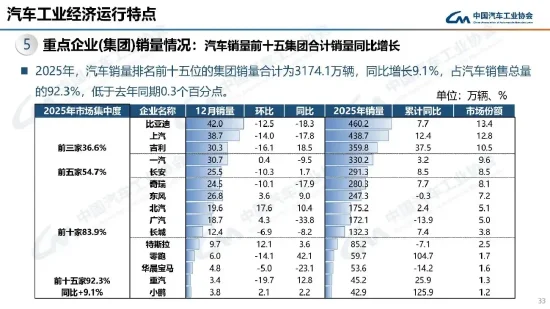
Core Insights - The Chinese automotive industry is projected to achieve record production and sales figures of 34.53 million and 34.40 million vehicles respectively in December 2025, maintaining its position as the world's largest market for 17 consecutive years [1][4]. Group 1: Market Performance - The passenger vehicle market is experiencing steady growth, significantly contributing to the overall automotive market expansion [5]. - The commercial vehicle market is recovering, with production and sales increasing by over 10%, surpassing 4 million units [5]. - New energy vehicles (NEVs) are leading the market, with production and sales exceeding 16 million units, accounting for over 50% of domestic new car sales [5]. Group 2: Export and Trade - The automotive export market shows strong resilience, with total exports exceeding 7 million vehicles, including 2.615 million NEVs, marking a new high in export scale [5]. Group 3: Market Concentration - The top fifteen automotive groups sold a total of 31.741 million vehicles, reflecting a year-on-year growth of 9.1%, which constitutes 92.3% of total vehicle sales, slightly down by 0.3 percentage points from the previous year [5][7]. - The top three groups, BYD, SAIC, and Geely, accounted for 36.6% of total vehicle sales [5][7]. - In the NEV segment, the top fifteen groups sold 15.669 million units, a year-on-year increase of 29.2%, representing 95% of total NEV sales, up by 0.7 percentage points from the previous year [5][7].






汽车ETF(516110)涨超0.9%,竞争策略变化或推动行业“价升量稳”
Mei Ri Jing Ji Xin Wen· 2026-01-14 06:16
Group 1 - The demand for long-range PHEVs priced below 200,000 yuan is expected to continue increasing, driven by new model releases from companies like BYD, Geely, Great Wall, and Chery, with battery capacities generally ranging from 25-30 kWh [1] - The Ministry of Industry and Information Technology requires plug-in hybrid electric vehicles to have an electric-only range of at least 100 kilometers to qualify for tax exemptions, which may further stimulate demand [1] - The sales proportion of long-range versions, such as BYD's Qin PLUS DMi, has increased quarter-on-quarter, as these models effectively reduce the frequency of charging for users [1] Group 2 - The automotive ETF (516110) tracks the 800 Automotive Index (H30015), which selects listed companies involved in automotive manufacturing and related industries, reflecting the overall performance of the Chinese automotive sector [1] - The index balances growth and value styles, providing a high level of industry representation [1] - In response to rising raw material costs and competitive pressures, automakers are expected to adopt a strategy of "enhanced features with price increases," which may lead to a stable volume despite price increases in the industry [1]


新能源汽车2026前瞻,“量变”到“质变”的分水岭
3 6 Ke· 2026-01-13 11:31
Core Insights - The Chinese electric vehicle (EV) industry is set to become mainstream by 2025, with retail penetration rates expected to exceed 60% by year-end, marking a significant shift from being an alternative option to a market leader [2][4] - Domestic brands like BYD and Geely are solidifying their positions, while new entrants are facing intense competition and differentiation [2][6] - The focus for 2026 will shift from market share expansion to value redefinition within the industry [3] Market Penetration - In the first eleven months of 2025, the production and sales of new energy vehicles (NEVs) in China saw a year-on-year increase of over 30%, with NEV sales accounting for 47.5% of total vehicle sales [4] - December is projected to see NEV retail sales reach 1.38 million units, with penetration rates likely to surpass 60% for the first time [4] - Domestic brands dominate the market, with a retail penetration rate of 79.6% for NEVs in November, far outpacing mainstream joint venture brands at 6.8% [4] Company Strategies and Challenges - BYD aims to expand its "smart driving equality" initiative, while facing challenges in balancing scale expansion with profit and quality [5] - Geely's strategy is showing results with a 60.5% NEV penetration rate, but it needs to build a "second growth curve" for overseas market presence [5] - Chery leads in overseas markets but must accelerate its domestic NEV transformation and smart technology integration [5] - New forces like Leap Motor are experiencing rapid growth, while Li Auto faces challenges due to product controversies and performance declines [6] Technological Advancements and Globalization - The "universal smart driving" concept is becoming a reality, with BYD's advanced driving assistance systems becoming more affordable [8] - The global expansion of Chinese EVs is evolving from simple product exports to establishing local manufacturing and supply chains in markets like Thailand [9] - The industry is witnessing a shift towards integrating technology and manufacturing, with companies like Chery and Seres successfully navigating the capital markets [10] Industry Restructuring and Future Directions - The industry is transitioning from a financing and expansion model to one focused on technology depth, profitability, and ecological value [10] - State-owned capital is evolving from a supportive role to an active industry integrator, aiming to stabilize the market and promote long-term R&D [11] - The automotive value chain is shifting towards a focus on electronic architecture, software, and services, with tech giants redefining the automotive experience [11] Challenges and Future Outlook - Structural challenges in the supply chain are emerging, with cost pressures affecting relationships with suppliers, particularly smaller firms [12] - Marketing practices that mislead consumers could damage long-term brand trust, highlighting the need for integrity in communications [12] - The industry must build resilient supply chains, drive technological innovation, and transition to localized ecosystems to sustain growth [13][14] - The competition is entering a new phase where success will depend on defining next-generation technology standards and achieving sustainable business models [15]


四大板块齐头并进——车企2025产销快报解析
Zhong Guo Qi Che Bao Wang· 2026-01-13 09:43
Core Insights - The Chinese passenger car market is projected to retail 23.78 million units in 2025, reflecting a 4% year-on-year growth, supported by policies like "trade-in" [2] - Major domestic automakers such as BYD, Geely, Changan, and Leap Motor have achieved significant progress, while several joint venture companies are showing signs of recovery in China [2] Domestic Automakers Performance - BYD achieved a record annual sales of 4.60 million units in 2025, a 7.73% increase, with pure electric vehicle sales reaching 2.25 million units, up 27.85%, surpassing Tesla in global sales [3] - SAIC Group sold 4.51 million vehicles in 2025, a 12.3% increase, with its new energy vehicle sales growing by 33.1% to 1.64 million units [3] - China FAW's total vehicle sales reached 3.30 million units, a 3.2% increase, with its new energy vehicle sales soaring by 71% to 366,000 units [4] - Geely's total sales reached 3.02 million units, a 39% increase, with new energy vehicle sales hitting 1.69 million units, up 90% [4] - Changan's sales reached 2.91 million units, an 8.5% increase, with new energy vehicle sales growing by 51% to 1.11 million units [5] - Chery Group achieved a record high of 2.81 million units sold, with new energy vehicle sales increasing by 54.9% to 903,800 units [5] Joint Venture Automakers Performance - Joint venture automakers are under pressure but some have found ways to adapt, with FAW-Volkswagen leading in sales with 1.59 million units sold [7] - SAIC Volkswagen achieved sales of 1.06 million units, maintaining a strong position in the market [8] - Toyota's joint ventures in China reported positive growth, with FAW Toyota selling 805,500 units, a 3-year consecutive growth [8] New Energy Vehicle Market - New energy vehicles are a common highlight across major domestic automakers, with significant growth in sales and market penetration [3][4][5] - New entrants like Leap Motor and NIO are also showing strong growth, with Leap Motor achieving 596,600 units sold, a 103% increase [10] - Xpeng Motors delivered 429,400 units, a 126% increase, while NIO delivered 326,000 units, a 46.9% increase [11] Export Growth - China's automobile exports are expected to exceed 7 million units in 2025, marking a historic high [13] - Chery led the export of Chinese passenger cars with 1.34 million units, a 17.4% increase [13] - BYD's overseas sales surpassed 1 million units, a 145% increase, with significant growth in Europe [14] - New energy vehicle exports are also on the rise, with companies like Leap and Xpeng expanding their international presence [16]



乘用车板块1月13日跌0.71%,海马汽车领跌,主力资金净流出6.24亿元
Zheng Xing Xing Ye Ri Bao· 2026-01-13 08:56
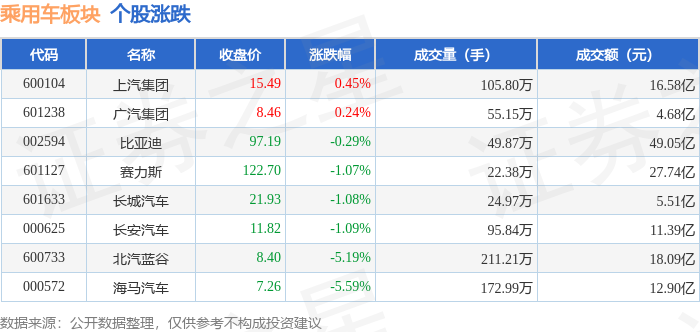
Market Overview - The passenger car sector experienced a decline of 0.71% on January 13, with Haima Automobile leading the drop [1] - The Shanghai Composite Index closed at 4138.76, down 0.64%, while the Shenzhen Component Index closed at 14169.4, down 1.37% [1] Individual Stock Performance - SAIC Motor Corporation (600104) closed at 15.49, up 0.45% with a trading volume of 1.058 million shares and a turnover of 1.658 billion yuan [1] - GAC Group (601238) closed at 8.46, up 0.24% with a trading volume of 551,500 shares and a turnover of 468 million yuan [1] - BYD (002594) closed at 97.19, down 0.29% with a trading volume of 498,700 shares and a turnover of 4.905 billion yuan [1] - Seres (601127) closed at 122.70, down 1.07% with a trading volume of 223,800 shares and a turnover of 2.774 billion yuan [1] - Great Wall Motors (601633) closed at 21.93, down 1.08% with a trading volume of 249,700 shares and a turnover of 551 million yuan [1] - Changan Automobile (000625) closed at 11.82, down 1.09% with a trading volume of 958,400 shares and a turnover of 1.139 billion yuan [1] - BAIC BluePark (600733) closed at 8.40, down 5.19% with a trading volume of 2.112 million shares and a turnover of 1.809 billion yuan [1] - Haima Automobile (000572) closed at 7.26, down 5.59% with a trading volume of 1.729 million shares and a turnover of 1.290 billion yuan [1] Fund Flow Analysis - The passenger car sector saw a net outflow of 624 million yuan from main funds, while retail investors contributed a net inflow of 451 million yuan [1] - The detailed fund flow for individual stocks shows: - SAIC Motor had a net inflow of 1.5 billion yuan from main funds, but a net outflow of 1.01 billion yuan from retail investors [2] - Great Wall Motors had a net inflow of 11.625 million yuan from main funds, with a net outflow of 9.9974 million yuan from retail investors [2] - GAC Group experienced a net outflow of 8.916 million yuan from main funds, with a net inflow of 440,000 yuan from retail investors [2] - BYD had a significant net outflow of 92.804 million yuan from main funds, but a net inflow of 10.8052 million yuan from retail investors [2] - Changan Automobile faced a net outflow of 1.15 billion yuan from main funds, while retail investors contributed a net inflow of 94.9543 million yuan [2] - Haima Automobile had a net outflow of 162 million yuan from main funds, but a net inflow of 143 million yuan from retail investors [2] - Seres had a net outflow of 2.02 billion yuan from main funds, with a net inflow of 178 million yuan from retail investors [2] - BAIC BluePark had a net outflow of 206 million yuan from main funds, while retail investors contributed a net inflow of 135 million yuan [2]



最前线|智能座舱开始AI变革,长城新车要标配车端智能体
3 6 Ke· 2026-01-13 07:25
Core Insights - The rapid advancement of AI capabilities is significantly enhancing intelligent driving and smart cockpit technologies, with lower application thresholds for cockpit systems due to reduced latency and computational power requirements [1] - The introduction of AI agents in vehicles is becoming a trend, with companies like Great Wall Motors leading the way by launching innovative systems that focus on interactive upgrades rather than just functional implementations [2][4] Group 1: AI Integration in Vehicles - Great Wall Motors has unveiled the ASL (Artificial Smart Language) system, which perceives the world in 3D and enhances user interaction by allowing natural language commands, evolving the relationship between humans and vehicles from simple control to conversational engagement [2][4] - The ASL1.0 system is built around intent recognition and proactive understanding, with its first models expected to launch in the first half of 2026 [3][8] - The ASL system is not merely a cockpit AI but a full-stack intelligent architecture that integrates various technological components, including user profiling and multi-modal perception [4][9] Group 2: Technological Advancements and Challenges - The ASL system requires significant engineering efforts to connect electronic architectures and support real-time inference and response across multiple scenarios, indicating a complex underlying infrastructure [4][10] - The upcoming models will utilize Qualcomm's Snapdragon 8797, providing 300 TOPS of computing power, which will increase costs but is essential for advanced AI functionalities [5][10] - The industry anticipates that the transformation towards AI agents in vehicles will take only 2-3 years to materialize, contrasting with the decade-long evolution of cockpit displays [5][12] Group 3: User Interaction and Experience - The ASL system aims to enhance user experience by shifting from a model where users actively control the vehicle to one where the vehicle anticipates and fulfills user needs automatically [12][14] - The system's design reflects a growing understanding that users prefer seamless interactions, leading to the development of proactive service capabilities that require minimal user input [12][13] - The ASL 2.0 system will cover five major intelligent scenarios, emphasizing the importance of dynamic user interfaces and natural dialogue capabilities [13][14]
魏建军做“吃播”,卢伟冰抽奖,12月企业家IP榜单发布,谁排第一?
Sou Hu Cai Jing· 2026-01-13 06:08
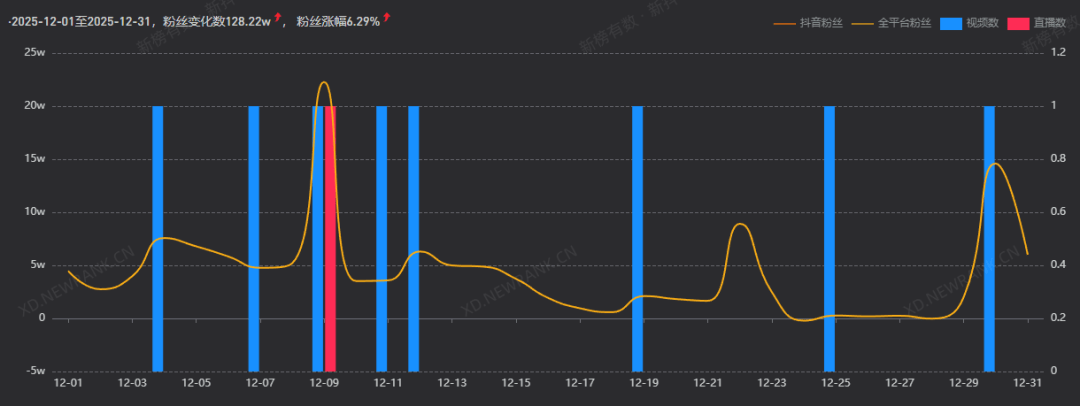
Core Insights - Entrepreneur IP has become a crucial part of corporate online promotion, with a focus on evaluating its influence through metrics such as follower count, growth, shares, comments, and likes [1] Group 1: Top Influencers - "Yu Chengdong" has maintained the top position for nine consecutive months, with 9 posts in December, receiving 863,000 likes and gaining 1.342 million followers [1] - "Wei Jianjun" ranks second, publishing 15 posts in December, accumulating 2.338 million likes and gaining 266,000 followers, rising 4 positions [2] - "Zhou Yunjie" from Haier ranks third, with 9 posts in December, receiving over 1.042 million likes and gaining 509,000 followers [8] Group 2: Content Analysis - "Yu Chengdong" focused on product highlights and live promotions, including features of Huawei products and annual live broadcasts [1] - "Wei Jianjun" shared content related to Great Wall Motors, personal life experiences, and live interactions, with significant engagement peaks on specific dates [2][4][6] - "Zhou Yunjie" emphasized brand activities, product promotions, and corporate developments, with notable follower growth linked to specific posts [8] Group 3: Engagement Metrics - "Yu Chengdong" achieved a stable follower increase over nine months, indicating consistent engagement [1] - "Wei Jianjun" experienced follower spikes on December 21, 16, and 30, driven by engaging content and live interactions [6] - "Zhou Yunjie" saw a significant follower increase on December 24, linked to a successful promotional event [8] Group 4: Emerging Influencers - "Lu Weibing" from Xiaomi rose 33 positions, publishing 22 posts in December, with 748,000 likes and 615,000 comments, the highest comment count among all entrepreneurs [10] - "Xu Fei" increased 38 positions, with 16 posts in December, receiving 475,000 likes and 169,000 comments [13]
9大车企要卖超1800万台,鸿蒙智行冲刺销量翻番,四家车企瞄准300万年销
3 6 Ke· 2026-01-13 03:03
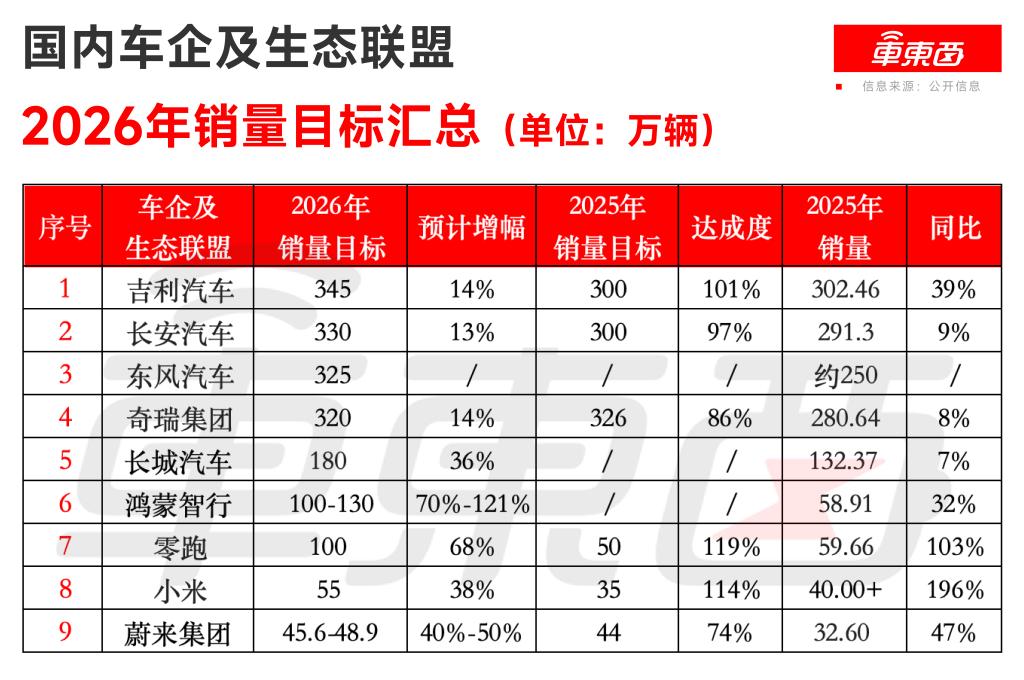
Core Viewpoint - The competition in the domestic automotive market is intensifying as major car manufacturers and alliances announce ambitious sales targets for 2026, totaling 18.339 million units, which exceeds the actual sales of 3.86 million units in 2025 [1] Group 1: New Energy Vehicle Manufacturers - New energy vehicle manufacturers such as Hongmeng Zhixing, Leap Motor, and NIO have set aggressive sales targets for 2026, with expected growth rates ranging from 40% to 121% [2][4] - Hongmeng Zhixing aims for sales between 1 to 1.3 million units, with a projected growth rate of 70%-121% [4] - Leap Motor targets 1 million units with a growth rate of 68%, while NIO's target is between 456,000 to 489,000 units, reflecting a growth of 40%-50% [2][12] - Xiaomi Auto plans to increase its sales target from 350,000 units in 2025 to 550,000 units in 2026, representing a growth of approximately 38% [8] Group 2: Traditional Automakers - Traditional automakers like Geely, Changan, and Chery have set more conservative targets, with Geely aiming for 3.45 million units, Changan for 3.3 million units, and Chery for 3.2 million units, reflecting growth rates of 14%, 13%, and 14% respectively [3][13] - Great Wall Motors plans to sell 1.8 million units in 2026, with a leading growth rate of 36% among traditional manufacturers [2][13] - Geely's target includes a significant focus on electric vehicles, aiming for 2.22 million units in 2026, up from 1.69 million in 2025, increasing its electric vehicle penetration from 56% to 64% [13][14] Group 3: Market Dynamics and Competition - The competition in the automotive market is shifting from mere scale expansion to a comprehensive contest involving technology, product offerings, and global strategies [18] - Market analysts predict that growth in the Chinese passenger car market may slow or even decline slightly in 2026, making every percentage point of growth critical and competitive [18] - The ability of companies to balance scale, profitability, and technological investment will determine their success in this increasingly fierce market [19]


乘用车2026 | 2025政策促需 2026高端发力+智能平权+出海提速
汽车琰究· 2026-01-13 00:05
Group 1 - The core viewpoint of the article emphasizes that the demand for automobiles is driven by the continuation of the trade-in policy, leading to an unexpected penetration of new energy vehicles (NEVs) and improved profitability through high-end products and overseas expansion [3][4][5][6][7][8] Group 2 - In 2025, the cumulative wholesale sales of passenger cars reached 24.119 million units, a year-on-year increase of 12.6%, with NEVs growing by 30.7% [3][8] - The penetration rate of NEVs in wholesale sales was 50.4%, up by 7.0 percentage points year-on-year, while the penetration rate for insurance reached 53.3%, an increase of 6.6 percentage points [3][46] - The share of domestic passenger cars in wholesale sales reached 69.3%, a year-on-year increase of 4.9 percentage points, with brands like Geely, Xiaomi, and Leap Motor showing significant growth [3][50] Group 3 - Looking ahead to 2026, the trade-in policy is expected to continue, supporting demand, with projected insurance sales of 22.32 million units, a decrease of 5.0% year-on-year, and wholesale sales of 30.10 million units, an increase of 1.0% [4][5] - The NEV insurance sales are expected to reach 13.8 million units, a year-on-year increase of 6.2%, while wholesale sales are projected to be 17.3 million units, up by 13.4% [4][15] Group 4 - The competitive landscape is shifting, with joint ventures declining and domestic brands accelerating their rise in the mid-to-high-end market [5][10] - In the 5-15 million price range, price-sensitive consumers are expected to drive competition, while brands like Geely, BYD, and Leap Motor are anticipated to gain higher sales growth due to their advantages in intelligence and cost-effectiveness [5][10] Group 5 - The article highlights the acceleration of intelligent driving technology, with major players like Huawei and BYD pushing for the democratization of advanced driving features [6][10] - The L3 commercial deployment is expected to gain momentum in 2026-2027, with various automakers launching new high-level driving systems and models [6][10] Group 6 - The export of passenger cars is projected to reach 6.64 million units in 2026, a year-on-year increase of 15.5%, driven by the technological advantages of domestic NEVs and the expansion of overseas manufacturing [7][11] - Companies like BYD and Geely are expected to increase their export efforts, with BYD establishing overseas factories and Geely accelerating NEV exports [7][11]