
Tuopu Group(601689)

Search documents
拓普集团股价涨6.31%,中银证券旗下1只基金重仓,持有22万股浮盈赚取103.62万元
Xin Lang Cai Jing· 2026-01-19 02:50
中银证券精选行业股票A(010892)成立日期2021年1月20日,最新规模6.07亿。今年以来收益3.42%, 同类排名3679/5579;近一年收益69.39%,同类排名538/4225;成立以来亏损36.24%。 中银证券精选行业股票A(010892)基金经理为林博程、陆莎莎。 截至发稿,林博程累计任职时间7年314天,现任基金资产总规模11.86亿元,任职期间最佳基金回报 110.75%, 任职期间最差基金回报-48.35%。 1月19日,拓普集团涨6.31%,截至发稿,报79.40元/股,成交20.74亿元,换手率1.56%,总市值1379.84 亿元。 资料显示,宁波拓普集团股份有限公司位于浙江省宁波市北仑区大碶街道育王山路268号,成立日期 2004年4月22日,上市日期2015年3月19日,公司主营业务涉及汽车零部件及配件的研发、生产和销售。 主营业务收入构成为:内饰功能件33.76%,底盘系统28.66%,减震器15.77%,汽车电子8.31%,热管理 系统7.58%,其他(补充)5.86%,电驱系统0.06%。 从基金十大重仓股角度 数据显示,中银证券旗下1只基金重仓拓普集团。中银证券精选 ...

拓普集团股价涨6.31%,光大保德信基金旗下1只基金重仓,持有62.59万股浮盈赚取294.79万元
Xin Lang Cai Jing· 2026-01-19 02:47
光大保德信智能汽车主题股票A(011104)成立日期2021年2月9日,最新规模7.71亿。今年以来收益 1.32%,同类排名4759/5579;近一年收益29.09%,同类排名2737/4225;成立以来亏损2.68%。 光大保德信智能汽车主题股票A(011104)基金经理为王明旭。 截至发稿,王明旭累计任职时间4年167天,现任基金资产总规模13.89亿元,任职期间最佳基金回报 40.16%, 任职期间最差基金回报-17.39%。 1月19日,拓普集团涨6.31%,截至发稿,报79.40元/股,成交20.48亿元,换手率1.54%,总市值1379.84 亿元。 资料显示,宁波拓普集团股份有限公司位于浙江省宁波市北仑区大碶街道育王山路268号,成立日期 2004年4月22日,上市日期2015年3月19日,公司主营业务涉及汽车零部件及配件的研发、生产和销售。 主营业务收入构成为:内饰功能件33.76%,底盘系统28.66%,减震器15.77%,汽车电子8.31%,热管理 系统7.58%,其他(补充)5.86%,电驱系统0.06%。 从基金十大重仓股角度 数据显示,光大保德信基金旗下1只基金重仓拓普集团。光大保 ...
一季度整车有望反弹,零部件聚焦新产业投资:汽车行业周报(20260112-20260118)-20260118
Huachuang Securities· 2026-01-18 12:26
Investment Rating - The report maintains a positive outlook for the automotive industry, expecting a rebound in vehicle sales in Q1 and focusing on investments in intelligent driving, robotics, and liquid cooling technologies [3]. Core Insights - The automotive sector is experiencing significant dynamics, including sales, pricing, exports, and robotics developments [2]. - The report highlights that January's early sales data shows a substantial year-on-year decline, primarily due to subsidy reductions and rising vehicle prices, leading to consumer hesitation [5]. - The report anticipates that the pressure on vehicle prices will be managed through strict enforcement of anti-competitive practices, aiming to stabilize prices and profit margins [5]. - The export market is expected to grow rapidly, supported by agreements that lower trade barriers for electric vehicles, enhancing profitability for manufacturers and dealers [5]. - The robotics sector is gaining traction, with the Optimus V3 generating market excitement and expectations for product launches [5]. Data Tracking - In early January, the average discount rate remained stable, with a 9.6% increase year-on-year, and the average discount amount reached 22,259 yuan, up by 2,192 yuan year-on-year [4]. - December's wholesale vehicle sales were reported at 2.85 million units, reflecting a year-on-year decline of 8.7% and a month-on-month decline of 6.3% [4]. - Notable sales performance in December included significant year-on-year growth for new energy vehicle manufacturers like NIO and Li Auto, while traditional automakers like SAIC and Changan showed mixed results [6]. Industry News - The report discusses various industry developments, including the price commitments for electric vehicles between China and Europe, which aim to facilitate trade [27]. - The Ministry of Industry and Information Technology is focusing on enhancing the competitiveness of the new energy vehicle sector and regulating market practices to prevent price wars [27]. - Recent data indicates a significant drop in retail sales of passenger vehicles in early January, with a 32% year-on-year decline [27]. Market Performance - The automotive sector saw a weekly increase of 0.71%, ranking 8th out of 29 sectors, while the overall market indices showed mixed results [10].





科技制造产业月报(2025年12月):奔跑的机器人,与变局的制造业-20260117
Huachuang Securities· 2026-01-17 14:01
Investment Rating - The report does not explicitly provide an investment rating for the industry Core Insights - The human-shaped robot's ability to run smoothly represents a significant technological leap from mere functionality to human-like capabilities, indicating a potential shift towards practical applications in complex environments [9][20] - The competition in the humanoid robot industry has evolved into a multi-dimensional strategic game, with different focuses across the supply chain, emphasizing the need for companies to integrate technology, establish standards, and meet real industry demands [22][30] - The future of humanoid robots hinges on overcoming five critical conditions: technological maturity, cost control, clear market positioning, infrastructure development, and societal acceptance [30][31] Summary by Sections Section 1: The Impact of Robot Running Demonstrations - The recent running demonstrations by Tesla's Optimus and Figure AI have generated significant global interest, suggesting a potential breakthrough in the commercialization of humanoid robots [5][6] - These demonstrations challenge the notion that advanced robotics can only exist in controlled environments, indicating a shift towards practical, scalable applications [31] Section 2: Technical Breakdown of Running Capabilities - Achieving running capabilities involves overcoming substantial technical challenges, including dynamic balance, rapid response times, and energy efficiency [10][19] - The transition from walking to running signifies a fundamental change in robotic capabilities, moving from static to dynamic balance, which is essential for operating in unpredictable environments [12][20] Section 3: Business Logic Behind the Demonstrations - The timing of these demonstrations reflects a strategic move by industry leaders to signal their technological advancements and readiness for market integration [32] - Both Tesla and Figure AI are pursuing different paths: Tesla aims for a universal platform while Figure AI focuses on specific industrial applications, highlighting the diverse strategies within the industry [26][30] Section 4: Industry Chain Dynamics - The competition among suppliers, manufacturers, and application developers is intensifying, with each segment vying for control over standards and market share [22][30] - The report emphasizes the importance of establishing a robust ecosystem that supports the development and deployment of humanoid robots in real-world applications [30] Section 5: Future Outlook - The next few years are critical for validating the feasibility of humanoid robots, with key indicators including commercial orders, supply chain formation, and cost reduction trends [31] - The industry is at a pivotal moment, transitioning from experimental demonstrations to practical implementations that can deliver economic value [31]




智能化迎来全球共振与产业加速,智能车ETF泰康(159720)红盘上涨1.25%,三花智控涨超6%
Xin Lang Cai Jing· 2026-01-16 06:01
Group 1 - The core viewpoint is that the smart electric vehicle (EV) sector is undergoing significant transformation, with a strong emphasis on the globalization of components and the rise of autonomous driving technologies, which are expected to enhance market penetration by 2026 [1][2] - The smart electric vehicle ETF, TaiKang (159720), has shown a 1.25% increase, tracking the CSI Smart Electric Vehicle Index, which rose by 1.17%, indicating strong performance among key component stocks [1] - The report highlights that the automotive chip sector is becoming a critical technological barrier, with ongoing domestic replacement strategies and rapid growth in the new energy vehicle market supporting the automotive parts industry [2] Group 2 - The ETF covers key aspects of smart driving, with the top ten weighted stocks accounting for over 58%, allowing investors to mitigate individual stock volatility while benefiting from overall industry growth [3] - The industry is expected to experience a positive cycle driven by technological breakthroughs, policy support, and scale expansion, positioning the smart car ETF as a long-term beneficiary [3] - The report anticipates that by 2025, the trend of intelligent driving will solidify, with significant advancements in high-level autonomous driving technologies and increased market penetration expected by 2026 [1][2]


拓普集团跌2.03%,成交额17.24亿元,主力资金净流出1.45亿元
Xin Lang Cai Jing· 2026-01-14 05:23
Group 1 - The core viewpoint of the news is that Top Group's stock has experienced fluctuations, with a recent decline of 2.03% and a year-to-date drop of 6.59% as of January 14 [1] - As of January 14, Top Group's stock price is 72.09 yuan per share, with a total market capitalization of 125.28 billion yuan [1] - The company reported a revenue of 20.93 billion yuan for the first nine months of 2025, reflecting a year-on-year growth of 8.14%, while the net profit attributable to shareholders decreased by 11.97% to 1.97 billion yuan [2] Group 2 - The main business segments of Top Group include interior functional parts (33.76%), chassis systems (28.66%), shock absorbers (15.77%), automotive electronics (8.31%), thermal management systems (7.58%), and others (5.86%) [1] - The company has distributed a total of 3.58 billion yuan in dividends since its A-share listing, with 2.06 billion yuan distributed in the last three years [3] - As of September 30, 2025, the number of shareholders increased by 30.02% to 143,700, while the average circulating shares per person decreased by 23.09% to 12,092 shares [2]
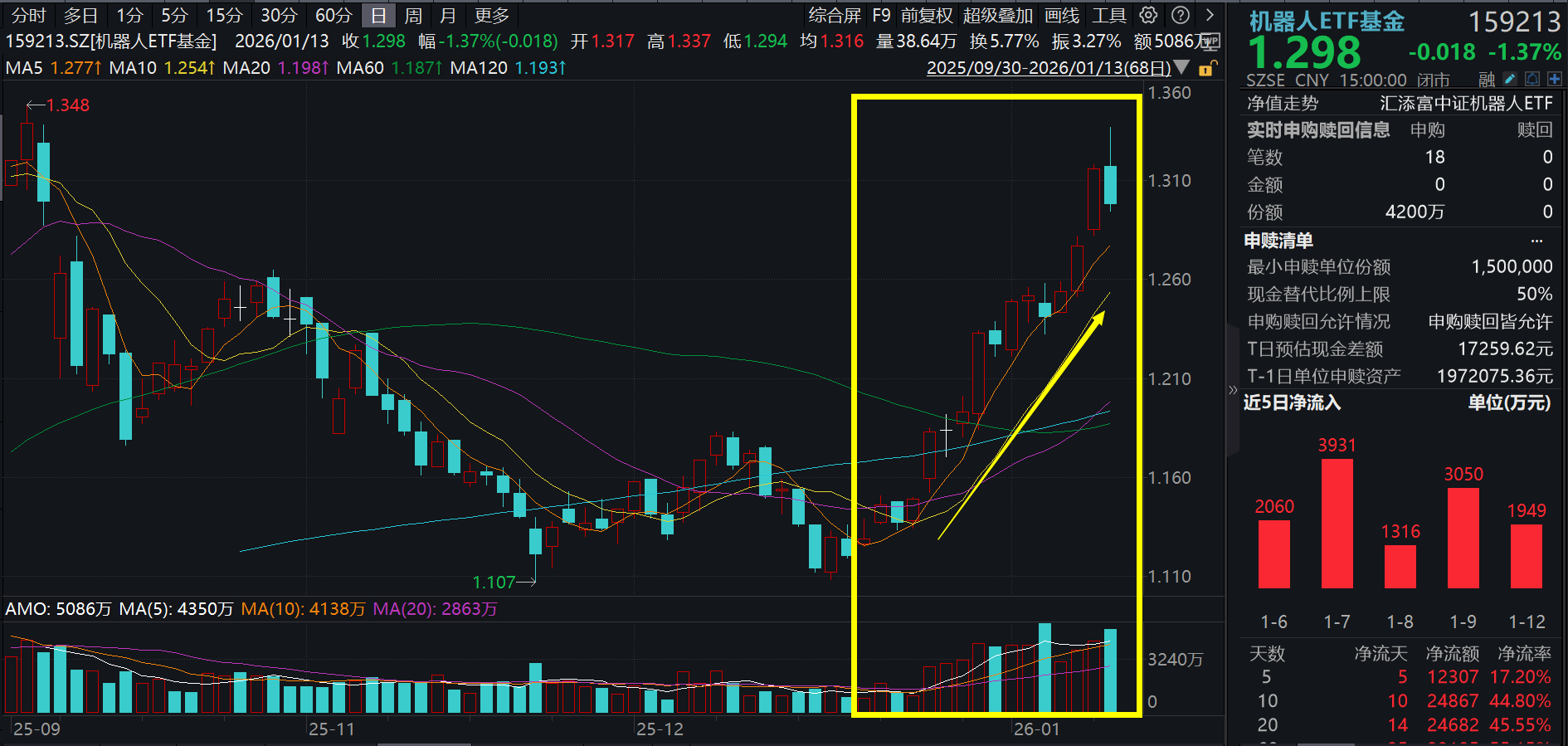
人形机器人再迎政策催化!中控技术涨近10%,资金连续11日涌入机器人ETF基金(159213),合计净流入超3亿元!机器人4年后将完胜人类医生?
Sou Hu Cai Jing· 2026-01-13 09:43
Market Overview - On January 13, the A-share market experienced a volatile pullback, with the Shanghai Composite Index halting its 17-day winning streak. The Robot ETF Fund (159213) fell by 1.37%, while it attracted over 55 million yuan in capital on that day, marking a total of over 300 million yuan in inflows over the past 11 days [1] ETF Fund Composition - The top ten constituent stocks of the Robot ETF Fund (159213) showed mixed performance, with notable gainers including Zhongkong Technology (+9.9%), Lide Harmony (+3.54%), and Keda Xunfei (+2.16%). Conversely, major declines were seen in Dazhu Laser (-5.52%) and Huichuan Technology (-3.12%) [2][4] Policy and Industry Dynamics - The Ministry of Industry and Information Technology announced initiatives for the 14th Five-Year Plan, focusing on revitalizing traditional industries and promoting emerging sectors, including quantum technology, humanoid robots, and AI [3] - The recent CES exhibition highlighted the dominance of Chinese humanoid robot manufacturers, with Chinese companies occupying 21 out of 38 humanoid robot booths, exceeding 50% of the total [5] Technological Developments - Elon Musk projected that general artificial intelligence (AGI) will arrive by 2026, with robots expected to surpass human surgical skills within three years and achieve superior performance compared to human doctors in four years [6] - Eastern Securities noted that the narrative around humanoid robots is shifting from simple mass production to AGI capabilities, suggesting that the latter will have a stronger impact on investment opportunities [7] Challenges in Production - The production of humanoid robots faces three main challenges: developing a highly dexterous hand, an AI brain capable of understanding the real world, and achieving large-scale production. The AI brain is identified as the most critical challenge for the industry's advancement [8] - Tesla is actively working on enhancing its AI brain for humanoid robots, with expectations for prototype production readiness by early 2026, indicating potential investment opportunities in the first half of 2026 [9] Investment Opportunities - The market is witnessing a significant interest in humanoid robots, with major global tech companies investing in this sector. The Robot ETF Fund (159213) is positioned to provide investors with access to the growth potential of the humanoid robot industry [10]


人形机器人:参与者布局梳理-Humanoid Robotics Who plays where
2026-01-13 02:11
Summary of Humanoid Robotics Industry Analysis Industry Overview - The analysis covers the humanoid robotics sector, focusing on approximately 150 global players, including OEMs and parts suppliers [1][2][3]. Key Characteristics of the Humanoid Robotics Ecosystem 1. **Supply Chain Structure** - Humanoid robotics companies are categorized into OEMs and parts suppliers, with a supply chain structure similar to the automotive industry, featuring multiple actuator suppliers [1]. 2. **Key Know-Hows** - Hardware expertise centers on robotic design, while software involves distinct layers: "robotic models" (brain and locomotion algorithms) and "world models" (simulation environments) [1]. 3. **Vertical Integration** - Most OEMs design critical components in-house, with varying degrees of outsourcing for production. Unitree is noted for its unique approach, focusing on hardware with integrated locomotion algorithms [1]. 4. **Competition and Differentiation** - The industry has a high number of participants, indicating low entry barriers. However, differentiation is possible through quality, agility, and cost, particularly in robotic models and actuators [1]. 5. **China vs. the West** - China is emerging as a significant player in humanoid robotics, with more participants than the rest of the world combined. China leads in most areas of the value chain, except for AI chips and simulation environments [1]. Competitive Landscape - **Non-Chinese Humanoid Robot OEMs** - Key players include Tesla, Boston Dynamics, and Agility Robotics, with varying capabilities in hardware and software [2]. - **Non-Chinese Humanoid Parts Suppliers** - Major suppliers include NVIDIA, Google, and Intel, providing essential components like AI chips and actuators [3]. - **Chinese Humanoid Robot OEMs** - Notable companies include Unitree Robotics, UBTech, and XPeng, with a focus on various hardware and software capabilities [4]. - **Chinese Humanoid Parts Suppliers** - Key suppliers include Hesai and RoboSense, contributing to the hardware and software needs of the industry [6][9]. Investment Implications - Recommendations include: - **Outperform**: Shuanghuan, Hesai, Tuopu, Inovance, Harmonic Drive - **Market-Perform**: Sanhua - **Underperform**: Leader Drive [10]. Financial Metrics - Specific financial metrics and projections for key companies are provided, including EPS and P/E ratios for 2024-2026 [11]. Conclusion - The humanoid robotics industry is characterized by rapid growth, significant competition, and a clear divide between Chinese and Western players. Investment opportunities exist, particularly in companies that demonstrate strong differentiation and technological capabilities.



汽车行业周报:如何展望2025Q4业绩?-20260112
Changjiang Securities· 2026-01-12 11:22
Investment Rating - The investment rating for the automotive industry is "Positive" and maintained [9] Core Insights - The wholesale sales of passenger vehicles in Q4 2025 are expected to be approximately 8.76 million units, a year-on-year decrease of 1% but a quarter-on-quarter increase of 14%. The profitability in Q4 may show differentiation compared to the same period last year, with expectations for a quarter-on-quarter improvement [2][5] - The revenue from automotive parts is anticipated to grow steadily quarter-on-quarter, but profitability may face pressure due to factors such as raw material costs and exchange rates [2][5] - The wholesale sales of heavy trucks are projected to be 314,000 units in Q4 2025, representing a year-on-year increase of 43.6% and a quarter-on-quarter increase of 11.5% [2][5] - The overall sales of buses are expected to see a significant quarter-on-quarter increase during the peak season, with sales of large and medium buses reaching 44,000 units, a year-on-year increase of 8.8% and a quarter-on-quarter increase of 42.2% [2][5] - The total sales of motorcycles are estimated to be around 4.73 million units in Q4 2025, reflecting a year-on-year increase of 11.0% but a quarter-on-quarter decrease of 6.2% [2][6] Summary by Sections Passenger Vehicles - Q4 2025 wholesale sales are expected to be about 8.76 million units, down 1% year-on-year but up 14% quarter-on-quarter. New energy vehicle sales are projected at 4.84 million units, up 13% year-on-year and 21% quarter-on-quarter [5] Automotive Parts - Revenue is expected to grow steadily quarter-on-quarter, but profitability may be pressured by raw material and exchange rate factors [5] Heavy Trucks - Q4 2025 wholesale sales are projected at 314,000 units, with a year-on-year increase of 43.6% and a quarter-on-quarter increase of 11.5% [5] Buses - Large and medium bus sales are expected to reach 44,000 units in Q4 2025, with a year-on-year increase of 8.8% and a quarter-on-quarter increase of 42.2% [5] Motorcycles - Total motorcycle sales are estimated at 4.73 million units in Q4 2025, reflecting an 11.0% year-on-year increase but a 6.2% quarter-on-quarter decrease [6]


汽车及汽车零部件行业周报:2026年“两新”政策落地,有望带动需求稳步向上-20260111
SINOLINK SECURITIES· 2026-01-11 15:10
Group 1 - The investment rating for the automotive industry is positive, with expectations for steady demand growth driven by the implementation of the "Two New" policy in 2026 [1][12][14] - The core viewpoint emphasizes that the subsidy policy has shifted from fixed amounts to a percentage of the vehicle price, which is expected to benefit high-end vehicles while putting pressure on low-priced cars [1][14] - The report anticipates a marginal recovery in sales growth in Q1 2026, with an upward revision of the annual domestic sales growth forecast to -2% [1][14][16] Group 2 - The report highlights opportunities in themes such as smart technology and overseas expansion, with passenger car exports maintaining a growth rate of over 20% year-on-year [2][17] - Key companies to watch include BYD, Geely, and Li Auto in the automotive sector, and Horizon Robotics and Top Group in the smart technology and robotics sectors [2][22] - The report notes that the export volume of passenger cars is expected to maintain double-digit growth in 2026, driven by recovering demand in markets like Russia and the increasing penetration of fuel and new energy vehicles [2][17] Group 3 - The automotive market saw a wholesale sales volume of 1.457 million units in the last week of December 2025, with a year-on-year increase of 5%, while new energy vehicles accounted for 772,000 units, up 22% year-on-year [4][31] - In December 2025, the total wholesale sales volume was 2.759 million units, down 10% year-on-year, with new energy vehicles at 1.554 million units, showing a 3% increase [4][31] - The retail sales data for December 2025 indicated a total of 2.296 million units sold, down 13% year-on-year, while new energy vehicles saw a 7% increase in retail sales [4][31][46]
