CHINA SATCOM(601698)

Search documents
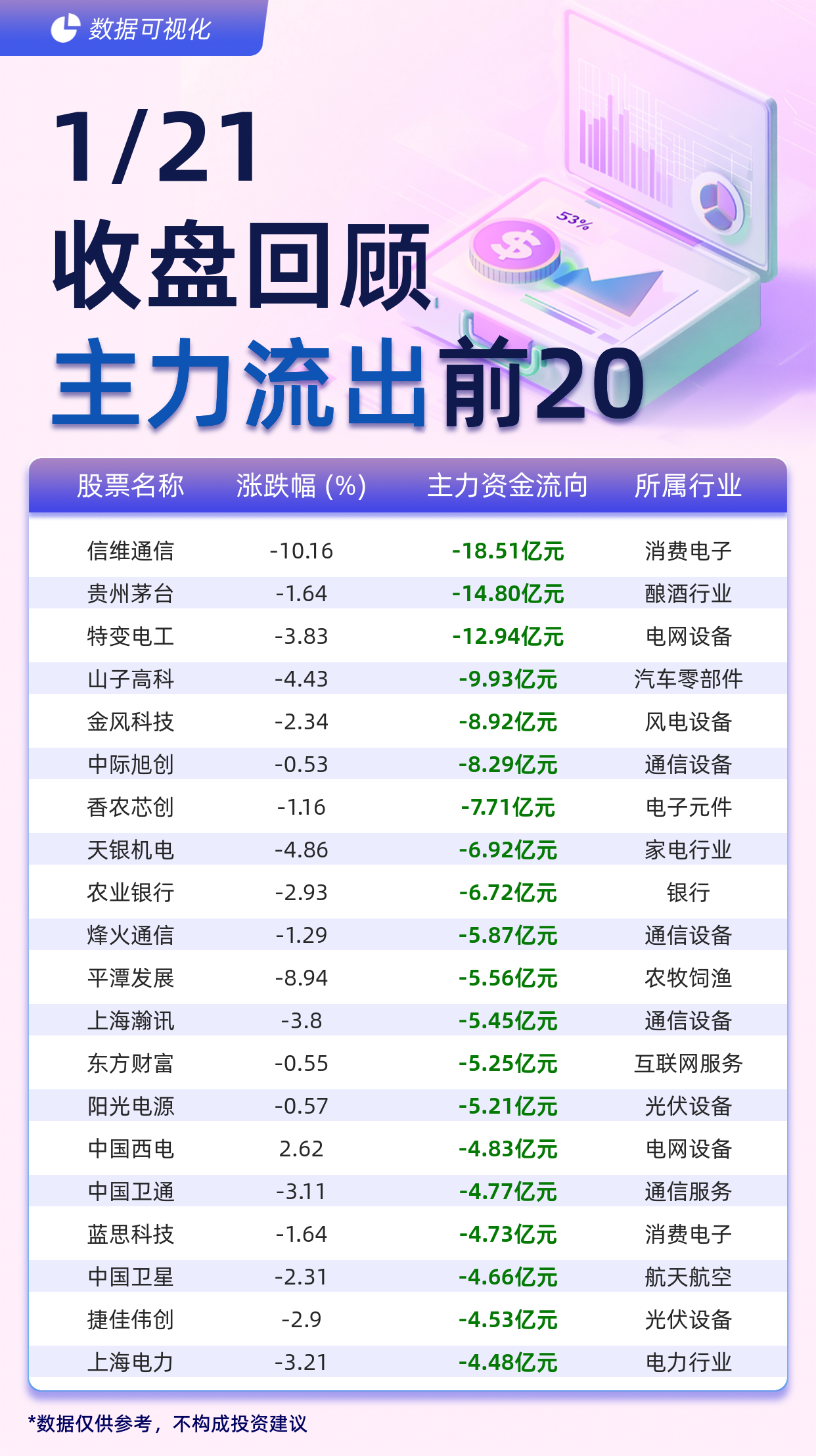
主力个股资金流出前20:信维通信流出18.51亿元、贵州茅台流出14.80亿元
Jin Rong Jie· 2026-01-21 07:11
Core Viewpoint - The data indicates significant outflows of main funds from various stocks, with notable amounts withdrawn from companies across different sectors, suggesting a potential shift in investor sentiment and market dynamics [1][2][3] Group 1: Stock Performance and Fund Outflows - The top stock with the largest fund outflow is XW Communication, with a withdrawal of 1.851 billion yuan and a decline of 10.16% in its stock price [2] - Guizhou Moutai follows with a fund outflow of 1.480 billion yuan and a decrease of 1.64% [2] - TBEA Co., Ltd. experienced a fund outflow of 1.294 billion yuan and a drop of 3.83% [2] - Other notable companies with significant outflows include: - Sanzi Gaoke: -0.993 billion yuan, -4.43% [2] - Goldwind Technology: -0.892 billion yuan, -2.34% [2] - Zhongji Xuchuang: -0.829 billion yuan, -0.53% [2] Group 2: Sector Analysis - The consumer electronics sector is represented by XW Communication and Lens Technology, both experiencing substantial fund outflows [2][3] - The beverage industry, highlighted by Guizhou Moutai, shows a minor decline in stock price despite significant fund outflow [2] - The power equipment sector, including TBEA Co., Ltd. and China Western Power, reflects mixed performance with varying fund outflows [2][3] - The telecommunications sector, represented by companies like Zhongji Xuchuang and Fenghuo Communication, also shows notable fund withdrawals [2][3]







中美竞逐万亿美元新赛道,五层解构下的投资蓝图
Tebon Securities· 2026-01-21 04:07
Investment Rating - The report maintains an "Outperform" rating for the commercial aerospace industry [1] Core Insights - The aerospace sector is transitioning from being viewed as a "cost center" driven by national will to a "growth engine" driven by commercial demand, with significant investments and strategic planning from both the US and China [6][9] - The global aerospace economy is projected to reach $613 billion in 2024, with commercial aerospace contributing 78%, and is expected to exceed $1 trillion by 2032 [6][9] - The value chain of commercial aerospace is divided into five core levels: "space, ground, terminal, rocket, and application," each presenting unique market opportunities and technical challenges from 2026 to 2030 [10][29] Summary by Sections 1. Space: Satellite Manufacturing - The satellite manufacturing market in China is expected to grow from approximately 7.1 billion yuan in 2025 to about 39.4 billion yuan by 2030, reflecting a shift from sporadic research models to continuous, batch engineering deliveries [16][18] 2. Ground: Ground Systems - The ground systems market is projected to increase from around 1.2 billion yuan in 2025 to approximately 39.1 billion yuan by 2030, evolving from a supporting role to a core infrastructure essential for stable satellite constellation operations [21][22] 3. Terminal: Key Variable for Commercial Aerospace - The terminal market is anticipated to grow from 500 million yuan in 2025 to about 141.9 billion yuan by 2030, driven by multiple vertical industries and potential consumer scenarios [23][24] 4. Rocket: Core Constraint - The cost of rocket launches is a critical constraint, with reusable technology expected to reduce costs by 80%-90% compared to traditional expendable rockets. The market for rocket launch services is projected to grow from approximately 10.7 billion yuan in 2025 to about 34.3 billion yuan by 2030 [25][26] 5. Application: Final Value Realization - The application market is expected to expand from 200 million yuan in 2025 to 525 billion yuan by 2030, with the revenue share from applications projected to rise from single digits to over 67% by around 2030 [27][28] 6. Investment Opportunities - Investment opportunities in commercial aerospace can be categorized into three main tracks: 1. Launch and manufacturing segments, which are expected to benefit directly from increased orders and visibility 2. Core components and systems, characterized by high technical barriers and critical for long-term competitiveness 3. Downstream applications and operational services, which, while currently limited in scale, hold the greatest long-term potential for value realization [29][30]


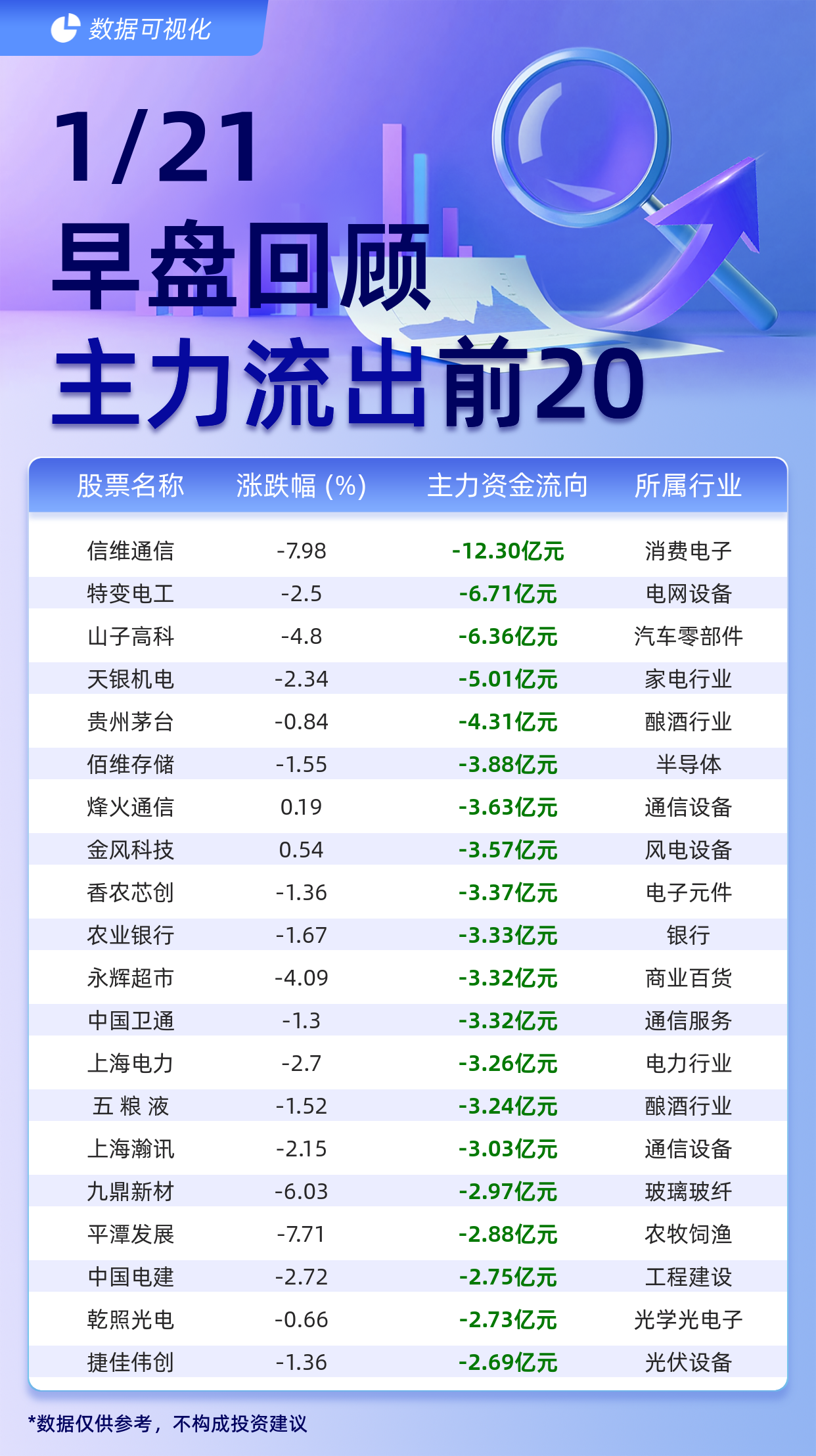
主力个股资金流出前20:信维通信流出12.30亿元、特变电工流出6.71亿元
Jin Rong Jie· 2026-01-21 04:04
Core Viewpoint - The data indicates significant outflows of capital from various stocks, with notable declines in share prices across multiple sectors, suggesting a bearish sentiment in the market. Group 1: Major Stocks with Capital Outflows - Xinyi Communication experienced a capital outflow of 1.23 billion, with a price drop of 7.98% [1][2] - Tebian Electric witnessed a capital outflow of 671 million, with a price decline of 2.5% [1][2] - Shanzi Gaoke had a capital outflow of 636 million, with a decrease of 4.8% [1][2] - Tianyin Electromechanical saw an outflow of 501 million, with a drop of 2.34% [1][2] - Kweichow Moutai experienced a capital outflow of 431 million, with a decline of 0.84% [1][2] Group 2: Additional Stocks with Notable Outflows - Baiwei Storage had a capital outflow of 388 million, with a price drop of 1.55% [1][2] - Fenghuo Communication saw an outflow of 363 million, with a slight increase of 0.19% [1][2] - Goldwind Technology experienced a capital outflow of 357 million, with a price increase of 0.54% [1][2] - Shannon Chip Creation had an outflow of 337 million, with a decline of 1.36% [1][2] - Agricultural Bank saw a capital outflow of 333 million, with a drop of 1.67% [1][2] Group 3: Further Stocks with Capital Outflows - China Satellite Communications experienced a capital outflow of 332 million, with a decline of 1.3% [3] - Shanghai Electric saw an outflow of 326 million, with a price drop of 2.7% [3] - Wuliangye experienced a capital outflow of 324 million, with a decline of 1.52% [3] - Shanghai Hanxun had an outflow of 303 million, with a drop of 2.15% [3] - Jiuding New Materials saw a capital outflow of 297 million, with a significant decline of 6.03% [3]


商业航天板块走弱 航天动力触及跌停
2 1 Shi Ji Jing Ji Bao Dao· 2026-01-21 01:43
Core Viewpoint - The commercial aerospace sector is experiencing a downturn, with significant declines in stock prices for various companies involved in the industry [1] Group 1: Company Performance - Aerospace Power has hit the daily limit down, indicating a severe drop in its stock price [1] - Other companies such as Aerospace Nanhai, Aerospace Mechatronics, Aerospace Development, Ruike Laser, China Satellite Communications, and Lekai Film have also seen declines in their stock prices, following the trend set by Aerospace Power [1]



商业航天板块走弱,航天动力触及跌停
Xin Lang Cai Jing· 2026-01-21 01:37
Group 1 - The commercial aerospace sector is experiencing a downturn, with significant declines in stock prices [1] - Aerospace Power has hit the daily limit down, indicating severe market pressure [1] - Other companies such as Aerospace Nanhu, Aerospace Mechatronics, Aerospace Development, Ruike Laser, China Satellite Communications, and Lucky Film have also seen their stock prices drop in tandem [1]
一键精准布局卫星全产业链
量化藏经阁· 2026-01-21 00:08
Group 1 - The commercial aerospace sector has significant market potential, with the global space economy expected to reach $612 billion in 2024, of which commercial aerospace revenue is projected to be $480 billion, accounting for 78% [2][4] - China's commercial aerospace market has rapidly grown from approximately 0.38 trillion yuan in 2015 to 2.3 trillion yuan in 2024, with an annual compound growth rate of about 22%. The market is expected to reach between 7 trillion and 10 trillion yuan by 2030 [4][6] - Countries are accelerating their efforts to secure satellite frequency and orbital resources, which are considered strategic assets. The "first come, first served" rule by the International Telecommunication Union (ITU) reshapes the competition landscape [6][8] Group 2 - The CSI Satellite Industry Index (931594.CSI) includes up to 50 listed companies involved in satellite manufacturing, launching, ground equipment, navigation, and communication, reflecting the overall performance of the satellite industry [16] - The index is heavily weighted towards the defense and military industry, with a weight of 59.26%. Companies within the index generally have high R&D expenditures, with 38% of constituent stocks spending over 20% of their revenue on R&D [18][21] - The index's revenue growth is projected at 18.12% for 2024, with net profit growth expected to be 222.01% in 2025, 48.86% in 2026, and 32.34% in 2027 [25] Group 3 - The China Securities Index Satellite Industry ETF (159218) is designed to track the CSI Satellite Industry Index and was established on May 14, 2025. The fund aims to minimize tracking deviation and error [42][43] - As of January 13, 2026, the ETF's circulation reached 2.115 billion shares, with a scale of 4.744 billion yuan, indicating significant recent growth and investor interest [44] - The fund manager, Ms. Xu Rongman, has extensive experience in managing index funds, overseeing products with a total scale exceeding 40 billion yuan [46]




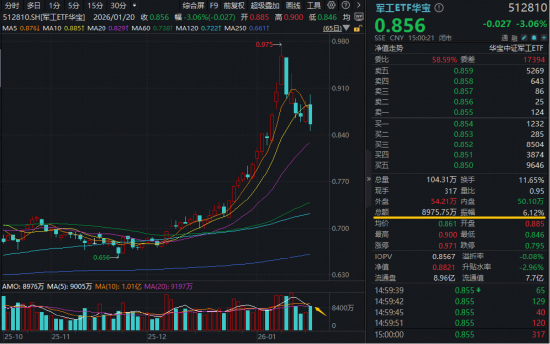
从大涨到大跌,军工坐上“过山车”!商业航天再杀跌,军工ETF华宝(512810)放量巨震6%,调整到位了吗?
Xin Lang Cai Jing· 2026-01-20 11:32
Core Viewpoint - The market experienced a collective decline on January 20, with a shift in investment style from high-valuation growth sectors to value sectors, leading to significant volatility in the military industry, particularly in the aerospace and low-altitude economy themes [1][5]. Military Industry Performance - The military ETF Huabao (512810) saw a trading range of 6.12% throughout the day, closing down 3.06%, erasing previous gains, with a trading volume of 89.76 million yuan [1][5]. - Leading stocks in the military ETF, particularly in commercial aerospace, faced significant declines, with Zhenlei Technology dropping nearly 9% and China Satellite Communications falling 7%, while several others dropped over 6% [3][13]. Market Analysis - Analysts attribute the volatility in the military sector to cautious liquidity expectations ahead of the Spring Festival and institutional portfolio adjustments, which have heightened risk aversion [5][15]. - The military sector is characterized by high growth potential, with small-cap stocks (market cap below 50 billion yuan) making up 56.47% of the military ETF's index, indicating high elasticity and volatility [5][15]. Investment Opportunities - The military sector is viewed as having high configuration value, with potential for investment during price dips, driven by historical opportunities in military trade, new quality-driven growth, and key timing catalysts [6][16]. - The global arms race is intensifying, with conflicts like India-Pakistan showcasing China's advanced equipment manufacturing capabilities, suggesting a historical opportunity for military trade to become a second growth curve for the industry [6][17]. - The new quality of combat power, characterized by intelligence, systematization, and informatization, is becoming a critical factor in strategic competition among major powers, with new production capabilities in commercial aerospace and low-altitude economy expected to further enhance military growth [7][16]. Future Outlook - The year 2026 marks the beginning of the "14th Five-Year Plan" and is a critical year for achieving the centenary goals of the military, indicating a potential new upward cycle for the military industry [6][17]. - The traditional military sector is expected to benefit from advantageous positioning, event catalysts, and improving fundamentals, presenting a significant opportunity for investment [7][17].

中国卫通(601698) - 中国卫通关于持股5%以上的股东权益变动触及1%刻度的提示性公告
2026-01-20 09:31
本公司董事会及全体董事保证公告内容与信息披露义务人提供的信息 一致。 重要内容提示: | 权益变动方向 | 比例增加□ | | 比例减少√ | | --- | --- | --- | --- | | 权益变动前合计比例 | 78.85% | | | | 权益变动后合计比例 | 78.00% | | | | 本次变动是否违反已作出的承诺、意向、计划 | 是□ | 否√ | | | 是否触发强制要约收购义务 | 是□ | 否√ | | 一、 信息披露义务人及其一致行动人的基本信息 证券代码:601698 证券简称:中国卫通 公告编号:2026-006 中国卫通关于持股 5%以上股东权益变动 触及 1%刻度的提示性公告 控股股东及其一致行动人保证向本公司提供的信息真实、准确、完整, 没有虚假记载、误导性陈述或重大遗漏。 1.身份类别 | | √控股股东/实际控制人及其一致行动人 | | --- | --- | | | □其他 5%以上大股东及其一致行动人 | | 投资者及其一致行动人的身份 | □合并口径第一大股东及其一致行动人(仅适用 | | | 于无控股股东、实际控制人) | | | □其他__无__ | 2. ...
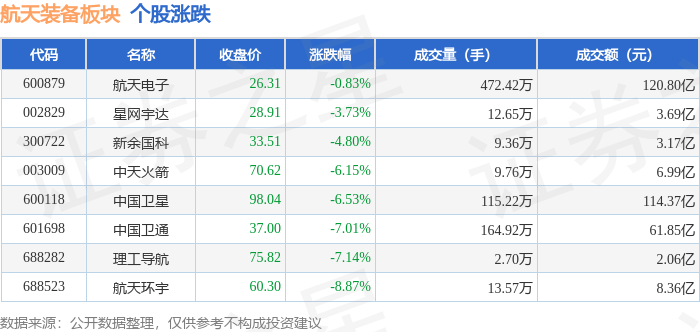
航天装备板块1月20日跌5.5%,航天环宇领跌,主力资金净流出33.85亿元
Zheng Xing Xing Ye Ri Bao· 2026-01-20 09:00
Market Overview - The aerospace equipment sector experienced a decline of 5.5% on January 20, with Aerospace HuanYu leading the drop [1] - The Shanghai Composite Index closed at 4113.65, down 0.01%, while the Shenzhen Component Index closed at 14155.63, down 0.97% [1] Stock Performance - Key stocks in the aerospace equipment sector showed the following closing prices and percentage changes: - Aerospace Electronics (600879): 26.31, -0.83% - Xingwang Yuda (002829): 28.91, -3.73% - Xinyu Guoke (300722): 33.51, -4.80% - Zhongtian Rocket (003009): 70.62, -6.15% - China Satellite (600118): 98.04, -6.53% - China Satcom (601698): 37.00, -7.01% - Ligong Navigation (688282): 75.82, -7.14% - Aerospace HuanYu (688523): 60.30, -8.87% [1] Capital Flow - The aerospace equipment sector saw a net outflow of 3.385 billion yuan from institutional investors, while retail investors had a net inflow of 3.481 billion yuan [1] - Detailed capital flow for key stocks includes: - Xinyu Guoke (300722): Institutional net outflow of 17.66 million yuan, retail net inflow of 16.89 million yuan - Ligong Navigation (688282): Institutional net outflow of 30.54 million yuan, retail net inflow of 32.30 million yuan - Xingwang Yuda (002829): Institutional net outflow of 49.15 million yuan, retail net inflow of 40.51 million yuan - Aerospace HuanYu (688523): Institutional net outflow of 92.41 million yuan, retail net inflow of 35.86 million yuan - Zhongtian Rocket (003009): Institutional net outflow of 96.91 million yuan, retail net inflow of 1.30 million yuan - Aerospace Electronics (600879): Institutional net outflow of 44.20 million yuan, retail net inflow of 82.70 million yuan - China Satcom (601698): Institutional net outflow of 101.00 million yuan, retail net inflow of 10.55 million yuan - China Satellite (600118): Institutional net outflow of 164.70 million yuan, retail net inflow of 134.47 million yuan [2]




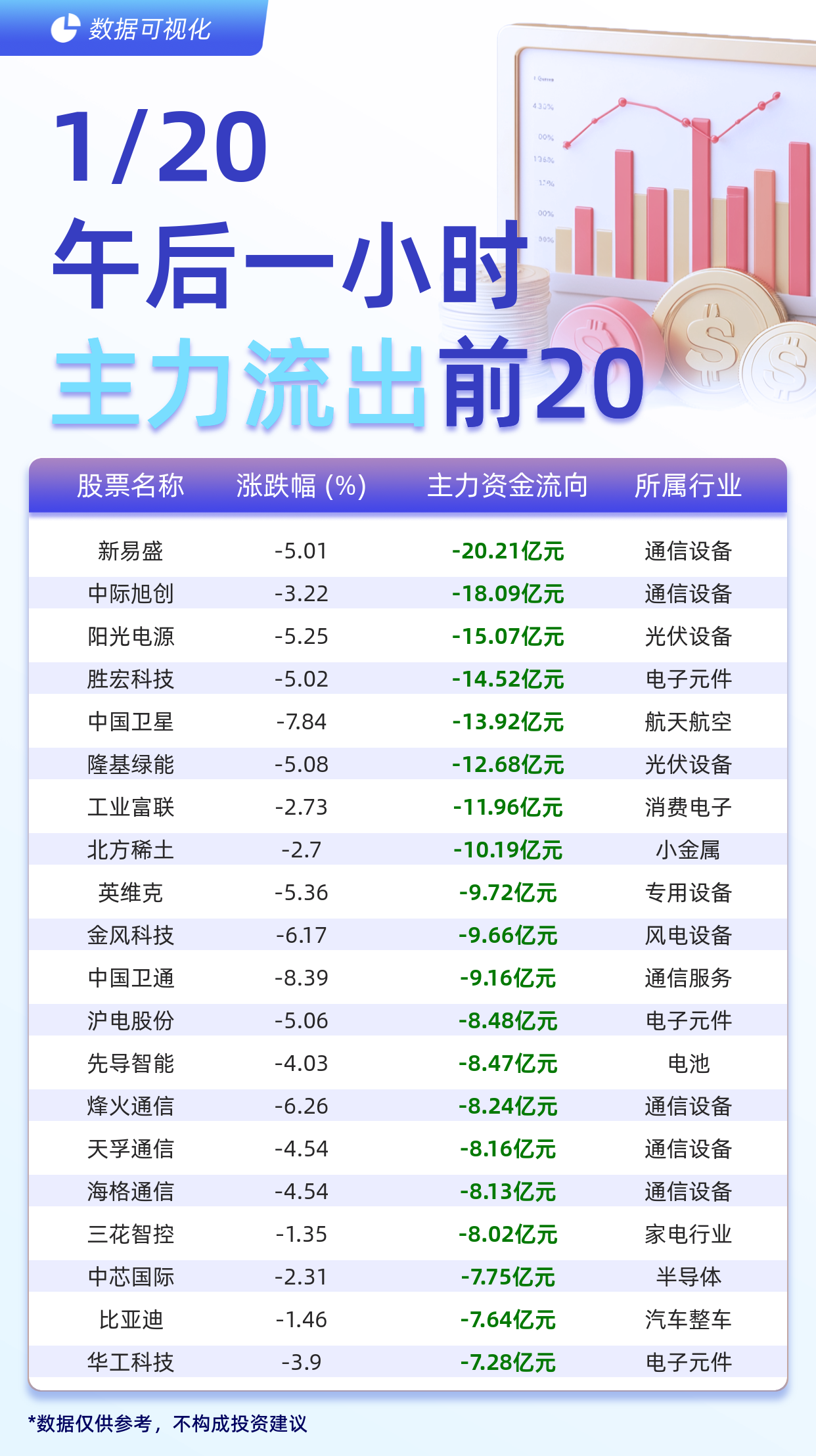
主力个股资金流出前20:新易盛流出20.21亿元、中际旭创流出18.09亿元
Jin Rong Jie· 2026-01-20 06:26
Core Viewpoint - The data indicates significant outflows of main funds from various stocks, particularly in the communication equipment and renewable energy sectors, suggesting a potential shift in investor sentiment and market dynamics [1][2][3] Group 1: Stock Performance and Fund Outflows - The top stock with the largest fund outflow is Xinye Technology, with a decrease of 20.21 billion yuan and a drop of 5.01% [2] - Zhongji Xuchuang follows with an outflow of 18.09 billion yuan and a decline of 3.22% [2] - Yangguang Electric Power experienced an outflow of 15.07 billion yuan, with a decrease of 5.25% [2] - Shenghong Technology saw a fund outflow of 14.52 billion yuan and a drop of 5.02% [2] - China Satellite had an outflow of 13.92 billion yuan, with a significant decline of 7.84% [2] Group 2: Sector Analysis - The communication equipment sector is notably affected, with multiple companies like Xinye Technology, Zhongji Xuchuang, and Fenghuo Communication experiencing substantial fund outflows [2][3] - The photovoltaic equipment sector, represented by Yangguang Electric Power and Longi Green Energy, also shows significant outflows, indicating potential challenges in this industry [2][3] - The electronic components sector, including Shenghong Technology and Huadian Co., is facing similar trends with notable fund withdrawals [2][3]