
Proya(603605)

Search documents
化妆品医美行业周报20260125:化妆品12月社零高增,Q4需求端景气度明显提升-20260125
Shenwan Hongyuan Securities· 2026-01-25 14:44
Investment Rating - The report maintains a "Positive" outlook on the cosmetics and medical beauty industry, indicating strong performance compared to the market [2]. Core Insights - The cosmetics and medical beauty sector has outperformed the market recently, with the Shenwan Beauty Care Index rising by 2.0% from January 16 to January 23, 2026, surpassing the Shenwan A Index by 0.8 percentage points [4][5]. - December 2025 saw a significant increase in social retail sales for cosmetics, reaching 38 billion yuan, with a growth rate of 8.8%, indicating robust demand even in the off-season. The overall growth rate for Q4 was 9.9%, significantly higher than the annual growth of 5.1% for 2025, driven by promotional events like Double 11 [10][17]. - The report anticipates continued high consumer demand in Q1 2026, supported by new product launches and regulatory approvals in the medical beauty sector [10]. Summary by Sections Industry Performance - The cosmetics and medical beauty sector has shown strong performance, with the Shenwan Cosmetics Index increasing by 2.6% and the Shenwan Personal Care Index rising by 4.2%, both outperforming the Shenwan A Index [4][5]. Key Company Reviews - Lin Qingxuan (2657HK) is highlighted as a benchmark in the high-end domestic skincare market, with revenue projected to grow from 690 million yuan in 2022 to 1.21 billion yuan in 2024, representing a CAGR of 32.7%. The company is expected to turn a profit of 187 million yuan in 2024, a 120% increase year-on-year [11][12]. - Langzi Co., Ltd. (002612.SZ) forecasts a net profit of 900 million to 1.05 billion yuan for 2025, reflecting a year-on-year growth of 245.25% to 302.80% [4]. - Qingsong Co., Ltd. (300132.SZ) anticipates a net profit of 130 million to 165 million yuan for 2025, with a growth rate of 137.73% to 201.74% [4]. Market Trends - The report notes that the high-end skincare market is expanding, with the market size expected to reach 218.5 billion yuan by 2029. The concept of "oil-based skincare" is becoming mainstream, driving growth in the facial oil segment, which is projected to grow at a CAGR of 42.8% from 2019 to 2024 [12][14]. - E-commerce channels are increasingly important, with Lin Qingxuan achieving a 65.4% online revenue share in H1 2025, leveraging platforms like Douyin and Tmall for growth [13]. Sales Data - In December 2025, the total retail sales of cosmetics reached 38 billion yuan, with a year-on-year growth of 8.8%. The overall retail sales for cosmetics in 2025 were 465.3 billion yuan, reflecting a 5.1% increase [17][21].





美妆品牌抢滩药店新渠道
经济观察报· 2026-01-25 04:58
Core Viewpoint - The OTC channel presents significant opportunities for beauty brands, offering professional endorsements, precise targeting of skincare needs, and immediate product experiences, but it also poses challenges due to strict professional requirements and a talent shortage in the industry [1][2][3]. Group 1: Market Entry and Growth - By 2025, over six domestic cosmetic companies are expected to enter the OTC channel, marking it as the "Year of Domestic Beauty OTC Layout" [2]. - Leading domestic beauty brand Proya (603605.SH) announced its entry into the OTC channel in January 2026, joining a growing list of companies [2]. - Brands like Winona and Kefu Beauty have been early entrants into the OTC channel, with Winona's sales nearing 1 billion yuan in 2023, capturing over 60% of the market share in this channel [5]. Group 2: Strategic Developments - In April 2025, Furuida Bio announced plans to accelerate its OTC channel development, aiming to cover 10,000 drugstore chains and launch 100 "cosmetic and medicinal" SKUs [5]. - Companies are increasingly focusing on integrating with the professional environment of pharmacies rather than merely distributing products [5]. - Proya is preparing multiple products for the OTC channel, emphasizing the importance of medical device products as a foundation for entry [6]. Group 3: Market Potential and Challenges - The OTC channel has approximately double the growth potential, with Winona targeting to cover 250,000 pharmacies [8]. - As of December 2024, there are about 705,000 licensed drug retail enterprises in China, with Winona covering over 110,000, representing about one-seventh of the total retail pharmacy stores [9]. - The demand for beauty products in pharmacies is rising due to pressures on traditional pharmacy profits and the need for transformation [9]. Group 4: Profitability and Talent Shortage - Medical device products have a significantly higher gross margin, averaging 77%-83%, compared to regular cosmetic products [9]. - The beauty industry faces a talent shortage in the pharmacy channel, as many brands rely on pharmacists who must understand both pharmaceuticals and cosmetics [10]. - Companies like Betaini are addressing this by training pharmacy staff to enhance customer trust and provide professional consultations [10][11].


珀莱雅正在失速?
虎嗅APP· 2026-01-25 03:36
Core Viewpoint - The article discusses the challenges faced by Proya, a leading domestic beauty brand in China, after achieving the top revenue position in the industry. It highlights the company's struggle to maintain its market leadership amid declining sales and profits, particularly following the transition to a new generation of leadership. Group 1: Company Performance - Proya's revenue for Q3 2025 was 1.736 billion yuan, a year-on-year decline of 11.63%, with net profit dropping by 23.64% to 227 million yuan, marking the first time the company faced a simultaneous decline in both revenue and profit [6][7]. - The company's stock price has significantly decreased from a peak of 129.01 yuan per share in March 2023 to 73.18 yuan per share by January 2026 [6][8]. - In 2024, Proya's main brand revenue reached 10.778 billion yuan, making it the only domestic beauty giant to enter the "100 billion club" [11]. Group 2: Challenges and Market Dynamics - The beauty industry is entering a micro-growth phase, with Proya facing challenges from industry cycles, intensified competition, and internal bottlenecks [7][9]. - Proya's reliance on a few key products, such as the Ruby Essence and the Early C and Late A series, has led to stagnation as these products approach the latter stages of their life cycles [12][13]. - The company is experiencing high marketing costs, which are eroding profit margins, as traditional marketing strategies become less effective in the current market environment [16][18]. Group 3: Strategic Responses - Proya is attempting to revitalize its product lines and has introduced new brands like OR and Cai Tang, but these efforts have not yet compensated for the slowdown in its main brand's growth [14][30]. - The company is also focusing on enhancing its offline presence, having initiated partnerships with offline pharmacies and retail channels, but has seen a decline in offline revenue [21][22]. - Proya's leadership transition has led to significant changes in its executive team, which may impact its strategic direction and operational stability [26][28]. Group 4: Financial Health and Future Outlook - Proya's financial health remains robust, with projected cash flow of 4.07 billion yuan by the end of 2024 and potentially reaching 6.2 billion yuan by the end of 2027, with no short-term or long-term bank loans [31]. - The company is exploring opportunities for international expansion and product development through potential listings and investments, which could provide additional growth avenues [31].

美妆品牌抢滩药店新渠道
Jing Ji Guan Cha Wang· 2026-01-24 08:48
Core Insights - The article discusses the growing trend of domestic beauty brands entering the OTC (over-the-counter) channel in China, with 2025 being marked as a pivotal year for this transition [2][3] - Major players like Proya and other beauty companies are preparing to launch products in the OTC space, which is seen as a way to leverage the professional credibility of pharmacies and meet specific skincare needs [4][5] Group 1: Market Entry and Growth - By 2025, over six domestic cosmetic companies are expected to enter the OTC channel, expanding the current limited presence of leading brands [2] - Proya announced its entry into the OTC channel in January 2026, joining other brands that have already established a presence [2][4] - The OTC channel has seen significant sales, with brands like Winona achieving nearly 1 billion yuan in sales from this channel in 2023 [3] Group 2: Strategic Partnerships and Product Development - Companies are focusing on strategic partnerships and product development tailored for the OTC market, with Proya preparing multiple products aimed at post-operative recovery and daily skincare [4] - Winona and other brands are actively seeking to enhance their product offerings and market reach through collaborations with pharmacies [3][4] Group 3: Market Potential and Challenges - The OTC channel is projected to have about double the growth potential, with Winona aiming to cover 250,000 pharmacies [5] - The regulatory environment is becoming more favorable for pharmacies to sell cosmetic products, which aligns with the increasing demand for beauty products in these settings [6] - Despite the opportunities, there is a significant talent shortage in the OTC channel, as brands require personnel who are knowledgeable in both pharmaceuticals and cosmetics [7] Group 4: Financial Metrics and Profitability - The average gross margin for medical beauty products in the OTC channel is significantly higher than that of regular cosmetic products, with margins for medical dressings ranging from 77% to 83% [6] - Specific companies report high gross margins, such as 84.22% for Chuerjia's medical device products and 82% for Jinjian Biological's collagen products [6]

戴可思回应违规?美宝莲被抵制?欧舒丹拟美股上市?|美周热点
Sou Hu Cai Jing· 2026-01-23 08:37
Industry Overview - The beauty retail sector in China experienced a year-on-year growth of 5.1%, with total retail sales reaching 465.3 billion yuan in 2025, significantly outperforming the overall retail market which grew by 3.7% [2] - December 2025 saw a notable increase in cosmetic retail sales, reaching 38 billion yuan, marking an 8.8% year-on-year growth, driven by year-end consumer demand and promotional activities [2] Brand Developments - Maybelline faced backlash after announcing a partnership with the youth group "Times Youth" as brand ambassadors, leading to consumer dissatisfaction and low sales figures [3] - Dakeci responded to an investigation regarding misleading advertising of its children's lip balm, clarifying that it did not promote the product as "food-grade" despite previous claims on e-commerce platforms [4] - The first "youthful needle" for temporal filling was approved in China, marking a significant advancement in aesthetic medicine [5] - The high-end fragrance brand Wenxian opened its first pop-up store in Shanghai, focusing on traditional incense culture [6][7] - Proya launched a new medical skincare series targeting post-surgery and specialized skin care, planning to enter OTC channels [8] - The UK brand Indu exited the color cosmetics market to focus on skincare, citing higher consumer loyalty in that segment [9] - Sephora announced a strategic partnership with Olive Young to create a dedicated K-beauty section, set to launch in North America and Singapore [10] - Valentino Beauty exited the South Korean market due to limited distribution and competition from local brands [11] - Patrick Ta Beauty entered the Middle Eastern market through a partnership with Sephora, launching in several countries [12] - Douglas reported a slight increase in Q1 sales but faced pressure on profit margins due to consumer price sensitivity [13][14] Regulatory and Market Trends - Recent reports highlighted the discovery of banned substances in children's creams, prompting regulatory investigations and product recalls [15] - Unilever Ventures invested in two Indian beauty brands, indicating confidence in the high-end, clean beauty market in India [16] - China Duty Free Group announced a significant acquisition of DFS assets for approximately 3.95 billion USD, enhancing its presence in the Greater Bay Area [17] - Saks Global filed for Chapter 11 bankruptcy, marking a significant event in the luxury retail sector [18] - L'Occitane is exploring a potential IPO in the US market, having previously been privatized in 2024 [20] - Shandong Province initiated a pilot program for electronic labels on cosmetics, aimed at improving product traceability and compliance [21] - New cosmetic testing standards are being proposed in China to enhance safety and regulatory compliance [22]


化妆品板块1月21日涨0.25%,拉芳家化领涨,主力资金净流出5552.25万元
Zheng Xing Xing Ye Ri Bao· 2026-01-21 09:08
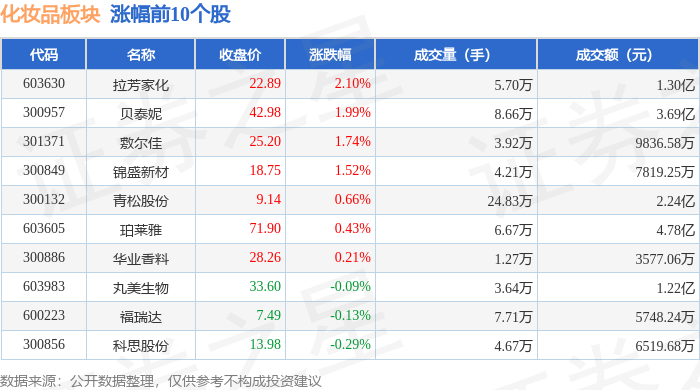
Group 1 - The cosmetics sector experienced a slight increase of 0.25% on January 21, with Lafang Jiahua leading the gains [1] - The Shanghai Composite Index closed at 4116.94, up 0.08%, while the Shenzhen Component Index closed at 14255.12, up 0.7% [1] - Lafang Jiahua's closing price was 22.89, reflecting a rise of 2.10%, with a trading volume of 57,000 shares and a transaction value of 130 million yuan [1] Group 2 - The cosmetics sector saw a net outflow of 55.52 million yuan from institutional investors, while retail investors had a net inflow of 30.86 million yuan [2] - The trading data for various companies showed mixed performance, with some companies like Betaini and Lafang Jiahua experiencing net outflows from institutional investors [3] - Betaini had a net outflow of 14.09 million yuan from institutional investors, while Lafang Jiahua saw a net inflow of 13.43 million yuan [3]



珀莱雅20260120
2026-01-21 02:57
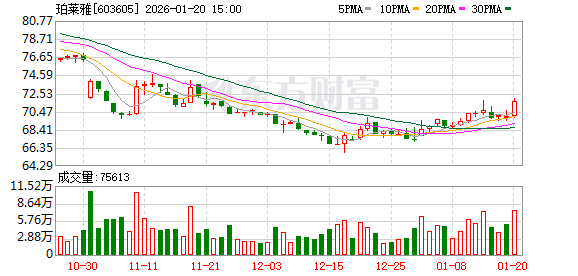
Summary of the Conference Call for Proya (珀莱雅) Company Overview - Proya is a cosmetics company that has experienced fluctuations in its valuation since its IPO in 2017, driven by net profit growth and a focus on blockbuster products during its initial years [2][4]. Key Points and Arguments Financial Performance - Since 2025, Proya has seen a significant slowdown in quarterly revenue growth, although the first quarter of 2025 exceeded profit expectations. Overall, the sustainability of this growth is questionable [3]. - The gross margin has shown a steady increase, while the net profit margin has remained relatively stable. However, the valuation has been on a downward trend since 2025, currently at historical lows [3][4]. Brand Performance - The main brand, Proya, experienced negative growth overall in 2025, with only the third quarter showing positive growth due to new product launches and a low base effect. In contrast, sub-brands such as of relax, 原色波塔, and 花知晓 performed exceptionally well, with of relax achieving a compound growth rate close to 150% [2][6]. Leadership and Strategic Concerns - There are concerns regarding the declining momentum of the main brand and risks associated with leadership changes. However, the new leadership team has successfully integrated over the past year, and the operational capabilities of the company have matured [7]. Product Innovation - Proya is actively pursuing product innovation in 2025, including upgrades to the dual-antioxidant series, which saw a 72% year-on-year increase within 10 days of launch, and a significant upgrade to the ruby series. A new ruby microbead essence is set to be launched, promoted through social media platforms like 小红书 [8]. Future Directions - The company plans to focus on key areas such as whitening, soothing, anti-aging, sun protection, and post-operative recovery. Additionally, Proya is investing in emerging brands like 花知晓 to expand its market presence and is exploring the home beauty device sector to tap into the broader water-light market [9][10]. Profit Forecast - Proya's net profit is projected to be approximately 1.58 billion yuan in 2025, maintaining slight growth, with an expected increase to 1.74 billion yuan in 2026, representing a year-on-year growth of around 10%. The current price-to-earnings ratio is 16 times, indicating a relatively cheap valuation compared to its quality [5][11]. Additional Important Insights - The company’s ability to regain valuation hinges on the recovery of its main brand's performance and stable growth across its business segments [4]. - Proya aims to establish itself as a benchmark for domestic brands and pursue international expansion to achieve valuation premiums [5][11].
珀莱雅:公司严格按照相关法律法规规定履行信息披露义务
Zheng Quan Ri Bao· 2026-01-20 12:13
Group 1 - The company, Proya, stated that it strictly adheres to relevant laws and regulations regarding information disclosure obligations [2] - Investors are advised to refer to the information disclosed by the company on the Shanghai Stock Exchange website for accurate updates [2]
珀莱雅:2026年1月15日,公司通过集中竞价交易方式首次回购公司股份230800股
Zheng Quan Ri Bao· 2026-01-20 12:12
Group 1 - The company, Proya, announced its first share repurchase on January 15, 2026, through centralized bidding, acquiring 230,800 shares [2] - The total amount spent on the share repurchase was approximately RMB 16,119,331, excluding transaction costs such as stamp duty and commissions [2]
珀莱雅:目前公司管理层人员背景涵盖金融、财务、供应链等领域,行业经验丰富
Zheng Quan Ri Bao· 2026-01-20 12:12
Core Viewpoint - The company emphasizes that the appointment of its directors and senior management strictly adheres to relevant laws and regulations, ensuring a qualified and experienced leadership team [2] Group 1 - The management team has diverse backgrounds in finance, accounting, and supply chain, indicating a well-rounded expertise [2] - The leadership possesses rich industry experience and an international perspective, aligning core competencies with their respective positions [2] - The company advises stakeholders to refer to disclosures on the Shanghai Stock Exchange for detailed information regarding management appointments [2]