
Proya(603605)

Search documents
美妆行业周度市场观察-20260204
Ai Rui Zi Xun· 2026-02-04 06:45
Investment Rating - The report does not explicitly provide an investment rating for the beauty industry Core Insights - The beauty industry is undergoing significant changes due to various factors including policy shifts, consumer preferences, and technological advancements Industry Trends - Hainan's "zero tariff, low tax rate, and simplified tax system" policy is expected to transform the region into a global beauty industry hub, allowing international brands to penetrate the market while enhancing the competitiveness of domestic brands [1] - The beauty sector is experiencing a shift from price competition to value competition, driven by the need for genuine product efficacy and core ingredient transparency [4] - The clean beauty segment is facing polarization, with some brands exiting the market while major players continue to invest, indicating a potential growth opportunity in this area [5] - The emergence of beauty robots is seen as a blue ocean market, with companies testing consumer acceptance in 2026 [5] - Multi-functional makeup products that combine skincare benefits are gaining popularity, reflecting a trend towards efficiency and convenience among consumers [6] - The men's skincare market is projected to grow significantly, with domestic brands gaining traction in a traditionally dominated space [8] - The beauty industry is transitioning to a "hardcore metrics" era, emphasizing scientific validation and emotional resonance in branding [8] - The withdrawal of foreign beauty brands from the Chinese market indicates a shift in competitive dynamics, with local brands rising and online costs increasing [9] - ESG (Environmental, Social, Governance) considerations are becoming crucial for brand differentiation and competitive advantage in the beauty sector [10] - The global beauty market is witnessing increased mergers and acquisitions, reshaping the competitive landscape [11] - The Chinese beauty market is expected to reach a transaction volume of over 1.1 trillion yuan, with domestic brands capturing a significant market share [12] Brand Dynamics - New domestic brands are successfully leveraging unique ingredients and precise marketing strategies to thrive in the competitive landscape [14] - The brand "C咖" has emerged as a leader in the oil skin care segment by focusing on scientific innovation and consumer needs [15] - The brand "半亩花田" is seeking to go public, reflecting the trend of marketing optimization and product upgrade in the domestic beauty industry [15] - The introduction of high-end fragrance cleaning products indicates a shift towards quality in the home cleaning market, targeting the upgrading consumer demand [16]

量化大势研判202602:市场△gf继续保持扩张
Guolian Minsheng Securities· 2026-02-04 05:29
- The report introduces a quantitative model framework for market trend analysis, focusing on five asset style stages: external growth, quality growth, quality dividend, value dividend, and bankruptcy value. The model evaluates assets based on their intrinsic attributes and prioritizes them using the sequence of g > ROE > D, analyzing whether there are "good assets" and whether they are "expensive" [5][8][9] - The model incorporates key factors such as expected growth (gf), actual growth (g), profitability (ROE), high dividend (D), and bankruptcy value (B/P). Each factor is associated with specific market phases, e.g., expected growth is relevant across all phases, while profitability is emphasized during maturity phases [9][12] - The quantitative model has demonstrated strong historical performance, achieving an annualized return of 27.67% since 2009. It has shown consistent excess returns in most years, particularly post-2017, with limited effectiveness in years like 2011, 2012, and 2016 [19][22] - The model's backtesting results for specific years include notable excess returns, such as 51% in 2009, 36% in 2013, and 62% in 2022. However, it also recorded underperformance in years like 2011 (-11%) and 2014 (-4%) [22] - The report details six specific strategies derived from the model, each focusing on different factors: - **Expected Growth Strategy**: Selects industries with the highest analyst-forecasted growth rates. Recent recommendations include sectors like automotive sales, lithium equipment, and tungsten [38][39] - **Actual Growth Strategy**: Focuses on industries with the highest unexpected growth (△g). Current recommendations include photovoltaic equipment, insurance, and coal chemical sectors [40][41] - **Profitability Strategy**: Targets high-ROE industries with low valuations under the PB-ROE framework. Recommended sectors include copper, liquor, and non-dairy beverages [43][44] - **Quality Dividend Strategy**: Utilizes a DP+ROE scoring system to identify industries. Current recommendations include forestry, lithium equipment, and fiberglass [46][47] - **Value Dividend Strategy**: Employs a DP+BP scoring system. Recommended sectors include security, daily chemicals, and buses [49][50] - **Bankruptcy Value Strategy**: Focuses on industries with the lowest PB+SIZE scores. Current recommendations include automotive sales, ceramics, and cotton textiles [53][54]





商贸零售行业 2 月投资策略:金价波动不改金饰龙头长期逻辑,AI+赋能代运营商业务破局
Guoxin Securities· 2026-02-03 05:26
Group 1: Core Insights - The report maintains an "outperform" rating for the retail sector, indicating potential for growth in the consumer market, particularly in the jewelry and beauty segments, as well as cross-border e-commerce [3][51]. - Fluctuations in gold prices have short-term emotional impacts on the jewelry sector, but the long-term growth logic remains intact, driven by brand building, craftsmanship innovation, and cultural storytelling [1][12]. - AI applications are rapidly being integrated into the retail sector, particularly through online service providers, which are leveraging deep partnerships with major e-commerce platforms to enhance consumer insights and brand strategies [2][19]. Group 2: Industry Summaries - In the gold and jewelry sector, companies with a high proportion of investment gold business, such as Cai Bai Co., are expected to achieve stable growth despite short-term price fluctuations, with projected net profits for 2025 expected to increase by 47.43% to 71.07% [1][14]. - The beauty and personal care sector is seeing a return to low valuations, with traditional leaders showing signs of recovery and new product launches expected to drive growth [3][51]. - Cross-border e-commerce leaders have demonstrated strong resilience against risks, with AI applications expected to enhance cost efficiency and product innovation, providing a catalyst for sustained growth [3][51]. Group 3: Recent Industry Data - In December 2025, the total retail sales of consumer goods reached 45,136 billion yuan, with a year-on-year growth of 0.9%, indicating a weak overall growth trend influenced by high base effects from the previous year [24][30]. - Online retail sales for the year reached 159,722 billion yuan, growing by 8.6%, with physical goods online retail accounting for 26.1% of total retail sales, reflecting a slight increase in penetration [25][30]. - The jewelry category saw a year-on-year growth of 5.9% in December, supported by rising prices and holiday gifting demand, while the cosmetics category grew by 8.8% due to promotional activities and consumption upgrades [30].

未知机构:申万化妆品26年1月抖音渠道重点国货GMV同比基于蝉妈妈数据分析-20260203
未知机构· 2026-02-03 01:45
Summary of Key Points from the Conference Call Records Industry Overview - The records focus on the cosmetics industry in China, specifically analyzing the Gross Merchandise Value (GMV) of various brands in January 2026 through data from the Douyin platform. Key Companies and Their Performance 1. 上美股份 (Shangmei Group) - Total GMV for 韩束 (Hansu) and its sub-brands in January was approximately 6.6 billion CNY, representing a 9% increase year-over-year [1] - 韩束 brand GMV was about 5.3 billion CNY, showing a decline of 3% [1] - NewPage brand GMV reached approximately 0.7 billion CNY, marking a significant increase of 120% [1] - 极方 (Jifang) achieved a GMV of 0.1 billion CNY, with rapid growth year-over-year [1] - 聚光白 (Juguangbai) also recorded a GMV of 0.1 billion CNY, indicating high growth [1] - 安敏优 (Anminyou) had a GMV of 0.3 billion CNY, with a remarkable year-over-year growth of 267% [1] 2. 珀莱雅 (Proya) - The three major brands under Proya had a combined GMV of 3.5 billion CNY in January, reflecting a 2% increase [1] - The main brand, 珀莱雅, generated a GMV of approximately 2.8 billion CNY, down by 2% [1] - 彩棠 (Caitang) brand GMV was 0.3 billion CNY, showing a decline of 12% [1] - OR洗护 (OR Hair Care) brand GMV reached 0.3 billion CNY, with a substantial increase of 148% [1] 3. 若羽臣 (Ruoyuchen) - The combined GMV for the brands 绽家 (Zhanjia), 斐萃 (Feicui), and Nuibay was 1.7 billion CNY [2] - 绽家 brand GMV was 0.7 billion CNY, increasing by 88% [2] - 斐萃 brand GMV was 0.8 billion CNY, showing a remarkable growth of 345% [2] 4. 丸美股份 (Marubi) - The total GMV for its two main brands was 2.6 billion CNY, reflecting a 1% increase [2] - 主品牌丸美 (Marubi) had a GMV of approximately 1.8 billion CNY, up by 5% [2] - 恋火 (Lianhuo) brand GMV was 0.8 billion CNY, down by 7% [2] 5. 毛戈平 (Mao Geping) - The brand achieved a GMV of approximately 2.9 billion CNY, with an increase of 78% [2] 6. 林清轩 (Lin Qingxuan) - The brand's GMV was 2.6 billion CNY, reflecting a significant increase of 145% [2] 7. 薇诺娜 (Winona) - The brand recorded a GMV of 1.0 billion CNY, with a growth of 156% [2] 8. 润本 (Runben) - The brand's GMV was approximately 0.4 billion CNY, showing a slight decline of 1% [2] 9. 福瑞达 (Furuida) - The two major brands under Furuida had a combined GMV of about 0.8 billion CNY, increasing by 12% [2] 10. 水羊股份 (Shuiyang) - The four major brands achieved a GMV of approximately 0.7 billion CNY, doubling year-over-year [2] 11. 上海家化 (Shanghai Jahwa) - The three skincare brands under Shanghai Jahwa had a combined GMV of about 0.9 billion CNY, reflecting a significant increase of 252% [2] 12. 植物医生 (Plant Doctor) - The brand's GMV in December was 0.1 billion CNY, showing a decline of 5% [2] 13. 拉芳 (Lafang) - The brand achieved a GMV of approximately 0.1 billion CNY, with an increase of 135% [2] Additional Insights - The data indicates a mixed performance across various brands, with some experiencing significant growth while others faced declines. - The overall trend suggests a competitive landscape in the cosmetics industry, with emerging brands showing strong growth potential, particularly in the Douyin channel. This analysis highlights the dynamic nature of the cosmetics market in China, emphasizing the importance of monitoring GMV trends for investment opportunities and risk assessment.



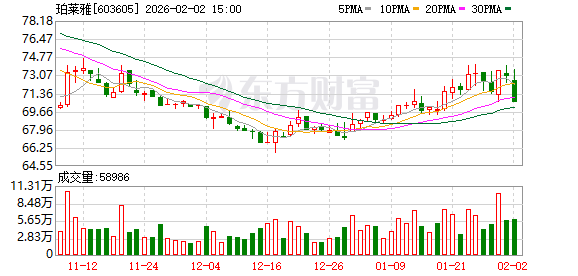
珀莱雅:累计回购股份290800股
Zheng Quan Ri Bao· 2026-02-02 13:41
Group 1 - The company, Proya, announced that as of January 31, 2026, it has repurchased a total of 290,800 shares through centralized bidding, which represents 0.07% of the company's current total share capital [2]

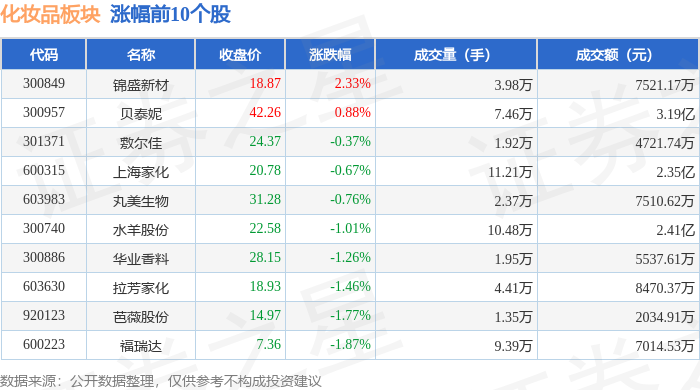
化妆品板块2月2日跌1.5%,珀莱雅领跌,主力资金净流出7589.5万元
Zheng Xing Xing Ye Ri Bao· 2026-02-02 09:10
Group 1 - The cosmetics sector experienced a decline of 1.5% on February 2, with Proya leading the drop [1] - The Shanghai Composite Index closed at 4015.75, down 2.48%, while the Shenzhen Component Index closed at 13824.35, down 2.69% [1] - Key individual stock performances in the cosmetics sector included Jinsong New Material up 2.33% and Beitaini up 0.88%, while several others like Fuhua and Bawei saw declines of 1.87% and 1.77% respectively [1] Group 2 - The cosmetics sector saw a net outflow of 75.895 million yuan from main funds, while retail funds experienced a net inflow of 77.0999 million yuan [2] - The individual stock fund flow data indicated that Water Sheep Co. had a main fund net inflow of over 5.3075 million yuan, while Shanghai Jahwa had a net outflow of 2.71908 million yuan from retail investors [3] - The overall market sentiment reflected a mixed response, with some stocks like Beitaini and Shanghai Jahwa attracting different levels of investment from main and retail funds [3]
珀莱雅:累计回购约29万股
Mei Ri Jing Ji Xin Wen· 2026-02-02 08:37
Group 1 - The company Proya announced on February 2 that as of January 31, 2026, it has repurchased approximately 290,000 shares through centralized bidding, accounting for 0.07% of the company's total share capital [1] - The highest repurchase price was 73 RMB per share, while the lowest was 69.76 RMB per share, with a total expenditure of approximately 20.5 million RMB [1] Group 2 - The automotive sales giant Baolide, known for selling luxury cars such as Rolls-Royce and Porsche, is now undergoing bankruptcy liquidation, with its headquarters in Hangzhou reportedly abandoned and its subsidiary in Yiwu sealed [1]
珀莱雅(603605) - 珀莱雅化妆品股份有限公司关于股份回购进展公告
2026-02-02 08:00
| 证券代码:603605 | 证券简称:珀莱雅 | 公告编号:2026-005 | | --- | --- | --- | | 债券代码:113634 | 债券简称:珀莱转债 | | 珀莱雅化妆品股份有限公司 二、 回购股份的进展情况 根据《上市公司股份回购规则》《上海证券交易所上市公司自律监管指引第 7 号——回购股份》的相关规定,公司在回购股份期间,应当在每个月的前 3 个交 易日内公告截至上月末的回购进展情况,现将回购进展情况公告如下: 关于股份回购进展公告 本公司董事会及全体董事保证本公告内容不存在任何虚假记载、误导性陈述 或者重大遗漏,并对其内容的真实性、准确性和完整性承担法律责任。 重要内容提示: | 回购方案首次披露日 | 2025/12/31 | | | | | | | | | --- | --- | --- | --- | --- | --- | --- | --- | --- | | 回购方案实施期限 | 2025 12 月 | 年 | 12 | 月 | 30 | 日~2026 | 年 | 29 日 | | 预计回购金额 | 8,000万元~15,000万元 | | | | | | | ...
珀莱雅(603605.SH):已累计回购29.08万股股份
Ge Long Hui A P P· 2026-02-02 07:40
Group 1 - The company, Proya (603605.SH), announced that as of January 31, 2026, it has repurchased a total of 290,800 shares through centralized bidding, representing 0.07% of the company's current total share capital [1] - The highest price for the repurchased shares was 73.00 CNY per share, while the lowest price was 69.76 CNY per share [1] - The total amount of funds used for the share repurchase was 20,497,169.00 CNY, excluding transaction costs such as stamp duty and commissions [1]
珀莱雅:已累计回购29.08万股股份
Ge Long Hui· 2026-02-02 07:40
Group 1 - The company, Proya (603605.SH), announced a share buyback program, having repurchased a total of 290,800 shares as of January 31, 2026, which represents 0.07% of its total share capital [1] - The highest price paid for the repurchased shares was 73.00 CNY per share, while the lowest price was 69.76 CNY per share [1] - The total amount spent on the share buyback was 20,497,169.00 CNY, excluding transaction costs such as stamp duty and commissions [1]