
HISENSE H.A.(000921)

Search documents
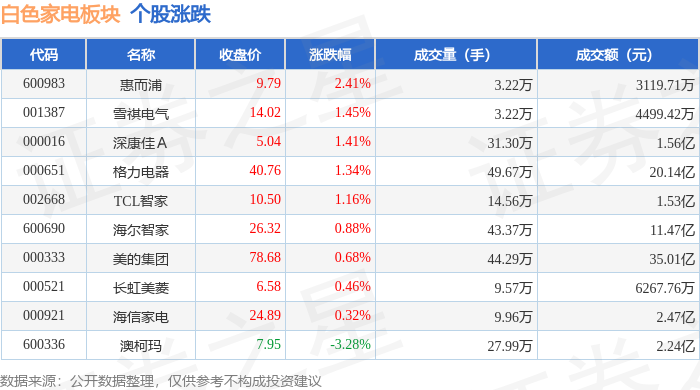
白色家电板块1月5日涨0.85%,惠而浦领涨,主力资金净流出1198.43万元
Zheng Xing Xing Ye Ri Bao· 2026-01-05 08:59
Market Performance - The white goods sector increased by 0.85% on January 5, with Whirlpool leading the gains [1] - The Shanghai Composite Index closed at 4023.42, up 1.38%, while the Shenzhen Component Index closed at 13828.63, up 2.24% [1] Stock Performance - Key stocks in the white goods sector showed the following closing prices and percentage changes: - Whirlpool: 9.79, up 2.41% [1] - Snowman Electric: 14.02, up 1.45% [1] - Deep Blue A: 5.04, up 1.41% [1] - Gree Electric: 40.76, up 1.34% [1] - TCL Smart Home: 10.50, up 1.16% [1] - Haier Smart Home: 26.32, up 0.88% [1] - Midea Group: 78.68, up 0.68% [1] - Changhong Meiling: 6.58, up 0.46% [1] - Hisense Home Appliances: 24.89, up 0.32% [1] - Aucma: 7.95, down 3.28% [1] Capital Flow - The white goods sector experienced a net outflow of 11.98 million yuan from institutional investors and 73.44 million yuan from retail investors, while retail investors had a net inflow of 85.43 million yuan [1] - Detailed capital flow for key stocks includes: - Gree Electric: 106 million yuan net inflow from institutions, but 30.02 million yuan net outflow from retail [2] - Hisense Home Appliances: 3.87 million yuan net inflow from institutions, with a net outflow of 9.75 million yuan from retail [2] - Whirlpool: 2.60 million yuan net inflow from institutions, with a net outflow of 1.50 million yuan from retail [2] - Aucma: 46.62 million yuan net outflow from institutions, but 37.85 million yuan net inflow from retail [2]






华西证券:国补政策收紧推动行业产品升级 品类补贴范围更加聚焦
智通财经网· 2026-01-05 03:00
Core Viewpoint - The current round of national subsidies is more focused compared to 2025, with stricter energy efficiency standards, which will help promote product structure upgrades in the industry, benefiting leading companies with a more complete layout of mid-to-high-end products [1]. Group 1: Policy Announcement - On December 29, 2025, the National Development and Reform Commission (NDRC) announced the implementation of a large-scale equipment update and consumer goods replacement policy for 2026, explicitly supporting the replacement of old home appliances [2]. - On December 30, 2025, the NDRC announced that the first batch of 625 billion yuan in ultra-long-term special government bonds to support consumer goods replacement has been allocated in advance [2]. Group 2: Funding and Subsidy Details - The first batch of 625 billion yuan in support funds for the replacement program has been allocated, with the subsidy categories being more focused compared to 2025. The scale is slightly reduced from the 810 billion yuan allocated in the first batch for 2025 [3]. - The total scale of special government bonds for consumer goods replacement in 2025 was 3000 billion yuan, distributed in four batches, with the first batch accounting for approximately 27%. The estimated total subsidy scale for 2026 is around 2300 billion yuan [3]. Group 3: Subsidy Categories and Standards - The subsidy categories for 2026 have been narrowed from 12 categories in 2025 to 6 categories, focusing on essential appliances such as refrigerators, washing machines, televisions, air conditioners, computers, and water heaters [3]. - The subsidy for 2026 is limited to first-level energy efficiency products, with a uniform subsidy rate of 15%. Each consumer can receive a subsidy for one unit of each product category, with a maximum subsidy of 1500 yuan per unit [4]. - In comparison, the 2025 subsidy standards allowed for second-level energy efficiency products with a subsidy of 15% of the sales price, and first-level products with a 20% subsidy, capped at 2000 yuan per unit [4]. Group 4: Investment Recommendations - Recommendations include leading white goods companies such as Midea Group, Hisense Home Appliances, and Haier Smart Home; and leading black goods companies such as Hisense Home Appliances and TCL Electronics [4].


家电股全线走高 26年家电以旧换新政策出台 有望提振家电消费景气
Zhi Tong Cai Jing· 2026-01-02 06:23
Group 1 - Home appliance stocks experienced a significant increase, with Skyworth Group rising by 10.45% to HKD 5.18, Midea Group increasing by 5% to HKD 89.2, Haier Smart Home up by 4.2% to HKD 25.3, and Hisense Home Appliances gaining 2.33% to HKD 23.72 [1] - The National Development and Reform Commission and the Ministry of Finance jointly issued a notice on December 30 regarding the implementation of large-scale equipment updates and the replacement of consumer goods by 2026, which is expected to positively impact the home appliance sector [1] - Dongfang Securities anticipates that the domestic sales pressure will improve in the first quarter of 2026 as national subsidy funds become available, and the industry will gradually enter a post-subsidy era [1] - Guotou Securities forecasts that the home appliance replacement policy will continue into 2026, with optimized support scope, subsidy standards, and implementation mechanisms, benefiting companies with R&D, channel, and brand advantages [1] - The easing of the US-China trade conflict is expected to reduce tariff pressures, allowing home appliance companies to gradually release global production capacity, with emerging markets contributing to incremental growth [1]
2026年家电以旧换新政策出台 家电消费景气有望提振(附概念股)
Zhi Tong Cai Jing· 2026-01-02 00:45
Group 1 - The 2026 appliance replacement policy will provide subsidies for consumers purchasing energy-efficient home appliances, with a subsidy of 15% of the product price, capped at 1,500 yuan per item [1] - The first batch of subsidies for the 2026 policy amounts to 62.5 billion yuan, which is lower than the 2025 plan, and the eligible appliance categories are fewer [1] - Citigroup believes the new policy will boost consumer sentiment despite the limited overall impact on e-commerce platforms due to high baseline effects and smaller subsidy scale [1] Group 2 - The 2026 policy is expected to stimulate domestic appliance sales and improve product structure, benefiting companies with R&D, channel, and brand advantages in the white and black goods sectors [2] - The easing of US-China trade tensions may reduce tariff pressures, allowing home appliance companies to gradually release global production capacity and gain incremental contributions from emerging markets [2] - The new policy is anticipated to drive the home appliance industry towards high-end, intelligent, and green upgrades, favoring large appliance companies with competitive advantages [2] Group 3 - Related Hong Kong-listed companies in the home appliance industry include Midea Group, Haier Smart Home, Hisense Home Appliances, TCL Electronics, Skyworth Group, and Xiaomi Group [3]
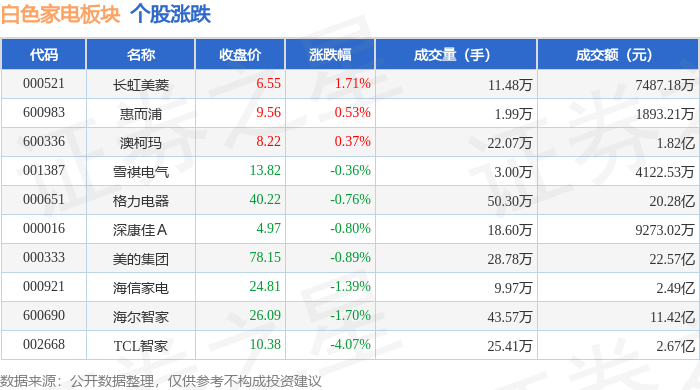
白色家电板块12月31日跌1.01%,TCL智家领跌,主力资金净流出4.24亿元
Zheng Xing Xing Ye Ri Bao· 2025-12-31 08:59
Market Overview - The white goods sector experienced a decline of 1.01% on December 31, with TCL leading the drop [1] - The Shanghai Composite Index closed at 3968.84, up 0.09%, while the Shenzhen Component Index closed at 13525.02, down 0.58% [1] Individual Stock Performance - Changhong Meiling (000521) closed at 6.55, up 1.71% with a trading volume of 114,800 shares and a turnover of 74.87 million yuan [1] - Whirlpool (600983) closed at 9.56, up 0.53% with a trading volume of 19,900 shares and a turnover of 18.93 million yuan [1] - Aucma (600336) closed at 8.22, up 0.37% with a trading volume of 220,700 shares and a turnover of 182 million yuan [1] - Gree Electric (000651) closed at 40.22, down 0.76% with a trading volume of 503,000 shares and a turnover of 2.028 billion yuan [1] - Midea Group (000333) closed at 78.15, down 0.89% with a trading volume of 287,800 shares and a turnover of 2.257 billion yuan [1] - Hisense Home Appliances (000921) closed at 24.81, down 1.39% with a trading volume of 99,700 shares and a turnover of 249 million yuan [1] - Haier Smart Home (600690) closed at 26.09, down 1.70% with a trading volume of 435,700 shares and a turnover of 1.142 billion yuan [1] - TCL Smart Home (002668) closed at 10.38, down 4.07% with a trading volume of 254,100 shares and a turnover of 267 million yuan [1] Capital Flow Analysis - The white goods sector saw a net outflow of 424 million yuan from institutional investors, while retail investors contributed a net inflow of 235 million yuan [1] - TCL Smart Home experienced a net outflow of 45.27 million yuan from retail investors, despite a net inflow of 35.83 million yuan from institutional investors [2] - Midea Group had a net outflow of 44.91 million yuan from retail investors, with a net inflow of 29.11 million yuan from institutional investors [2] - Haier Smart Home had a significant net inflow of 68.95 million yuan from retail investors, despite a net outflow of 21.1 million yuan from institutional investors [2]

美的、海尔、海信、TCL,一场决定未来十年命运的战争
Xin Lang Cai Jing· 2025-12-31 02:07
Core Viewpoint - The Chinese home appliance industry is at a critical juncture, with the theme for 2026 being "going overseas" as domestic market saturation and overcapacity issues become more pronounced. This shift represents a "second entrepreneurship" for companies like Haier, Midea, Hisense, and TCL, marking a decisive battle for the next decade [2]. Group 1: Market Overview - The global home appliance market is nearly 4.5 trillion yuan, indicating significant overseas market potential [4]. - Midea and Haier are projected to generate around 270 billion yuan in revenue each in 2024, translating to a global market share of only about 6% [5]. - Domestic brands struggle to exceed 10% market share in most overseas regions, while leading competitors like Samsung and LG dominate [8]. Group 2: Historical Context and Challenges - Chinese home appliance companies have historically relied on capacity export and brand acquisitions for overseas expansion, but this growth model is becoming less effective [9]. - The gap between global manufacturing share (over 45%) and retail share (less than 20%) highlights a significant challenge in value creation and brand premium [9]. - Haier and Midea's overseas revenue share has stagnated around 50% and 42% respectively over the past five years, indicating a lack of growth [9]. Group 3: Brand and Channel Development - The need for a "second entrepreneurship" in brand and channel development is emphasized, as domestic brands face challenges in replicating their successful domestic strategies in international markets [15]. - Building brand recognition and effective distribution channels in overseas markets is crucial, as traditional strategies may not apply [16][20]. - The complexity of overseas channels, dominated by large retailers, poses significant barriers for Chinese companies [20]. Group 4: Opportunities and Strategies - Technological innovation is seen as a key to overcoming brand premium challenges, with Chinese companies making strides in areas like AI and smart home technology [22]. - Emerging markets such as Southeast Asia and Latin America present significant growth opportunities due to low penetration rates and less established competition [29]. - E-commerce is becoming a vital channel for market entry, allowing brands to reach consumers without heavy investment in physical stores [34]. Group 5: Future Outlook - The transition to a full value chain operation by 2026 signifies a shift from manufacturing management to comprehensive brand and channel strategies [36]. - Success in this transformation is critical for elevating Chinese manufacturing from a "global factory" to a "global brand," enhancing competitiveness in the global market [36].


家用电器行业投资策略周报-20251230
CAITONG SECURITIES· 2025-12-30 13:17
Core Insights - The report maintains a positive outlook on the home appliance sector, particularly focusing on the cost reduction potential of aluminum replacing copper in air conditioning systems [2][5] - The adoption of aluminum-copper technology is seen as a significant step towards reducing production costs amid rising copper prices and resource scarcity [10][15] Group 1: Aluminum-Copper Technology Impact - The use of aluminum instead of copper in air conditioning units can lead to substantial cost savings, with estimates suggesting a reduction of 208 to 277 RMB per unit when replacing 50% of copper, and up to 416 to 554 RMB when replacing 100% [11][12] - Copper currently constitutes about 26% to 33% of the cost in standard air conditioning units, with high-end models reaching over 40% [11][12] - The global market has seen significant adoption of aluminum-copper products, particularly in Japan where approximately 40% to 50% of air conditioners use aluminum heat exchangers [15][16] Group 2: Domestic Market Challenges - Despite the cost advantages, the domestic promotion of aluminum-copper air conditioners faces challenges, including inferior thermal conductivity and corrosion resistance compared to copper [19][20] - Consumer perception is a major barrier, as negative opinions about aluminum's reliability persist, complicating market acceptance [19][20] - The first domestic aluminum-copper air conditioner was launched by Wanbao in collaboration with JD.com, targeting the mid-to-low-end market, which may help accelerate industry-wide material transitions [16][17] Group 3: Industry Performance and Trends - The home appliance sector has shown mixed performance, with the overall index increasing by 0.44%, while specific segments like white goods and black goods experienced varied changes [21][22] - Recent data indicates a decline in domestic sales growth for air conditioners, refrigerators, and washing machines, reflecting broader market challenges [33][47] - The report highlights the importance of monitoring raw material prices, with copper and aluminum prices showing significant fluctuations that could impact production costs [29][31]


家电行业2026年度投资策略:重视红利、拥抱出海、把握家电+转型机遇
HUAXI Securities· 2025-12-30 09:17
Core Insights - The report emphasizes the strong resilience of leading white goods companies, highlighting their high dividend yields, with Gree Electric at 7.3%, Midea Group at 5.1%, Hisense Home Appliances at 4.9%, and Haier Smart Home at 4.6% [6][22] - The "Home Appliance +" strategy indicates opportunities in extending the appliance industry into robotics, with companies like Midea Group and Fuhua Co. making significant advancements [6][58] - The export market shows potential, particularly in the U.S. real estate sector, with expectations of demand recovery due to anticipated interest rate cuts and housing stimulus policies [6][70] Section Summaries 2025 Home Appliance Review - The home appliance index has shown a modest increase of 7.7% year-to-date, underperforming the CSI 300 index by approximately 9.7 percentage points [11][14] - The market style in 2025 has favored growth stocks, while the home appliance sector has leaned towards value, leading to a mismatch in market expectations [13][14] - The public fund allocation in the home appliance sector is at a historical low of 2.94%, indicating potential for future growth as external demand remains optimistic [18][19] Dividends - Leading white goods companies maintain high dividend yields, with Gree Electric at 7.3%, Supor at 6.1%, and Midea Group at 5.1%, reflecting strong earnings resilience [24][29] - The report suggests that the dividend rates for companies like Midea and Haier may continue to increase, supported by robust profit growth [24][30] Domestic Sales - The national subsidy policy has positively impacted consumer confidence, with a clear trend towards structural upgrades in appliance consumption [34] - The sales growth of home appliances has been driven by the "trade-in" policy, although growth rates have shown a declining trend in the latter part of the year [34][39] - The air conditioning market has maintained stable pricing, with a continued trend towards mid-to-high-end products [39] "Home Appliance +" - Midea Group has made significant investments in robotics, with humanoid robots already in practical application within factories [58] - Fuhua Co. is expected to launch its grain storage robots in 2026, indicating a diversification into new growth areas [59] - Key component manufacturers like Huaxiang Co. and Hanyu Group are positioned to benefit from the robotics trend, focusing on core components such as reducers and harmonic drives [64][65] Exports - The U.S. real estate market is expected to recover, with potential interest rate cuts and housing stimulus policies likely to boost demand for home appliances [71][84] - Retail inventory levels in the U.S. are high, which may affect sales performance in the short term, but long-term housing demand remains strong [76][83] - The report anticipates that if mortgage rates fall below 6%, there could be a significant recovery in demand within the real estate chain [84]



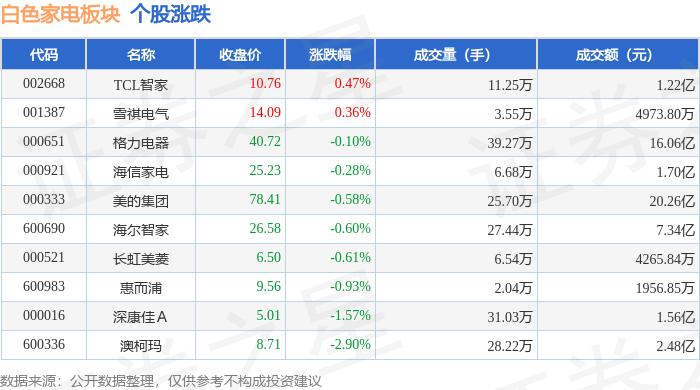
白色家电板块12月29日跌0.48%,澳柯玛领跌,主力资金净流入6074.62万元
Zheng Xing Xing Ye Ri Bao· 2025-12-29 09:06
Market Overview - The white goods sector experienced a decline of 0.48% on December 29, with Aucma leading the drop [1] - The Shanghai Composite Index closed at 3965.28, up 0.04%, while the Shenzhen Component Index closed at 13537.1, down 0.49% [1] Stock Performance - TCL Smart Home (002668) closed at 10.76, up 0.47% with a trading volume of 112,500 shares and a transaction value of 122 million yuan [1] - Gree Electric Appliances (000651) closed at 40.72, down 0.10% with a trading volume of 392,700 shares and a transaction value of 1.606 billion yuan [1] - Midea Group (000333) closed at 78.41, down 0.58% with a trading volume of 257,000 shares and a transaction value of 2.026 billion yuan [1] - Haier Smart Home (600690) closed at 26.58, down 0.60% with a trading volume of 274,400 shares and a transaction value of 734 million yuan [1] - Aucma (600336) closed at 8.71, down 2.90% with a trading volume of 282,200 shares and a transaction value of 248 million yuan [1] Capital Flow - The white goods sector saw a net inflow of 60.7462 million yuan from institutional investors, while retail investors experienced a net outflow of 625.939 million yuan [1] - Gree Electric Appliances had a net inflow of 160 million yuan from institutional investors, but a net outflow of 58.1725 million yuan from retail investors [2] - Midea Group had a net inflow of 41.9801 million yuan from institutional investors, with a net outflow of 52.5536 million yuan from retail investors [2] - Haier Smart Home experienced a net outflow of 81.9545 million yuan from institutional investors, while retail investors had a net inflow of 9.8857 million yuan [2]

2025年1-10月中国家用电冰箱(家用冷冻冷藏箱)产量为8995.9万台 累计增长0.9%
Chan Ye Xin Xi Wang· 2025-12-27 03:02
Core Viewpoint - The report highlights a projected decline in the production of household refrigerators in China for the year 2025, indicating a potential shift in market dynamics within the industry [1]. Industry Overview - According to data from the National Bureau of Statistics, the production of household refrigerators in China is expected to reach 8.79 million units in October 2025, representing a year-on-year decrease of 6% [1]. - From January to October 2025, the cumulative production of household refrigerators is projected to be 89.96 million units, showing a slight increase of 0.9% compared to the previous year [1]. Market Research Insights - The report titled "2025-2031 China Smart Refrigerator Industry Market Panorama Research and Development Trend Judgment Report" by Zhiyan Consulting provides an in-depth analysis of the smart refrigerator market in China [1]. - Zhiyan Consulting is recognized as a leading industry consulting firm in China, specializing in comprehensive industry research reports, business plans, feasibility studies, and customized services [1].

