
HISENSE H.A.(000921)

Search documents
家电行业专题研究:拥抱龙头,重视出海
Xin Lang Cai Jing· 2025-12-26 12:24
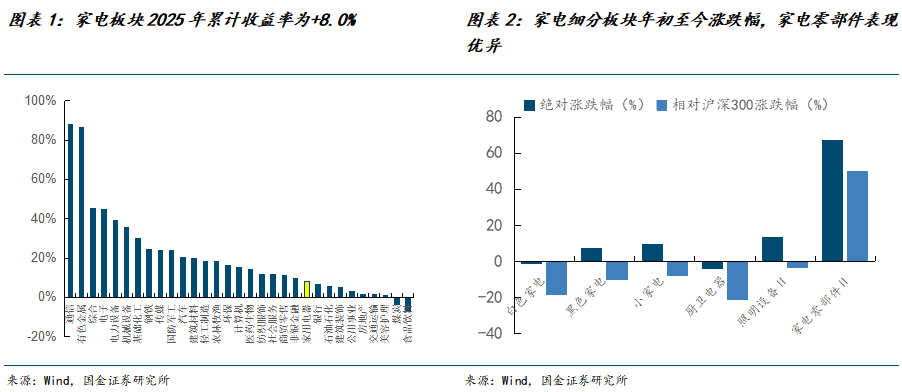
Group 1: Domestic Demand and Market Outlook - The home appliance sector is expected to show a "high first half and stable second half" trend in 2025, driven by policy continuation and consumption peaks [1] - In the first three quarters of 2025, air conditioner shipments increased by 8.4%, refrigerators by 2.4%, and washing machines by 4.1% year-on-year [1][13] - For 2026, the continuation of subsidies is anticipated to mitigate the impact of high base effects and demand pull-forward, with projected declines in overall appliance sales of -4% to -7.3% under various subsidy scenarios [1][16][19] Group 2: Export Performance and Global Market Trends - Home appliance exports have slowed down due to tariff policies and global supply chain adjustments, but still show resilience and structural highlights [2] - In 2025, the export growth rate for air conditioners is expected to be weaker than that of washing machines and refrigerators, primarily due to adverse weather conditions affecting overseas demand [2][39] - The U.S. market is projected to benefit from a rate cut, which may enhance demand for home appliances, while the European market is expected to maintain a slow recovery [42][44][50] Group 3: Investment Themes - The narrative in the black appliance sector is shifting from "market share chasing" to "profit and pricing power," with Chinese brands like Hisense and TCL expected to convert market share into higher profits [3][55] - White appliances are seen as having strong growth potential due to their historical resilience through cycles, with leading brands like Midea and Haier expected to maintain stable growth and generous dividends [3][83] - The global competition in new consumer products, particularly in smart imaging and robotic vacuum cleaners, is expected to favor Chinese brands, highlighting their competitive advantages [3] Group 4: Financial Metrics and Valuation - As of December 22, 2025, the home appliance sector's PE TTM is 16.27 times, remaining below the 10-year average of 32.8% [7] - The white appliance segment's current PE is 11.22, while black appliances stand at 25.94, indicating varying levels of market valuation [9] - The home appliance sector has seen a decline in public fund holdings, with a heavy allocation of only 2.46% in Q3 2025, reflecting concerns over demand in 2026 [9]




白色家电板块12月26日涨0.04%,澳柯玛领涨,主力资金净流出2.18亿元
Zheng Xing Xing Ye Ri Bao· 2025-12-26 09:07
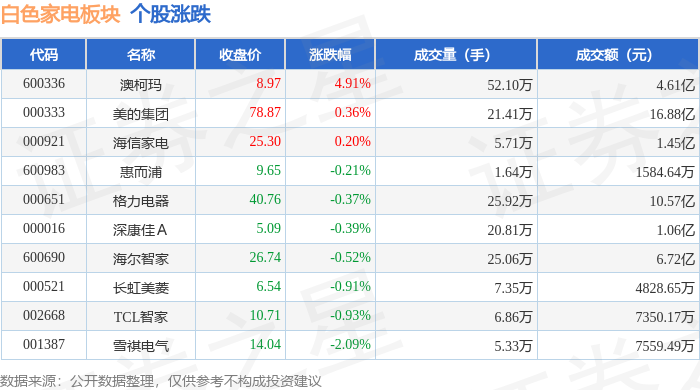
Market Overview - The white goods sector increased by 0.04% on December 26, with Aucma leading the gains [1] - The Shanghai Composite Index closed at 3963.68, up 0.1%, while the Shenzhen Component Index closed at 13603.89, up 0.54% [1] Stock Performance - Aucma (600336) closed at 8.97, up 4.91% with a trading volume of 521,000 shares and a turnover of 461 million yuan [1] - Midea Group (000333) closed at 78.87, up 0.36% with a trading volume of 214,100 shares and a turnover of 1.688 billion yuan [1] - Hisense Home Appliances (000921) closed at 25.30, up 0.20% with a trading volume of 57,100 shares and a turnover of 145 million yuan [1] - Whirlpool (600983) closed at 9.65, down 0.21% with a trading volume of 16,400 shares and a turnover of 15.846 million yuan [1] - Gree Electric (000651) closed at 40.76, down 0.37% with a trading volume of 259,200 shares and a turnover of 1.057 billion yuan [1] - Haier Smart Home (600690) closed at 26.74, down 0.52% with a trading volume of 250,600 shares and a turnover of 672 million yuan [1] Capital Flow - The white goods sector experienced a net outflow of 218 million yuan from institutional investors, while retail investors saw a net inflow of 60.15 million yuan [1] - Midea Group had a net inflow of 28.86 million yuan from institutional investors, but a net outflow of 41.76 million yuan from retail investors [2] - Aucma saw a net inflow of 5.70 million yuan from institutional investors, with a slight outflow from retail investors [2] - TCL Smart Home (002668) had a net inflow of 1.57 million yuan from institutional investors, while retail investors contributed a net inflow of 914,500 yuan [2] - Haier Smart Home experienced a significant net outflow of 1.05 billion yuan from institutional investors, but a net inflow of 536.78 million yuan from retail investors [2]




2025年1-10月中国房间空气调节器产量为23034.4万台 累计增长3%
Chan Ye Xin Xi Wang· 2025-12-26 03:13
Core Viewpoint - The report highlights a decline in the production of room air conditioners in China, with a projected decrease of 13.5% in October 2025 compared to the previous year, indicating potential challenges in the air conditioning industry [1]. Industry Overview - According to the National Bureau of Statistics, the cumulative production of room air conditioners in China from January to October 2025 is 23,034.4 million units, reflecting a cumulative growth of 3% [1]. - The report is based on insights from Zhiyan Consulting, a leading industry consulting firm in China, which has been focused on industry research for over a decade [1]. Company Insights - The companies mentioned in the report include Gree Electric Appliances (000651), Midea Group (000333), Haier Smart Home (600690), Hisense Home Appliances (000921), TCL Technology (000100), and Harbin Air Conditioning (600202) [1].


白色家电板块12月25日跌0.02%,澳柯玛领跌,主力资金净流出2.89亿元
Zheng Xing Xing Ye Ri Bao· 2025-12-25 09:08
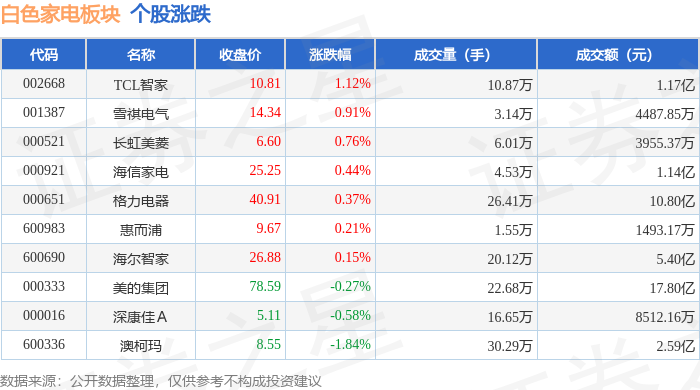
Core Viewpoint - The white goods sector experienced a slight decline of 0.02% on December 25, with Aucma leading the drop, while the Shanghai Composite Index rose by 0.47% and the Shenzhen Component Index increased by 0.33% [1] Group 1: Market Performance - The closing price for TCL Smart Home was 10.81, with an increase of 1.12% and a trading volume of 108,700 shares, amounting to 117 million yuan [1] - Snowball Electric closed at 14.34, up by 0.91%, with a trading volume of 31,400 shares [1] - Changhong Meiling's closing price was 6.60, reflecting a 0.76% increase with a trading volume of 60,100 shares [1] - Hisense Home Appliances closed at 25.25, up by 0.44%, with a trading volume of 45,300 shares [1] - Gree Electric Appliances closed at 40.91, increasing by 0.37% with a trading volume of 264,100 shares [1] - Whirlpool closed at 9.67, up by 0.21%, with a trading volume of 15,500 shares [1] - Haier Smart Home closed at 26.88, reflecting a 0.15% increase with a trading volume of 201,200 shares [1] - Midea Group closed at 78.59, down by 0.27%, with a trading volume of 226,800 shares [1] - Deep Konka A closed at 5.11, down by 0.58%, with a trading volume of 166,500 shares [1] - Aucma closed at 8.55, leading the decline with a drop of 1.84% and a trading volume of 302,900 shares [1] Group 2: Capital Flow - The white goods sector saw a net outflow of 289 million yuan from main funds, while retail investors contributed a net inflow of 228 million yuan [1] - TCL Smart Home experienced a net inflow of 1.38 million yuan from main funds, while retail investors had a net inflow of 589,560 yuan [2] - Changhong Meiling had a net inflow of 4.08 million yuan from main funds, but saw outflows from both retail and speculative funds [2] - Aucma faced a significant net outflow of 33.82 million yuan from main funds, while retail investors contributed a net inflow of 13.64 million yuan [2] - Gree Electric Appliances had a net outflow of 68.64 million yuan from main funds, with retail investors contributing a net inflow of 41.71 million yuan [2]


海信家电20251224
2025-12-25 02:43
Summary of Hisense Home Appliances Conference Call Company Overview - **Company**: Hisense Home Appliances - **Industry**: Home Appliances Key Points Industry and Market Conditions - The fourth quarter of 2025 continues to face operational pressures due to the decline of national subsidies and high base effects from the previous year. However, some product categories are seeing a rebound in price indices, leading to slight improvements in profit margins. The overseas market is undergoing inventory destocking, with expectations for order recovery in December and early next year [2][3][4]. Product and Business Development - The newly launched water-based paint factory in Changsha is expected to enhance the central air conditioning business and improve processing depth, aiding in order growth in the mature markets of Europe and America. Currently, water machine products account for about 5% of total revenue, with positive outlooks for the water-cooled and liquid-cooled market trends [2][5]. - Hisense is exploring aluminum alternatives to copper to mitigate the impact of rising copper prices, with some experience in overseas markets. The domestic market will require consideration of technology maturity and consumer acceptance [2][6]. Strategic Focus and Brand Development - The company anticipates that the effects of subsidy exhaustion will be less severe than historical policies. Hisense is focusing on building core competencies and brand recognition in the post-subsidy era, targeting consumer segments with products like fresh air conditioners and embedded refrigerators to gain competitive advantages [2][7]. - The competitive landscape in the air conditioning market is expected to shift in 2026, with leading companies focusing more on core capabilities and brand image enhancement. Hisense aims to strengthen its competitive edge to perform better in the post-subsidy environment [2][8]. Operational Efficiency and Market Strategy - Hisense plans to maintain profitability in the processing sector while expanding market share in emerging markets. The company is integrating resources from Nantong, Hisense Hitachi, and Jiakang to improve overall efficiency and reduce ineffective SKUs [2][9]. - The air conditioning division has faced operational pressures in 2025, prompting management to implement integration and efficiency measures, including procurement and channel collaboration [2][10]. Revenue and Profit Guidance - For 2026, the central control products are expected to achieve positive growth, with varying quarterly performances. The public construction segment is projected to grow from 15% to 35% of revenue, while the renovation segment is expected to decrease from 35% to 15% [2][11]. - The company is optimistic about overall performance in 2026, despite challenges in the renovation segment, which has seen a decline of over 20% each quarter [2][11]. International Market Outlook - Hisense's international sales have shown good growth, with regions like Latin America exceeding 30% growth. However, some areas like ASEAN have experienced declines due to adverse weather conditions. The company plans to enhance market share and average selling price (ASP) in mature markets while expanding product offerings in flexible markets like Latin America and ASEAN [2][12]. - The 2026 FIFA World Cup in North America is expected to significantly boost Hisense's growth in these regions, leveraging sponsorship to enhance brand visibility and market penetration [2][13]. Risk Management and Supply Chain - Hisense is managing risks related to increased tariffs on exports to Mexico by optimizing local procurement and maintaining a competitive edge through its Mexican manufacturing base [2][14]. - The company is also addressing the impact of the domestic new energy vehicle tax reduction and softening European demand by optimizing product structures to enhance market competitiveness [2][14]. Financial Planning and Capital Expenditure - Hisense plans to maintain a dividend payout ratio of around 50% and is exploring new incentive schemes for employees. Capital expenditures will include the construction of the Changsha mobile phone factory and the second and third phases of the Thailand industrial park, aimed at meeting future demand in Europe and the U.S. [2][17]. Future Guidance - Specific revenue and profit guidance for 2026 will be assessed based on domestic and international market conditions, with plans to communicate updates to the market as necessary [2][18].
家电行业周报(25年第51周):11月家电零售表现筑底,冰洗出口增速有所改善-20251222
Guoxin Securities· 2025-12-22 11:16
Investment Rating - The report maintains an "Outperform the Market" rating for the home appliance industry [6][5][10]. Core Viewpoints - The home appliance retail sector is experiencing a bottoming out in November, with expectations for recovery driven by continued national subsidies and improvements in exports [1][18]. - Despite a challenging environment with high base effects from the previous year, the resilience of leading companies in the home appliance sector remains strong, particularly in the white goods segment [13][14]. - The report highlights a potential rebound in retail demand for home appliances, supported by ongoing national subsidy policies and improved export conditions [18][19]. Summary by Sections 1. Key Recommendations - Recommended companies include Midea Group, Haier Smart Home, TCL Smart Home, Gree Electric Appliances, and Hisense Home Appliances in the white goods category; Hisense Visual Technology in the black goods category; and Roborock, Bear Electric, and Ecovacs in the small appliances category [5][6][14]. 2. Market Performance and Insights - In November, the retail sales of home appliances and audio-visual equipment fell by 19.4% year-on-year, while the overall retail sales in China grew by 1.3% [2][19]. - The export value of home appliances decreased by 6% year-on-year in November, with air conditioning exports down by 25.7%, while refrigerators and washing machines showed signs of recovery with growth rates of 7.6% and 15.8%, respectively [3][46]. - Air conditioning production and sales saw declines exceeding 30% in November, but January production is expected to improve due to the timing of the Spring Festival [4][59]. 3. Key Data Tracking - The home appliance sector achieved a relative return of +0.44% compared to the broader market [61]. - Prices for copper and aluminum increased by 0.4% and 2.4%, respectively, while cold-rolled steel prices remained stable [63][64]. - The real estate sector continues to face challenges, with residential construction and sales areas down by 20.1% and 8.1% year-on-year, respectively [73].
大力神杯青岛焕彩 容声以“鲜”世技术打造硬实力
Zheng Quan Ri Bao Wang· 2025-12-22 10:48
Group 1 - The event featuring the FIFA World Cup trophy in Qingdao symbolizes a deep dialogue between Chinese brands and global top-tier IPs, with Rongsheng showcasing its 2026 World Cup customized refrigerator "Rongsheng Xiwang" [1] - Rongsheng has been a representative Chinese brand partnering with the World Cup for three consecutive sessions, leveraging the event for immersive offline exhibitions and online multi-channel promotions to resonate with sports spirit [1][3] - The company emphasizes its commitment to freshness and health, paralleling the pursuit of excellence in sports, and has developed the WILL natural preservation technology to enhance food preservation [1] Group 2 - The Rongsheng Xiwang refrigerator features the WILL natural preservation technology, which enhances nutritional value and doubles vitamin C content through advanced systems like SUPL Pro wide-area pulse light and AI negative ion sterilization [2] - Rongsheng has set industry standards for embedded refrigerators and authored a white paper on active sterilization technology, establishing itself as a leader in the sector [2] - Market performance reflects the effectiveness of its technology, with the Rongsheng Fangtang 506 flagship model achieving top sales in the offline market shortly after launch, and the Fangtang 515 leading online sales during the Double 11 shopping festival [2]
白色家电板块12月22日跌0.57%,澳柯玛领跌,主力资金净流出1.84亿元
Zheng Xing Xing Ye Ri Bao· 2025-12-22 09:03
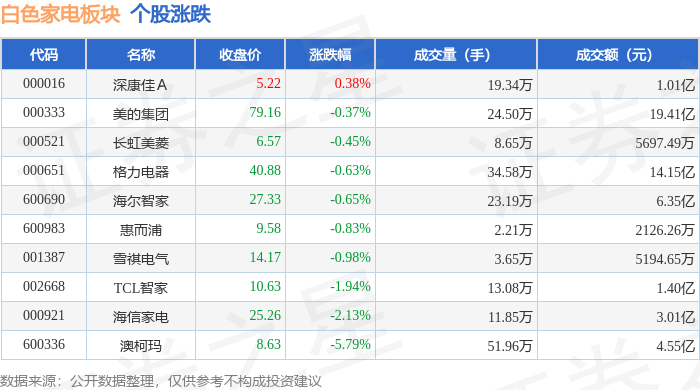
Core Viewpoint - The white goods sector experienced a decline of 0.57% on December 22, with Aucma leading the drop, while the overall Shanghai Composite Index rose by 0.69% and the Shenzhen Component Index increased by 1.47% [1] Group 1: Market Performance - The closing price for Midea Group was 79.16, down by 0.37%, with a trading volume of 245,000 shares and a transaction value of 1.94 billion yuan [1] - Gree Electric Appliances closed at 40.88, down by 0.63%, with a trading volume of 345,800 shares [1] - Haier Smart Home closed at 27.33, down by 0.65%, with a trading volume of 231,900 shares [1] - Aucma saw the largest decline at 5.79%, closing at 8.63, with a trading volume of 519,600 shares [1] Group 2: Capital Flow - The white goods sector had a net outflow of 184 million yuan from institutional investors, while retail investors saw a net inflow of 16.2 million yuan [1] - Haier Smart Home had a net inflow of 7.685 million yuan from institutional investors, but a net outflow of 5.353 million yuan from retail investors [2] - Midea Group experienced a significant net outflow of 136 million yuan from institutional investors, while retail investors had a net inflow of 74.33 million yuan [2] - Aucma faced a net outflow of 37.77 million yuan from institutional investors, but retail investors contributed a net inflow of 34.78 million yuan [2]
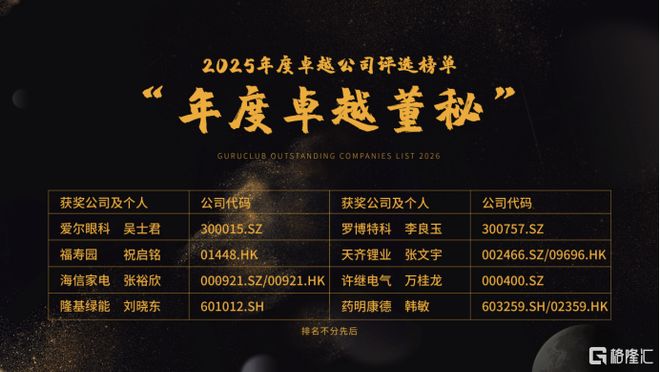
格隆汇“科技赋能·资本破局”线上分享会暨“金格奖”——“年度卓越董秘”奖项揭晓:爱尔眼科(300015.SZ)吴士君、福寿园(01448.HK)祝启铭等8位上榜
Ge Long Hui· 2025-12-22 08:50
Core Viewpoint - The "Golden Award" annual excellence company selection by Gelonghui highlights outstanding companies and their secretaries, emphasizing the importance of corporate governance and investor relations in the market [1][2]. Group 1: Award Winners - Eight individuals received the "Annual Excellence Secretary" award, including Wu Shijun from Aier Eye Hospital, Zhu Qiming from Fushouyuan, Zhang Yuxin from Hisense Home Appliances, Liu Xiaodong from Longi Green Energy, Li Liangyu from Robotech, Zhang Wenyu from Tianqi Lithium, Wan Guilong from XJ Electric, and Han Min from WuXi AppTec [1]. - The award recognizes secretaries for their exceptional performance in corporate governance, equity management, information disclosure, and investor relations [1]. Group 2: Evaluation Process - The selection process for the awards involved quantitative data analysis and expert review to determine the final results [1]. - The "Golden Award" aims to create a valuable reference for investors by ranking listed companies and unicorns across various stock exchanges, including the Hong Kong Stock Exchange, Shanghai Stock Exchange, Shenzhen Stock Exchange, New York Stock Exchange, and NASDAQ [2].



2025年中国除湿机行业政策、发展历程、产业链、发展规模、市场集中度、重点企业及发展趋势研判:随着应用场景的不断拓展,需求不断增加,增长潜力强劲[图]
Chan Ye Xin Xi Wang· 2025-12-22 01:16
Core Viewpoint - The dehumidifier market in China is experiencing significant growth due to increasing awareness of indoor environmental quality, technological advancements, and expanding applications in various sectors such as biomedicine, data centers, and new energy battery production [1][6]. Industry Definition and Classification - Dehumidifiers, also known as moisture removers, consist of components such as compressors, heat exchangers, air duct systems, water tanks, controllers, and casings [2][4]. - They can be categorized based on usage scenarios (household, commercial, industrial), dehumidification methods (refrigeration, wheel, solution), and functionalities (standard, cooling, temperature control, multifunctional) [3][4]. Market Demand and Supply - In 2024, China's dehumidifier production is projected to reach 12.95 million units, with a demand of 1.83 million units and a market size of 2.566 billion yuan; by 2025, production is expected to be 12.09 million units, demand 1.75 million units, and market size 2.407 billion yuan [6][8]. - The household dehumidifier segment dominates the market, accounting for approximately 63.91% in 2024, with commercial and industrial dehumidifiers making up 18.36% and 17.73%, respectively [8]. Industry Development Environment - The Chinese government has implemented various policies to encourage the development of the dehumidifier industry, including measures to promote green and intelligent home appliance consumption [4][5]. Industry Chain - The upstream of the dehumidifier industry includes key raw materials and components such as compressors, fans, heat exchangers, water tanks, and controllers, while the midstream involves manufacturing, and the downstream applications span households, commercial, and industrial sectors [10][11]. Competitive Landscape - The domestic dehumidifier market features a mix of major home appliance companies (e.g., Midea, Gree, Haier) and specialized brands (e.g., Deye, Oujing) [14][15]. - The market is characterized by a "domestic-led + imported high-end coexistence" structure, with domestic brands focusing on mid-to-high-end markets and imported brands targeting high-end segments [14][15]. Key Companies - Deye Technology Co., Ltd. is a leading player in the dehumidifier market, focusing on innovation and high-end industrial dehumidifiers, with a projected total cost of 635 million yuan for its products in 2024 [12][17]. - Oulun Electric Co., Ltd. has established a comprehensive product system covering household, commercial, and industrial dehumidifiers, with dehumidifier revenue accounting for approximately 55.15% of its total revenue in 2024 [19]. Industry Trends - The dehumidifier industry is moving towards smart, energy-efficient, and environmentally friendly solutions, with a focus on enhancing user experience and expanding market demand [20][21]. - There is a trend towards customized products for specific scenarios and the integration of multiple functions, such as dehumidification combined with air purification and temperature control [21][22]. - The industry is expected to see increased concentration, with leading companies leveraging technology and scale to maintain competitive advantages, while niche players may find opportunities in specialized markets [22][23].

