
Bank of Ningbo(002142)

Search documents
再融资结构性松绑,银行业盈利改善
HTSC· 2026-02-24 05:10
Investment Rating - The report maintains an "Overweight" rating for the securities and banking sectors [9]. Core Insights - The report highlights the structural relaxation of refinancing policies, which is expected to improve profitability in the banking sector. The central bank's Q4 monetary policy report emphasizes the implementation of personal credit repair measures, supporting micro-entities [1][28]. - The report identifies investment opportunities in the order of securities > insurance > banking, with a focus on the potential for marginal improvements in the brokerage business due to the recent refinancing policy adjustments [12][24]. Summary by Sections Securities Sector - The optimization of refinancing measures announced by the exchanges is expected to lead to marginal improvements in the brokerage business, with leading firms likely to solidify their advantages through professional capabilities. The Chinese brokerage index performed better than the Hang Seng index during the holiday period, increasing by 0.20% [2][13]. - Recommended stocks include leading brokerages such as CITIC Securities, Guotai Junan, and GF Securities, as well as quality regional firms like Guoyuan Securities [3][12]. Insurance Sector - The report notes a mixed performance in the insurance sector, with property insurance companies showing gains while life insurance companies mostly declined. China Property & Casualty Insurance rose by 5%, while China Taiping fell by 4% [24][25]. - Investors are advised to focus on quality leaders in the insurance sector, with a preference for defensive stocks like China Ping An and China Life Insurance for conservative investors [24][25]. Banking Sector - The banking sector is experiencing a recovery in performance, with Q4 profits improving and net interest margins stabilizing. The report indicates a year-on-year increase in social financing, primarily due to the pre-positioning of government bonds and a rebound in off-balance-sheet financing [28][37]. - Recommended stocks include quality regional banks such as Nanjing Bank and Chengdu Bank, which are expected to perform well due to their strong fundamentals [3][28].





中国人民银行、金融监管总局 发布我国系统重要性银行名单
Jin Rong Shi Bao· 2026-02-24 01:28
Core Viewpoint - The People's Bank of China and the National Financial Regulatory Administration have conducted the 2025 assessment of systemically important banks, identifying 21 domestic banks categorized into five groups based on their systemic importance scores [1] Group 1: Assessment of Systemically Important Banks - A total of 21 domestic systemically important banks have been recognized, including 6 state-owned commercial banks, 10 joint-stock commercial banks, and 5 city commercial banks [1] - The banks are divided into five groups based on their systemic importance scores, with the first group consisting of 11 banks, the second group having 4 banks, the third group with 2 banks, the fourth group containing 4 banks, and the fifth group having no banks [1] Group 2: Breakdown of Bank Groups - The first group includes: China Minsheng Bank, China Everbright Bank, Ping An Bank, Huaxia Bank, Ningbo Bank, Jiangsu Bank, Beijing Bank, Nanjing Bank, Guangfa Bank, Zheshang Bank, and Shanghai Bank [1] - The second group consists of: Industrial Bank, China CITIC Bank, Shanghai Pudong Development Bank, and China Postal Savings Bank [1] - The third group includes: Bank of Communications and China Merchants Bank [1] - The fourth group comprises: Industrial and Commercial Bank of China, Bank of China, China Construction Bank, and Agricultural Bank of China [1] - The fifth group currently has no banks included [1] Group 3: Future Regulatory Actions - The People's Bank of China and the National Financial Regulatory Administration will implement additional regulatory measures for systemically important banks according to the "Regulations on Additional Supervision of Systemically Important Banks (Trial)" [1] - The aim is to enhance the synergy between macro-prudential management and micro-prudential supervision, ensuring the safe and sound operation of systemically important banks [1] - This initiative is intended to better support the high-quality development of the real economy [1]




银行业周度追踪2026年第6周:商业银行四季度利润增速回升-20260224
Changjiang Securities· 2026-02-23 23:30
Investment Rating - The industry investment rating is "Positive" and maintained [11] Core Insights - The banking index fell by 1.3% this week, underperforming the CSI 300 and ChiNext indices by 1.6% and 2.5% respectively, indicating a short-term style switch in the market [6][19] - H-shares of banks led the gains, while most A-shares declined, with notable performances from Huaxia Bank and Shanghai Bank due to improved earnings and strong expectations for convertible bond conversions [6][19] - The price-to-book (PB) ratio and return on equity (ROE) of bank stocks remain undervalued, with a continued recommendation for high-quality city commercial banks in Zhejiang, Jiangsu, and Shandong provinces, including Hangzhou Bank, Ningbo Bank, Jiangsu Bank, Nanjing Bank, Qingdao Bank, Qilu Bank, and Suzhou Bank [6][19] - The report also suggests focusing on low-valuation, high-dividend, and convertible bond opportunities, particularly in Industrial Bank [6][19] Summary by Sections Market Performance - The banking sector's trading activity has decreased, with turnover rates falling, although the transaction volume share for state-owned and rural commercial banks has rebounded [8][39] - The average dividend yield for the six major state-owned banks in A-shares is 4.28%, with a spread of 249 basis points over the 10-year government bond yield, while H-shares yield 5.21% [7][29] Profit Growth and Net Interest Margin - The overall asset growth rate for commercial banks reached 9.0% year-on-year by the end of Q4 2025, with major state-owned banks seeing a growth rate of 10.8% [9][44] - The net profit growth for commercial banks was 2.3% year-on-year, indicating a positive trend, particularly among city and rural commercial banks [9][44] - The net interest margin for 2025 is projected at 1.42%, with a marginal stabilization observed, and a further narrowing of the decline expected in 2026 [9][46] Asset Quality - The non-performing loan (NPL) ratios across various banks are stable or improving, attributed to increased write-off efforts, while the provision coverage ratio continues to decline [10][49] - Capital adequacy ratios remain stable, with attention on the potential impact of the second round of fiscal injections for state-owned banks and refinancing for smaller banks in 2026 [10][49]




银行周报:25Q4银行监管指标:25年银行净利润增速回正-20260223
GUOTAI HAITONG SECURITIES· 2026-02-23 14:55
Investment Rating - The report assigns an "Overweight" rating for the banking sector [4]. Core Insights - The banking sector's net profit growth has turned positive, with a year-on-year increase of 2.33% in Q4 2025, showing an improvement compared to the previous quarters [4][10]. - The net interest margin has stabilized at 1.42%, with expectations of a narrowing decline in 2026 due to the re-pricing of high-cost long-term deposits and a slowdown in the reduction of new loan rates [4][10]. - The non-performing loan (NPL) ratio decreased to 1.50%, indicating a positive trend in asset quality [4][10]. - The capital adequacy ratio improved slightly to 15.5%, reflecting a marginal increase in capital levels [4][10]. Summary by Sections 1. Key Regulatory Indicators for Q4 2025 - Total assets of commercial banks grew by 9.0% year-on-year, with large banks showing a growth rate of 10.8% [7]. - The average capital return rate was 7.78%, and the average asset return rate was 0.60% [10]. 2. Industry and Company Dynamics - The report highlights the ongoing implementation of a moderately loose monetary policy by the central bank, aimed at stabilizing economic growth and ensuring adequate liquidity [10]. - The banking sector's focus for 2026 includes identifying banks with potential for performance growth, particularly recommending Ningbo Bank, China Merchants Bank, and Nanjing Bank [4][10]. 3. Weekly Data Tracking - The report includes weekly tracking of stock performance, with notable fluctuations in bank stock prices, indicating market volatility [18].

11家银行年报抢先看!浦发、中信规模突破10万亿,青岛银行增速领跑
Xin Lang Cai Jing· 2026-02-23 02:11
Core Insights - 11 A-share banks reported their 2025 performance, showing an average total asset growth rate of 11.32%, with city commercial banks significantly outperforming joint-stock banks in profitability [1][12]. Group 1: Performance Overview - The average growth rate of total assets for the 11 banks was 11.32%, while the average growth rate for operating income was 3.30%, and the average growth rate for net profit attributable to shareholders was 7.83% [1][12]. - Analyst Zheng Qingming from Shenwan Hongyuan Securities predicts that listed banks will exhibit stable revenue with gradually improving profit growth, expecting a 0.9% year-on-year revenue growth and a 1.9% recovery in net profit growth for 2025 [1][13]. Group 2: Joint-Stock Banks Performance - Four joint-stock banks (Shanghai Pudong Development Bank, CITIC Bank, China Merchants Bank, and Industrial Bank) reported total assets exceeding 10 trillion yuan, with Shanghai Pudong Development Bank's total assets reaching 100,817.46 billion yuan, a 6.55% increase from 2024 [2][15]. - Shanghai Pudong Development Bank achieved the fastest net profit growth among joint-stock banks, with a net profit of 500.17 billion yuan, an increase of 10.52% year-on-year [2][15]. Group 3: City Commercial Banks Performance - City commercial banks outperformed joint-stock banks in several metrics, with an average total asset growth rate of 15.1%, operating income growth of 5.73%, and net profit growth of 11% [5][19]. - Qingdao Bank emerged as the fastest-growing bank, with total assets growing by 18.12% to 8149.60 billion yuan and net profit increasing by 21.66% [5][19]. Group 4: Asset Quality and Income - Shanghai Pudong Development Bank reported a decrease in non-performing loans and a decline in the non-performing loan ratio, indicating improved asset quality [3][16]. - Several banks, including Ningbo Bank and Nanjing Bank, reported significant increases in net interest income, with Ningbo Bank achieving a 10.77% increase to 531.61 billion yuan [10][25].




国有大行主导手机银行市场,生态嵌入构筑护城河
Jing Ji Guan Cha Wang· 2026-02-18 05:47
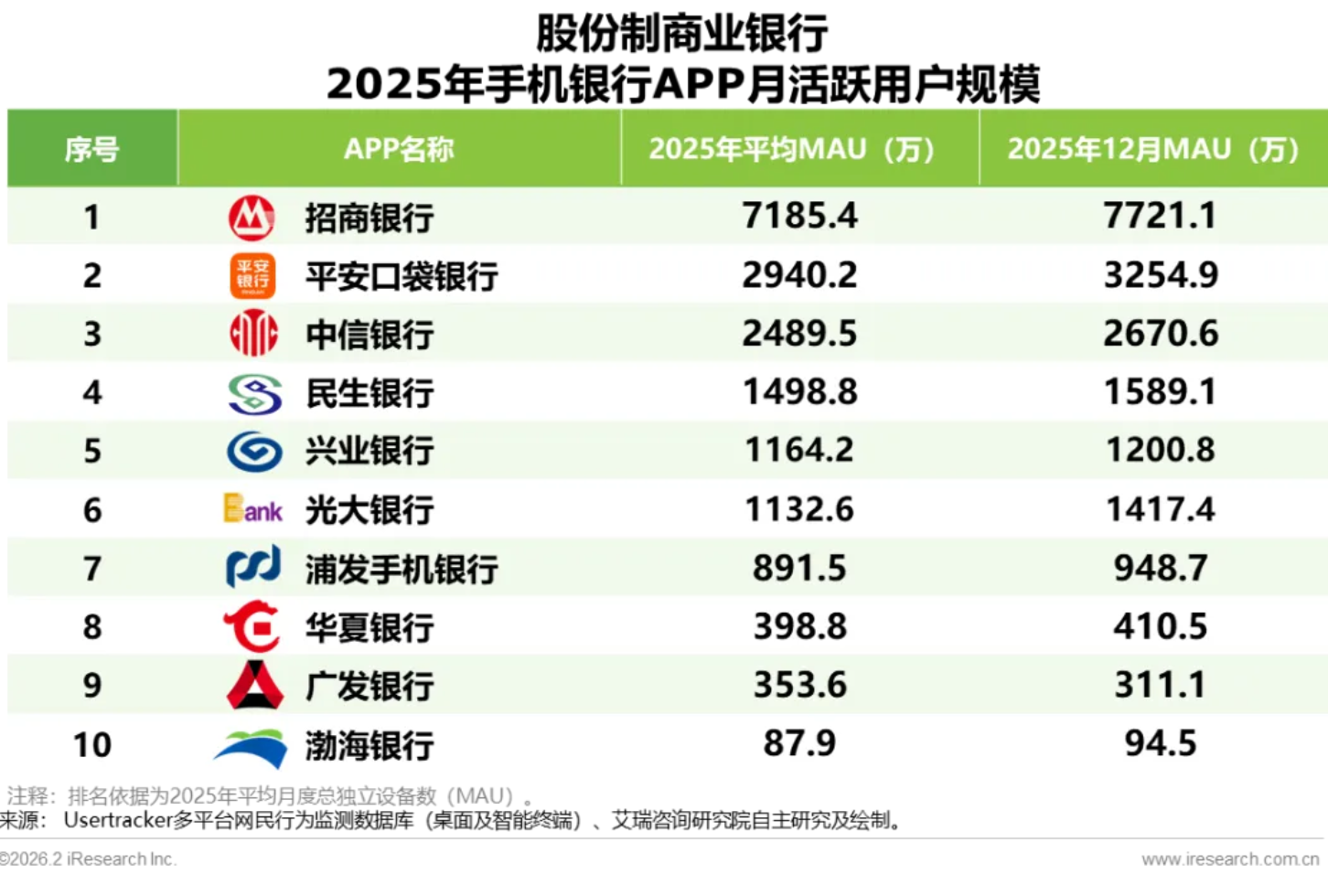
Core Insights - The Chinese mobile banking market is entering a stage of stock competition in 2025, with monthly active users (MAU) stabilizing between 648 million and 739 million [2] - State-owned commercial banks dominate the market due to their ecological embedding advantages, with Agricultural Bank of China leading at 249 million MAU, followed by Industrial and Commercial Bank of China (194 million) and China Construction Bank (109 million) [2] - Private banks are expected to collectively exit the top 50 MAU rankings in 2025 due to a lack of offline branch support and local living ecosystems [2] Group 1: Major Players - Agricultural Bank of China has the highest MAU at 249 million, followed by Industrial and Commercial Bank of China with 194 million and China Construction Bank with 109 million, forming the first tier of banks [2] - China Bank and Postal Savings Bank have MAUs exceeding 50 million, constituting the second tier [2] - China Merchants Bank leads the joint-stock banks with 71.85 million MAU, while Ping An Bank and CITIC Bank form the second tier, with other joint-stock banks generally below 20 million MAU [2] Group 2: Market Dynamics - The core advantage of state-owned banks lies in their "full-scenario integration" capabilities, embedding services deeply into high-frequency life scenarios such as government affairs, social security, healthcare, and education [2] - Agricultural Bank of China extends its services to rural areas through intelligent service matching and customer customization, while Industrial and Commercial Bank of China utilizes its "Gong Xiao Zhi" model for interactive service [2] - Regional banks like Jiangsu Bank, Beijing Bank, and Ningbo Bank show stable performance by focusing on local markets, with some rural commercial banks like Fujian Rural Credit exceeding 4.5 million MAU, indicating the sustainability of localized operations in the stock market [2]



2.7分钟定生死 手机银行存量厮杀谁在“断臂”,谁在“吃肉”?
Jing Ji Guan Cha Wang· 2026-02-18 04:57
Core Insights - The report by iResearch indicates that the monthly active users (MAU) of mobile banking apps in China have stabilized after fluctuating between 648 million and 739 million, signaling a ceiling in user growth and a shift from acquiring new users to enhancing existing user engagement [2] - User behavior is undergoing a structural reversal, with the effective daily usage time per device dropping from 4.9 minutes in 2023 to around 2.7 minutes by mid-2025, leading to a focus on high-frequency, short-duration, and functional usage [2] - Financial institutions are compelled to streamline operations and focus resources on core transaction scenarios to survive in this competitive landscape, where efficiency and precision are paramount [2] Mobile Banking Market Overview - The top three banks in terms of MAU are Agricultural Bank of China (2.49 billion), Industrial and Commercial Bank of China (1.94 billion), and China Construction Bank (1.09 billion), with all six major state-owned banks ranking in the top ten [3][5][6] - Private banks, represented by WeBank and MYbank, have faced significant setbacks, with many dropping out of the top 50 MAU rankings by 2025 [4] Competitive Landscape - State-owned banks are solidifying their dominance through extensive customer bases and integrated ecosystems, leveraging services embedded in high-frequency life scenarios such as government services and healthcare [7] - Joint-stock commercial banks are adopting a "specialized and precise" survival strategy, with China Merchants Bank leading among them with 71.85 million MAU, focusing on wealth management and intelligent interaction [8][10] - Regional banks are thriving by deeply engaging with local markets, while private banks struggle due to high customer acquisition costs and lack of local ecosystem support [13][14] Future Outlook - The mobile banking market is transitioning from a phase of scale expansion to one of value cultivation, with state-owned banks building moats through ecosystems, joint-stock banks seeking niches through specialization, and regional banks solidifying their local roots [14] - The ability to create irreplaceable value in a limited user engagement environment will be crucial, with technology applications such as AI reshaping service processes and enhancing risk management [15][16]

银行行业2026年1月金融数据点评:政府债发力明显,股市活跃推动存款搬家
Zhong Guo Yin He Zheng Quan· 2026-02-15 06:24
Investment Rating - The report maintains a "Recommended" rating for the banking sector, highlighting its high dividend and low valuation attributes that continue to attract long-term capital [5]. Core Insights - The banking sector is experiencing a significant contribution from government bonds to social financing growth, with a notable increase in government bond issuance in January 2026 [5]. - The report indicates that while social financing has increased year-on-year, the growth rate has decreased compared to the previous month, primarily due to weaker RMB loans and fluctuating demand from the real economy [5]. - The capital market's activity is driving a "deposit migration" process, as increased market engagement leads to higher liquidity in the banking sector [5]. Summary by Sections Banking Industry - In January 2026, new social financing reached 7.22 trillion yuan, an increase of 165.4 billion yuan year-on-year, with government bonds being the main contributor [5]. - RMB loans increased by 4.9 trillion yuan, which is a decrease of 319.4 billion yuan year-on-year, influenced by demand fluctuations and debt restructuring [5]. - The report notes that short-term loans in the real sector have increased, while medium and long-term loans remain weak, particularly in the real estate sector, which saw a 28.5% decline in sales for major developers [5]. Market Activity - The report highlights that M1 and M2 growth rates are at 4.9% and 9% respectively, indicating an increase in liquidity [5]. - Financial institutions' RMB deposits increased by 9.9% year-on-year, with a monthly increase of 8.09 trillion yuan, driven by both household and corporate deposits [5]. - The report emphasizes the role of an active capital market in attracting deposits, with a 58% increase in average daily trading volume in January [5].

银行业周报:央行关注存款搬家,2025Q4银行业净利增速回正
Zhong Guo Yin He Zheng Quan· 2026-02-15 06:24
Investment Rating - The report maintains a "Recommended" rating for the banking sector, highlighting the continued attractiveness of high dividend yields and low valuations for long-term investors [5]. Core Insights - The banking sector is expected to benefit from a stable growth in scale and a recovery in net profit growth, with a year-on-year increase of 2.33% in net profit for 2025 [9][11]. - The central bank's monetary policy will continue to be moderately accommodative, focusing on structural optimization and financial support for key areas such as domestic demand and small and medium enterprises [7][8]. - The phenomenon of "deposit migration" is impacting the liability structure of banks, but overall liquidity remains stable [8][9]. Summary by Sections Latest Research Insights - The central bank's 2025Q4 monetary policy report emphasizes maintaining ample liquidity and optimizing financial resource allocation through fiscal and monetary policy coordination [7]. - The report indicates that the average weighted interest rate for new loans in 2025 was 3.15%, a decrease of 9 basis points compared to the previous year [7]. Weekly Market Performance - The banking sector underperformed the market, with a decline of 1.31% compared to a 0.36% increase in the CSI 300 index [5]. - The current price-to-book ratio for the banking sector is 0.64, with a dividend yield of 4.64% [5]. Regulatory and Policy Updates - The banking sector's key regulatory indicators for 2025Q4 show a net profit growth recovery, with total assets increasing by 9% year-on-year [9][10]. - The non-performing loan ratio decreased to 1.5%, indicating an improvement in asset quality across various types of banks [10][11]. Investment Recommendations - The report suggests focusing on banks with low valuations and high dividend yields, recommending specific banks such as ICBC, Agricultural Bank of China, and Postal Savings Bank [5][39]. - The anticipated continuation of accommodative monetary policy and structural financial support is expected to enhance the effectiveness of policies aimed at boosting domestic demand [5][7].
1月金融数据点评:财政靠前发力支撑社融,M1增速显著回升
Orient Securities· 2026-02-14 14:12
Investment Rating - The report maintains a "Positive" outlook for the banking sector in 2026, indicating a return to fundamental narratives supported by policy-driven financial tools [6][25]. Core Insights - The report highlights that in January 2026, social financing (社融) increased by 8.2% year-on-year, with a total increment of 7.22 trillion yuan, exceeding market expectations [9][10]. - The report emphasizes the resilience of asset expansion in the banking sector, supported by a concentrated repricing cycle of deposits, which is expected to stabilize net interest margins [25][26]. - It identifies two main investment themes: quality small and medium-sized banks with solid fundamentals and state-owned banks with defensive value [26]. Summary by Sections Social Financing and Loan Growth - In January 2026, social financing increased by 8.2% year-on-year, with a total increment of 7.22 trillion yuan, which is 1,654 billion yuan more than the previous year [9][10]. - The report notes that the increment in government bonds was significant, with an increase of 2,831 billion yuan, marking the highest level for January since 2020 [10]. - The report indicates that the growth rate of loans fell to 6.1% year-on-year, with new loans amounting to 4.71 trillion yuan, which is 4,200 billion yuan less than the previous year [13][14]. Deposit Growth and Monetary Aggregates - M1 and M2 growth rates showed a rebound, with M1 increasing by 4.9% year-on-year and M2 by 9.0% [21]. - The report states that new RMB deposits reached 8.09 trillion yuan, an increase of 3.77 trillion yuan year-on-year, driven by significant growth in corporate and non-bank deposits [21][24]. Investment Recommendations - The report suggests focusing on two investment lines: quality small and medium-sized banks such as Nanjing Bank, Ningbo Bank, and Chongqing Rural Commercial Bank, and state-owned banks like Bank of Communications and Industrial and Commercial Bank of China, which are rated as stable [25][26].
