SUNWODA(300207)

Search documents
中伟股份:与欣旺达签署固态电池战略合作框架协议
Xin Lang Cai Jing· 2025-12-25 10:18
中伟股份公告,公司与欣旺达动力科技股份有限公司于2025年12月25日签署了《固态电池战略合作框架 协议》。双方将围绕前驱体产品技术开发、产品供应、正极材料开发及全球产能布局等领域开展全方位 战略合作,共同开发固态电池应用系列的新能源电池材料,推动其产业化实施。 ...

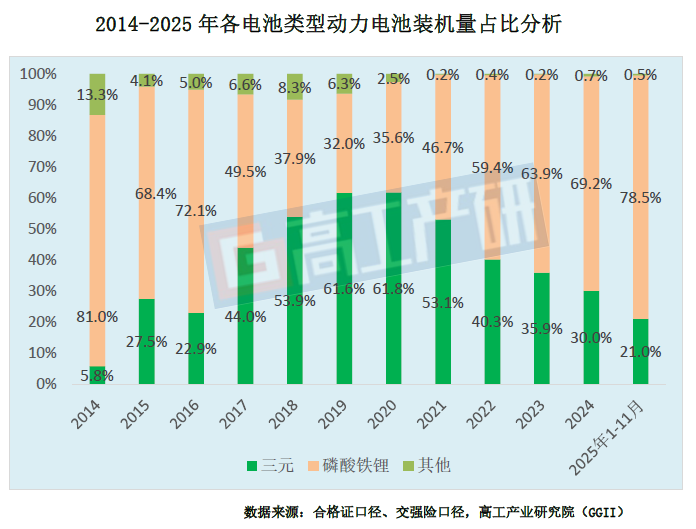
GGII:2025年1-11月国内磷酸铁锂动力电池装机份额高达78.5% 后市有望突破历史峰值
智通财经网· 2025-12-25 08:52
Core Insights - The domestic lithium iron phosphate (LFP) battery installation volume is projected to reach approximately 490 GWh from January to November 2025, representing a year-on-year growth of 55% and a market share of 78.5%, an increase of 10 percentage points compared to the same period last year [1][5]. Group 1: Market Trends - The significant increase in the market share of LFP batteries is primarily driven by market demand rather than policy incentives, contrasting with 2014 when policy was the main driver [3]. - The proportion of new vehicles equipped with LFP batteries has remained between 90% and 96% this year, with a notable increase from 92% to 94.5% in the second half of the year, indicating a growing preference among manufacturers for LFP technology [5]. Group 2: Product Offerings - The number of new energy passenger car models equipped with LFP batteries has risen from 213 to 536 over the past three years, with popular models like Geely Xingyuan, Xiaomi SU7, and XPeng MONA M03 accelerating production and delivery, further boosting the market share of LFP batteries [8]. Group 3: Competitive Landscape - The top 10 companies in the domestic LFP battery installation market accounted for 95.3% of the total volume from January to November 2025, with companies like CATL, EVE Energy, and Xinwangda showing steady growth over the past three years [10]. - CATL's market share is projected to increase from 34.42% in 2023 to 36.79% in 2025, while BYD's share is expected to decline from 43.49% to 29.19% during the same period [11].





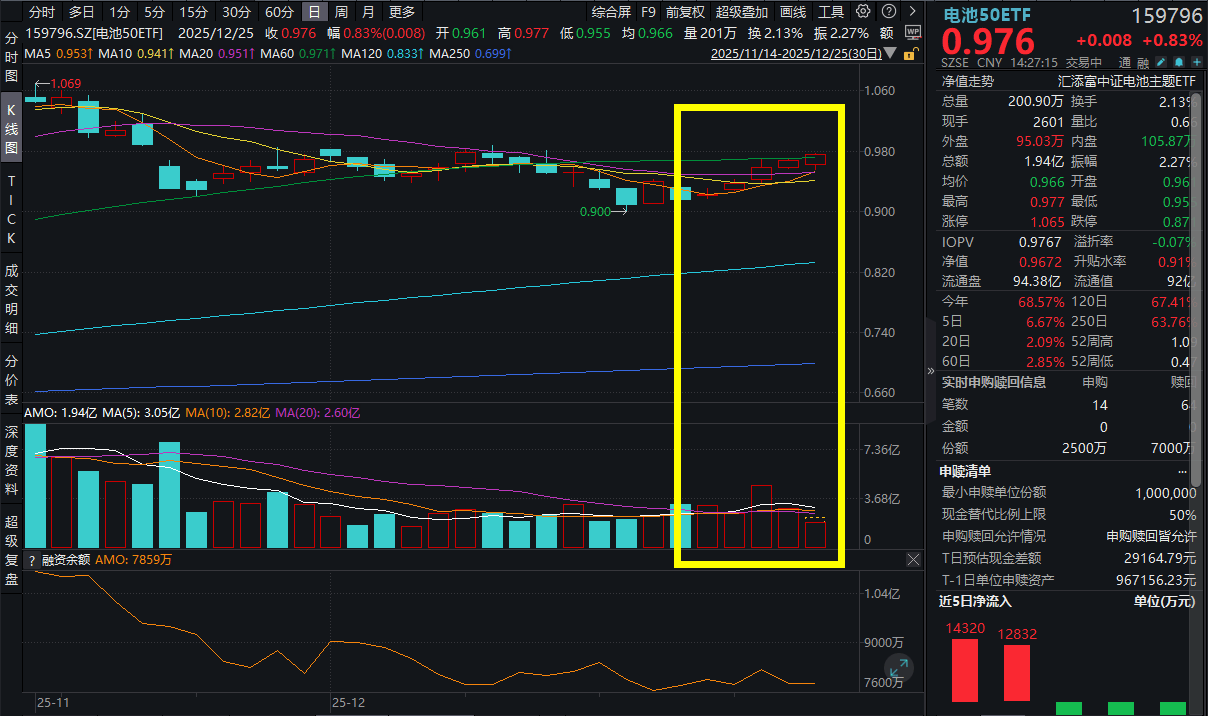
碳酸锂期货 “限购模式”开启!电池板块午后强劲翻红,先导智能涨超2%,电池50ETF(159796)涨近1%冲击五连阳,锂电材料领域迎多重积极变化
Sou Hu Cai Jing· 2025-12-25 06:57
Core Viewpoint - The A-share market is experiencing a strong upward trend, with the Battery 50 ETF (159796) showing significant gains and a notable increase in trading volume, indicating positive investor sentiment in the battery sector [1][3]. Market Performance - As of December 25, the Battery 50 ETF (159796) surged by 0.83%, with a trading volume exceeding 200 million yuan, marking a potential five-day winning streak [1]. - The index's constituent stocks exhibited mixed performance, with Sanhua Intelligent Control rising over 5% and leading other stocks, while companies like CATL and Yiwei Lithium Energy experienced slight declines [3][4]. Lithium Carbonate Market - Lithium carbonate futures saw a significant increase, rising nearly 6% on December 24, approaching 130,000 yuan, and reaching a new high for the year [6]. - The main contract for lithium carbonate experienced a short-term surge, with a daily decline narrowing to 0.6% after initially dropping nearly 6% [6]. Industry Trends - The lithium battery materials sector is witnessing multiple positive changes, driven by unexpected demand in energy storage, leading to a recovery in the industry’s overall health [6][7]. - The electrolyte supply chain is expected to see a significant upward shift, with lithium hexafluorophosphate prices rising rapidly, indicating a tight balance in the industry by 2026 [6][7]. Supply and Demand Forecast - Projections for lithium battery demand show an increase from 1,502 GWh in 2024 to 2,603 GWh by 2026, while supply is expected to grow from 2,271 GWh to 3,558 GWh in the same period, resulting in a decreasing surplus rate [8]. - The supply-demand balance for various components, including electrolytes and separators, is expected to improve significantly, with supply growth lagging behind demand [8]. Investment Strategy - The Battery 50 ETF (159796) is highlighted as a strategic investment option, focusing on sectors with high growth potential, such as energy storage and solid-state batteries, which are expected to benefit from technological advancements [9][11]. - The ETF's index has a high concentration of energy storage components (27%) and solid-state battery components (42%), positioning it favorably for future growth opportunities [9][11]. Conclusion - The Battery 50 ETF (159796) is positioned as a leading investment vehicle in the battery sector, with a low management fee and significant market presence, making it an attractive option for investors looking to capitalize on the sector's growth [14].




欣旺达南昌新能源公司增资至37亿
Xin Lang Cai Jing· 2025-12-25 06:45
天眼查App显示,近日,南昌欣旺达新能源有限公司发生工商变更,注册资本由约30亿人民币增至约37 亿人民币。该公司成立于2021年8月,法定代表人为刘桂松,经营范围包括电池制造、电池销售、软件 开发、电子产品销售等。股东信息显示,该公司由欣旺达动力科技股份有限公司全资持股。 ...
欣旺达南昌新能源公司增资至37亿 增幅约23%
Xin Lang Cai Jing· 2025-12-25 06:39
Core Insights - Nanchang Xinwangda New Energy Co., Ltd. has increased its registered capital from approximately 3 billion RMB to about 3.7 billion RMB, representing a growth of around 23% [1] Company Overview - The company was established in August 2021 and is legally represented by Liu Guisong [1] - Its business scope includes battery manufacturing, battery sales, software development, and electronic product sales [1] - Xinwangda New Energy is wholly owned by Xinwangda Power Technology Co., Ltd. [1]
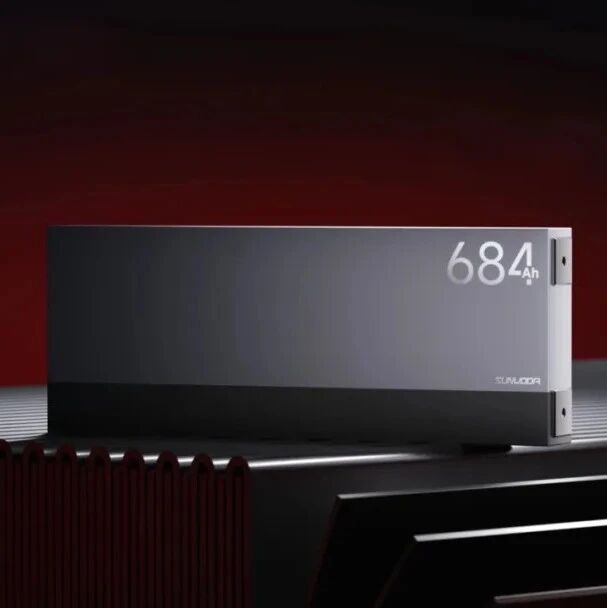
欣旺达第100万颗684Ah叠片电芯顺利下线!
中关村储能产业技术联盟· 2025-12-24 23:49
Core Viewpoint - The successful production of the 1 millionth 684Ah stacked cell by XINWANDA marks a significant milestone in the large-capacity energy storage cell manufacturing, demonstrating the company's leading advantages in technology and production capabilities [2][4]. Group 1: Production Milestone - On February 23, XINWANDA achieved the production of its 1 millionth 684Ah stacked cell, just three months after starting mass production on September 6 [2]. - This milestone indicates that large-capacity stacked cells have entered a stable and mature stage of mass manufacturing [2]. Group 2: Technological and Manufacturing Advantages - XINWANDA's success is attributed to its forward-looking layout and continuous investment in the stacking process, which has established a complete manufacturing system from product design to mass production [4]. - The company has achieved improvements in consistency, reliability, and efficiency, ensuring stable delivery of large-capacity energy storage cells [4]. Group 3: Industry Impact - The successful launch of the 1 millionth 684Ah stacked cell strengthens XINWANDA's core competitiveness in the energy storage cell sector and lays the foundation for large-scale applications and long-term partnerships in the global energy storage market [4]. - This achievement validates the industrialization path of the stacking process in large-capacity energy storage cells, promoting advancements in energy storage systems towards higher safety, efficiency, and overall lifecycle value [4].
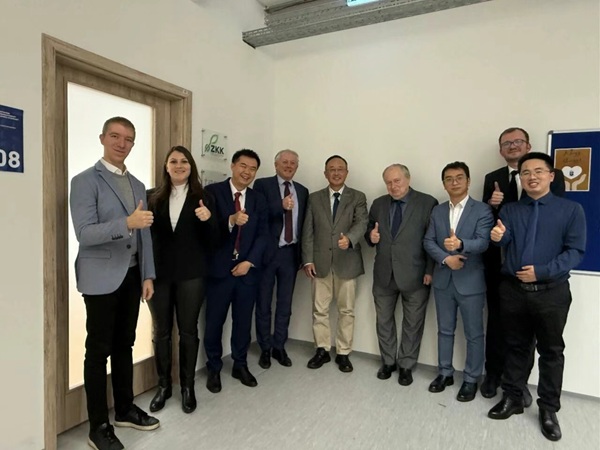
欣旺达:与匈牙利电池联盟深度对话 共探电池护照与可持续发展合作新路径
Zhong Guo Qi Che Bao Wang· 2025-12-24 10:59
Group 1 - The core discussion focused on the implementation of battery passports and sustainable development in the battery industry, establishing a cooperative bridge between China and Central Europe [1][3] - Liang Rui shared insights on the latest developments in the global and Chinese battery industry, including breakthroughs in solid-state batteries and ultra-fast charging technologies, as well as the consensus reached at the Global Battery Alliance (GBA) 2025 annual conference [3] - The company has made significant progress in sustainable development, including the promotion of green electricity and energy-saving projects, and has developed a battery passport platform that manages the entire lifecycle and carbon footprint [3] Group 2 - HUBA, as a key organization for the development of Hungary's local battery industry, expressed strong willingness to collaborate and recognized the company's advanced experience in battery digital compliance and GBA pilot operations [3][4] - Both parties agreed to establish a regular communication mechanism for the implementation of EU battery regulations and precise carbon footprint accounting, enhancing information exchange and experience sharing [3][4] - The dialogue addressed the strategic value of new energy storage industries amid global energy structure adjustments, with a focus on expanding hydrogen storage technology applications and improving safety regulations [4]
“充电像加油”还有多远?超快充技术狂奔,安全标准体系亟待升级
Zhong Guo Neng Yuan Wang· 2025-12-24 09:29
Core Insights - The competition in the new energy vehicle charging market is intensifying, driven by the dual forces of technological maturity and rising demand for ultra-fast charging solutions [1] Group 1: New Products and Solutions - Ultra-fast charging technology is becoming a key direction in the evolution of charging technologies, with major domestic and international automakers and battery manufacturers increasing their investments and innovations in this area [2] - Li Auto plans to mass-produce its self-developed 5C battery, enhancing safety and user experience [2] - Chunan New Energy launched the "Zufeng" 6C fast-charging battery, achieving a continuous 6C charging rate and a range of over 1000 kilometers [2] - A new commercial vehicle ultra-fast charging battery, Gen2, was released by Xinwanda, following the introduction of a large-capacity battery for heavy trucks [2] - Huawei introduced a liquid-cooled megawatt fast charging solution with a peak power of 1.5 megawatts, capable of charging 20 kWh per minute [2] Group 2: Infrastructure Development - The surge in private car ownership is accelerating the deployment of ultra-fast charging stations in residential and commercial areas, while the electrification of logistics heavy trucks is driving the construction of high-power DC charging equipment [3] Group 3: Safety Standards and Challenges - Achieving fast charging performance requires a multi-dimensional optimization of vehicles, batteries, charging equipment, thermal management, and costs, presenting certain technical challenges [4] - The new national standard for electric vehicle batteries, effective from July 2026, includes safety tests for fast charging cycles, requiring batteries to pass external short-circuit tests after 300 fast charging cycles [4] - The development of new anode materials, such as silicon-based and hard carbon, is necessary to meet the higher safety requirements posed by ultra-fast charging [5] Group 4: Ecosystem Construction - The development of ultra-fast charging technology is entering a "fast lane," with applications expanding beyond passenger vehicles to commercial vehicles and emerging eVTOL markets [6] - A more complete and efficient ultra-fast charging ecosystem is crucial for the speed and quality of industry development, necessitating collaboration among battery, vehicle, and charging infrastructure sectors [6] - There is a need for unified charging standards and communication protocols to enhance compatibility between charging stations and batteries, facilitating user convenience [6] Group 5: Regional Infrastructure Gaps - Coverage of charging infrastructure in third- and fourth-tier cities and rural areas remains insufficient, with a need for improved ratios of fast and ultra-fast charging stations [7] - The existing charging network is lagging in adapting to vehicle evolution, indicating a need for policy support to encourage the construction of high-quality charging stations in rural areas and ultra-fast networks for logistics heavy trucks [7]

动力电池和储能电池需求旺盛,锂电材料价格回升 | 投研报告
Zhong Guo Neng Yuan Wang· 2025-12-24 02:04
Core Viewpoint - The lithium battery industry is experiencing significant growth in production and demand, with notable increases in both battery and phosphoric iron lithium cathode material output in November 2025 compared to the same period in 2024 [1][2]. Production - In November 2025, domestic battery production reached 176.3 GWh, marking a year-on-year increase of 49.66% and a month-on-month increase of 3.34% [1][2]. - The production of phosphoric iron lithium cathode materials in November 2025 was 26.89 million tons, reflecting a year-on-year growth of 29.43% and a month-on-month growth of 0.75%, with a capacity utilization rate of 62.53% [1][2]. Pricing - The price of industrial-grade lithium carbonate rose to 101,000 yuan per ton as of December 19, 2025, with a weekly increase of 7.44% [3]. - The price of phosphoric iron lithium (power type) remained stable at 39,100 yuan per ton as of December 19, 2025 [3]. - The average price of square phosphoric iron lithium energy storage cells remained stable, with prices reported at 0.385, 0.310, and 0.310 yuan/Wh for different capacities [3]. Demand - In November 2025, the monthly shipment of phosphoric iron lithium batteries reached 75.3 GWh, a year-on-year increase of 43.62% and a month-on-month increase of 11.56%, setting a new high for the year [4]. - The monthly shipment of ternary power batteries was 18.2 GWh, showing a year-on-year increase of 33.82% and a month-on-month increase of 10.30% [4]. - The export volume of Chinese power batteries in November 2025 was 21.2 GWh, a year-on-year increase of 69.60% and a month-on-month increase of 9.28% [4]. Investment Recommendations - The company suggests focusing on core enterprises in the battery sector that are leading in both domestic and overseas markets, particularly those with a collaborative layout in power batteries and energy storage [5]. - Companies to watch include CATL (300750.SZ), Yiwei Lithium Energy (300014.SZ), and others involved in lithium battery materials [5].


锂电2025:从深度回调到迅速复苏
Shang Hai Zheng Quan Bao· 2025-12-23 19:06
Core Viewpoint - The lithium battery industry is experiencing a significant recovery in 2025, driven by unexpected growth in global energy storage demand and a mismatch between actual production capacity and planned capacity in China [2][3]. Group 1: Industry Recovery - The year 2025 is identified as a "value return year" for the energy storage industry, with companies like Ruipu Lanjun reporting full production capacity and orders extending into the first quarter of 2026 [3]. - Major lithium battery companies, including XINWANDA and YIWAI Lithium Energy, are experiencing "full production and sales," indicating a strong demand for energy storage batteries [3]. - The total shipment of lithium batteries in China for the first three quarters of 2025 reached 430 GWh, exceeding the total for 2024 by 30% [3]. Group 2: Supply Chain Dynamics - The price of lithium battery materials, particularly lithium hexafluorophosphate, has surged over 240% from its low point earlier in the year, affecting various components in the supply chain [4]. - There is a growing trend of long-term contracts in the lithium battery supply chain, with companies securing large procurement agreements to ensure supply chain stability [4]. - The tightening of lithium mining approvals has led to a significant increase in lithium carbonate prices, with futures contracts surpassing 120,000 yuan/ton [4][8]. Group 3: Industry Transformation - The lithium battery industry is transitioning from a reliance on "price for volume" to a focus on technological innovation and high-quality development [5]. - The concept of "anti-involution" is becoming a key theme in the lithium battery sector, reflecting a broader trend in Chinese manufacturing towards quality and efficiency over mere scale [6]. - The net profit margin for battery companies remains low, with a median of 2.78% for 105 listed companies in the sector, indicating ongoing challenges despite the recovery [7]. Group 4: Solid-State Battery Development - Solid-state batteries are gaining attention as the next generation of battery technology, with significant investments and production capacity planned [9]. - The industry is moving towards a more organized competitive landscape, with breakthroughs in standardization and collaboration across the supply chain [10]. - The commercialization timeline for solid-state batteries is projected to accelerate, with expectations for large-scale applications between 2028 and 2030 [10][11]. Group 5: Future Outlook - The lithium battery industry is expected to face new growth challenges, with ongoing efforts to address internal competition and enhance supply chain security [11]. - The central economic work conference has highlighted the need for a unified national market and further measures to combat "involution," which may improve profit margins in the lithium battery sector [11]. - The future of the lithium battery industry is tied to new technologies and applications, with significant opportunities arising from the global transition to low-carbon energy and increased demand for energy storage solutions [11].