
HUA XIA BANK(600015)

Search documents
1月信贷社融点评:温和开门红
ZHESHANG SECURITIES· 2026-02-14 05:23
Investment Rating - The industry investment rating is "Positive" (maintained) [4] Core Insights - The report highlights a "strong deposit, weak loan" characteristic in the opening month of the year [4] - In January 2026, new social financing increased by 7.2 trillion yuan, a year-on-year increase of 166.2 billion yuan, with a balance growth of 8.2% [4][5] - New RMB loans in January 2026 amounted to 4.7 trillion yuan, a year-on-year decrease of 420 billion yuan, with a balance growth of 6.1% [4][5] - The report indicates that consumer demand has shown some recovery, particularly in short-term loans, but overall consumer credit demand may remain pessimistic throughout the year [1][2] Summary by Sections Credit Overview - Entity credit remained stable, with a significant reduction in bill financing [1] - Retail loans saw an increase of 456.5 billion yuan in January, with short-term loans contributing 109.7 billion yuan [1] - Corporate loans totaled 4.5 trillion yuan, a year-on-year decrease of 330 billion yuan, influenced by a substitution effect between short-term loans and bill financing [2] Social Financing - Government bonds contributed significantly to social financing, with new issuance of 976.4 billion yuan in January, a year-on-year increase of 283.1 billion yuan [5] - The report notes a trend of "deposit migration," with non-bank deposits reaching 36 trillion yuan, accounting for 10.7% of total deposits [5] Investment Recommendations - The report recommends a "New Momentum Portfolio" including banks like Nanjing Bank, Shanghai Bank, and others, highlighting their potential for value recovery [3][5] - It emphasizes the importance of high-dividend bank stocks in the current environment, suggesting that banks with new growth drivers may achieve greater value restoration [5]





最新21家系统重要性银行名单公布
Jing Ji Ri Bao· 2026-02-14 04:21
Group 1 - The People's Bank of China and the National Financial Regulatory Administration have conducted an assessment for the 2025 systemically important banks, identifying 21 domestic banks as systemically important, including 6 state-owned commercial banks, 10 joint-stock commercial banks, and 5 city commercial banks [1][3] - The list aims to establish a comprehensive macro-prudential management system and strengthen the regulation of systemically important financial institutions [2] Group 2 - Systemically important banks in China are categorized into five groups based on their importance scores, with the first group consisting of 11 banks, the second group having 4 banks, the third group with 2 banks, the fourth group containing 4 banks, and no banks in the fifth group [3] - The People's Bank of China plans to enhance the combined effect of macro-prudential management and micro-prudential regulation, continuing to solidify additional supervision for systemically important banks to promote their safe and sound operation and better serve the high-quality development of the real economy [3]




银行1月信贷社融点评:温和开门红
ZHESHANG SECURITIES· 2026-02-14 03:24
Investment Rating - The industry investment rating is "Positive" (maintained) [4] Core Insights - The report highlights a "strong deposit, weak loan" characteristic in the opening month of the year [4] - In January 2026, new social financing increased by 7.2 trillion yuan, a year-on-year increase of 166.2 billion yuan, with a balance growth of 8.2% [4][5] - New RMB loans in January 2026 amounted to 4.7 trillion yuan, a year-on-year decrease of 420 billion yuan, with a balance growth of 6.1% [4][5] - The report indicates that consumer demand has shown some recovery, particularly in short-term loans, but overall consumer credit demand may remain pessimistic throughout the year [1][2] Summary by Sections Credit Overview - Entity credit remained stable, with a significant reduction in bill financing [1] - Retail loans added 456.5 billion yuan in January, a year-on-year increase of 12.7 billion yuan [1] - Corporate loans added 4.5 trillion yuan, a year-on-year decrease of 330 billion yuan, primarily due to a reduction in bill financing [2] Social Financing - Government bonds contributed significantly to social financing, with new issuance of 976.4 billion yuan, a year-on-year increase of 283.1 billion yuan [5] - The report notes a trend of "deposit migration," with non-bank deposits reaching 36 trillion yuan, accounting for 10.7% of total deposits [5] Investment Recommendations - The report recommends a "New Momentum Portfolio" including banks such as Nanjing Bank, Shanghai Bank, and Industrial and Commercial Bank of China, highlighting their potential for value recovery [3][5] - It emphasizes the importance of high-dividend bank stocks as having allocation value amid steady declines in credit growth [5]
骏马迎春添新色 金融相伴暖民心华夏银行成都分行多措并举保障春节现金服务
Sou Hu Cai Jing· 2026-02-14 02:21
Core Viewpoint - As the Spring Festival approaches, there is a significant increase in cash demand due to various activities such as purchasing goods, visiting relatives, and giving red envelopes. The bank is committed to providing warm and efficient financial services to ensure the safety of the public's finances [1]. Group 1: Cash Demand and Services - Individual merchants and workers are experiencing a surge in demand for cash services, including change and cash withdrawals [1]. - The Chengdu branch of Huaxia Bank has proactively planned and deployed services to meet these needs, ensuring timely and adequate cash supply [1]. Group 2: Innovative Cash Exchange Solutions - The Chengdu Jinsha branch has launched a special service for cash exchange, establishing a "green channel" for small change and offering "appointment exchange + home delivery" services to merchants [2]. - This initiative allows for efficient cash supply by coordinating with merchants through phone and WeChat, ensuring that cash is available as needed [2]. Group 3: Cash Supply Management - The bank has conducted a scientific assessment of cash flow patterns during the Spring Festival, increasing the reserve of commonly used denominations and new banknotes to ensure sufficient cash supply [4]. - A daily monitoring and dynamic replenishment mechanism has been implemented to track cash inventory and transaction flow at various branches [4]. Group 4: Financial Safety Initiatives - To enhance financial security, the Chengdu branch has organized various interactive activities to promote knowledge about cash handling and counterfeit prevention [6]. - These activities have received positive feedback from participants, highlighting the bank's commitment to community engagement and financial education [6]. Group 5: Future Service Enhancements - The Chengdu branch plans to continue optimizing cash services and deepen the promotion of knowledge related to counterfeit prevention and digital currency [7]. - The bank aims to enhance service quality and meet diverse customer needs through professional and considerate financial services [7].


国内系统重要性银行名单发布 21家银行入选
Cai Jing Wang· 2026-02-14 02:03
Core Viewpoint - The People's Bank of China has conducted an assessment of systemically important banks for 2025, identifying 21 domestic banks categorized into five groups based on their systemic importance scores [1] Group 1: Assessment Overview - The assessment is part of a broader effort to establish a comprehensive macro-prudential management system and strengthen the regulation of systemically important financial institutions [1] - The evaluation was carried out in collaboration with the National Financial Regulatory Administration [1] Group 2: Classification of Banks - A total of 21 banks were recognized as systemically important, including 6 state-owned commercial banks, 10 joint-stock commercial banks, and 5 city commercial banks [1] - The banks are divided into five groups based on their systemic importance scores: - Group 1: 11 banks including China Minsheng Bank, China Everbright Bank, Ping An Bank, Huaxia Bank, Ningbo Bank, Jiangsu Bank, Beijing Bank, Nanjing Bank, Guangfa Bank, Zheshang Bank, and Shanghai Bank [1] - Group 2: 4 banks including Industrial Bank, China CITIC Bank, Shanghai Pudong Development Bank, and China Postal Savings Bank [1] - Group 3: 2 banks including Bank of Communications and China Merchants Bank [1] - Group 4: 4 banks including Industrial and Commercial Bank of China, Bank of China, China Construction Bank, and Agricultural Bank of China [1] - Group 5: No banks were classified in this group [1]

18股获推荐,华夏银行目标价涨幅超17%
2 1 Shi Ji Jing Ji Bao Dao· 2026-02-14 01:40
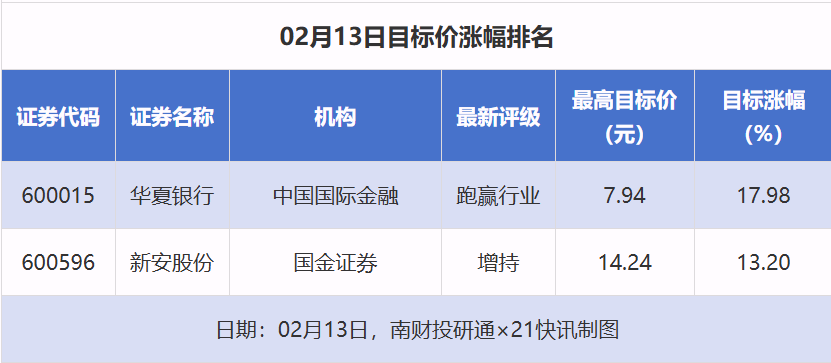
Group 1 - The core viewpoint of the article highlights the target price increases for listed companies, with notable gains for Huaxia Bank and Xin'an Co., with target price increases of 17.98% and 13.20% respectively [1][2] - On February 13, a total of 18 listed companies received recommendations from brokers, with Huaxia Bank, Pudong Construction, and Changan Automobile each receiving one recommendation [2] - The article mentions that on February 13, brokers provided 7 instances of initial coverage, with Changan Automobile receiving an "Overweight" rating from Shanxi Securities, and Xin'an Co. receiving an "Increase" rating from Guojin Securities [2][4] Group 2 - Huaxia Bank (600015) received a "Outperform" rating from China International Capital Corporation with a target price of 7.94 yuan, reflecting a target price increase of 17.98% [2][4] - Xin'an Co. (600596) was rated "Increase" by Guojin Securities with a target price of 14.24 yuan, indicating a target price increase of 13.20% [2][4] - Other companies receiving initial coverage include Daimai Co. with a "Buy" rating, and Ningbo Huaxiang with a "Buy" rating, both indicating positive outlooks in their respective sectors [4]


央行重要发布!名单公布
Sou Hu Cai Jing· 2026-02-14 01:14
Core Viewpoint - The People's Bank of China and the National Financial Regulatory Administration have conducted an assessment of systemically important banks for 2025, identifying 21 domestic banks categorized into five groups based on their systemic importance scores [1]. Group 1: Assessment of Systemically Important Banks - A total of 21 banks have been recognized as systemically important, including 6 state-owned commercial banks, 10 joint-stock commercial banks, and 5 city commercial banks [1]. - The banks are divided into five groups based on their systemic importance scores, with the first group containing 11 banks, the second group 4 banks, the third group 2 banks, the fourth group 4 banks, and the fifth group having no banks [1]. Group 2: Breakdown of Banks by Group - **First Group (11 banks)**: Includes China Minsheng Bank, China Everbright Bank, Ping An Bank, Huaxia Bank, Ningbo Bank, Jiangsu Bank, Beijing Bank, Nanjing Bank, Guangfa Bank, Zheshang Bank, and Shanghai Bank [1]. - **Second Group (4 banks)**: Includes Industrial Bank, China CITIC Bank, Shanghai Pudong Development Bank, and China Postal Savings Bank [1]. - **Third Group (2 banks)**: Includes Bank of Communications and China Merchants Bank [1]. - **Fourth Group (4 banks)**: Includes Industrial and Commercial Bank of China, Bank of China, China Construction Bank, and Agricultural Bank of China [1]. - **Fifth Group**: No banks are included in this group [1]. Group 3: Future Regulatory Actions - The People's Bank of China and the National Financial Regulatory Administration will implement additional regulatory measures for systemically important banks according to the "Regulations on Additional Supervision of Systemically Important Banks (Trial)" [1]. - The aim is to enhance the synergy between macro-prudential management and micro-prudential supervision, ensuring the safe and sound operation of systemically important banks and better supporting the high-quality development of the real economy [1].
我国系统重要性银行名单公布
新华网财经· 2026-02-14 01:10
Group 1 - The People's Bank of China and the National Financial Regulatory Administration have conducted an assessment for the 2025 systemically important banks, identifying 21 domestic banks, including 6 state-owned commercial banks, 10 joint-stock commercial banks, and 5 city commercial banks [3][4]. - The list aims to establish a comprehensive macro-prudential management system and strengthen the regulation of systemically important financial institutions [4]. - Systemically important banks are categorized into five groups based on their importance scores, with the first group including 11 banks such as China Minsheng Bank and China Everbright Bank, and the fourth group including major banks like Industrial and Commercial Bank of China and Bank of China [5]. Group 2 - The People's Bank of China and the National Financial Regulatory Administration will enhance the combined efforts of macro-prudential management and micro-prudential regulation to solidify additional supervision of systemically important banks, promoting their safe and sound operation to better serve the high-quality development of the real economy [5].

系统重要性银行名单出炉
Shang Hai Zheng Quan Bao· 2026-02-13 17:01
Core Viewpoint - The People's Bank of China has identified 21 domestic systemically important banks for the year 2025, aiming to enhance macro-prudential management and regulatory oversight of these institutions [1] Group 1: Identification of Systemically Important Banks - A total of 21 banks have been recognized as systemically important, including 6 state-owned commercial banks, 10 joint-stock commercial banks, and 5 city commercial banks [1] - The banks are categorized into five groups based on their systemic importance scores, with the first group containing 11 banks, the second group 4 banks, the third group 2 banks, the fourth group 4 banks, and the fifth group having no banks [1] Group 2: Breakdown of Bank Groups - Group 1 includes: China Minsheng Bank, China Everbright Bank, Ping An Bank, Huaxia Bank, Ningbo Bank, Jiangsu Bank, Beijing Bank, Nanjing Bank, Guangfa Bank, Zheshang Bank, and Shanghai Bank [1] - Group 2 consists of: Industrial Bank, China CITIC Bank, Shanghai Pudong Development Bank, and China Postal Savings Bank [1] - Group 3 includes: Bank of Communications and China Merchants Bank [1] - Group 4 comprises: Industrial and Commercial Bank of China, Bank of China, China Construction Bank, and Agricultural Bank of China [1] Group 3: Future Regulatory Actions - The People's Bank of China and the financial regulatory authority will implement additional regulatory measures as per the "Regulations on Additional Supervision of Systemically Important Banks (Trial)" to ensure the safe and sound operation of these banks [1] - The aim is to strengthen the macro-prudential management and micro-prudential regulatory synergy, promoting the healthy development of systemically important banks to better serve the high-quality development of the real economy [1]
21家系统重要性银行名单出炉!浙商银行新入选
Guang Zhou Ri Bao· 2026-02-13 15:09
Core Viewpoint - The People's Bank of China and the National Financial Regulatory Administration have published the list of systemically important banks for 2025, identifying 21 domestic banks, including 6 state-owned commercial banks, 10 joint-stock commercial banks, and 5 city commercial banks [1][2]. Group 1: Systemically Important Banks - The newly published list includes Zhejiang Commercial Bank as a new entrant among systemically important banks [1]. - The banks are categorized into five groups based on their systemic importance scores, with the first group containing 11 banks, the second group 4 banks, the third group 2 banks, the fourth group 4 banks, and the fifth group having no banks [1]. - The first group includes China Minsheng Bank, China Everbright Bank, Ping An Bank, Huaxia Bank, Ningbo Bank, Jiangsu Bank, Beijing Bank, Nanjing Bank, Guangfa Bank, Zhejiang Commercial Bank, and Shanghai Bank [1]. - The second group consists of Industrial Bank, China CITIC Bank, Shanghai Pudong Development Bank, and China Postal Savings Bank [1]. - The third group includes Bank of Communications and China Merchants Bank [1]. - The fourth group comprises Industrial and Commercial Bank of China, Bank of China, China Construction Bank, and Agricultural Bank of China [1]. - No banks are listed in the fifth group [1]. Group 2: Regulatory Measures - The People's Bank of China and the National Financial Regulatory Administration will implement additional regulatory measures for systemically important banks according to the "Regulations on Additional Supervision of Systemically Important Banks (Trial)" [2]. - The aim is to enhance macro-prudential management and micro-prudential supervision, ensuring the safe and sound operation of systemically important banks [2]. - This initiative is intended to better serve the high-quality development of the real economy [2].
