HUA XIA BANK(600015)

Search documents
震荡市显韧性,黄金增强策略理财产品近3月收益仍领先
2 1 Shi Ji Jing Ji Bao Dao· 2026-02-09 01:15
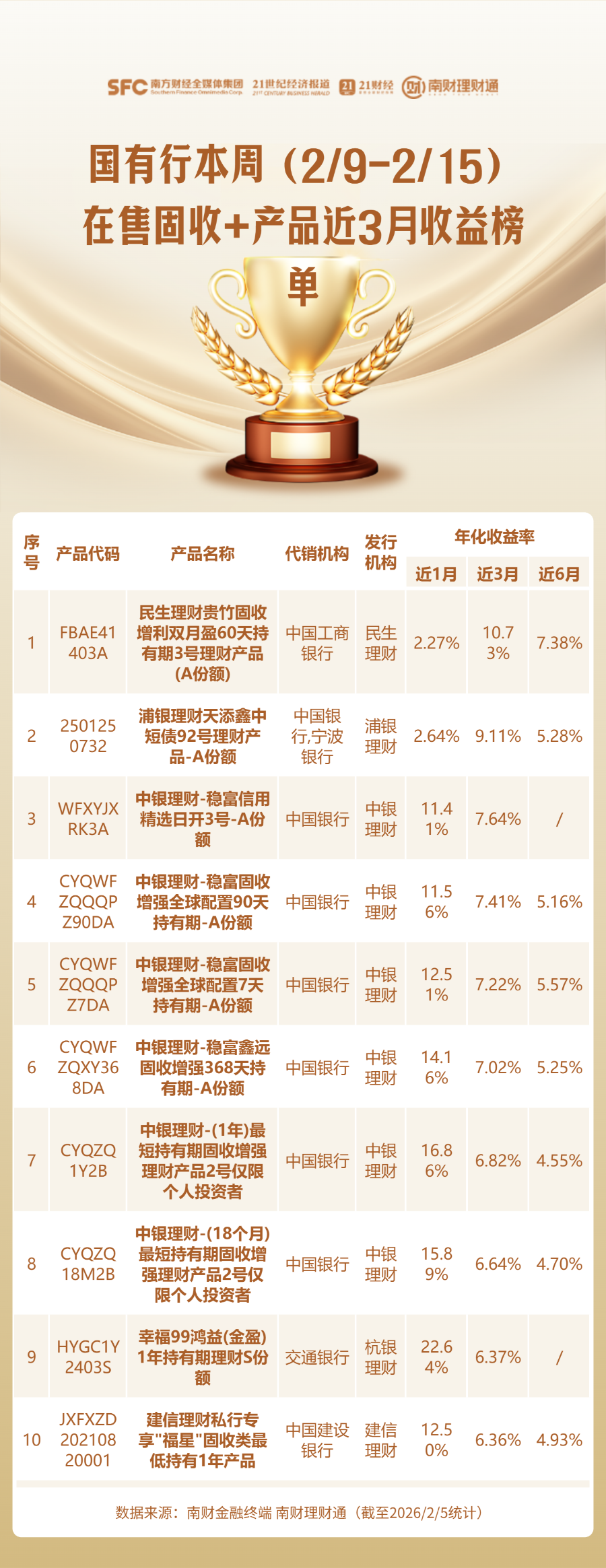
Core Insights - The report focuses on fixed income + products issued by wealth management companies, highlighting superior performing products available for investors through distribution channels [1] - A ranking of products is provided based on their annualized performance over the last month, three months, and six months, with a particular emphasis on the three-month annualized yield to reflect their performance amid recent market fluctuations [1] Distribution Channels - The report includes a list of 28 distribution institutions, which consist of major banks such as Industrial and Commercial Bank of China, Bank of China, Agricultural Bank of China, and others [1] Product Performance - The ranking showcases various products with their respective annualized yields, indicating the performance metrics over different time frames, such as 2.64% for one month and 9.11% for three months for a specific product [5] - The data is sourced from the South Finance Financial Terminal, with statistics as of February 5, 2026, providing a snapshot of the current market offerings [5][10]







收益率碾压现金产品!这份“闲钱理财”榜单透露了哪些机会?
2 1 Shi Ji Jing Ji Bao Dao· 2026-02-09 01:15
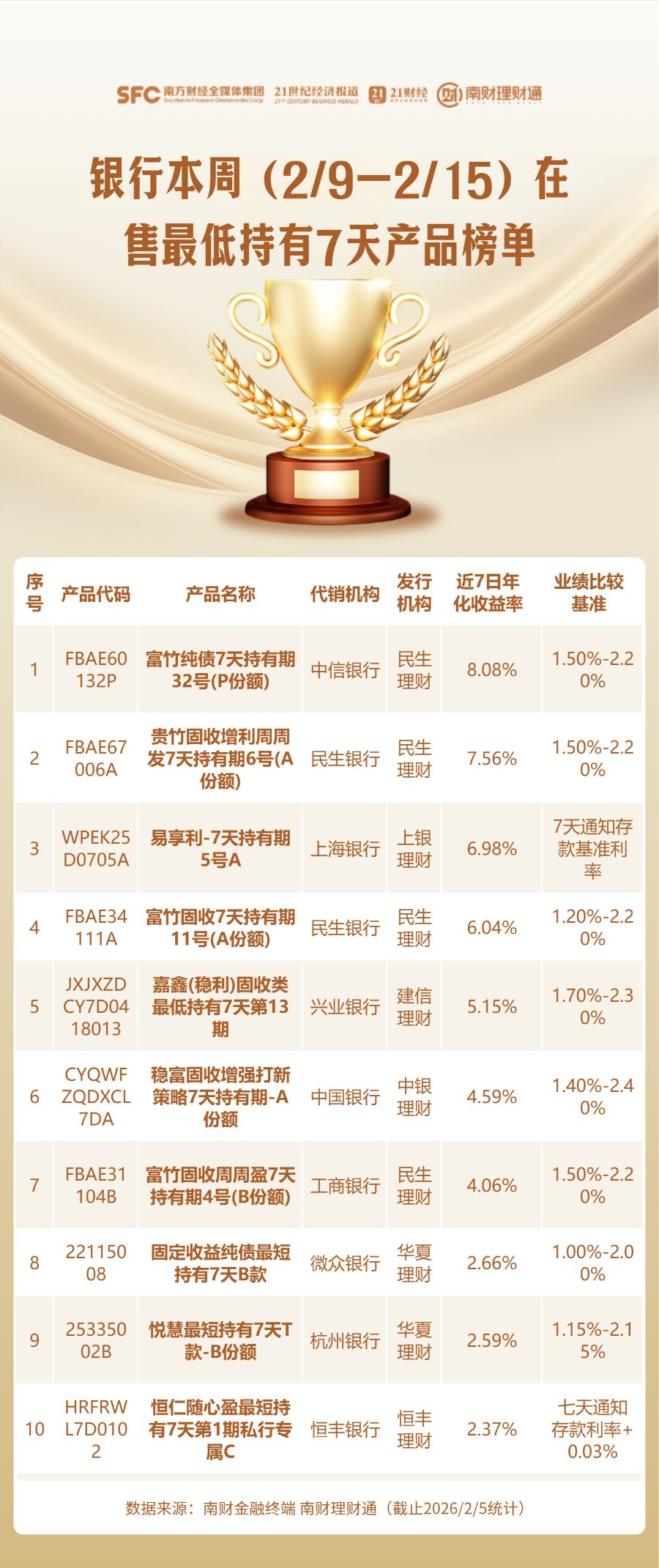
Core Insights - The article focuses on the performance of minimum holding period RMB public offering products, ranking them based on annualized returns for holding periods of 7, 14, 30, and 60 days [1] Group 1: 7-Day Holding Period Products - The top-performing product is from Minsheng Bank with an annualized return of 7.56% [5] - Other notable products include a 6.98% return from Shanghai Bank and a 6.04% return from Minsheng Bank [5] Group 2: 14-Day Holding Period Products - The leading product is from Minsheng Bank with a return of 7.39% [8] - China Bank follows with a return of 4.44% [8] Group 3: 30-Day Holding Period Products - The highest return is 18.14% from Hangzhou Bank [12] - Other significant returns include 12.34% from Minsheng Bank and 9.72% from Minsheng Bank [12][13] Group 4: 60-Day Holding Period Products - The top product is from China Bank with a return of 9.33% [15] - Other products include 5.95% from Shanghai Bank and 5.54% from Huaxia Bank [15][16]
跨境流动性跟踪20260208:贸易回流比率再度回正,服务逆差大幅收窄
GF SECURITIES· 2026-02-09 01:11
Investment Rating - The industry rating is "Buy" [4] Core Views - The trade return ratio has turned positive again, and the service trade deficit has significantly narrowed [16][18] - The cross-border capital flow is expected to gradually return, positively impacting domestic liquidity [5][19] - The service trade deficit for December 2025 was 966 billion CNY, a year-on-year decrease of 466 billion CNY, with a full-year deficit of 13,760 billion CNY, down 2,544 billion CNY, approximately 16% [18] Summary by Sections 1. Current Observation - The State Administration of Foreign Exchange (SAFE) released data on China's international balance of payments for December 2025, indicating a potential impact on the central bank's willingness to settle foreign exchange [16] - The trade return ratio is at a historical high, with a monthly unconverted trade net outflow of 447 billion CNY, a year-on-year increase of 1,392 billion CNY [17] 2. Arbitrage Trading Returns - The arbitrage trading return rate for 10Y US Treasury bonds in CNY has dropped significantly to -1.77%, indicating a shift in cross-border capital dynamics [17] 3. Service Trade Deficit - The service trade deficit has narrowed significantly, with major contributions from improved policies for foreign visitors, reduced international shipping costs, and enhanced competitiveness in high-tech services [18] 4. Cross-Border Liquidity Outlook - Despite the recent appointment of Kevin Warsh as the next Federal Reserve Chair, the trend of cross-border capital return is expected to continue, influenced by the Fed's monetary policy stance [19][21] - The short-term liquidity in the US remains tight, with limited space for balance sheet reduction, while long-term prospects depend on economic performance [20][21]

十几亿不良债权转让 财新批评华夏银行深圳分行风控失守
Zhong Guo Jing Ji Wang· 2026-02-05 07:14
Core Viewpoint - The article discusses the significant issue of non-performing loans at Huaxia Bank's Shenzhen branch, highlighting the bank's failure in risk control and the subsequent transfer of bad debts to China Cinda Asset Management Company [1] Group 1: Non-Performing Loans - Huaxia Bank's Shenzhen branch has multiple company loans exceeding 1 billion yuan that have turned into non-performing loans, which were packaged and transferred in the fourth quarter of 2025 [1] - The total principal balance of the loans involved in the transfer amounts to approximately 1.107 billion yuan, with overdue interest of about 574 million yuan, resulting in a total of 1.681 billion yuan for both principal and interest [1] Group 2: Transfer Agreement - On October 21, 2025, Huaxia Bank's Shenzhen branch and China Cinda Asset Management Company announced the signing of a non-performing debt transfer agreement on June 20, 2025 [1] - The agreement includes the transfer of all rights related to the principal debts and guarantee contracts of multiple borrowers [1]
股份制银行板块2月4日涨1.51%,招商银行领涨,主力资金净流入11.33亿元
Zheng Xing Xing Ye Ri Bao· 2026-02-04 08:56
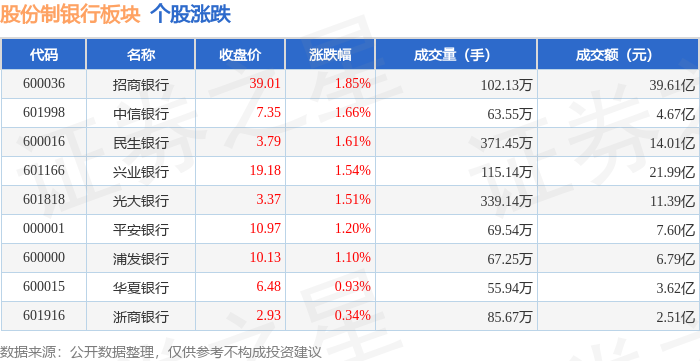
Group 1 - The banking sector saw an increase of 1.51% on February 4, with China Merchants Bank leading the gains [1] - The Shanghai Composite Index closed at 4102.2, up 0.85%, while the Shenzhen Component Index closed at 14156.27, up 0.21% [1] - Key stocks in the banking sector showed various performance metrics, with China Merchants Bank closing at 39.01, up 1.85%, and CITIC Bank at 7.35, up 1.66% [1] Group 2 - The banking sector experienced a net inflow of 1.133 billion yuan from main funds, while retail and speculative funds saw net outflows of 0.351 billion yuan and 0.782 billion yuan, respectively [1] - Major banks like China Merchants Bank and Industrial Bank had significant net inflows of 1.642 billion yuan and 0.322 billion yuan, respectively, indicating strong institutional interest [1] - In contrast, banks like Everbright Bank and CITIC Bank faced net outflows of 0.549 billion yuan and 0.239 million yuan, reflecting weaker retail sentiment [1]




黄金白银继续暴跌 轮到银行股机会了?
Di Yi Cai Jing· 2026-02-04 01:02
Core Viewpoint - The A-share market experienced significant declines in various sectors, particularly in metals and banks, with a notable focus on bank stocks as a safe haven amid volatility in precious metals prices [1][3][4]. Group 1: Market Performance - On February 2, A-share non-ferrous metals led the decline with a drop of 7.62%, while steel, chemicals, coal, and oil and gas sectors also fell over 5% [1]. - The Shanghai Composite Index closed down 2.48%, with over 4,600 stocks declining and a trading volume of approximately 2.61 trillion yuan, a decrease of nearly 250 billion yuan from the previous trading day [3][4]. - The banking sector showed resilience, with certain banks like Citic Bank and Shanghai Bank posting gains of 2.64% and 1.62%, respectively, amidst the overall market downturn [4]. Group 2: Bank Sector Analysis - The banking sector has seen a significant correction, with the China Securities Bank Index dropping 6.76% as of January 30, with major banks like Pudong Development Bank and Agricultural Bank of China experiencing declines of 19.29% and 12.5%, respectively [4][5]. - Analysts believe that the peak of fund outflows from the banking sector has passed, with the sector's valuation becoming more attractive, as the median price-to-book (PB) ratio is around 0.57 and the median dividend yield has risen to over 4.5% [5][6]. - Recent reports indicate that passive fund outflows have been a major factor in the banking sector's recent adjustments, but the selling pressure is expected to diminish, allowing for potential recovery in bank stock prices [6][7]. Group 3: Institutional Insights - Institutions are starting to show interest in bank stocks, with reports indicating that active funds had reduced their holdings in bank stocks by 1.3 billion shares by the end of the fourth quarter [7]. - Several regional banks have announced stock buyback plans, which have been positively received by the market, reinforcing confidence in the banking sector's fundamentals [7].


丈量地方性银行(2):浙江163家区域性银行全梳理-20260203
GF SECURITIES· 2026-02-03 13:31
Investment Rating - The industry investment rating is "Buy" [2] Core Insights - The report provides a comprehensive analysis of 163 regional banks in Zhejiang Province, highlighting their asset and liability structures, profitability, and asset quality [6][20] - The asset growth rate for major city commercial banks in Zhejiang is 9.4%, which is lower than the 14.2% growth rate of listed city commercial banks, while major rural commercial banks show an asset growth rate of 8.0%, exceeding the 6.7% growth rate of listed rural commercial banks [6][25] - The report indicates that the loan-to-asset ratio for city commercial banks is projected to reach 55.5% in 2024, an increase of 95 basis points year-on-year, while rural commercial banks will see a decrease to 59.3%, down 19 basis points [31] - Profitability metrics show that the average Return on Assets (ROA) for city commercial banks in Zhejiang is 0.78%, slightly above the average of listed city commercial banks, while rural commercial banks have an average ROA of 0.82%, which is below the average of listed rural commercial banks [6][31] - The asset quality of regional banks in Zhejiang is reported to be better than that of listed banks, with non-performing loan ratios lower by 16 basis points for city commercial banks and 9 basis points for rural commercial banks compared to their listed counterparts [6][31] Summary by Sections Section 1: Economic Structure of Zhejiang Province - Zhejiang Province is focused on high-quality development and aims to become a model for common prosperity [13] - The province's GDP is heavily concentrated in cities like Hangzhou, Ningbo, and Wenzhou, with Hangzhou accounting for 24.3% of the total GDP in 2025 [15] Section 2: Overview of 163 Regional Banks - The report categorizes the banks into city commercial banks, rural banks, and others, with a total of 163 banks in the region [20] - The distribution of registered capital among these banks is relatively balanced, with 63 banks having over 500 million yuan in registered capital [22] Section 3: Asset and Liability Structure - The asset growth of major city and rural commercial banks has been declining since 2019, with city banks showing a growth rate of 9.4% in the first half of 2025 [25] - The liability structure indicates that customer deposits account for 77.5% of liabilities for city commercial banks, which is higher than the 66.2% for listed city banks [44] Section 4: Profitability and Asset Quality - The average ROE for city commercial banks in Zhejiang is 11.98%, slightly lower than the average of listed city banks [6][31] - The report highlights that the non-performing loan ratio for city commercial banks is lower than that of listed banks, indicating better asset quality [6][31]
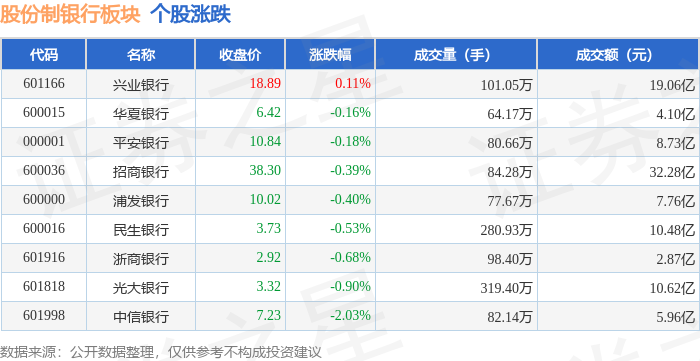
股份制银行板块2月3日跌0.53%,中信银行领跌,主力资金净流出2.88亿元
Zheng Xing Xing Ye Ri Bao· 2026-02-03 09:03
Group 1 - The banking sector experienced a decline of 0.53% on February 3, with CITIC Bank leading the drop [1] - The Shanghai Composite Index closed at 4067.74, up 1.29%, while the Shenzhen Component Index closed at 14127.1, up 2.19% [1] - Individual stock performance in the banking sector showed mixed results, with Industrial Bank slightly up by 0.11% and CITIC Bank down by 2.03% [1] Group 2 - The banking sector saw a net outflow of 288 million yuan from institutional investors, while retail investors contributed a net inflow of 353 million yuan [2] - Specific stock flows indicated that Industrial Bank had a net inflow of 20.39 million yuan from institutional investors, while CITIC Bank had a net outflow of 29.66 million yuan [2] - Retail investors showed significant interest in several banks, with Minsheng Bank receiving a net inflow of 51.32 million yuan [2]
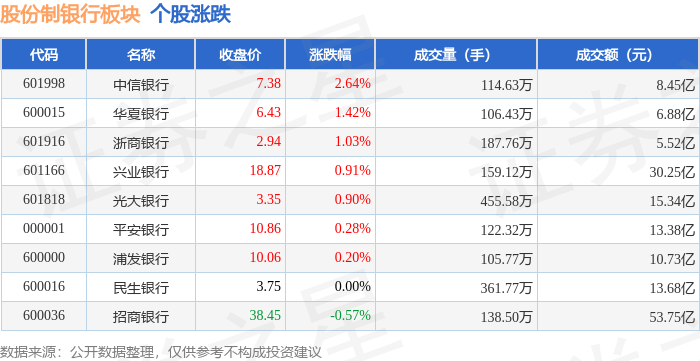
股份制银行板块2月2日涨0.46%,中信银行领涨,主力资金净流入1.62亿元
Zheng Xing Xing Ye Ri Bao· 2026-02-02 09:15
Group 1 - The banking sector saw a slight increase of 0.46% on February 2, with CITIC Bank leading the gains [1] - The Shanghai Composite Index closed at 4015.75, down 2.48%, while the Shenzhen Component Index closed at 13824.35, down 2.69% [1] - CITIC Bank's stock price rose by 2.64% to 7.38, with a trading volume of 1.1463 million shares and a transaction value of 845 million yuan [1] Group 2 - The net inflow of main funds in the banking sector was 162 million yuan, while retail funds saw a net inflow of approximately 89.95 million yuan [1] - CITIC Bank had a net inflow of 72.32 million yuan from main funds, but a net outflow of 18.99 million yuan from retail funds [1] - Minsheng Bank experienced a net inflow of 65.07 million yuan from main funds, with a net outflow of 30.58 million yuan from retail funds [1]

各银行在售高收益纯固收产品一览!合资理财子产品首次上榜
2 1 Shi Ji Jing Ji Bao Dao· 2026-02-02 09:13
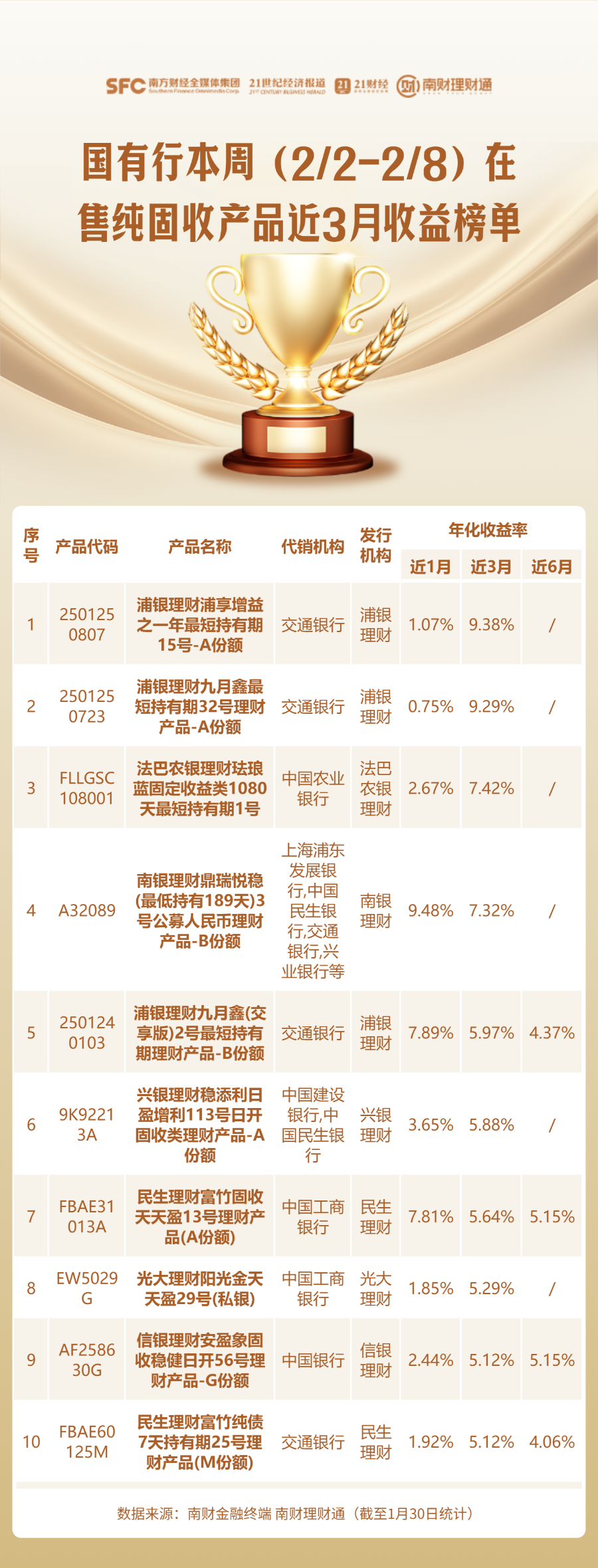
Core Insights - The report focuses on the performance of pure fixed-income products issued by wealth management companies, highlighting the best-performing products available for sale through various distribution channels [1][4] Group 1: Product Performance - The ranking of products is based on their annualized returns over the past month, three months, and six months, with a particular emphasis on the three-month annualized yield to reflect their performance amid recent market fluctuations [1] - A total of 28 distribution institutions are involved, including major banks such as Industrial and Commercial Bank of China, Bank of China, Agricultural Bank of China, and others [1] Group 2: Product Availability - The list of products is categorized as "available for sale," but actual availability may vary due to factors such as sold-out quotas or differences in product listings shown to different customers by banks [1] - Investors are advised to refer to the actual displays on the distribution bank's app for the most accurate information regarding product availability [1] Group 3: Data Source - The data presented in the report is sourced from the Nanfang Financial Terminal and Nanfang Wealth Management, with statistics as of January 30 [3][5]