Gofar Stock(600538)

Search documents
国发股份(600538) - 关于上海证券交易所对公司业绩预告相关事项问询函的回复公告
2026-02-23 08:00
证券代码:600538 证券简称:国发股份 公告编号:临 2026-005 北海国发川山生物股份有限公司 关于上海证券交易所对公司业绩预告相关事项 问询函的回复公告 本公司董事会及全体董事保证本公告内容不存在任何虚假记载、误导性陈 述或者重大遗漏,并对其内容的真实性、准确性和完整性承担法律责任。 重要内容提示 截至本回复公告之日,公司 2025 年度年报编制工作尚在进行中,本回复中 所披露的公司 2025 年度相关财务数据均为未经审计的初步测算数据,后续存在 财务数据调整的可能,具体准确的财务数据以公司后续正式披露的经审计 2025 年年报为准。 北海国发川山生物股份有限公司(以下简称"公司""国发股份")于 2026 年 1 月 23 日收到了上海证券交易所上市公司监管一部《关于北海国发川山生物 股份有限公司业绩预告相关事项的问询函》(上证公函【2026】0106 号)(以下 简称"问询函"),公司及相关方对《问询函》提到的问题进行了认真讨论和研 究,现将《问询函》所涉及问题的回复公告如下: 一、公司对相关问题的回复 问题一: | 项 目 | 金额 | 相关业务开展情况及扣 | 是否存在其他应当扣 | | ...

国发股份逆市上涨,技术面超跌反弹与板块情绪回暖成主因
Jing Ji Guan Cha Wang· 2026-02-13 07:45
最近业绩情况 公司1月16日发布的2025年业绩预告显示预计亏损8500万元,但亏损同比收窄10%,主要因子公司商誉 减值(约6200万元)及业务调整影响。市场对此前跌停反应过度,后续情绪有所缓和。 资金走向 经济观察网国发股份(600538)在2026年2月13日出现逆市上涨,主要受技术面超跌反弹、医药板块情 绪回暖、业绩利空阶段性消化及资金流向变化等因素影响。 股票近期走势 2月9日公司股价因业绩预亏及龙虎榜资金大幅流出跌停(单日跌幅10.05%),随后连续两个交易日缩量震 荡。截至2月13日,股价短期技术指标进入超卖区间(KDJ的J值降至0.89),存在修复需求。当日股价低 开高走,收盘报6.75元,涨幅4.81%,收复5日均线(6.614元),但仍低于20日均线(7.016元)。 行业板块情况 尽管当日上证指数下跌1.26%,医药生物板块跌幅0.78%,但国发股份所属的医药商业板块跌幅收窄至 0.89%,部分资金流向小市值超跌股。公司流通市值仅35.38亿元,易受短期资金扰动。 2月13日主力资金小幅净流入15.19万元,与前一日净流出314.11万元相比呈现回流迹象。但整体成交额 仅1.40亿元,较 ...
大额买入与资金流向跟踪(20260202-20260206)
GUOTAI HAITONG SECURITIES· 2026-02-10 08:59
Quantitative Factors and Construction Methods - **Factor Name**: Large Order Transaction Amount Ratio **Factor Construction Idea**: This factor captures the buying behavior of large capital by analyzing the proportion of large order transaction amounts in the total daily transaction amount[8] **Factor Construction Process**: 1. Use tick-by-tick transaction data to identify buy and sell orders based on the sequence numbers of bids and asks 2. Filter transactions by order size to identify large orders 3. Calculate the proportion of large buy order transaction amounts in the total daily transaction amount **Formula**: $ \text{Large Order Transaction Amount Ratio} = \frac{\text{Large Buy Order Transaction Amount}}{\text{Total Daily Transaction Amount}} $ **Evaluation**: This factor effectively reflects the buying behavior of large capital[8] - **Factor Name**: Net Active Buy Transaction Amount Ratio **Factor Construction Idea**: This factor measures the active buying behavior of investors by calculating the net active buy transaction amount as a proportion of the total daily transaction amount[8] **Factor Construction Process**: 1. Use tick-by-tick transaction data to classify each transaction as either active buy or active sell based on the buy/sell indicator 2. Subtract the active sell transaction amount from the active buy transaction amount to obtain the net active buy transaction amount 3. Calculate the proportion of the net active buy transaction amount in the total daily transaction amount **Formula**: $ \text{Net Active Buy Transaction Amount Ratio} = \frac{\text{Active Buy Transaction Amount} - \text{Active Sell Transaction Amount}}{\text{Total Daily Transaction Amount}} $ **Evaluation**: This factor provides insights into the active buying tendencies of investors[8] --- Factor Backtesting Results - **Large Order Transaction Amount Ratio**: - Top 10 stocks with the highest 5-day average values: 1. Hanjiang Heshan (603616.SH): 93.5%, 99.2% time-series percentile[10] 2. Minbao Optoelectronics (301362.SZ): 89.7%, 98.4% time-series percentile[10] 3. Hangdian Co., Ltd. (603618.SH): 86.1%, 99.6% time-series percentile[10] 4. Jinzhengda (002470.SZ): 85.2%, 83.9% time-series percentile[10] 5. Guofa Co., Ltd. (600538.SH): 84.9%, 92.4% time-series percentile[10] 6. Shunna Co., Ltd. (000533.SZ): 84.7%, 100.0% time-series percentile[10] 7. Quanzhu Co., Ltd. (603030.SH): 84.6%, 94.4% time-series percentile[10] 8. Beijing Investment Development (600683.SH): 84.5%, 96.0% time-series percentile[10] 9. Chongqing Steel (601005.SH): 84.3%, 52.2% time-series percentile[10] 10. Huadian International (600027.SH): 83.6%, 95.2% time-series percentile[10] - **Net Active Buy Transaction Amount Ratio**: - Top 10 stocks with the highest 5-day average values: 1. Minsheng Bank (600016.SH): 21.1%, 100.0% time-series percentile[11] 2. Kairuide (002072.SZ): 20.3%, 99.6% time-series percentile[11] 3. Intercontinental Oil & Gas (600759.SH): 19.5%, 100.0% time-series percentile[11] 4. Boen Group (001366.SZ): 17.8%, 100.0% time-series percentile[11] 5. Bowan Technology (600883.SH): 17.5%, 99.6% time-series percentile[11] 6. Xiangyou Technology (600476.SH): 16.8%, 99.2% time-series percentile[11] 7. Zhejiang Commercial Bank (601916.SH): 16.8%, 94.4% time-series percentile[11] 8. General Elevator (300931.SZ): 15.9%, 100.0% time-series percentile[11] 9. Weier Pharmaceutical (603351.SH): 15.3%, 94.0% time-series percentile[11] 10. Ruierte (002790.SZ): 15.2%, 98.4% time-series percentile[11]





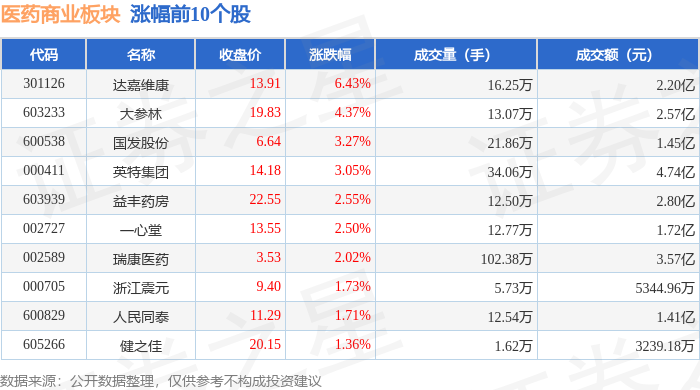
医药商业板块1月19日涨0.39%,达嘉维康领涨,主力资金净流出4.36亿元
Zheng Xing Xing Ye Ri Bao· 2026-01-19 08:56
Core Viewpoint - The pharmaceutical commercial sector experienced a slight increase of 0.39% on January 19, with significant contributions from stocks like Dajia Weikang, which led the gains [1] Group 1: Market Performance - The Shanghai Composite Index closed at 4114.0, up by 0.29%, while the Shenzhen Component Index closed at 14294.05, up by 0.09% [1] - Dajia Weikang (301126) led the sector with a closing price of 13.91, reflecting a rise of 6.43% and a trading volume of 162,500 shares, amounting to a transaction value of 220 million yuan [1] - Other notable performers included Dacianlin (603233) with a 4.37% increase, Guofang Co. (600538) up by 3.27%, and Yifeng Pharmacy (603939) rising by 2.55% [1] Group 2: Fund Flow Analysis - The pharmaceutical commercial sector saw a net outflow of 436 million yuan from institutional investors, while retail investors contributed a net inflow of 486 million yuan [2] - The individual stock fund flow indicated that Ruikang Pharmaceutical (002589) had a net inflow of 19.77 million yuan from institutional investors, while it faced a net outflow of 17.52 million yuan from retail investors [3] - Dajia Weikang (301126) also experienced a net inflow of 13.40 million yuan from institutional investors, despite a net outflow of 15.06 million yuan from retail investors [3]


国发股份(600538.SH)发预亏,预计2025年度归母净亏损8500万元左右
智通财经网· 2026-01-16 11:33
智通财经APP讯,国发股份(600538.SH)发布公告,公司预计2025年度实现归属于母公司所有者的净利 润为亏损8500万元左右,与上年同期(法定披露数据)相比,亏损减少900万元左右,同比减少亏损10%。 ...
国发股份(600538) - 2025 Q4 - 年度业绩预告
2026-01-16 10:00
证券代码:600538 证券简称:国发股份 公告编号:临 2026-004 经财务部门初步测算,公司 2025 年的经营情况如下: 北海国发川山生物股份有限公司 2025 年年度业绩预亏公告 本公司董事会及全体董事保证本公告内容不存在任何虚假记载、误导性陈述 或者重大遗漏,并对其内容的真实性、准确性和完整性承担法律责任。 重要内容提示: ●业绩预告的具体适用情形:净利润为负值。 ●北海国发川山生物股份有限公司(以下简称"公司")预计 2025 年度实现 营业收入 3.3 亿元左右,预计 2025 年度实现归属于母公司所有者的净利润为 -8,500 万元左右,预计 2025 年度实现归属于母公司所有者的扣除非经常性损益后 的净利润为-8,550 万元左右。 一、本期业绩预告情况 (一)业绩预告期间 2025 年 1 月 1 日至 2025 年 12 月 31 日 (二)业绩预告情况 1.预计 2025 年度实现营业收入 3.3 亿元左右,扣除与主营业务无关的业务收 入和不具备商业实质的收入后的营业收入为 3.3 亿元左右。 2.预计 2025 年度实现归属于母公司所有者的净利润为-8,500 万元左右,与上 年 ...
国发股份(600538.SH):2025年度预亏8500万元左右
Ge Long Hui A P P· 2026-01-16 09:03
格隆汇1月16日丨国发股份(600538.SH)公布,公司预计2025年度实现营业收入3.3亿元左右,预计2025年 度实现归属于母公司所有者的净利润为-8,500万元左右,预计2025年度实现归属于母公司所有者的扣除 非经常性损益后的净利润为-8,550万元左右。 ...
国发股份:预计2025年年度净利润亏损8500万元
Xin Lang Cai Jing· 2026-01-16 09:03
国发股份公告,预计2025年年度净利润亏损8500万元,上年同期亏损9385.02万元。预计2025年年度实 现营业收入3.3亿元左右,与上年同期3.4亿元相比有所下降。 ...
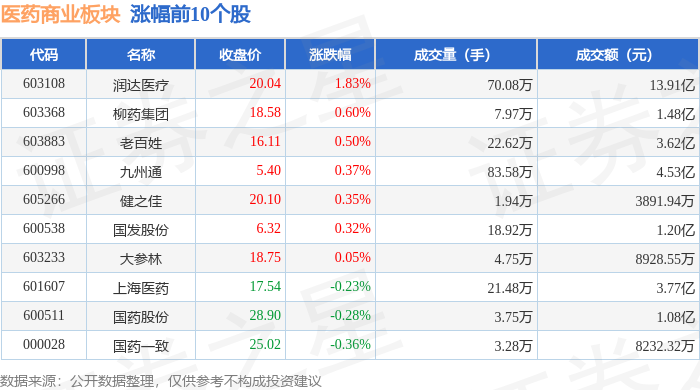
医药商业板块1月15日跌2.19%,华人健康领跌,主力资金净流出9.9亿元
Zheng Xing Xing Ye Ri Bao· 2026-01-15 08:58
Market Overview - The pharmaceutical commercial sector experienced a decline of 2.19% on January 15, with Huaren Health leading the drop [1] - The Shanghai Composite Index closed at 4112.6, down 0.33%, while the Shenzhen Component Index closed at 14306.73, up 0.41% [1] Individual Stock Performance - Notable gainers included: - RunDa Medical (603108) with a closing price of 20.04, up 1.83% and a trading volume of 700,800 shares [1] - LiuYao Group (603368) closed at 18.58, up 0.60% with a trading volume of 79,700 shares [1] - LaoBaiXing (603883) closed at 16.11, up 0.50% with a trading volume of 226,200 shares [1] - Significant decliners included: - Huaren Health (301408) closed at 23.81, down 19.99% with a trading volume of 491,100 shares [2] - ShangYu PingMin (301017) closed at 18.50, down 13.75% with a trading volume of 373,900 shares [2] - YaoYiGou (300937) closed at 37.40, down 11.79% with a trading volume of 121,400 shares [2] Capital Flow Analysis - The pharmaceutical commercial sector saw a net outflow of 990 million yuan from institutional investors, while retail investors had a net inflow of 977 million yuan [2] - The table of capital flow indicates that: - LaoBaiXing (603883) had a net inflow of 46.10 million yuan from institutional investors [3] - JiuZhouTong (600998) had a net inflow of 40.43 million yuan from institutional investors [3] - RunDa Medical (603108) had a net inflow of 37.80 million yuan from institutional investors [3]




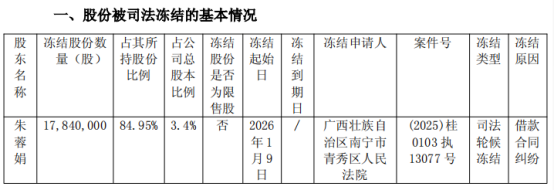
大股东深陷债务危机,股权全遭冻结!国发股份控制股或生变
Shen Zhen Shang Bao· 2026-01-14 10:12
Core Viewpoint - The major shareholder of Guofa Co., Ltd. (600538), Zhu Rongjuan, has had 17.84 million shares (3.40% of total shares) judicially frozen due to a loan contract dispute, raising concerns about potential changes in the company's control structure [1][3]. Shareholder Situation - Zhu Rongjuan's total shareholding of 21 million shares (4.01% of total shares) is now entirely under judicial marking, freezing, or pending freezing [1]. - The freezing is a result of multiple significant debt lawsuits involving Zhu and her associate, Peng Tao, with a total execution amount of approximately 504 million yuan [3]. - The company's shareholding structure is highly dispersed, with Zhu's shareholding at only 7.57% before the freeze, and the top ten shareholders holding about 20% collectively, indicating liquidity among shareholders [3]. Corporate Governance - Recent adjustments in corporate governance include the resignation of non-independent director Li Yong, who was subsequently elected as an employee representative director while retaining key positions such as vice president and board secretary [3]. Financial Performance - In Q3 2025, the company achieved a net profit of 1.99 million yuan, marking a turnaround from previous losses, although it still reported a cumulative loss of 3.85 million yuan for the first three quarters, a significant reduction in losses by 81.56% year-on-year [4]. - The improvement in performance is attributed to increased investment income and the reversal of credit impairment losses, despite a decline in overall gross margin and negative operating cash flow [4].