Dongxing Securities Co.,Ltd.(601198)

Search documents
东兴证券:政策、技术、需求三重驱动 AI成计算机投资核心主线
Zhi Tong Cai Jing· 2025-12-24 02:44
Core Viewpoint - The investment in the computer industry should focus on the three-dimensional framework of "fundamentals, cost-effectiveness, and attractiveness," with artificial intelligence (AI) as the core theme of the technology cycle, driven by policy support, technological evolution, and demand release, forming a "multi-dimensional resonance" [1][3]. Industry Review - As of December 16, 2025, the Shenwan Computer Index has increased by 17.07%, slightly lower than the CSI 300 (+17.72%) and the CSI 1000 (+23.88%), ranking 14th among 31 Shenwan first-level industries, indicating a mid-level overall performance [2]. - The sector exhibited high volatility compared to the market average, reflecting strong elasticity, with mid-cap stocks (market cap of 10 billion to 20 billion) showing an average increase of 40.64%, significantly outperforming other market cap segments [2]. - The institutional holding ratio is approximately 2.16%, with an underweight ratio of -2.52%, indicating a low level but a stabilization of the downward trend, suggesting potential for recovery in allocation [2]. Industry Outlook - The investment in the computer industry should be based on the three-dimensional framework of "fundamentals, cost-effectiveness, and attractiveness," with AI remaining the core theme of the technology cycle [3]. - The "14th Five-Year Plan" emphasizes "technological self-reliance," providing strong support for AI, "new productivity," and trusted computing [3]. - The global focus of AI development is shifting from training to inference, with Gartner's 2025 technology maturity curve indicating that edge AI is expected to mature within two years [3]. Demand Side - The global token call volume has surged, with leading model companies like OpenAI and Anthropic experiencing rapid revenue growth, and cloud vendors' AI-related revenue increasing by over 20% year-on-year [4]. - The demand for domestic intelligent computing centers is projected to grow from 2016 MW in 2024 to 9480 MW in 2027, with a CAGR of 67.5%, indicating continuous infrastructure investment [4]. Investment Strategy - Focus on AI as the main line, with attention to the recovery of trusted computing and structural opportunities in emerging/future industries [5]. - On the AI computing side, attention should be paid to domestic AI chip manufacturers (e.g., Haiguang Information, Cambricon) and AI servers [5]. - The trusted computing industry is expected to reach a scale of 2.34 trillion yuan by 2025, with significant growth potential [5].

“中金+东兴+信达”合并重组预案出炉
Jin Rong Shi Bao· 2025-12-24 02:37
Core Viewpoint - The merger of China International Capital Corporation (CICC) with Dongxing Securities and Xinda Securities is expected to create a leading brokerage firm in terms of asset scale, net capital, and business coverage, potentially reshaping the competitive landscape of the industry and accelerating the development of a first-class investment bank [1][3]. Group 1: Merger Details - The merger involves a share swap with CICC as the surviving entity, with share prices set at 36.91 CNY for CICC, 16.14 CNY for Dongxing Securities, and 19.15 CNY for Xinda Securities, reflecting a 26% premium for Dongxing Securities [2]. - The share swap ratios are 1:0.4373 for Dongxing Securities and 1:0.5188 for Xinda Securities, with CICC expected to issue approximately 3.096 billion new A-shares [2]. - Major shareholders, including Central Huijin and China Orient, have committed to lock their shares for 36 months, indicating confidence in the long-term development of the merged entity [2]. Group 2: Financial Impact - Post-merger, the total assets of the new entity are projected to reach 1,009.58 billion CNY, marking the emergence of a trillion-level brokerage firm in China [2]. - As of Q3 2025, the combined total assets of CICC, Dongxing Securities, and Xinda Securities are reported as 764.94 billion CNY, 116.39 billion CNY, and 128.25 billion CNY, respectively [5]. - The three firms achieved revenues of 20.76 billion CNY, 3.61 billion CNY, and 3.02 billion CNY, with net profits of 6.57 billion CNY, 1.60 billion CNY, and 1.35 billion CNY for the first three quarters of 2025 [6]. Group 3: Strategic Advantages - The merger is expected to create significant synergies, enhancing resource integration and capital strength, thereby improving the overall service capability and resilience against market fluctuations [4]. - CICC's strengths in investment banking and private equity will complement Dongxing and Xinda's regional presence and retail client base, leading to a comprehensive service system [4]. - The merger aligns with national strategies to build a strong financial sector and is seen as a response to the call for enhancing the quality of small financial institutions [4].


ETF盘前资讯 | “万亿航母”合并预案出炉,今起复牌!顶流券商ETF(512000)异动抢跑,机构提示三条并购主线
Jin Rong Jie· 2025-12-23 15:59
Group 1 - The core viewpoint of the news is that CICC, along with Dongxing Securities and Cinda Securities, has announced a significant asset restructuring plan, which is expected to reshape the securities industry landscape and propel CICC's growth [1] - The share exchange ratios for the merger are set at 1:0.4373 for Dongxing Securities and 1:0.5188 for Cinda Securities, both reflecting varying degrees of premium [1] - Following the merger, CICC's total asset scale is projected to exceed 1 trillion yuan, making it the fourth "trillion-dollar giant" in the industry [1] Group 2 - The securities sector is anticipated to experience a wave of mergers and acquisitions in 2025, with significant progress expected in 2026 under the guidance of regulatory authorities [2] - Three main lines of mergers are identified: mergers between brokers under the same controlling shareholder, mergers between regional listed and non-listed brokers, and mergers aimed at filling business gaps [2] - The industry still has ample room for incremental business growth, and leading brokers are expected to strengthen their positions through mergers and increased leverage [2]
证券板块12月23日跌0.33%,华创云信领跌,主力资金净流出15.35亿元
Zheng Xing Xing Ye Ri Bao· 2025-12-23 09:16
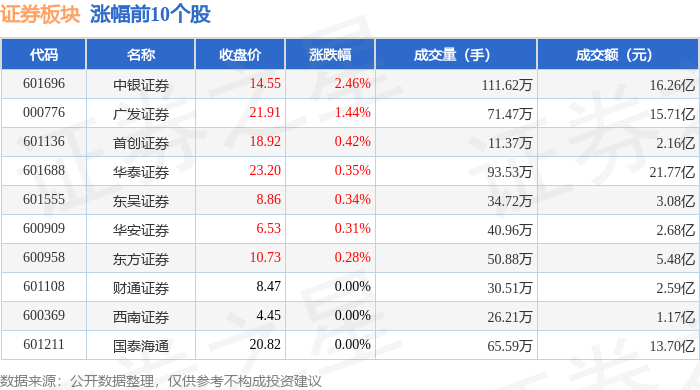
Market Overview - On December 23, the securities sector declined by 0.33% compared to the previous trading day, with Huachuang Yuxin leading the decline [1] - The Shanghai Composite Index closed at 3919.98, up 0.07%, while the Shenzhen Component Index closed at 13368.99, up 0.27% [1] Individual Stock Performance - Notable gainers included: - Bank of China Securities (601696) with a closing price of 14.55, up 2.46% and a trading volume of 1.1162 million shares, totaling 1.626 billion yuan [1] - GF Securities (000776) closed at 21.91, up 1.44% with a trading volume of 714,700 shares, totaling 1.571 billion yuan [1] - Notable decliners included: - Huachuang Yuxin (600155) closed at 6.56, down 3.24% with a trading volume of 499,700 shares, totaling 332 million yuan [2] - China International Capital Corporation (601995) closed at 35.53, down 1.50% with a trading volume of 275,900 shares, totaling 986 million yuan [2] Capital Flow Analysis - The securities sector experienced a net outflow of 1.535 billion yuan from institutional investors, while retail investors saw a net inflow of 821 million yuan [2] - The main capital flow for selected stocks included: - Bank of China Securities had a net inflow of 86.0426 million yuan from institutional investors, but a net outflow of 87.7168 million yuan from retail investors [3] - Industrial Securities (601377) saw a net inflow of 31.4879 million yuan from institutional investors, with a net outflow of 49.1248 million yuan from retail investors [3]




大额买入与资金流向跟踪(20251215-20251219)
GUOTAI HAITONG SECURITIES· 2025-12-23 05:11
Quantitative Models and Construction Methods 1. Model Name: Large Order Transaction Amount Ratio - **Model Construction Idea**: This model tracks the buying behavior of large funds by calculating the proportion of large order transaction amounts to the total daily transaction amount[7] - **Model Construction Process**: 1. Use tick-by-tick transaction data to identify buy and sell orders based on bid and ask sequence numbers 2. Filter transactions by order size to identify large orders 3. Calculate the ratio of large buy order transaction amounts to the total daily transaction amount - Formula: $ \text{Large Order Transaction Amount Ratio} = \frac{\text{Large Buy Order Transaction Amount}}{\text{Total Daily Transaction Amount}} $ - **Model Evaluation**: This indicator effectively captures the buying behavior of large funds[7] 2. Model Name: Net Active Buy Amount Ratio - **Model Construction Idea**: This model measures the active buying behavior of investors by calculating the net active buy amount as a proportion of the total daily transaction amount[7] - **Model Construction Process**: 1. Use tick-by-tick transaction data to classify each transaction as either active buy or active sell based on the buy/sell flag 2. Calculate the net active buy amount by subtracting the active sell amount from the active buy amount 3. Compute the ratio of the net active buy amount to the total daily transaction amount - Formula: $ \text{Net Active Buy Amount Ratio} = \frac{\text{Active Buy Amount} - \text{Active Sell Amount}}{\text{Total Daily Transaction Amount}} $ - **Model Evaluation**: This indicator effectively captures the active buying behavior of investors[7] --- Model Backtesting Results 1. Large Order Transaction Amount Ratio - **Top 10 Stocks by 5-Day Average**: - **East Securities (601198.SH)**: 88.1%, 99.6% time-series percentile[9] - **Shanghai Kaibao (300039.SZ)**: 86.3%, 100.0% time-series percentile[9] - **Sanxiang Impression (000863.SZ)**: 86.0%, 99.6% time-series percentile[9] - **Chongqing Steel (601005.SH)**: 86.0%, 78.7% time-series percentile[9] - **Jinzhengda (002470.SZ)**: 85.7%, 89.8% time-series percentile[9] - **Wanlong Optoelectronics (300710.SZ)**: 85.6%, 99.6% time-series percentile[9] - **Yasheng Group (600108.SH)**: 85.5%, 84.4% time-series percentile[9] - **Sinochem International (600500.SH)**: 85.5%, 90.4% time-series percentile[9] - **Chongqing Water (601158.SH)**: 85.2%, 96.7% time-series percentile[9] 2. Net Active Buy Amount Ratio - **Top 10 Stocks by 5-Day Average**: - **Jiuhua Tourism (603199.SH)**: 26.2%, 100.0% time-series percentile[10] - **Bailong Oriental (601339.SH)**: 22.9%, 100.0% time-series percentile[10] - **Zijin Bank (601860.SH)**: 20.2%, 100.0% time-series percentile[10] - **Bailong Chuangyuan (605016.SH)**: 19.5%, 100.0% time-series percentile[10] - **Hengshun Vinegar (600305.SH)**: 17.8%, 100.0% time-series percentile[10] - **Qingfangcheng (600790.SH)**: 17.7%, 99.6% time-series percentile[10] - **Shandong Steel (600022.SH)**: 17.7%, 99.6% time-series percentile[10] - **Shengda Forestry (002259.SZ)**: 17.5%, 100.0% time-series percentile[10] - **Taoli Bread (603866.SH)**: 17.2%, 100.0% time-series percentile[10] - **Jiangsu Sopo (600746.SH)**: 16.8%, 100.0% time-series percentile[10] 3. Broad-Based Indices - **5-Day Average Results**: - **Shanghai Composite Index**: Large Order Ratio 73.7% (82.0% percentile), Net Active Buy Ratio 2.2% (3.7% percentile)[12] - **SSE 50**: Large Order Ratio 71.7% (58.2% percentile), Net Active Buy Ratio 5.8% (92.6% percentile)[12] - **CSI 300**: Large Order Ratio 73.0% (41.0% percentile), Net Active Buy Ratio 2.9% (20.9% percentile)[12] - **CSI 500**: Large Order Ratio 73.8% (86.9% percentile), Net Active Buy Ratio 1.5% (3.3% percentile)[12] - **ChiNext Index**: Large Order Ratio 70.5% (6.1% percentile), Net Active Buy Ratio 0.1% (14.8% percentile)[12] 4. Industry-Level Analysis - **Top Industries by 5-Day Average**: - **Steel**: Large Order Ratio 79.0% (79.1% percentile), Net Active Buy Ratio 12.7% (0.8% percentile)[13] - **Agriculture, Forestry, Animal Husbandry, and Fishery**: Large Order Ratio 77.1% (87.7% percentile), Net Active Buy Ratio 10.8% (3.3% percentile)[13] - **Food and Beverage**: Large Order Ratio 71.5% (95.5% percentile), Net Active Buy Ratio 10.1% (32.8% percentile)[13] - **Real Estate**: Large Order Ratio 78.7% (70.9% percentile), Net Active Buy Ratio 8.8% (9.8% percentile)[13] - **Consumer Services**: Large Order Ratio 75.8% (32.4% percentile), Net Active Buy Ratio 8.9% (13.9% percentile)[13] 5. ETF Analysis - **Top 10 ETFs by Large Order Ratio**: - **Haifutong Shanghai Urban Investment Bond ETF (511220.SH)**: 93.4%, 63.5% percentile[15] - **Fortune Military Industry ETF (512710.SH)**: 92.1%, 100.0% percentile[15] - **Guotai CSI A500 ETF (159338.SZ)**: 91.5%, 19.7% percentile[15] - **Guotai 10-Year Treasury ETF (511260.SH)**: 91.5%, 91.8% percentile[15] - **Penghua National Defense ETF (512670.SH)**: 90.7%, 99.6% percentile[15] - **Top 10 ETFs by Net Active Buy Ratio**: - **Huaxia Food and Beverage ETF (515170.SH)**: 18.2%, 99.6% percentile[16] - **Yinhua 5G Communication ETF (159994.SZ)**: 16.7%, 100.0% percentile[16] - **E Fund CSI 300 Non-Bank ETF (512070.SH)**: 16.0%, 95.9% percentile[16] - **Huatai-PineBridge Dividend Low Volatility ETF (512890.SH)**: 15.7%, 94.3% percentile[16] - **Fortune Agriculture ETF (159825.SZ)**: 15.2%, 96.7% percentile[16]


中金合并,有类似海光的机会…
Xin Lang Cai Jing· 2025-12-22 15:04
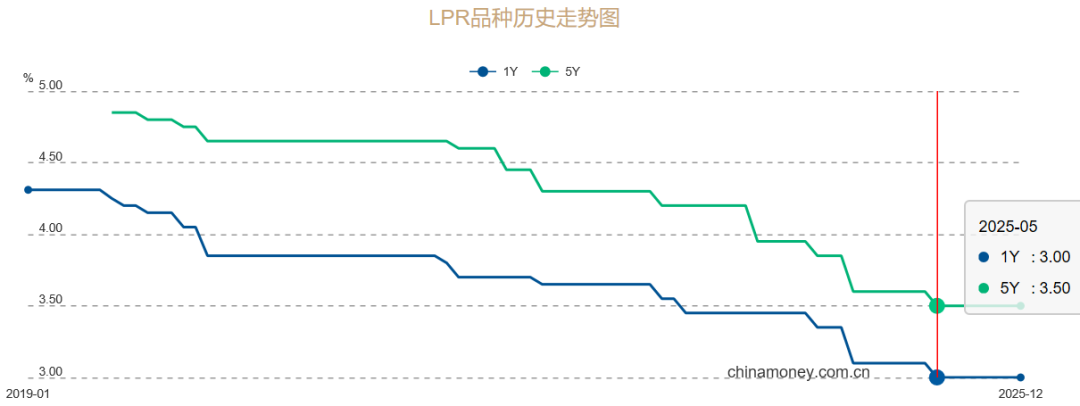
Group 1: LPR and Monetary Policy - The last LPR quote for the year shows no change in both 1-year and 5-year rates, with only one interest rate cut in 2025 [1] - The Federal Reserve has cut rates three times this year, totaling a reduction of 75 basis points, contributing to the appreciation of the RMB against the USD [2][12] - This situation has reduced barriers for international capital flow into China and indicates significant monetary policy space for the upcoming year [13] Group 2: M&A Activity - China International Capital Corporation (CICC) is set to absorb and merge with both Xinda and Dongxing Securities [3][14] - The merger involves a complex share exchange where 1 share of Dongxing will convert to 0.4373 shares of CICC, and 1 share of Xinda will convert to 0.5188 shares of CICC [15] - Current share prices indicate a discrepancy, with Dongxing's implied post-merger price at 15.77 CNY and Xinda's at 18.71 CNY, while their actual prices are 14.21 CNY and 17.85 CNY, respectively, showing a price difference of 9.89% and 4.6% [6][15] Group 3: Market Dynamics and Strategies - The price difference arises from two factors: uncertainty regarding the execution of the merger and the time required for regulatory approvals [7][16] - If the merger is successful, the share prices of Xinda and Dongxing are expected to converge towards their implied merger prices as the execution date approaches [16] - Investors can consider strategies such as buying Xinda or Dongxing while shorting CICC to lock in the price difference, although this involves risks if the merger fails [7][16] Group 4: Cash Exit Options - Shareholders of Xinda and Dongxing have the option to choose cash instead of shares if they do not wish to become shareholders of CICC, which is a protective measure for shareholders [18] - The cash exit prices are set at 34.8 CNY for CICC, 17.79 CNY for Xinda, and 13.13 CNY for Dongxing, with hidden cash exit prices calculated based on the share exchange ratios [19] - Various strategies can be employed around these cash exit prices, including buying below the cash exit price and selling at the hidden cash exit price [19]
行业供给侧改革提速,关注非银板块配置机遇
Changjiang Securities· 2025-12-22 11:28
Investment Rating - The report maintains a "Positive" investment rating for the non-bank financial sector [7]. Core Insights - The non-bank sector has shown strong performance this week, with notable developments in the brokerage sector, including the merger plans of China International Capital Corporation (CICC) with Dongxing and Xinda, indicating a further acceleration of supply-side reforms in the industry. The insurance sector is also seeing regulatory advancements with the China Banking and Insurance Regulatory Commission (CBIRC) seeking public opinion on the draft asset-liability management guidelines for insurance companies. The report suggests that the long-term outlook is positive, with improved return on equity (ROE) and valuation recovery expected, making the sector increasingly attractive for investment [2][4]. - The report recommends focusing on companies with stable profit growth and dividend rates, such as Jiangsu Jinzu, China Ping An, and China Pacific Insurance, which have strong market positions and business models. Additionally, it highlights companies like New China Life, China Life, Hong Kong Exchanges and Clearing, CITIC Securities, Dongfang Caifu, Tonghuashun, and Jiufang Zhitu Holdings based on their earnings elasticity and valuation levels [4]. Summary by Sections Market Performance - The non-bank financial index increased by 2.9% this week, outperforming the CSI 300 by 3.2%. Year-to-date, the non-bank financial index is up 9.8%, but underperformed the CSI 300 by 6.3% [5]. - The average daily trading volume in the market decreased to 17,604.84 billion yuan, down 9.86% week-on-week, with a daily turnover rate of 1.83%, down 19.91 basis points [5]. Industry News and Company Announcements - Key announcements include the merger plans of CICC with Dongxing and Xinda, and the CBIRC's public consultation on insurance asset-liability management guidelines. The report also notes the upcoming dividend announcements from Huaxi Securities, CICC, and Shenwan Hongyuan [6][19]. Insurance Sector Insights - In October 2025, the cumulative insurance premium income reached 548.33 billion yuan, a year-on-year increase of 7.99%. Life insurance premiums grew by 9.56%, while property insurance premiums increased by 4.02% [23][24]. - The total assets of insurance companies reached 40.59 trillion yuan, with life insurance companies holding 35.68 trillion yuan, reflecting a 0.68% increase [27][28]. Brokerage Sector Insights - The report highlights a decline in the overall equity market, with the CSI 300 index down 0.28% and the ChiNext index down 2.26%. The brokerage sector's investment assets are primarily in bonds, with equity investments comprising about 10%-30% [40][46]. - Margin trading balances decreased to 2.50 trillion yuan, down 0.34% week-on-week, indicating a cautious approach to stock pledge business due to previous credit risks [49]. Financing and Asset Management - In November 2025, equity financing reached 50.65 billion yuan, while bond financing totaled 706 billion yuan, indicating a recovery in financing activities [53]. - The report notes a rebound in the issuance of collective asset management products, with 4.387 billion units issued in November, up 4.1% from the previous month [55].
杰美特跌3.91% 2020年上市超募7.7亿东兴证券保荐
Zhong Guo Jing Ji Wang· 2025-12-22 08:35
Core Viewpoint - Jiemite (300868.SZ) has experienced a decline in stock price, closing at 28.48 yuan with a drop of 3.91% [1] Group 1: Company Overview - Jiemite was listed on the Shenzhen Stock Exchange's Growth Enterprise Market on August 24, 2020, with an initial public offering (IPO) of 32 million shares at a price of 41.26 yuan per share [1] - The total amount raised from the IPO was 1.32 billion yuan, with net proceeds of approximately 1.19 billion yuan after deducting issuance costs of 130.62 million yuan [1] - The company had an oversubscription amounting to 766.72 million yuan [1] Group 2: Financial Performance - On the day following its listing, August 25, 2020, Jiemite's stock reached an all-time high of 95.60 yuan [1] - Currently, the stock is in a state of decline, having fallen below its initial offering price [1] Group 3: Fund Utilization - The funds raised are intended for three main projects: expanding production capacity for mobile smart device accessories, building a technology research and development center, and upgrading brand construction and marketing networks [1] Group 4: Underwriting Information - The sponsor for Jiemite's IPO was Dongxing Securities Co., Ltd., with representatives Peng Dan and Jia Weiqiang [1] - The total underwriting fees amounted to 131 million yuan, of which Dongxing Securities received 112 million yuan [1]

金融行业周报:中金公司重组预案出炉,中央财办进一步明确政策导向-20251222
Ping An Securities· 2025-12-22 05:35
证券研究报告 金融行业周报 ——中金公司重组预案出炉,中央财办进一步明确政策导向 证券分析师 袁喆奇S1060520080003(证券投资咨询) 李冰婷S1060520040002(证券投资咨询) 许 淼S1060525020001(证券投资咨询) 研究助理 李灵琇S1060124070021(一般证券业务) 请务必阅读正文后免责条款 2025年12月22日 1 1、中金公司"三合一"重大资产重组预案出炉。12月17日晚间,中金公司与东兴证券、信达证券同步披露重大资产重组预 案,中金公司换股吸收合并两家公司的交易定价与方案明晰。3家上市券商A股股票均于12月18日开市起复牌。本次合并后主 体有望在发挥原有中金公司投资银行、私募股权投资、机构业务、资产管理和国际化业务优势的基础上,吸收信达证券和东 方证券在企业纾困、并购重整、区域布局、零售客户上的特色资源,新主体资本金得到进一步补充的情况下,有望充分发挥 AMC产业优势和股东赋能,实现汇金系"投行+AMC资源"的深度协同,加快一流投资银行和投资机构建设进程。 2、中央财办详解2025年中央经济工作会议精神。12月16日,中央财办有关负责同志详解年中央经济工作会 ...
东兴证券:煤炭行业“反内卷”催化产能收缩 高分红彰显中期投资价值
智通财经网· 2025-12-22 04:01
Core Viewpoint - The "anti-involution" policy is expected to promote industry self-discipline and capacity verification, leading to a stable increase in coal prices, with the coal industry transitioning towards high-quality development during the 14th Five-Year Plan period [1][2]. Group 1: Coal Price Trends - The coal price is anticipated to recover from its lows, with a projected stable increase in 2026. In 2025, coal prices are expected to fluctuate, with the lowest price for Qinhuangdao 5500 kcal thermal coal dropping to 610 CNY/ton in mid-June and recovering to 813 CNY/ton by December 1 [2]. - The China coking coal price index is projected to fluctuate between 1100-1570 CNY/ton in 2025, with a significant recovery of 37.14% from its lowest point [2]. Group 2: Supply Side Dynamics - The "anti-involution" policy aims to break low-price competition and shift the industry focus from scale expansion to quality improvement. The National Energy Administration has initiated capacity verification for coal mines in several provinces, which may lead to a decline in production due to stricter safety regulations [3]. - The coal import tax reinstated on January 1, 2024, and the emphasis on controlling low-quality coal imports are expected to reduce the volume of imported coal, with a notable 11% decrease in coal and lignite imports from January to November 2025 [3]. Group 3: Demand Side Insights - Thermal power generation is expected to remain resilient, with a projected increase in demand driven by AI computing power, which is anticipated to significantly boost electricity consumption in data centers [4]. - The cumulative thermal power generation from January to October 2025 was 52,130.5 billion kWh, showing a slight year-on-year decline, but thermal power is expected to play a crucial role in meeting electricity demand during peak periods [4]. Group 4: Dividend and Investment Outlook - The coal industry is witnessing a shift towards higher dividend payouts, with companies like China Shenhua and Shaanxi Coal aiming to maintain or increase their cash dividend ratios, reflecting a broader trend of enhancing shareholder returns [5]. - The introduction of market value management assessments and the emphasis on cash dividends are expected to strengthen the investment value of coal companies, with a focus on stable and sustainable returns [5]. Group 5: Investment Recommendations - Investment strategies should focus on leading coal companies with strong resource endowments, cost advantages, and stable dividend policies, such as China Shenhua and Shaanxi Coal, while also considering companies with growth potential like Guanghui Energy and Huayang Co [6].