
CHALCO(601600)

Search documents
小摩:料今年以旧换新政策继续利好金属商品市场 推荐买紫金矿业(02899)等
智通财经网· 2026-01-21 03:49
Core Viewpoint - Morgan Stanley forecasts China's GDP growth to reach 5% year-on-year by 2025, driven primarily by consumption stimulation from the trade-in policy [1] Group 1: Economic Outlook - The growth trend in the commodity market is expected to continue into 2026, with global demand-driven metals (such as gold, copper, and lithium) outperforming domestic demand-driven sectors (like coal and steel) [1] - Supply disruptions and accelerated industry consolidation are anticipated to persist throughout the year [1] Group 2: Policy Impact - The trade-in subsidy policy is projected to extend into 2026, with incentives becoming more targeted and efficiency-focused, still providing substantial support for overall commodity demand [1] Group 3: Industry Preferences - The preferred order for the basic materials sector in 2026 is gold and copper, followed by aluminum, lithium, coal, and steel [1] - The materials sector is expected to continue outperforming the MSCI China Index in 2026 [1] Group 4: Investment Recommendations - Investors are advised to buy Zijin Mining (02899, 601899.SH) and to accumulate China Aluminum (02600, 601600.SH) and China Hongqiao (01378) on dips [1] - Luoyang Molybdenum (03993) may experience a temporary pause due to the issuance of convertible bonds [1]

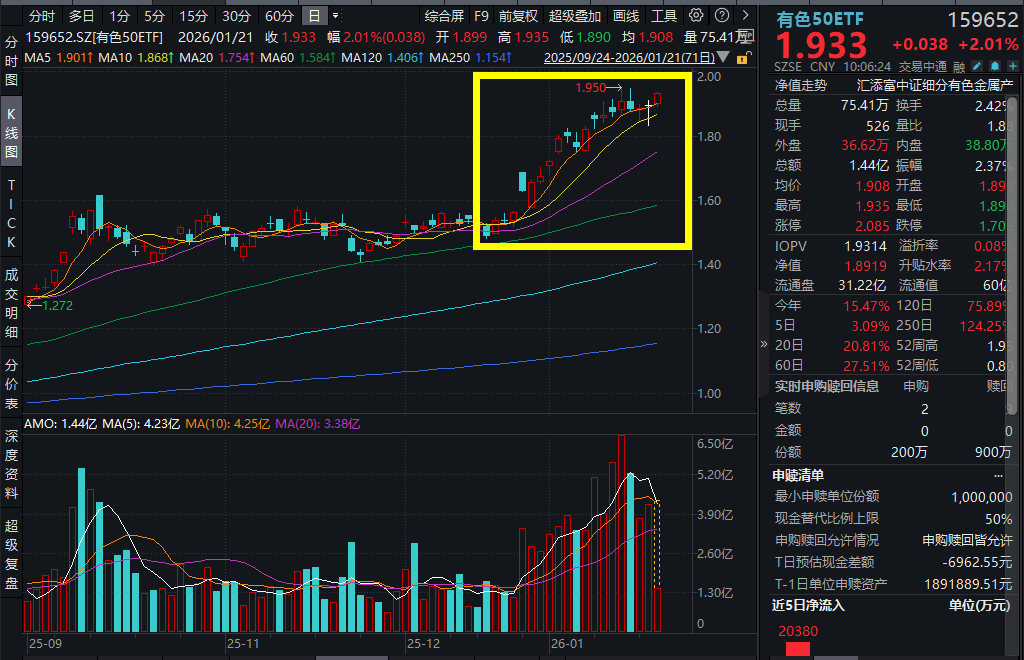
金、铜再度大涨,山东黄金涨超4%,有色50ETF(159652)劲升2%,近5日获净申购超3.5亿元!铜超级周期来袭?两大逻辑一文读懂
Sou Hu Cai Jing· 2026-01-21 02:42
Core Viewpoint - The A-share market is experiencing a strong upward trend, particularly in the non-ferrous metal sector, with significant gains in related ETFs and stocks [1][5]. Market Performance - As of January 21, the non-ferrous metal sector is showing robust performance, with the Non-Ferrous 50 ETF (159652) rising over 2% [1]. - Key stocks in the sector include: - Shandong Gold up 4.54% - Ganfeng Lithium up 3.10% - Northern Rare Earth up 1.63% [2][5]. Commodity Prices - On January 21, COMEX gold and spot gold both surpassed the $4800 mark, each increasing by over 1%, reaching historical highs [3]. - LME copper is also on the rise, currently up by 0.6% [3]. Geopolitical and Economic Factors - Geopolitical tensions are heightening, leading to increased risk aversion in the market [3]. - The U.S. Federal Reserve's political independence is under scrutiny, particularly with Jerome Powell's upcoming testimony [3]. Policy Developments - On January 20, multiple departments introduced an action plan to enhance the linkage between futures and spot markets for non-ferrous metals, aiming to improve the international competitiveness of the "Shanghai price" [3]. Investment Opportunities - Oriental Securities emphasizes the importance of focusing on industrial metals, predicting a strategic opportunity in the copper sector due to supply constraints and improving smelting fees [4]. - The report suggests that the copper market is expected to benefit from a recovery in production from major mines, which could enhance profit margins for smelting companies [4]. Strategic Insights - The current economic climate is characterized by a "spiral down" phase, highlighting copper's strategic importance as a key metal amid global economic shifts [6]. - The demand for copper is expected to surge due to the AI revolution, with projections indicating an additional demand of approximately 79-170 thousand tons by 2030 from data center expansions alone [6]. ETF Performance - The Non-Ferrous 50 ETF (159652) is noted for its high copper content (34%) and gold content (12%), making it a leading choice in the sector [8]. - The ETF has shown superior performance with a cumulative return of 99.61% since 2022, driven by earnings rather than valuation increases [10].





A股重磅!宽基ETF连续出现净赎回,有“巨无霸”份额回落至“924”行情之前,多只科创、创业板系ETF份额缩水,发生了啥?
Jin Rong Jie· 2026-01-20 08:57
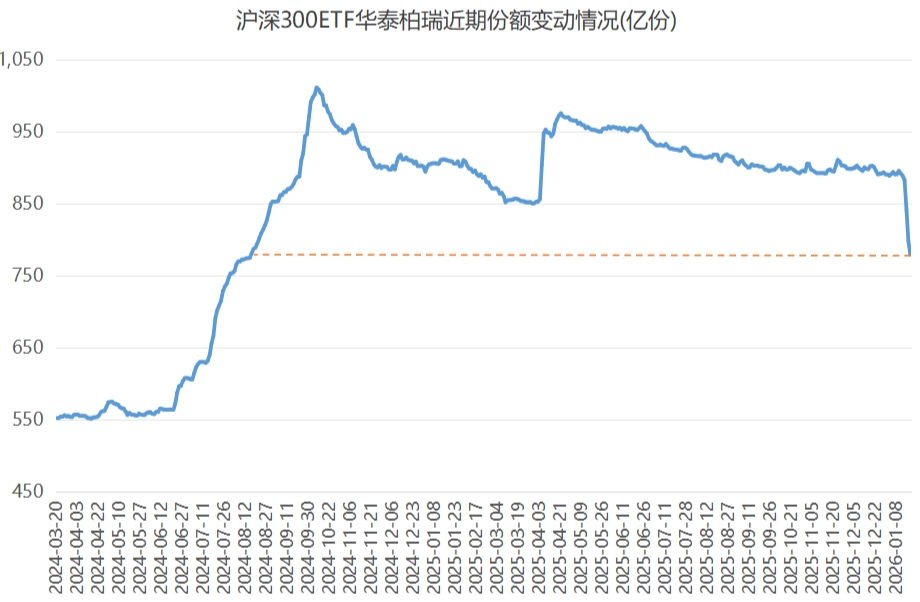
Group 1 - Recent net redemptions in A-share broad-based ETFs have drawn market attention, with significant outflows recorded on January 15 and 16, totaling 687 billion and 863 billion respectively, marking the highest single-day outflows in history [1] - As of January 19, four out of six major broad-based ETFs saw their shares decline by over 10% in the last three trading days, with the largest, Huatai-PB CSI 300 ETF, dropping to 778.63 billion shares, a scale of approximately 369.2 billion, the lowest since August 2024 [1] - The ChiNext and STAR Market ETFs also experienced significant declines, with the E Fund STAR 50 ETF and E Fund ChiNext ETF seeing share reductions of 34.55% and 20.22% respectively [3] Group 2 - In contrast to the outflows from broad-based ETFs, certain commodity, cross-border, and narrow-based ETFs attracted significant inflows, with the Southern Nonferrous ETF being the only product to receive over 10 billion in net inflows, totaling 100.87 billion, driven by rising base metal prices [3] - Other ETFs such as Yongying Satellite ETF, Harvest Software ETF, and GF Media ETF also received net inflows exceeding 6 billion [3] - According to CITIC Securities, the impact of ETF redemptions on individual stocks was significant, with main board, ChiNext, and STAR Market stocks experiencing sell-offs of 946 billion, 334 billion, and 265 billion respectively during the peak outflow days [3] Group 3 - Regulatory measures have been implemented to cool down the market following rapid price increases and overheated sentiment, including raising the minimum margin requirement for margin trading from 80% to 100% [5][6] - The China Securities Regulatory Commission emphasized the need for comprehensive market monitoring and timely counter-cyclical adjustments to maintain market stability and prevent excessive volatility [6] - There are differing views on the long-term outlook for A-shares, with some analysts suggesting the potential for a slow bull market due to reforms, while others remain skeptical about escaping historical volatility patterns [7]



钢矿央企掌门人年薪最高差一倍,背后是业绩的加速分化
Di Yi Cai Jing· 2026-01-20 07:52
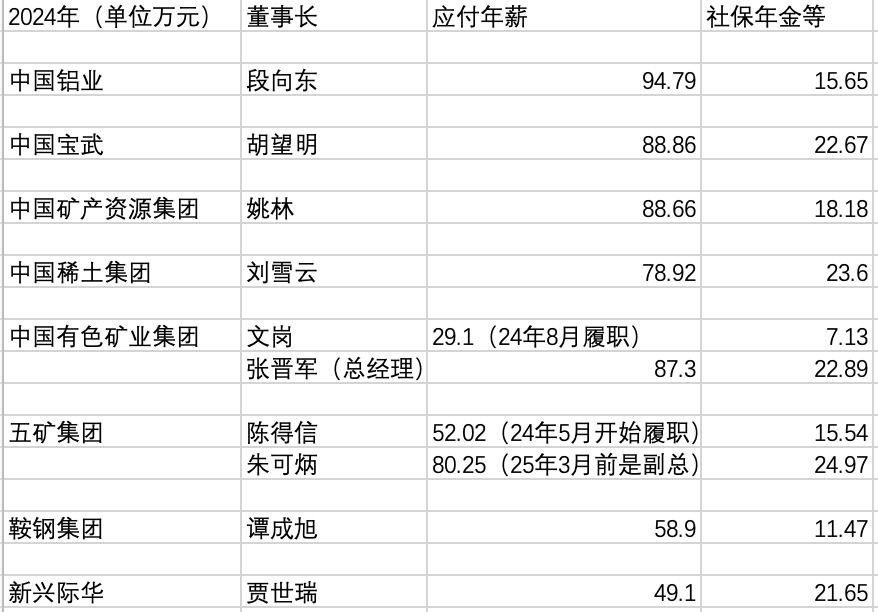
Group 1: Salary Trends - In 2024, the salaries of leaders in steel central enterprises generally decreased, while those in the non-ferrous metal mining sector mostly increased [1][4] - The highest salary among the eight central enterprises is held by the chairman of China Aluminum Corporation, Duan Xiangdong, at 947,900 yuan, followed by the chairman of China Baowu Steel Group, Hu Wangming, at 888,600 yuan [2][5] - The average salary for the eight steel and mining central enterprises' leaders did not exceed 1 million yuan, with the highest total salary including social insurance and other benefits being around 1.1 million yuan [1][2] Group 2: Performance and Salary Correlation - The salary of central enterprise leaders is closely linked to their performance, which explains the general increase in salaries for leaders in the non-ferrous metal mining sector [7] - China Aluminum Corporation reported a net profit of 12.4 billion yuan in 2024, a year-on-year increase of 85.38%, contributing to the rise in its leadership salaries [8] - The non-ferrous metal industry is projected to achieve a total profit of around 420 billion yuan in 2024, with a year-on-year growth of over 10% [9] Group 3: Industry Challenges - The steel industry faced a challenging operating environment in 2024, with major steel companies reporting a total profit of 45.7 billion yuan, a decline of 47.2% year-on-year [6] - The crude steel production in 2024 was 1.01 billion tons, down 1.7% year-on-year, and the domestic steel price index fell by 8.4% [6] - Despite the difficulties in 2024, the steel industry's performance is expected to improve in 2025, with a projected profit increase of 1.9 times in the first three quarters [6]



金属行业周报:地缘局势扰动,金价仍有支撑-20260120
BOHAI SECURITIES· 2026-01-20 06:47
Investment Rating - The report maintains a "Positive" rating for the steel industry and a "Positive" rating for the non-ferrous metals industry, with "Buy" ratings for specific companies including Luoyang Molybdenum, Zhongjin Gold, Huayou Cobalt, Zijin Mining, and China Aluminum [7][8]. Core Insights - The geopolitical situation continues to create volatility, but gold prices are expected to remain supported due to ongoing tensions [3][52]. - The steel industry is anticipated to see improved profitability due to the implementation of growth policies and an optimistic demand outlook in sectors like shipbuilding and construction [4][5]. - The copper market is expected to tighten due to supply constraints from major mines, while demand is projected to increase in sectors such as electric power grids and new energy vehicles [4][41]. - The aluminum sector faces challenges with oversupply in alumina and potential short-term price corrections, but the demand from the new energy vehicle sector remains a key focus [4][48]. - The rare earth industry is expected to see a revaluation of related companies due to China's export controls and the strategic importance of rare earth resources [7][4]. Summary by Sections Steel Industry - Current steel mill inventory pressure is not significant, and short-term demand decline is limited, with expectations of price support before the Spring Festival [5][19]. - As of January 16, 2026, the total steel inventory was 12.4955 million tons, a decrease of 0.39% from the previous week, but an increase of 7.72% year-on-year [26][27]. - The comprehensive price index for steel on January 16, 2026, was 3,457.46 CNY/ton, reflecting a 0.15% increase from the previous week [39][40]. Copper Industry - The copper market is facing a lack of driving force for price increases, but expectations for 2026 remain positive due to anticipated demand growth [3][41]. - As of January 16, 2026, LME copper prices were 13,000 USD/ton, with SHFE copper prices at 101,900 CNY/ton, showing a slight decrease in LME prices but an increase in SHFE prices [46]. Aluminum Industry - The aluminum processing sector is currently in a contraction phase, with a PMI of 42.4% as of December 2025 [48]. - The average price of alumina on January 16, 2026, was 2,666 CNY/ton, down 1.00% from the previous week [49]. Precious Metals - The geopolitical landscape and mixed economic data from the U.S. are influencing gold prices, which are expected to remain supported [52]. - As of January 16, 2026, COMEX gold prices were 4,601.10 USD/oz, reflecting a 1.83% increase from the previous week [53].


成交额超2亿元,有色金属ETF基金(516650)回调获资金抢筹
Sou Hu Cai Jing· 2026-01-20 02:37
Core Viewpoint - The market is experiencing a collective pullback in major indices, with significant declines in copper and gold prices, while emerging sectors like AI data centers are driving long-term demand for non-ferrous metals [1][2]. Group 1: Market Performance - As of January 20, 2026, major indices have collectively retreated, with copper prices experiencing a sharp drop and gold prices slightly declining [1]. - Gold ETFs, such as Huaxia (518850), fell by 0.2%, while the gold stock ETF (159562) decreased by 2.31%, and the non-ferrous metal ETF fund (516650) dropped by 2.34% [1]. - The trading volume was active, with a turnover of 216 million yuan and a turnover rate of 1.49%, indicating potential fund accumulation [1]. Group 2: Fund Flows and Demand Drivers - Non-ferrous metal ETFs have seen continuous net inflows over the past 18 days, totaling 10.774 billion yuan [1]. - Emerging fields like AI data centers are becoming core demand drivers for non-ferrous metals, with significant reliance on copper and aluminum for power and cooling systems [1]. - The demand for copper and aluminum is expected to be supported in the long term due to "AI capital expenditure growth" and global energy transition trends [1]. Group 3: Industrial Product Price Dynamics - According to Dongfang Securities, market expectations for short-term interest rate cuts have been dampened following statements from Trump, leading to weakened financial support for industrial product prices [2]. - Increased domestic inventory and lower downstream processing rates have contributed to negative feedback for major industrial products like copper and aluminum [2]. - Despite short-term volatility, strong support for industrial products is anticipated due to internal and external policy expectations, with some inventories at historically low levels [2]. Group 4: ETF Index Composition - As of December 31, 2025, the top ten weighted stocks in the CSI Non-ferrous Metal Industry Theme Index (000811) include Zijin Mining, Luoyang Molybdenum, Northern Rare Earth, and others, collectively accounting for 52.98% of the index [2].

供应趋紧之下铝价涨势如虹 汇丰上调中国宏桥目标价至41港元
Zhi Tong Cai Jing· 2026-01-19 04:07
汇丰表示,尽管行业轮动,需求仍保持韧性:在需求方面,受汽车轻量化和电池外围强劲需求推动,与 电动汽车相关的消费依然强劲。电网层面的投资则继续提供一个稳定的、为期多年期的需求来源。太阳 能需求正从近期峰值全面正常化,仍是铝需求的重要贡献者。建筑层面的需求在经历多年疲软后似乎正 在企稳,减轻了长期以来铝市场增长路径的不利因素。总体而言,该机构预计中国铝需求将保持强大韧 性,支撑更紧张的市场平衡态势。 汇丰分析师团队强调称,这种趋紧的平衡已转化为铝价格走势。上海期货交易所的铝价已突破23,000 元人民币/吨的重要关口,伦敦金属交易所LME铝价持续上行至突破3,000美元/吨,创下多年来的历史 最高点位,但尚未重返2021/22年所见的历史最高峰值(分别为大约24,000元人民币/吨以及>3,800美 元/吨),这表明如果状况持续或进一步趋紧,仍然存在可观的上行潜力。 不过汇丰的分析师们表示,结构性供应限制依然存在:比如,在中国市场,产能上限继续限制增量级别 产出,尽管价格强劲,但汇丰认为产量大幅增长的空间很小。海外供应增长则相对温和,且日益面临中 断风险。South32旗下Mozal铝厂(约0.25百万吨)确认将 ...
有色及贵金属行业周报:流动性预期回摆,无碍长多逻辑延续
Orient Securities· 2026-01-19 03:24
Investment Rating - The report maintains a positive outlook on the non-ferrous metals industry [6] Core Viewpoints - The report indicates that negative feedback is intensifying, leading to potential price fluctuations. As industrial product prices rise, domestic downstream negative feedback is increasing, resulting in accelerated inventory accumulation. Recent margin increases by CME and SHFE for certain products may lead to significant short-term price volatility in industrial metals. However, the overall bullish trend for industrial products remains unchanged under the expectation of supportive policies [3][9] Summary by Sections 1. Cycle Assessment - Liquidity expectations are reverting, which does not hinder the long-term bullish logic. Recent statements from Trump favoring Hassett for the National Economic Council position have increased market expectations for the new Fed chair. The probability of a Fed rate cut in April has dropped to 30%. This has led to potential price fluctuations in precious metals due to a weakened narrative around short-term rate cuts [9][13] 2. Industry and Stock Performance - The non-ferrous metals sector rose by 3.03% in the week ending January 16, ranking third among all industries [18] 3. Precious Metals - Short-term narratives around rate cuts are faltering, leading to potential price volatility in precious metals. As of January 16, SHFE gold rose by 2.57% to 1,032.32 CNY per gram, while COMEX gold increased by 2.62% to 4,590.00 USD per ounce. The report notes that the People's Bank of China increased its gold reserves to 7,415 million ounces, marking a continuous increase for 14 months [14][29] 4. Copper - The report highlights that negative feedback is intensifying, leading to increased price volatility for copper. As of January 16, SHFE copper fell by 0.63% to 100,770 CNY per ton, while LME copper decreased by 1.50% to 12,803 USD per ton. The report also notes a significant increase in global visible copper inventory [17][28] 5. Aluminum - The aluminum processing sector shows resilience, with profitability per ton of aluminum expected to remain high. As of January 16, SHFE aluminum fell by 1.66% to 23,925 CNY per ton. The report indicates that the average profit for the aluminum industry is around 7,868 CNY per ton [16][89]


金属铝行业简析报告
MCR嘉世咨询· 2026-01-19 02:50
Investment Rating - The report does not explicitly state an investment rating for the aluminum industry Core Insights - Aluminum is the second most produced and consumed metal globally, following steel, due to its lightweight, corrosion resistance, high conductivity, and recyclability, making it a cost-effective and sustainable industrial metal [3] - The industry is characterized by a "cost + processing fee" business model, where profits are driven by the price difference between aluminum and overall production costs [16] - China's electrolytic aluminum production capacity is capped at 45 million tons, which has led to a focus on cost and efficiency rather than expansion, positioning the country as the largest producer globally [24] Summary by Sections Industry Definition - Aluminum is a lightweight, corrosion-resistant metal with excellent conductivity and processing capabilities, achieving a balance between physical properties, economic costs, and sustainability [3] Main Processes - The primary production methods for aluminum include the Bayer process for alumina and the electrolytic method for primary aluminum [5][8] Key Policies - China's electrolytic aluminum policy includes a 45 million ton capacity ceiling to prevent disorderly expansion and promote green low-carbon transformation [9] - The industry is guided by policies aimed at high-quality development, resource recycling, and safety production standards [10] Industry Chain Analysis - The value in the aluminum industry is concentrated in the midstream electrolytic aluminum preparation segment, with significant upstream resource dependencies [11] Business Model - The core profit driver in the aluminum industry is the difference between aluminum prices and production costs, with varying profit drivers across different segments [16] Upstream Bauxite - China heavily relies on imported bauxite, with a 70% dependency, leading to supply chain vulnerabilities [20] Midstream Electrolytic Aluminum - China holds approximately 60% of global electrolytic aluminum production capacity, with strict policy constraints shaping the competitive landscape [24] Downstream Demand - Global aluminum demand is steadily increasing, with China being the largest consumer, accounting for 62.89% of global demand by 2024 [31] Future Opportunities - The aluminum industry is expected to benefit from policy support for green transformation, increased demand for aluminum in power grids, and a boom in recycled aluminum production [39][40][41][42]
有色及贵金属周报:流动性预期回摆,无碍长多逻辑延续-20260119
Orient Securities· 2026-01-19 02:43
Investment Rating - The report maintains a positive outlook on the non-ferrous metals industry [6] Core Viewpoints - The report indicates that negative feedback is intensifying, leading to potential price fluctuations. As industrial product prices rise, domestic downstream negative feedback is increasing, resulting in accelerated inventory accumulation. Recent margin increases by CME and SHFE for certain products may lead to significant short-term price volatility in industrial metals. However, the overall bullish trend for industrial products remains unchanged under the support of domestic and international policies [3][9] Summary by Sections 1. Cycle Assessment - Liquidity expectations are rebounding, which does not hinder the long-term bullish logic. Recent statements from Trump favoring Hassett for the National Economic Council chair have increased market expectations for the next Federal Reserve chair. The probability of a rate cut in April has dropped to 30%. This may lead to price fluctuations in precious metals due to the weakened short-term rate cut narrative. In the industrial sector, as prices rise, negative feedback from domestic downstream is intensifying, and inventory is accumulating rapidly [9][13] 2. Industry and Stock Performance - The non-ferrous metals sector rose by 3.03% in the week ending January 16, ranking third among all industries [18] 3. Precious Metals - Short-term rate cut narratives are challenged, leading to potential price fluctuations in precious metals. For the week ending January 16, SHFE gold rose by 2.57% to 1,032.32 CNY per gram, while COMEX gold increased by 2.62% to 4,590.00 USD per ounce. SHFE silver surged by 20.03% to 22,483.00 CNY per kilogram, and COMEX silver rose by 12.30% to 89.19 USD per ounce [14][15][29] 4. Copper - Negative feedback is intensifying, leading to increased price volatility for copper. For the week ending January 16, SHFE copper fell by 0.63% to 100,770 CNY per ton, while LME copper decreased by 1.50% to 12,803 USD per ton. The supply side remains tight, and the transmission to the smelting end is approaching [17][28] 5. Aluminum - The processing operation remains resilient, and the profit per ton of aluminum is expected to stay high. For the week ending January 16, SHFE aluminum fell by 1.66% to 23,925 CNY per ton, while LME aluminum decreased by 0.06% to 3,134 USD per ton. The processing operation rate slightly increased to 60.2%, with overall inventory accumulating [16][89]