
Sirui(688102)

Search documents
商业航天:以第一性原理推演中国商业航天降本革命(附报告)
材料汇· 2026-01-21 15:30
Core Conclusion - By 2026, China's commercial aerospace industry is expected to reach a turning point in cost reduction for launch capacity, driven by the concentrated deployment of low Earth orbit (LEO) constellations and the normalization of high-frequency launches, with reusable rockets nearing breakthroughs in reducing unit launch costs. The industry's business model will shift from state-driven tasks to market-driven profitability, with a valuation logic transitioning towards "space infrastructure" as application scenarios and business models are restructured [3]. Market Outlook - 2026 is anticipated to be a prosperous year for China's commercial aerospace sector, with an accelerated pace of multi-constellation launches transitioning to large-scale deployment, leading to a rapid increase in rocket launch frequency. The commercial rocket launch service market in China is projected to grow from 10.26 billion yuan in 2025 to 47.39 billion yuan by 2030, corresponding to a CAGR of approximately 35.8%, primarily driven by high-frequency launch demand from dense deployment of LEO constellations [4][11]. - The industry is expected to maintain medium to long-term growth, with over 237,000 satellites needing to be deployed in accordance with ITU regulations by 2039. Starlink currently has over 9,000 satellites in orbit, and the demand for subsequent launches remains robust due to tightening frequency resources [4][11]. Cost Reduction Pathways - The essence of commercial rockets is a "space logistics" business, where core variables include efficiency improvements and cost reductions in launch capacity. Key pathways for cost reduction include breakthroughs in full-flow engine technology, high-frequency reuse capabilities, and industrialization in manufacturing [5]. - The unit cost of launching rockets is expected to decrease significantly through various stages: 1. Initial launch cost is approximately 55,000 yuan/kg 2. By around 2026, after achieving first-stage reuse, costs may drop to about 25,000 yuan/kg 3. Upgrading from aluminum to stainless steel structures could further reduce costs to approximately 19,000 yuan/kg 4. With the maturation of recovery methods, costs may decline to around 13,000 yuan/kg 5. Long-term, achieving second-stage reuse could bring costs close to 5,000 yuan/kg [5]. Industry Structure and Investment Opportunities - The commercial rocket industry is still in its early growth and valuation evolution phase. Key catalysts for valuation uplift in China's commercial aerospace sector include the realization of reusable rockets for large-scale LEO satellite networking and the transition from customized to standardized launches through long-term batch tasks [7][8]. - The valuation logic for commercial aerospace companies is shifting from manufacturing-oriented to platform and infrastructure-oriented technology enterprises, covering diverse long-term space mission needs such as manned flights and deep space exploration [8]. Key Players and Market Segments - The core technical barriers in rocket engines are concentrated in critical components such as thrust chambers and turbine pumps. The value in satellite manufacturing is primarily found in communication payloads [9]. - Key companies involved in the aerospace supply chain include: - Power Systems: Yingliu Co., Srey New Materials, Guoji Precision Engineering - Satellite Communication Systems: Shanghai Hantong, Aerospace Electronics, Guobo Electronics - Materials and Structural Components: Western Materials, Parker New Materials, Guoji Heavy Industry, Huazhuo High-Tech - Testing and Verification: Xicai Testing, Su Testing [9][10].





商业航天行业深度系列(一):以第一性原理推演中国商业航天降本革命
Shanghai Aijian Securities· 2026-01-21 10:19
Investment Rating - The report rates the industry as "stronger than the market" [1] Core Insights - The report concludes that 2026 will mark a turning point for China's commercial aerospace industry, with a shift from state-driven missions to market-driven profitability, driven by the deployment of low-orbit satellite constellations and advancements in reusable rocket technology [1][6] - The commercial rocket launch service market in China is projected to grow from 10.26 billion yuan in 2025 to 47.39 billion yuan by 2030, with a CAGR of approximately 35.8% [1][12] - The report emphasizes that the core components of rocket launch services are engines (54%) and structural components (24%), which together account for 78% of the value in the launch service segment [1][12] Summary by Sections Industry Overview - The commercial aerospace industry is defined as activities that provide aerospace products and services through social capital investment under national policy guidance, including the R&D, manufacturing, launch, and operation of spacecraft and rockets [6][7] - The global aerospace economy is expected to reach $612 billion by 2024, with commercial aerospace revenues accounting for approximately $480 billion, representing about 78% of the total [6][7] Market Dynamics - The demand for satellite launches is expected to surge as China enters a concentrated deployment phase for low-orbit satellite constellations, with over 200,000 satellites planned for deployment [18][19] - The report highlights that the competition for low-orbit frequency resources is intensifying, necessitating faster deployment of satellite constellations [19][21] Cost Structure and Efficiency - The report breaks down the cost structure of rockets, indicating that engines and structural components dominate the value chain [1][12] - It outlines a pathway for reducing launch costs, projecting that the unit cost of launching payloads could decrease significantly as technology advances [1][12] Investment Recommendations - The report suggests focusing on companies involved in key segments such as propulsion systems, satellite communication systems, materials and structural components, and testing and validation services [2][4] - Specific companies to watch include 应流股份 (603308), 斯瑞新材 (688102), and 上海瀚讯 (300762), among others [2][4]

中美竞逐万亿美元新赛道,五层解构下的投资蓝图
Tebon Securities· 2026-01-21 04:07
Investment Rating - The report maintains an "Outperform" rating for the commercial aerospace industry [1] Core Insights - The aerospace sector is transitioning from being viewed as a "cost center" driven by national will to a "growth engine" driven by commercial demand, with significant investments and strategic planning from both the US and China [6][9] - The global aerospace economy is projected to reach $613 billion in 2024, with commercial aerospace contributing 78%, and is expected to exceed $1 trillion by 2032 [6][9] - The value chain of commercial aerospace is divided into five core levels: "space, ground, terminal, rocket, and application," each presenting unique market opportunities and technical challenges from 2026 to 2030 [10][29] Summary by Sections 1. Space: Satellite Manufacturing - The satellite manufacturing market in China is expected to grow from approximately 7.1 billion yuan in 2025 to about 39.4 billion yuan by 2030, reflecting a shift from sporadic research models to continuous, batch engineering deliveries [16][18] 2. Ground: Ground Systems - The ground systems market is projected to increase from around 1.2 billion yuan in 2025 to approximately 39.1 billion yuan by 2030, evolving from a supporting role to a core infrastructure essential for stable satellite constellation operations [21][22] 3. Terminal: Key Variable for Commercial Aerospace - The terminal market is anticipated to grow from 500 million yuan in 2025 to about 141.9 billion yuan by 2030, driven by multiple vertical industries and potential consumer scenarios [23][24] 4. Rocket: Core Constraint - The cost of rocket launches is a critical constraint, with reusable technology expected to reduce costs by 80%-90% compared to traditional expendable rockets. The market for rocket launch services is projected to grow from approximately 10.7 billion yuan in 2025 to about 34.3 billion yuan by 2030 [25][26] 5. Application: Final Value Realization - The application market is expected to expand from 200 million yuan in 2025 to 525 billion yuan by 2030, with the revenue share from applications projected to rise from single digits to over 67% by around 2030 [27][28] 6. Investment Opportunities - Investment opportunities in commercial aerospace can be categorized into three main tracks: 1. Launch and manufacturing segments, which are expected to benefit directly from increased orders and visibility 2. Core components and systems, characterized by high technical barriers and critical for long-term competitiveness 3. Downstream applications and operational services, which, while currently limited in scale, hold the greatest long-term potential for value realization [29][30]


长十二火箭发射周期再缩短事件点评:火箭发射节奏持续加快,商业航天产业稳步提速
GUOTAI HAITONG SECURITIES· 2026-01-20 11:40
Investment Rating - The report assigns an "Accumulate" rating for the industry [4]. Core Insights - The launch cycle of the Long March 12 rocket has been shortened, indicating a potential acceleration in China's commercial space launch rhythm. The report anticipates that by 2026, China's commercial space sector will experience rapid growth, becoming a core investment direction in the military industry during the 14th Five-Year Plan [2][4]. Summary by Sections Industry Overview - The Long March 12 rocket, developed by the China Aerospace Science and Technology Corporation, has demonstrated strong performance with a near-Earth orbit capacity of at least 12 tons and a 700 km sun-synchronous orbit capacity of at least 6 tons. The rocket's launch cycle has been optimized, reducing the time by 4 days, showcasing high efficiency in testing and launch operations [4]. Future Outlook - By 2025, significant breakthroughs in manned spaceflight, deep space exploration, and commercial space sectors are expected, with a projected total of 92 launches, setting a historical record. The report highlights that 2026 will bring further surprises and advancements in China's space endeavors, including the construction of space stations and lunar exploration [4]. Investment Recommendations - The report recommends specific stocks for investment, including Aerospace Electronics, Shaanxi Huada, Zhimin Da, Guobo Electronics, Guangwei Composite, and AVIC High-Tech. Related stocks mentioned include Chaojie Co., Zhenlei Technology, China Satellite, Aerospace Electric, Zhongtian Rocket, and Srey New Materials [4].


金属新材料板块1月20日跌2.41%,斯瑞新材领跌,主力资金净流出10.91亿元
Zheng Xing Xing Ye Ri Bao· 2026-01-20 08:51
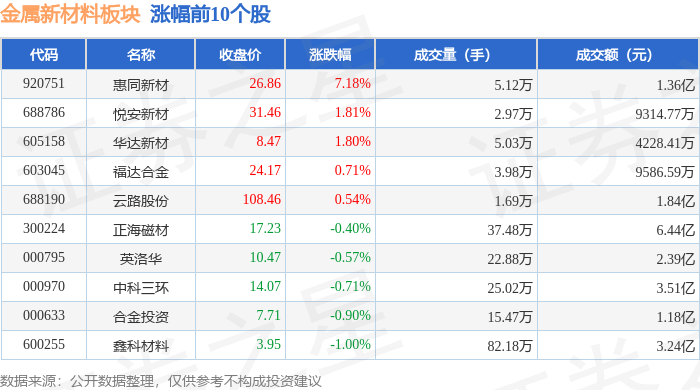
Market Overview - The metal new materials sector experienced a decline of 2.41% on January 20, with Srei New Materials leading the drop [1] - The Shanghai Composite Index closed at 4113.65, down 0.01%, while the Shenzhen Component Index closed at 14155.63, down 0.97% [1] Stock Performance - Notable gainers included: - Huitong New Materials (code: 920751) with a closing price of 26.86, up 7.18% and a trading volume of 51,200 shares, totaling 136 million yuan [1] - Ni'an New Materials (code: 688786) closed at 31.46, up 1.81% with a trading volume of 29,700 shares, totaling 93.15 million yuan [1] - Huada New Materials (code: 605158) closed at 8.47, up 1.80% with a trading volume of 50,300 shares, totaling 42.28 million yuan [1] - Significant decliners included: - Srei New Materials (code: 688102) closed at 42.74, down 7.09% with a trading volume of 384,500 shares, totaling 1.68 billion yuan [2] - Shenzhen New Star (code: 603978) closed at 26.53, down 5.45% with a trading volume of 130,100 shares, totaling 35.2 million yuan [2] - Zhongzhou Special Materials (code: 300963) closed at 21.05, down 5.18% with a trading volume of 259,500 shares, totaling 553 million yuan [2] Capital Flow - The metal new materials sector saw a net outflow of 1.09 billion yuan from institutional investors, while retail investors experienced a net inflow of 945 million yuan [2] - The capital flow for specific stocks indicated: - Yulu Co., Ltd. (code: 688190) had a net inflow of 16.82 million yuan from institutional investors [3] - Huitong New Materials (code: 920751) had a net inflow of 12.71 million yuan from institutional investors [3] - Jiangnan New Materials (code: 603124) experienced a net outflow of 1.86 million yuan from institutional investors [3]
斯瑞新材股价涨5.3%,华夏基金旗下1只基金重仓,持有115.12万股浮盈赚取265.92万元
Xin Lang Cai Jing· 2026-01-19 03:16
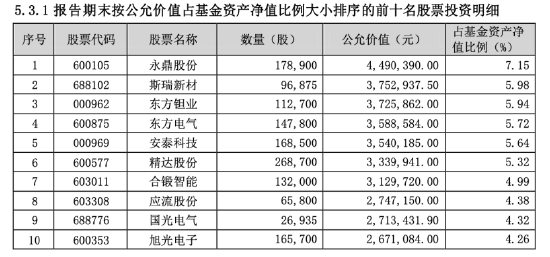
Group 1 - The core viewpoint of the news is that Srey New Materials has seen a stock price increase of 5.3%, reaching 45.86 CNY per share, with a trading volume of 904 million CNY and a turnover rate of 2.75%, resulting in a total market capitalization of 35.562 billion CNY [1] - Srey New Materials, established on July 11, 1995, is located in Xi'an, Shaanxi Province, and was listed on March 16, 2022. The company specializes in high-strength and high-conductivity copper alloy materials and products, medium and high-voltage electrical contact materials and products, high-performance metal chromium powder, CT and DR tube components, and next-generation copper-iron alloy materials [1] - The revenue composition of Srey New Materials includes high-strength and high-conductivity copper alloy materials and products at 46.51%, medium and high-voltage electrical contact materials and products at 22.90%, other main businesses at 14.09%, supplementary other at 6.12%, medical imaging components at 5.31%, and high-performance metal chromium powder at 5.08% [1] Group 2 - From the perspective of major fund holdings, data shows that one fund under Huaxia Fund has a significant position in Srey New Materials. Huaxia Xinghua Mixed Fund (519908) held 1.1512 million shares in the third quarter, accounting for 2.88% of the fund's net value, ranking as the tenth largest holding [2] - The estimated floating profit for Huaxia Xinghua Mixed Fund from its investment in Srey New Materials is approximately 2.6592 million CNY [2] - Huaxia Xinghua Mixed Fund, established on April 12, 2013, has a current scale of 702 million CNY, with a year-to-date return of 8.64%, ranking 1670 out of 9009 in its category, and a one-year return of 42.35%, ranking 2972 out of 8164 [2]
商业航天 多地各显其能 产业布局“竞速赛”开启
Shang Hai Zheng Quan Bao· 2026-01-15 18:01
Core Insights - The commercial aerospace industry in China is experiencing significant growth, with an annual increase of over 20%, projected to reach between 7 trillion to 10 trillion yuan by 2030. The formal inclusion of commercial aerospace in the national space development plan by the end of 2025 highlights its strategic importance and potential [1]. Group 1: Industry Growth and Events - Major cities like Beijing, Shanghai, and Shenzhen are hosting commercial aerospace exhibitions, which serve as indicators of industry development and resource aggregation [1][2]. - The third Beijing Commercial Aerospace Industry High-Quality Development Conference and the 2026 Beijing International Commercial Aerospace Exhibition will take place from January 23 to 25, featuring over 300 global companies, including major domestic players [1][2]. Group 2: Regional Development and Policies - Beijing's Yizhuang area is a key hub for the commercial aerospace industry, housing over 180 companies, with a significant concentration of commercial rocket enterprises [2]. - Recent policies in Beijing and Shanghai aim to accelerate the development of the commercial aerospace sector, including action plans for innovation and advanced manufacturing clusters [3]. Group 3: Regional Strategies and Goals - Shaanxi and Sichuan provinces are leveraging their unique resources to develop differentiated paths in the commercial aerospace sector, with Shaanxi aiming to establish a 100 billion yuan industry by 2030 [4]. - Shaanxi's action plan includes the establishment of over 200 enterprises in the commercial aerospace sector by 2030, supported by a robust industrial ecosystem [4][5]. - Chengdu is also actively developing its commercial aerospace capabilities, with plans to reach a scale of 50 billion yuan by 2027, focusing on satellite applications and core electronic components [5][6].

同泰新能源优选1年持有四季报“押注”可控核聚变新战场,基金经理陈宗超:能源革命爆发力远超想象
Xin Lang Cai Jing· 2026-01-14 10:06
Core Insights - The article discusses the investment outlook for the 2025 fund reports, focusing on AI applications, commercial aerospace, and nuclear fusion as potential investment themes for 2026 [1] Group 1: Fund Performance - The fund managed by Chen Zongchao, Tongtai New Energy Preferred 1-Year Holding A, achieved a quarterly return of 26.28%, ranking first among its peers [3][11] - The fund's returns over the past month, three months, and six months were 16.38%, 25.96%, and 70.17%, respectively, with a one-year return of 96.53%, nearly doubling [3][11] Group 2: Investment Strategy - Chen Zongchao emphasizes a structural differentiation in the power equipment and new energy sector, advocating for a focus on cutting-edge and uncertain areas like controllable nuclear fusion [1][2] - The core logic is based on the advantages of controllable nuclear fusion, which is driven by advancements in high-temperature superconductors and the growth of artificial intelligence, positioning it as a key battleground for major powers [1][2] Group 3: Market Dynamics - 2025 is seen as a pivotal year for controllable nuclear fusion to transition from scientific ideal to industrial reality, supported by strong policy drivers and a diversified investment ecosystem involving state platforms, energy state-owned enterprises, local funds, and private capital [2][7] - The investment potential of controllable nuclear fusion is projected to exceed that of wind, solar, and lithium battery industries once the technology matures and achieves large-scale commercialization [2][7] Group 4: Portfolio Composition - The fund's top ten holdings differ significantly from traditional new energy funds, including companies like Yongding Co., Sry New Materials, and Antai Technology, which are closely linked to key aspects of the nuclear fusion industry chain [8][9]


金属新材料板块1月14日跌0.43%,斯瑞新材领跌,主力资金净流出10.23亿元
Zheng Xing Xing Ye Ri Bao· 2026-01-14 08:50
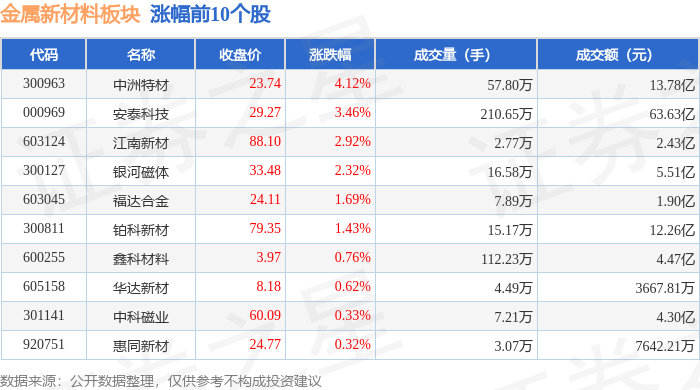
Market Overview - The metal new materials sector experienced a decline of 0.43% on January 14, with Srei New Materials leading the drop [1] - The Shanghai Composite Index closed at 4126.09, down 0.31%, while the Shenzhen Component Index closed at 14248.6, up 0.56% [1] Stock Performance - Notable gainers in the metal new materials sector included: - Zhongzhou Special Materials (300963) with a closing price of 23.74, up 4.12% and a trading volume of 578,000 shares, totaling 1.378 billion yuan [1] - Antai Technology (696000) closed at 29.27, up 3.46% with a trading volume of 2.1065 million shares, totaling 6.363 billion yuan [1] - Jiangnan New Materials (603124) closed at 88.10, up 2.92% with a trading volume of 27,700 shares, totaling 243 million yuan [1] - Conversely, Srei New Materials (688102) saw a significant decline, closing at 46.63, down 4.41% with a trading volume of 615,000 shares, totaling 296.7 million yuan [2] - Other notable decliners included: - Tianli Composite (920576) down 3.23% to 97.25 [2] - Xinlaifu (301323) down 2.48% to 58.49 [2] Capital Flow - The metal new materials sector saw a net outflow of 1.023 billion yuan from institutional investors, while retail investors contributed a net inflow of 1.172 billion yuan [2] - Specific stock capital flows indicated: - Antai Technology had a net inflow of 475.43 million yuan from retail investors, while institutional investors experienced a net outflow of 302 million yuan [3] - Platinum New Materials (300811) had a net inflow of 891.04 million yuan from institutional investors, with a net outflow of 2.154 billion yuan from retail investors [3]

斯瑞新材(688102) - 关于调整2025年前三季度利润分配现金分红总额的公告
2026-01-13 10:15
证券代码:688102 证券简称:斯瑞新材 公告编号:2026-004 陕西斯瑞新材料股份有限公司 关于调整2025年前三季度利润分配现金分红总额 的公告 二、调整原因 重要内容提示: 现金分红总额调整情况:陕西斯瑞新材料股份有限公司(以下简称"公 司")2025 年前三季度利润分配拟维持每 10 股派发现金红利 0.40 元(含税) 不变,派发现金分红的总额由 30,905,367.16 元(含税)调整为 30,927,607.16 元(含税)。 自公司董事会审议通过 2025 年前三季度利润分配方案之日起至本公告 披露日,公司因 2023 年股票期权激励计划首次授予及预留授予股票期权第一个 行权期自主行权,新增股份 556,000 股,公司总股本由 774,901,878 股变更为 775,457,878 股,扣除公司回购专用证券账户中股份数(2,267,699 股)后的股 本为 773,190,179 股。根据公司 2025 年前三季度利润分配方案,公司拟维持每 股分配比例不变,以权益分派的股权登记日登记的总股本扣除公司回购专户中的 股份数后为基数,相应调整现金分红总额。 一、调整前 2025 年前三季 ...