VANKE(000002)

Search documents
港股内房股午后涨幅扩大,融创中国(01918.HK)涨超10%,龙光集团(03380.HK)涨超7%,万科企业(02202.HK)、越秀地产(00123...
Jin Rong Jie· 2026-02-04 06:06
Group 1 - Hong Kong property stocks saw significant gains in the afternoon, with Sunac China (01918.HK) rising over 10% [1] - Longfor Group (03380.HK) increased by more than 7% [1] - Vanke Enterprises (02202.HK) and Yuexiu Property (00123.HK) both rose over 6% [1] Group 2 - Other stocks such as China Resources Land (01109.HK), Agile Group (03383.HK), and Country Garden (02007.HK) also experienced upward movement [1]


万科前高层郁亮王石接连被传失联,两年亏损超1300亿
Sou Hu Cai Jing· 2026-02-04 03:21
Core Viewpoint - Vanke's former executives, including Yu Liang and Wang Shi, have been reported missing, raising concerns about the company's leadership and future amidst significant financial losses [1][5][15]. Financial Performance - Vanke is projected to incur a net loss of approximately 82 billion yuan in 2025, marking a record loss in A-shares, with cumulative losses over two years reaching 131.48 billion yuan, while its current market value is only 55.67 billion yuan, indicating losses are 2.4 times its market cap [5][17]. - The company's net profit for 2024 is expected to be a loss of 49.48 billion yuan, following a decline of 46.39% in 2023 to 12.16 billion yuan [9][17]. - The financial report indicates a significant drop in net profit from 4.95 billion yuan in the previous year to approximately 82 billion yuan, with basic earnings per share dropping from 4.17 yuan to about 6.89 yuan [7]. Market Position and Historical Context - Vanke, once a leader in the Chinese real estate market, has seen its stock price plummet by 88% from a peak of 39.8 yuan in 2017 to 4.75 yuan, resulting in a market value loss exceeding 400 billion yuan [8]. - The company was a top performer in 2019, achieving sales of 630.84 billion yuan and a net profit of 38.87 billion yuan, but has since transitioned from a profitable entity to one facing severe financial challenges [8][9]. Leadership Changes and Implications - Yu Liang, who was considered a trusted successor by Wang Shi, has recently stepped down and is now reportedly missing, which has raised alarms about the company's governance [12][15]. - Wang Shi, the founder, has also been rumored to be missing but has since posted updates on social media, indicating he is responding to concerns about his absence [5][15]. - The departure of Zhu Jiusheng, a key figure in Vanke's management, has been interpreted as a significant shift in the company's strategy amid increasing debt pressures [11]. Operational Challenges - Vanke's projected losses are attributed to several factors, including a significant decline in project settlement scale, low gross margins, increased credit and asset impairment provisions, and losses from non-core financial investments [17][19]. - The company is facing a challenging environment with high land acquisition costs and a market downturn affecting sales and project settlements, leading to a situation where the cost of land exceeds the revenue from sales [19][20]. Future Outlook - Despite the challenges, Vanke remains optimistic about its future, planning to focus on operational improvements and strategic adjustments to enhance its development and operational capabilities [17][20]. - The company has received support from its largest shareholder, Shenzhen Metro Group, which has provided loans to assist in debt repayment, indicating a level of confidence in Vanke's ability to navigate its current difficulties [20].


基本面120ETF嘉实(159910)开盘涨0.37%
Xin Lang Cai Jing· 2026-02-04 01:42
Group 1 - The core viewpoint of the article highlights the performance of the Basic Fundamental 120 ETF managed by Harvest Fund Management, which opened at 2.461 yuan with a slight increase of 0.37% [1] - The ETF's major holdings include companies such as CATL, Midea Group, Gree Electric Appliances, BOE Technology Group, Ping An Bank, Luxshare Precision, Vanke A, TCL Technology, Wuliangye, and Weichai Power, with varying performance among these stocks [1] - Since its inception on August 1, 2011, the ETF has achieved a return of 145.57%, while its return over the past month is 2.89% [1] Group 2 - The ETF's performance benchmark is the Shenzhen Basic Fundamental 120 Index, indicating its investment strategy is aligned with this index [1] - The fund manager is Harvest Fund Management Co., Ltd., and the fund manager is Li Zhi [1]





2026年,房地产会更“惨”吗?
财富FORTUNE· 2026-02-03 13:07
一面是上海核心区位的高品质改善型住宅依然供不应求,一面是上海远郊三宗宅地近期全都底价成交。 这两幅画面,构成了当下中国房地产市场最真实的AB面。 地产已被戏称为"地惨",背后是这个行业长达二十年的高速增长周期正式落幕。自2020年"三条红线"政 策如一道惊雷直接刺破行业泡沫以后,房地产市场量价从2021年的历史高点快速回落,虽在2023年春季 有过短暂反弹,但随即进入持续三年的深度调整;地方政府的土地出让收入也从2021年8.7万亿元的峰 值,到2025年腰斩至4.1万亿元。 图片来源:视觉中国 与此同时,全国楼市同涨同跌的时代也宣告结束。 越来越多迹象显示,市场对"核心资产"(核心城市 的好房子)和"非核心资产"(多数普通城市的房产以及核心城市的普通房产)的定价预期彻底分离。这 意味着在2026年以及更远的未来,房地产并非一个惨或不惨的简单二元命题,而是开启了一个漫长、复 杂且充满分化的磨底与重构时代。 "地惨"时代:房价分化与城市命运分野 如果要追溯一个确切的时间节点,房地产市场的崩塌或许始于2020年的"三条红线"政策。 2018年至2019年间,行业呈现过热态势,部分企业采取激进融资策略,杠杆率甚至高 ...

北京2026年土地首拍,中铁投首次摘得北京涉宅地块
Bei Jing Shang Bao· 2026-02-03 11:25
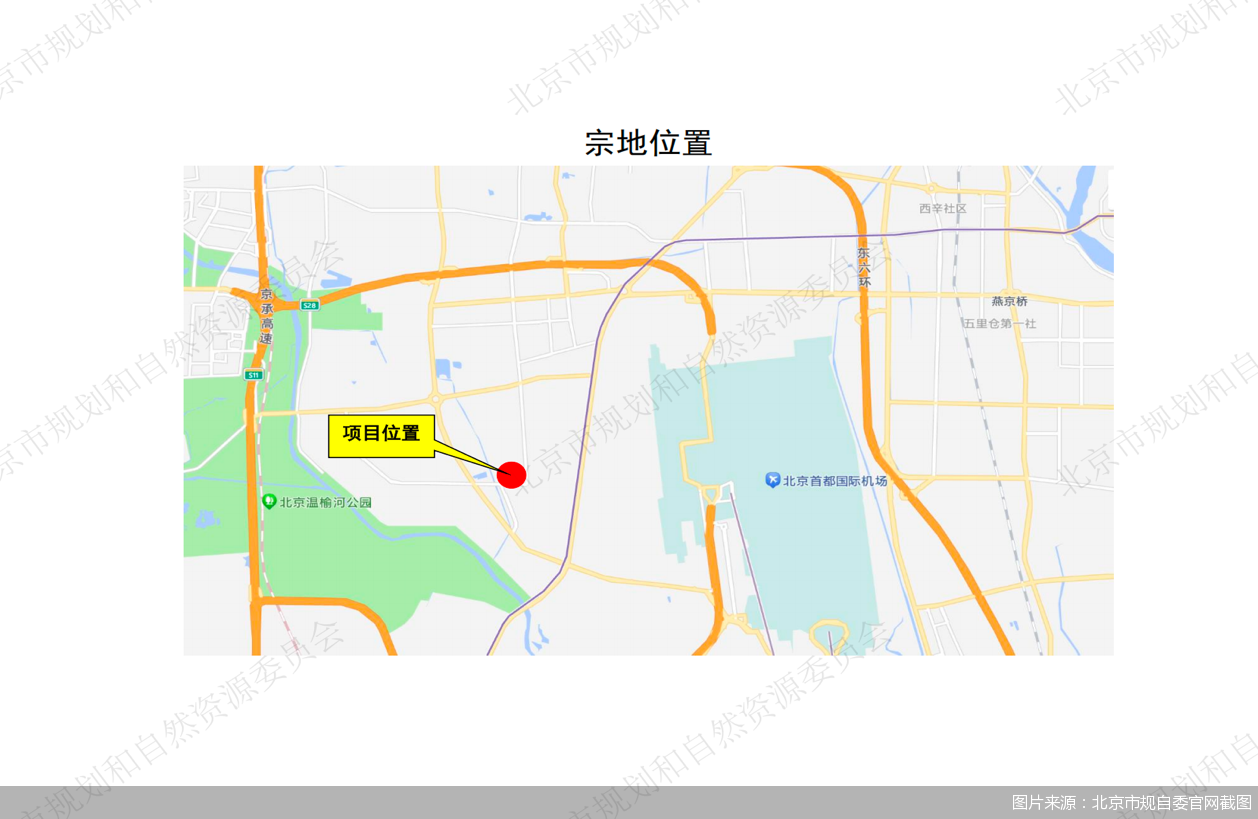
2月3日,北京2026年首场土拍正式开启,三宗宅地总出让金额达57.62亿元。此次出让的地块分别位于石景山区、通州区及顺义区。其中,顺义区新国展三 期SY00-2301-0003、0004、0005地块(以下简称"新国展地块")由中国铁工投资集团摘得。北京商报记者梳理发现,中国铁工投资集团作为中国中铁旗下全 资子公司,此前在北京多以一级开发、城市更新合作方或联合体成员身份参与城市建设,极少独立在公开市场竞得住宅用地。此次成功拿地,意味着该企业 首次进入北京商品住宅用地市场,也成为本次土拍的一大看点。 同日,北京发布2026年第一轮拟供商品住宅用地清单,共涉及5宗地,土地面积约16公顷,建筑规模约24万平方米,上述用地拟于近期供应。 中指研究院土地市场研究负责人张凯表示,本次土拍全部以底价成交,与2025年初高溢价抢拍现象形成对比。这种反差实际上延续了2025年北京土地市 场"量减价升"的整体格局。根据北京市规划和自然资源委员会发布的《北京市2026年度建设用地供应计划》,今年北京商品住宅用地安排200—240公顷,较 2025年的240—300公顷继续缩量,这已是连续第四年缩减。在供应缩量的背景下,土地出让的 ...

新房成交环比上涨,万科债务展期获新进展:房地产行业周报(2026年第5周)-20260203
Huachuang Securities· 2026-02-03 09:41
证 券 研 究 报 告 证券分析师:许常捷 邮箱:xuchangjie@hcyjs.com 执业编号:S0360525030002 房地产行业周报(2026 年第 5 周) 推荐(维持) 新房成交环比上涨,万科债务展期获新进展 行业研究 房地产 2026 年 02 月 03 日 华创证券研究所 证券分析师:单戈 邮箱:shange@hcyjs.com 执业编号:S0360522110001 证券分析师:杨航 邮箱:yanghang@hcyjs.com 执业编号:S0360525090001 行业基本数据 | | | 占比% | | --- | --- | --- | | 股票家数(只) | 107 | 0.01 | | 总市值(亿元) | 12,279.48 | 0.99 | | 流通市值(亿元) | 11,766.97 | 1.17 | 相对指数表现 | % | 1M | 6M | 12M | | --- | --- | --- | --- | | 绝对表现 | 1.8% | 5.3% | 9.6% | | 相对表现 | 2.4% | -8.3% | -11.0% | -7% 4% 15% 26% 25/0 ...

地产债情绪修复到哪里?
Guolian Minsheng Securities· 2026-02-03 06:10
Report Industry Investment Rating - Not provided in the given content Core Views of the Report - In 2026, real estate policies remain "stable". Policies for the resident sector focus on "burden - reduction", while those for real - estate enterprises prioritize risk prevention. The phasing - out of the "Three Red Lines" policy and other measures may have contributed to a certain repair of the trading sentiment of real - estate entities [5][10][12]. - Although real - estate bonds have increased in trading volume and average trading duration, the high - valuation ratio remains above 60%. It is recommended to trade real - estate entities cautiously and choose short - duration state - owned enterprises within 1Y [20]. - The credit bond market is active this week. Considering the possible stable and loose funds and the allocation demand of amortized debt funds, the spreads of each term are likely to remain low and may narrow further. Investment strategies include basic allocation of short - term credit products and enhancing returns by considering 5 - 10Y secondary perpetual bonds or 5Y urban investment and industrial bonds [27]. - Different regions' urban investment platforms have different investment logics. For example, "economic powerhouses" can appropriately extend the duration to 5 years, regions with debt - resolution policies can consider a duration of less than 3 years, and prefecture - level cities with strong industrial bases can choose a 3 - 5Y duration [41][42][43]. Summary by Relevant Catalogs 1. This Week's Real - Estate Hot Events 1.1 The Gradual Exit of the "Three Red Lines" Policy - On January 28, 2026, regulatory authorities no longer required real - estate enterprises to report "Three Red Lines" indicators monthly. The "Three Red Lines" policy was introduced in August 2020, which set standards for real - estate financing and implemented differentiated debt - scale management based on enterprises' "line - crossing" situations [5][8]. 1.2 A Review of Real - Estate - Related Policies Since 2026 - For the resident sector, policies since January 1, 2026, include VAT adjustments for housing sales, tax - refund policies for home - replacement, and interest - rate cuts for existing housing loans. For real - estate enterprises, policies focus on risk prevention, such as loan extensions for projects on the "white list" and the implementation of project - company systems and host - bank systems [10][12]. 2. How Far Has the Sentiment of Real - Estate Bonds Recovered? 2.1 Recent Trading Conditions in the Real - Estate Bond Market - In January 2026, the trading volume of industrial urban investment real - estate bonds gradually increased, while that of urban investment real - estate bonds fluctuated. The high - valuation trading ratio of both industrial and urban investment real - estate entities remained between 60 - 70%. The daily peak trading volume of industrial real - estate bonds was 9.332 billion yuan on January 26, and that of urban investment real - estate bonds was 5.344 billion yuan on January 13. The trading activity of industrial real - estate entities increased significantly within the month [14]. 2.2 How Far Has the Trading Sentiment of Popular Industrial Real - Estate Entities Recovered? - Except for Vanke, the average YTM of popular industrial real - estate entities increased in January 2026. Some entities showed a phenomenon of trading pulling up the duration, which may explain the increase in average trading YTM. However, entities like Cinda Investment and Huafa Co., Ltd. had significant increases in trading yields without a significant increase in average duration at the end of the month, and their trading deviated significantly from the valuation, indicating that there may still be a large number of sell - offs [19][20]. 3. Investment Strategies - The credit bond market is active this week, with the trading volume increasing to about 1.74 trillion yuan. The average trading duration of urban investment bonds and industrial bonds in the secondary market has increased. In the primary market, the issuance of urban investment financial bonds has decreased. Considering the possible stable and loose funds and the allocation demand of amortized debt funds, the spreads of each term are likely to remain low and may narrow further [27]. - Allocation plans include basic allocation of short - term credit products with relatively controllable credit risks and enhancing returns by considering 5 - 10Y secondary perpetual bonds or 5Y urban investment and industrial bonds. Some 5 - 10Y secondary perpetual bonds still show certain relative value, and attention can also be paid to 5Y securities company subordinated bonds and 10Y secondary capital bonds [27][31]. - For urban investment platforms in different regions, different investment logics are proposed. For "economic powerhouses" such as Guangdong, Jiangsu, etc., the duration can be appropriately extended to 5 years; for regions with significant debt - resolution policies, a duration of less than 3 years can be considered; for prefecture - level cities with strong industrial bases, a 3 - 5Y duration is recommended [41][42][43]. 4. Primary Market Tracking - Relevant figures are provided, including this week's credit bond issuance, financial bond issuance, credit bond exchange review and registration, and credit bond association registration completion, but specific data analysis is not elaborated in the summary part [56][59][63][66]. 5. Secondary Market Observation 5.1 The "Volume" of Secondary Market Transactions - Figures show this week's credit bond trading scale and quantity, urban investment bond trading scale by province, industrial bond trading scale by industry, and the weighted trading duration of urban investment and industrial bonds by province [68][72][79][80]. 5.2 The "Price" of Secondary Market Transactions - Figures show this week's urban investment bond yields by term and implied rating, industrial bond yields by enterprise type (state - owned and private enterprises), and financial bond yields by province and variety [81][82][83][84][85].

百强房企再洗牌:7家新面孔杀入
Feng Huang Wang· 2026-02-03 00:41
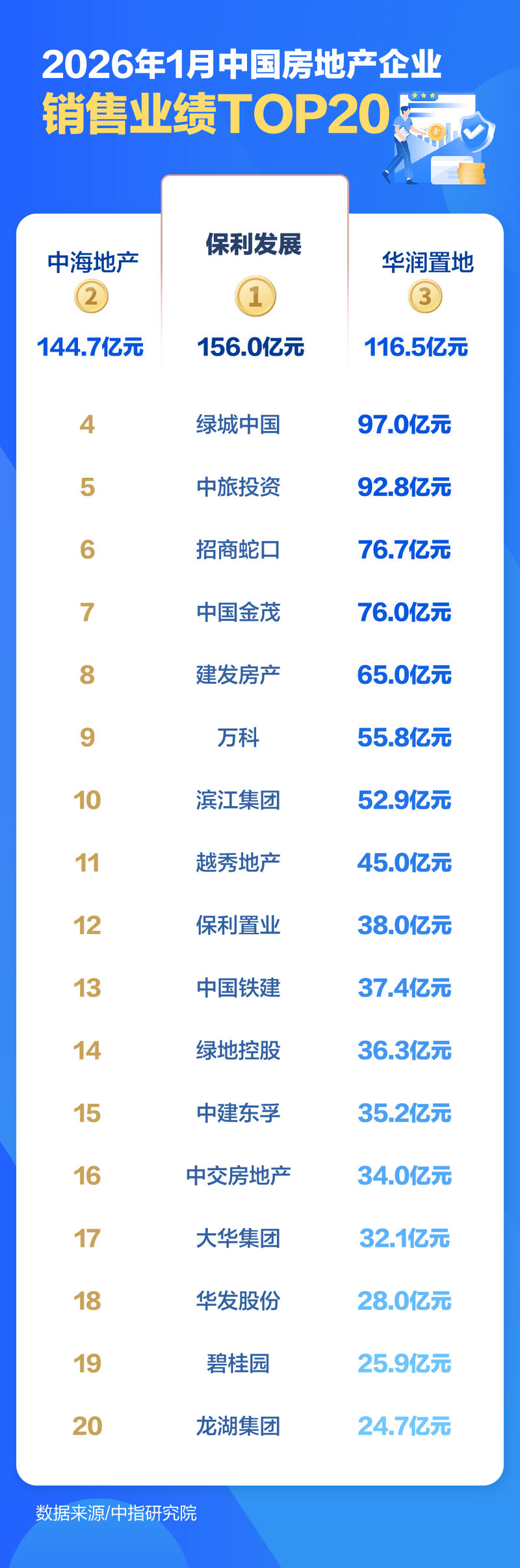
Core Viewpoint - The top 100 real estate companies in China are experiencing a significant reshuffling in their rankings as of January 2026, with a notable decline in overall sales figures compared to the previous year [2][3]. Group 1: Sales Performance - In January 2026, the total sales of the top 100 real estate companies reached 190.52 billion yuan, representing an 18.9% year-on-year decline [2]. - Only three companies achieved sales exceeding 10 billion yuan in January, a decrease of two compared to the same period last year [2]. - The number of companies with sales over 5 billion yuan increased to ten, up by two from the previous year [2]. Group 2: Ranking Changes - The top 10 rankings saw significant changes, with Poly Developments, China Overseas, and China Resources remaining in the top four, while Vanke dropped from fifth to ninth place [3]. - China Travel Investment emerged as a major dark horse, jumping from outside the top 40 to fifth place [3]. - China Jinmao rose from thirteenth to seventh, indicating intensified competition within the top tier [3]. Group 3: Performance of Private Enterprises - Among the 32 companies that experienced year-on-year growth in January, six private enterprises had growth rates exceeding 100% [3]. - Bangtai Group and China Construction Yipin entered the top 20 in sales, benefiting from strategic investments during market lows [3]. Group 4: New Entrants and Market Dynamics - Seven new companies entered the top 100 list in January, with four being small to medium-sized private enterprises [4]. - State-owned enterprises continue to dominate land acquisition, with companies like Yuexiu Property and China Resources maintaining strong investment levels [4]. Group 5: Policy and Market Outlook - The policy environment is shifting towards stabilizing expectations, with measures such as extended tax rebates and loan extensions being implemented [4]. - The market is expected to see a gradual release of demand in March, driven by promotional activities from real estate companies before the Spring Festival [5].



房企开年排位生变:“保中华”格局延续 最大黑马竟是它?
Xin Jing Bao· 2026-02-02 13:33
Core Viewpoint - In January 2026, the sales performance of the top 100 real estate companies in China showed a total sales amount of 190.5 billion yuan, reflecting a year-on-year decline of 18.9%, indicating a stable continuation of the downward trend observed in the previous year [5][10]. Group 1: Sales Performance - The total sales amount for the top 100 real estate companies in January 2026 was 190.5 billion yuan, which is a year-on-year decrease of 18.9%, consistent with the decline observed throughout the previous year [5][10]. - The top three companies in terms of total sales were Poly Developments (15.6 billion yuan), China Overseas Land & Investment (14.47 billion yuan), and China Resources Land (11.65 billion yuan) [5][10]. - The average sales amount for the top 10 companies was 9.33 billion yuan, down 11.6% year-on-year, while the average for companies ranked 11-30 was 2.6 billion yuan, down 25.6% [10]. Group 2: Market Dynamics - The decline in sales is attributed to a high base from January of the previous year, where core city markets were notably active [5][9]. - The new entrant, China Travel Investment, ranked 5th with a sales amount of 9.28 billion yuan, marking a significant rise from previous years [9]. - The sales performance of the top 10 companies remained relatively stable, with three companies showing year-on-year increases, while seven experienced declines [10]. Group 3: Future Outlook - Analysts expect that as the Chinese New Year approaches, real estate companies may increase marketing efforts, which could lead to a temporary boost in market activity [11]. - There is a need for coordinated policy efforts from both demand and supply sides to effectively restore market confidence [11].
重生之我在大A开超市...
Xin Lang Cai Jing· 2026-02-02 12:52
Group 1 - The market witnessed significant volatility in February, with a notable decline in gold and silver prices, attributed to market reactions to potential changes in U.S. Federal Reserve leadership and monetary policy [8][6]. - Gold prices dropped from 5600 to 4682, while silver experienced a nearly 40% intraday pullback, indicating severe market stress and liquidity issues [6][8]. - The decline in gold is not fundamentally driven but rather a result of liquidity squeeze and increased implied volatility, with the market reacting to Trump's nomination of a Fed chair with a history of advocating for interest rate cuts and balance sheet reductions [8][10]. Group 2 - The telecommunications sector is facing increased tax burdens as the VAT rate for telecom services is set to rise from 6% to 9%, which will impact revenue and profit margins for major operators [14][15]. - Major telecom companies, including China Unicom, China Telecom, and China Mobile, experienced significant stock price declines following the announcement, with China Unicom's H-shares dropping over 11% at one point [14][15]. - The adjustment in tax policy may lead to a shift in industry dynamics, potentially reducing inefficient competition and encouraging a focus on technological innovation and high-quality services [14]. Group 3 - The real estate sector is under severe pressure, exemplified by Vanke's projected net loss of 82 billion, marking a 65.7% increase in losses compared to the previous year, which is expected to be the largest annual loss in A-share history [12][13]. - This situation reflects the broader challenges facing the real estate industry, with recovery dependent on both individual company strategies and overall market stabilization [12][13]. Group 4 - The liquor industry, particularly high-end brands like Moutai, is showing signs of recovery with price stabilization and potential for valuation improvement, despite ongoing challenges [17][18]. - The liquor sector is characterized by low expectations, low valuations, and low holdings, with public fund holdings in liquor stocks at a historical low of 3.93% [17][18]. - Analysts suggest that 2026 may present a bottoming opportunity for the industry, with expectations of a recovery phase beginning to emerge [18][19].