
HIKVISION(002415)

Search documents
数字经济ETF工银(561220)开盘跌0.26%,重仓股中芯国际跌1.89%,海光信息跌1.54%
Xin Lang Cai Jing· 2026-02-11 01:37
Group 1 - The Digital Economy ETF ICBC (561220) opened at a decline of 0.26%, priced at 1.535 yuan [1] - Major holdings in the Digital Economy ETF include companies like SMIC, which fell by 1.89%, and Haiguang Information, which dropped by 1.54% [1] - The fund's performance benchmark is the China Securities Index for State-Owned Enterprises in the Digital Economy, managed by ICBC Credit Suisse Asset Management [1] Group 2 - Since its inception on May 21, 2025, the fund has achieved a return of 54.05%, while its return over the past month has been -0.65% [1] - The fund manager is Shi Baojiao, indicating a specific leadership in managing the ETF [1]





“智”护生产安全 海康威视观澜大模型落地湖北宜化
Zheng Quan Ri Bao Wang· 2026-02-10 11:12
本报讯(记者冯思婕)2月10日,杭州海康威视(002415)数字技术股份有限公司(以下简称"海康威视")公 众号发布消息称,近日,在湖北宜化(000422)集团有限责任公司(以下简称"宜化集团"),节日氛围与 生产热情相互交织。在全力保障生产稳定运行的重要关头,AI为这份年味更添一份安心,依托海康威 视视频感知设备与观澜大模型搭建的智能巡检系统,推动宜化集团数字化管理变革,助力提质降本增 效。 视觉大模型加持 看准皮带洒料、堵料 在宜化集团旗下的宜化磷化工有限公司(以下简称"磷化工"),皮带运输机承担着磷矿石的转运,是保障 连续生产的关键环节。作为厂区"大动脉",皮带运输机长期运行会产生"健康风险",例如皮带撕裂、跑 偏、堵料等问题,不仅影响生产效率,也存在安全隐患。 针对这一痛点,海康威视在磷化工100多个皮带运输机关键点位部署智能监测系统。通过跑偏检测、大 块物料检测、皮带堵料大模型算法,系统能够分析皮带的运行状态,精准识别跑偏情况及皮带与滚筒边 缘的相对位置变化,一旦发现异常立即告警。 视觉大模型的应用,提高了目标检出率,切实降低误报率。此项应用,有效预防了因皮带跑偏等问题引 发的设备损坏与物料洒落,预 ...


沪深北交易所同日“亮剑”:再融资新政对A股影响(附精选股票)
Sou Hu Cai Jing· 2026-02-10 06:14
Core Viewpoint - The simultaneous release of refinancing optimization measures by Shanghai, Shenzhen, and Beijing stock exchanges marks a significant transformation in China's capital market, aimed at enhancing capital allocation efficiency and reshaping the A-share market landscape [1]. Group 1: Policy Framework and Differences - The policy frameworks of the three exchanges are highly similar, focusing on "supporting the strong, limiting the weak, promoting innovation, and enhancing convenience and regulation" [2]. - Shanghai Stock Exchange emphasizes "main board" characteristics, tailoring financing rules for large, mature technology companies [2]. - Shenzhen Stock Exchange adopts a bolder stance on supporting technology innovation, easing fundraising restrictions for growth-oriented enterprises [2]. - Beijing Stock Exchange focuses on "innovative small and medium-sized enterprises," addressing their financing challenges with flexible policies [2]. Group 2: Strategic Insights on Separate Announcements - The decision to release policies on the same day rather than a joint announcement reflects the nuanced wisdom of tiered regulation in China's capital market [3]. - Different market positioning allows each exchange to cater to the unique characteristics and needs of the enterprises they serve, avoiding a one-size-fits-all approach [3]. - The simultaneous release creates a strong policy resonance, reinforcing market perception of deepening capital market reforms while maintaining the distinct identities of each exchange [3]. Group 3: Deep Impacts on Market Perception - The new measures aim to shift the long-standing fear of "blood-sucking" effects of refinancing, which was believed to drain market funds and destabilize the market [4]. - The principle of "supporting the strong, limiting the weak" will act as a catalyst for market differentiation, favoring quality companies, especially in hard technology, while raising barriers for poorly performing firms [4]. - The policy directs resources towards "new productive forces," providing strong support for leading companies in sectors like semiconductors, AI, biomedicine, and high-end manufacturing [5]. - Allowing companies that have experienced stock price declines to raise funds through methods like private placements and convertible bonds offers a lifeline to solid businesses facing temporary challenges [6]. - A complete regulatory loop is established, tightening post-fundraising supervision while relaxing initial approvals, transforming refinancing from a mere "money-raising tool" to an "engine" for corporate development [7]. Group 4: Implications for Investors - The coordinated actions of the three exchanges signify the entry of China's refinancing mechanism into a "precise drip irrigation" era, providing tailored financing support for different types of enterprises [8]. - Investors are advised to focus on genuinely innovative and well-governed companies while avoiding those that merely chase trends without substance [8]. - The transformation of refinancing from a "blood-sucking machine" to a "blood-producing pump" is expected to enhance the value discovery function of the A-share market, leading to a healthier and more vibrant capital market [8].







中国电科集团板块大涨 海康威视涨幅居前
Xin Lang Zheng Quan· 2026-02-10 02:21
声明:市场有风险,投资需谨慎。本文基于第三方数据库自动发布,不代表新浪财经观点,任何在本文 出现的信息均只作为参考,不构成个人投资建议。如有出入请以实际公告为准。如有疑问,请联系 biz@staff.sina.com.cn。 责任编辑:小浪快报 02月10日消息,截止10:15,中国电科集团板块大涨,海康威视等个股涨幅居前。 ...
A股1.88万亿研发投入开启AI元年 340万技术人才锻造新质生产力
Chang Jiang Shang Bao· 2026-02-09 06:54
深交所数据显示,深市上市公司2024年研发总投入合计超过7600亿元,研发强度超过10%的公司有410 家,研发投入超过10亿元的公司有119家。其中,创业板2024年研发投入达2036.84亿元,整体研发强度 达5.05%,其中294家公司研发强度超过10%,48家公司连续两年研发投入超过5亿元。从资金投向来 看,创业板超六成的研发资金投入战略性新兴产业。 以研发金额来看,2024年研发费用超1亿元的公司有2034家,超10亿元的有248家,超100亿元的有23 家。其中,比亚迪摘得桂冠,研发费用高达531.95亿元。这也是其A股历史上首次跻身榜首位置。其研 发投入覆盖刀片电池迭代、智能驾驶算法优化及高端车型平台开发,2024年推出的第五代DM技术将插 混车型续航里程推向2000公里级别,印证了"技术为王"战略的成功。 建筑央企阵营中,中国建筑以454.59亿元研发投入稳居次席,较2023年微降1.3%。该企业聚焦智能建 造、低碳建材等方向,其研发的装配式建筑技术已应用于雄安新区等国家级工程,推动行业向工业化、 绿色化转型。中国中铁、中国交建等基建巨头研发费用同步收缩,反映传统基建领域技术迭代进入平台 期, ...



2026年2月五维行业比较观点:持股过节,关注成长-20260208
EBSCN· 2026-02-08 13:29
持股过节,关注成长 ——2026年2月五维行业比较观点 策略组 张宇生 SAC编号:S0930521030001 策略组 王国兴 SAC编号:S0930524070013 请务必参阅正文之后的重要声明 核心观点 2026年2月8日 证券研究报告 1 国海富兰克林基金 请务必参阅正文之后的重要声明 五维行业比较框架介绍。股价表现受多重因素影响,单一指标难以有效指导行业比较。想要做好行业比较,需要对各种可能 影响股价的因素均进行分析并做出综合判断,并且对于未来可能的市场主导因素,应该赋予更高的权重。基于此,我们综合 市场风格、基本面、资金面、交易面、估值五个维度,构建了"五维行业比较框架" ,在非财报季时期,我们对于五个维 度进行等权打分,而在财报季,则给予基本面维度更高权重,并降低市场风格及估值维度的权重。 历史回测来看,五维行业比较框架表现优异,得分越高的行业表现往往更好。通过复盘2016年至2025年2月期间五维行业比 较框架的历史表现,可以发现该框架下得分越高的行业股价表现往往更好,按得分高低将行业依次分为第1组、第2组 、第3 组、第4组、第5组,各组的年化收益率分别为11.8%、1.3%、-1.4%、 ...






算力需求强劲,关注CPO等新技术演进
Orient Securities· 2026-02-07 09:53
Investment Rating - The report maintains a "Positive" investment rating for the electronic industry, indicating an expectation of returns stronger than the market benchmark by over 5% [5]. Core Insights - Strong demand for computing power driven by AI applications is expected to continue, with significant investments from major cloud providers [8]. - The hardware supply-demand imbalance is spreading across various sectors, leading to price increases [8]. - New technologies such as CPO (Co-Packaged Optics) are anticipated to create additional demand [8]. Summary by Sections Investment Recommendations and Targets - Key investment targets include: - Semiconductor manufacturing: SMIC (688981, Buy), Hua Hong Semiconductor (01347, Buy) - Testing and packaging: Changdian Technology (600584, Buy), Tongfu Microelectronics (002156, Buy), and others [9]. - Server storage: Lianqi Technology (688008, Buy) - CPUs: Haiguang Information (688041, Buy), Longxin Technology (688047, Not Rated), and others [9]. - Passive components: Sanhua Group (300408, Buy), Fenghua Advanced Technology (000636, Not Rated) [9]. - Server manufacturing: Industrial Fulian (601138, Buy), Huaqin Technology (603296, Buy) [9]. - Analog and power chips: Naxin Micro (688052, Buy), Sierui Technology (688536, Not Rated), and others [9]. - Semiconductor equipment: Zhongwei Company (688012, Buy), Northern Huachuang (002371, Buy), and others [9]. - Optical devices/chips: Zhishang Technology (301486, Not Rated), Tianfu Communication (300394, Not Rated), and others [9]. AI Applications and Edge Computing - Key targets in edge AI applications include: - AI main control chips: Amlogic (688099, Buy), Hengxuan Technology (688608, Buy) - Edge storage: Zhaoyi Innovation (603986, Buy), Bawei Storage (688525, Buy) [10]. - Terminal manufacturers: Hikvision (002415, Buy), Luxshare Precision (002475, Buy), BYD Electronics (00285, Not Rated), and others [10]. - Core components for AI edge: Huanxu Electronics (601231, Buy), Sunny Optical Technology (02382, Buy), and others [10].




开年险资调研忙 新质生产力受关注
Zhong Guo Zheng Quan Bao· 2026-02-06 03:50
Core Insights - Insurance capital management is increasingly focused on deep research of individual stocks and industries, with significant interest in A-share listed companies as indicated by over 300 companies being researched since the beginning of 2026 [1][2] Group 1: Research Trends - A total of 96 insurance companies and 32 insurance asset management companies have participated in the research of A-share listed companies since the beginning of 2026 [2] - Key players such as Taiping Pension, Changjiang Pension, and China Life Pension have conducted over 30 research sessions each within a month [2] - Regional banks and sectors like electronic components, semiconductor materials, and devices are receiving heightened attention from insurance capital [2] Group 2: Investment Strategies - Insurance capital views company research as a crucial part of investment strategy, often focusing on high-quality stocks with long-term growth potential [3] - The demand for high dividend stocks is driven by the need for stable cash flow in a low-interest-rate environment, with banks being a primary focus for insurance capital [4] - Insurance capital is increasingly adopting a dividend strategy, favoring high dividend stocks to stabilize returns amid pressure on fixed-income yields [4] Group 3: Focus on New Productive Forces - Insurance capital is aligning with long-term investments in new productive forces, particularly in technology innovation and emerging strategic industries [5] - There is a focus on investing in sectors with real technological barriers and clear business models that can deliver performance [5] Group 4: Investment Paths - For mature technology leaders, insurance capital is likely to invest directly for excess returns, while for emerging tech sectors, indirect investments through ETFs or industry funds are preferred to manage risks [6] - The insurance capital sector is particularly interested in AI-driven technology and high-end manufacturing, with a strategy to invest in companies with clear business models and strong competitive advantages [6]






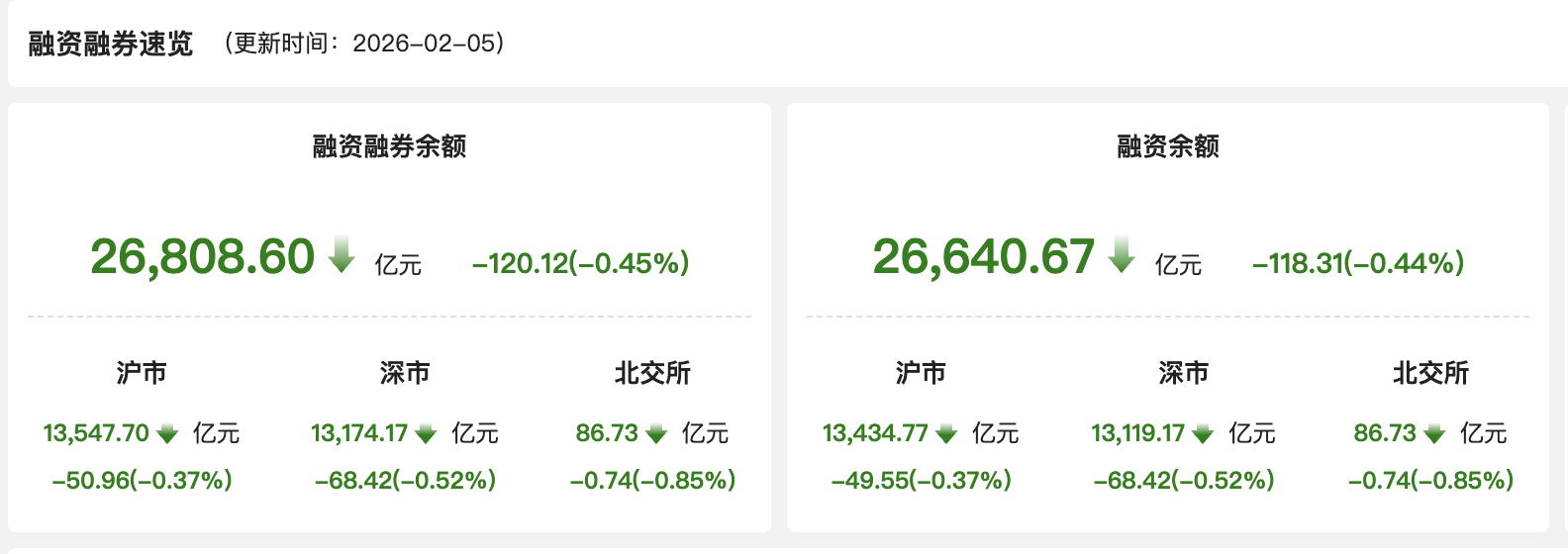
5日两融余额减少120.12亿元 公用事业行业获融资净买入居首
Sou Hu Cai Jing· 2026-02-06 01:52
上证报中国证券网讯(卢伊 记者 徐蔚)2月5日,A股两融余额为26808.60亿元,较上一交易日减少120.12亿元,占A股流通市值比例为2.62%。当日两融交 易额为1993.51亿元,较上一交易日减少260.13亿元,占A股成交额的9.08%。 | | 融资融券余额 | | | | --- | --- | --- | --- | | 26,808.60 ↓ 亿元 - 120.12(-0.45%) | | | 26,640.67 | | 沪市 | 深市 | 北交所 | 沪市 | | 13,547.70 ↓ 亿元 | 13,174.17 ↓ 亿元 | 86.73 ↓ 亿元 | 13,434.77 ↓ 亿元 | | -50.96(-0.37%) | -68.42(-0.52%) | -0.74(-0.85%) | -49.55(-0.37%) | 资金流向方面,申万31个一级行业中有9个行业获融资净买入,其中,公用事业行业获融资净买入额居首,当日净买入3.86亿元;获融资净买入居前的行业 还有煤炭、建筑装饰、基础化工等。 个股方面,20只股获融资净买入额超1亿元。中际旭创获融资净买入额居首,净买入9.44亿元; ...


数字经济ETF工银(561220)开盘跌0.47%,重仓股中芯国际跌1.48%,海光信息跌1.00%
Xin Lang Cai Jing· 2026-02-06 01:41
Group 1 - The Digital Economy ETF (工银561220) opened at 1.480 yuan, experiencing a decline of 0.47% [1] - Major holdings in the ETF include companies like SMIC, which fell by 1.48%, and Haiguang Information, which dropped by 1.00% [1] - The ETF's performance benchmark is the China Securities Index for State-Owned Enterprises in the Digital Economy, managed by ICBC Credit Suisse Asset Management [1] Group 2 - Since its inception on May 21, 2025, the ETF has achieved a return of 48.72%, with a monthly return of 0.79% [1]
