NNCI(600301)

Search documents
【干货】锑产业链全景梳理及区域热力地图
Qian Zhan Wang· 2026-02-10 03:09
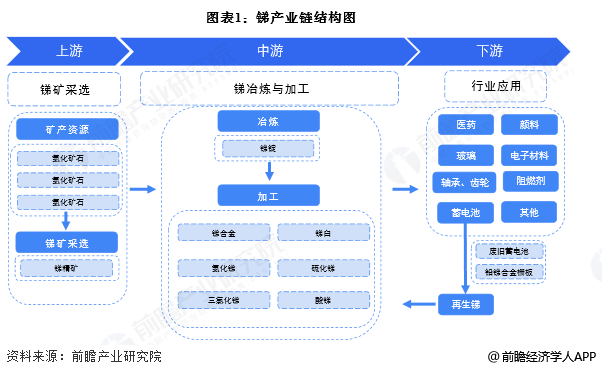
Core Insights - The antimony industry is characterized by its high industrial value and strategic importance, with antimony being used as an additive in various industrial applications [1] - The antimony supply chain includes upstream mining and selection, midstream smelting and processing, and downstream applications such as flame retardants and batteries [1][3] Group 1: Industry Overview - Antimony is a scarce resource with significant industrial applications, classified as a strategic mineral resource by the government [1] - The antimony supply chain consists of three main segments: upstream (mining and selection), midstream (smelting and processing), and downstream (applications) [1][3] - Key applications of antimony include flame retardants, glass, electronic materials, bearings, gears, and batteries, with the latter allowing for the recycling of antimony [1] Group 2: Key Companies and Production Data - Major upstream companies in the antimony mining sector include Hunan Gold, Huaxi Nonferrous, and Huayu Mining [3] - In 2024, Hunan Gold is projected to produce 29,209 tons of antimony, a decrease of 6.15% year-on-year, while Huaxi Nonferrous expects a production increase of 9.17% to 15,417.7 tons [10] - Midstream companies such as Hengbang Co. and Zhuhai Group are involved in smelting and processing, with Hengbang Co. reporting revenue of 957 million yuan from related operations in 2024 [10] Group 3: Regional Distribution - The antimony industry is predominantly concentrated in Hunan province, followed by Guangxi, Guangdong, and Jiangxi, with a significant disparity in the number of companies compared to other regions [5][7] - The majority of upstream, midstream, and recycling companies are located in Hunan, with other provinces like Tibet and Guangxi having fewer enterprises [7] Group 4: Investment Trends - Investment activities in the antimony sector from 2022 to 2025 highlight ongoing developments and strategic initiatives by key players [11] - Companies are focusing on enhancing production capabilities and exploring new product developments, particularly in high-precision alloys and recycling processes [10]


黄金白银,闪崩
Xin Lang Cai Jing· 2026-02-05 12:18
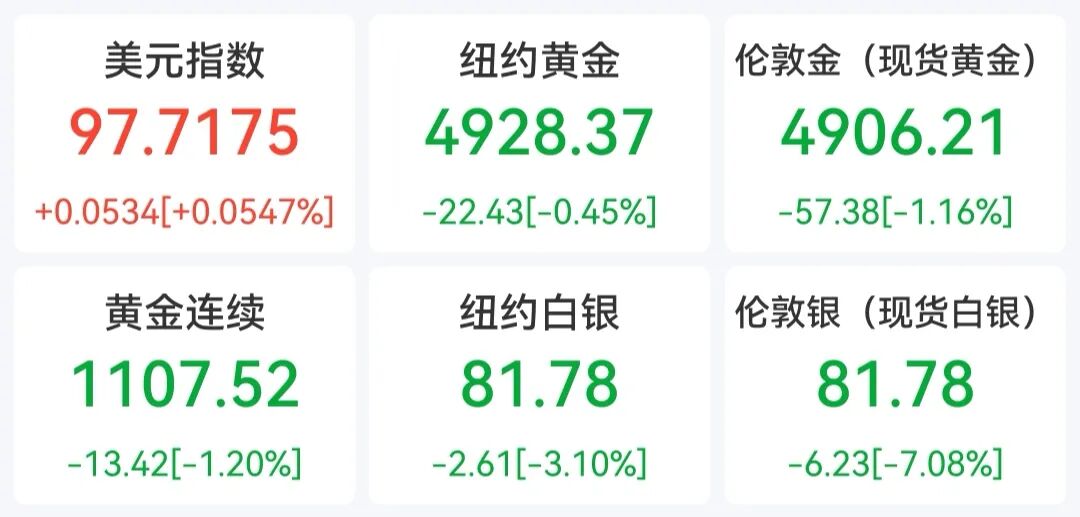
Group 1: Market Overview - Precious metals sector experiences significant adjustments, with Hunan Silver hitting the daily limit down and Xiaocheng Technology dropping over 10% [3][8] - Major declines observed in several gold and silver companies, including Sichuan Gold, Hunan Gold, and Zhaojin Mining [3][4] Group 2: Price Fluctuations - International gold and silver prices continue to fluctuate, with April gold futures trading between $4,800 and $5,000 per ounce, and March silver futures between $70 and $90 per ounce [4][6] - Following substantial sell-offs, precious metal prices remain volatile near key psychological levels, with analysts warning of ongoing selling pressure [5][10] Group 3: Analyst Insights - Analysts from various financial institutions express concerns about the short-term outlook for gold and silver prices, indicating that the market may not have reached a bottom yet [5][10] - The recent sell-off in precious metals is viewed as a market adjustment rather than a trend reversal, suggesting a more stable and non-linear price increase in the future [5][10]


“围剿”中国工厂
3 6 Ke· 2026-02-05 05:27
Core Viewpoint - The surge in metal prices, particularly copper, is significantly impacting downstream manufacturing industries in China, leading to squeezed profit margins for manufacturers while upstream companies benefit from rising raw material prices [3][5][9]. Group 1: Price Surge in Raw Materials - In 2025, copper prices increased by 34.34%, and the upward trend continued into 2026 [2]. - The price of lithium carbonate, essential for electric vehicle batteries, skyrocketed from 75,700 yuan per ton in January 2025 to 175,250 yuan per ton by January 23, 2026, marking a 131.4% increase [7]. - Tungsten concentrate prices surged to 520,000 yuan per ton, while tungsten carbide prices rose from approximately 300,000 yuan per ton to 1,200,000 yuan per ton [7]. Group 2: Impact on Manufacturing Industries - The home appliance industry is heavily affected by rising copper prices, with copper accounting for over 20% of the total cost of air conditioners. The copper price reached 105,020 yuan per ton in February 2026, up 42.25% from early 2025, leading to an 8.45% increase in air conditioner costs [10]. - The electric vehicle industry faces significant cost inflation, with UBS reporting that the cost increase for pure electric vehicles (BEVs) due to metal prices alone is approximately 5,600 yuan per vehicle, primarily driven by lithium price increases [12]. - The automotive industry's single vehicle gross profit was only 13,000 yuan in 2025, making it challenging for manufacturers to pass on rising costs to consumers amid fierce competition [13]. Group 3: Upstream vs. Downstream Dynamics - Upstream mining companies are experiencing explosive profit growth due to rising raw material prices, with Zijin Mining forecasting a net profit of 51 to 52 billion yuan for 2025, a year-on-year increase of 59% to 62% [8]. - In contrast, manufacturing companies are facing unprecedented cost pressures, leading to a decline in profit margins. The manufacturing sector's profit margin was only 4.7% in 2025, compared to 15.9% for the mining sector [21][19]. - The overall revenue of China's industrial enterprises has been increasing, but profit margins have been declining, indicating a challenging environment for manufacturers [19][21]. Group 4: Strategies for Survival and Growth - Many Chinese manufacturing companies are exploring ways to extend their business scope internationally, moving beyond low-end products to high-value items like electric vehicles and industrial robots [24]. - Some companies are actively integrating vertically by acquiring upstream resources, such as copper mines, to mitigate the impact of rising raw material prices [24]. - Technological advancements are also being pursued, with companies investing in alternatives to reduce dependency on expensive raw materials, such as the development of sodium-ion batteries [26].






未知机构:铜价回落延后的订单正在爆发来自于Mysteel数据-20260203
未知机构· 2026-02-03 01:50
Summary of Key Points from Conference Call Records Industry Overview - The records focus on the copper industry and strategic metals, highlighting recent trends in pricing and demand dynamics [1][2]. Core Insights and Arguments - **Copper Price Decline and Recovery in Orders**: - A significant drop in copper prices has led to a surge in downstream purchasing activity. According to a survey by Mysteel, 31 domestic copper rod manufacturers and 6 traders reported an order volume of 43,000 tons, an increase of 28,600 tons from the previous day, representing a 197.73% week-on-week growth [1]. - Specifically, the order volume for refined copper rods reached 41,700 tons, marking a historical high since the survey began, with a week-on-week increase of 29,000 tons, or 228.75% [1]. - This indicates that as copper prices fall, downstream demand is beginning to materialize, with companies moving to fulfill delayed orders from December [1]. - **Strategic Metals and Resource Stocks**: - The value of strategic resources will determine the positioning of resource stocks in the market. The external manifestation of this value is reflected in the pricing of strategic metals [2]. - There is confidence in the long-term prospects for strategic metals, particularly tin and nickel, with a strong outlook for these commodities through 2026 [3][4]. Additional Important Content - **Investment Opportunities in Resource Companies**: - Recommendations for bottom-fishing in quality companies include: - **Copper**: Zijin Mining (900 billion as a bottom), Western Mining (70 billion bottom), and Luoyang Molybdenum (around 450 billion bottom). Minmetals Resources and China Nonferrous Mining are noted for their low valuations [4]. - **Aluminum**: China Aluminum (200 billion bottom, 22 billion profit) based on a price assumption of 23,000 [4]. - **Tin**: Huaxi Nonferrous (300 billion, with profits expected around 2 billion) and Tin Industry Co. (already low valuation) based on a price assumption of 350,000 [4]. - **Nickel**: Huayou Cobalt with profits of 8 billion at a nickel price of 15,000, considered very cheap [4].


有色金属行业周报:国内电铜库存开始去化,价格或走强-20260202
Huaxin Securities· 2026-02-02 12:16
Investment Rating - The report maintains a "Recommended" investment rating for the gold, copper, aluminum, tin, and antimony industries [11]. Core Insights - The domestic copper inventory is beginning to decrease, which may lead to stronger prices [6]. - The gold market is expected to stabilize and rise further due to the anticipated interest rate cuts by the Federal Reserve [5]. - The aluminum supply remains rigid, supporting the investment outlook for the aluminum sector [11]. - Tin prices are expected to be supported by tight supply conditions [11]. - Antimony prices are rebounding after a six-month decline, indicating a positive outlook for the antimony sector [11]. Summary by Sections Industry Performance - The non-ferrous metals sector (Shenwan) has shown significant performance with a 1-month increase of 22.6%, a 3-month increase of 35.7%, and a 12-month increase of 128.5% [3]. Precious Metals - Gold prices reached $4981.85 per ounce, with a week-on-week increase of $35.60, or 0.72%. Silver prices were $103.19 per ounce, up $4.19, or 4.23% [4]. Copper and Aluminum - Copper prices closed at $13,440 per ton on the LME, up $460 per ton, or 3.54%. SHFE copper closed at ¥103,170 per ton, up ¥2,120, or 2.10% [6]. - Domestic aluminum prices were ¥24,640 per ton, with a week-on-week increase of ¥510 [7]. Tin and Antimony - Domestic refined tin prices were ¥423,630 per ton, down ¥110, or 0.03%. The supply and demand for tin are weak, leading to a price fluctuation around high levels [9]. - Antimony prices remain supported due to tight supply conditions, with current prices at ¥160,000 per ton [10]. Recommended Stocks - The report recommends specific stocks in various sectors, including Zhongjin Gold, Shandong Gold, Zijin Mining, and others across gold, copper, aluminum, tin, and antimony industries [12].


A股五张图:2月目标,回本!
Xuan Gu Bao· 2026-02-02 10:35
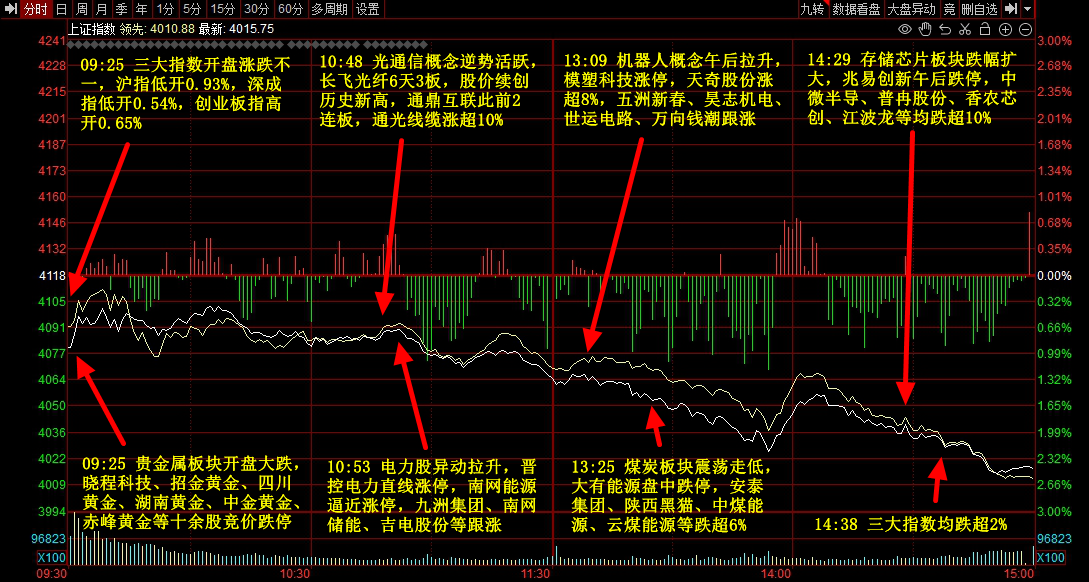
Market Overview - The market experienced significant losses on the first trading day of February, with the Shanghai Composite Index, Shenzhen Component Index, and ChiNext Index closing down by 2.48%, 2.69%, and 2.46% respectively, with over 4,600 stocks declining and trading volume shrinking to 2.6 trillion yuan [4][3]. Sector Performance - The non-ferrous metals sector faced a collective downturn, with major stocks like Tongling Nonferrous Metals and Huayou Cobalt hitting the daily limit down, reflecting a broader trend of heavy losses across various non-ferrous commodities [5][15]. - The precious metals market saw silver prices drop significantly, with a decline of over 25% in New York silver futures, indicating a severe sell-off triggered by market dynamics [9][10]. Specific Stock Movements - Wenta Technology faced a dramatic decline, with its net profit projected to drop by 376.52% to 217.68%, leading to a trading halt at the daily limit down. This was attributed to asset impairment related to disputes with Anshi Semiconductor [31]. ETF Market - The ETF market also reflected the bearish sentiment, with major ETFs like the SSE 50 ETF and CSI 500 ETF experiencing sharp declines, particularly the CSI 500 which saw a drop of 6.5% in the afternoon session [27].


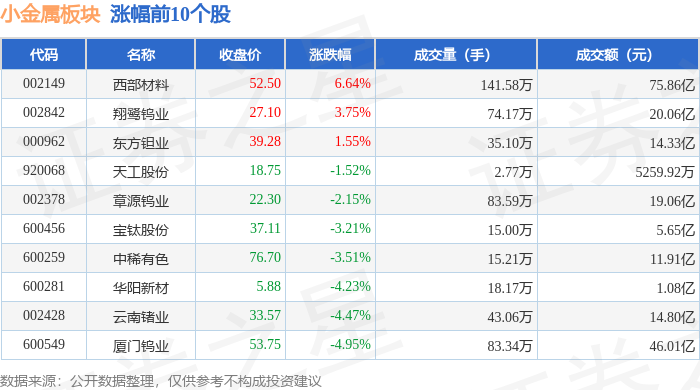
小金属板块2月2日跌6.21%,华锡有色领跌,主力资金净流出38.57亿元
Zheng Xing Xing Ye Ri Bao· 2026-02-02 09:07
Market Overview - The small metals sector experienced a decline of 6.21% on February 2, with Huaxi Nonferrous leading the drop [1] - The Shanghai Composite Index closed at 4015.75, down 2.48%, while the Shenzhen Component Index closed at 13824.35, down 2.69% [1] Individual Stock Performance - Notable gainers included: - Xibu Materials (002149) with a closing price of 52.50, up 6.64% and a trading volume of 1.4158 million shares, totaling 7.586 billion yuan [1] - Xianglu Tungsten Industry (002842) closed at 27.10, up 3.75% with a trading volume of 741,700 shares, totaling 2.006 billion yuan [1] - Dongfang Silver Industry (000962) closed at 39.28, up 1.55% with a trading volume of 351,000 shares, totaling 1.433 billion yuan [1] - Major decliners included: - Huaxi Nonferrous (600301) closed at 50.95, down 10.00% with a trading volume of 108,200 shares, totaling 556 million yuan [2] - Tin Industry Co. (000960) closed at 35.84, down 9.99% with a trading volume of 1.0418 million shares, totaling 3.829 billion yuan [2] - Guizhou Research Platinum Industry (600459) closed at 21.20, down 9.98% with a trading volume of 133,200 shares, totaling 282 million yuan [2] Capital Flow Analysis - The small metals sector saw a net outflow of 3.857 billion yuan from major funds, while retail investors had a net inflow of 3.875 billion yuan [2][3] - Specific stock capital flows included: - Xibu Materials (002149) had a net inflow of 601 million yuan from major funds, while retail investors had a net outflow of 137 million yuan [3] - Huaxi Nonferrous (600301) experienced a net outflow of 17.8951 million yuan from major funds, with a net inflow of 3.257 million yuan from retail investors [3] - Guizhou Research Platinum Industry (600459) had a significant net outflow of 29.4683 million yuan from major funds, while retail investors had a net inflow of 27.9283 million yuan [3]


锡:强预期与弱现实博弈下盘面高位宽幅震荡:锡期货2026年2月报告-20260202
Fang Zheng Zhong Qi Qi Huo· 2026-02-02 06:57
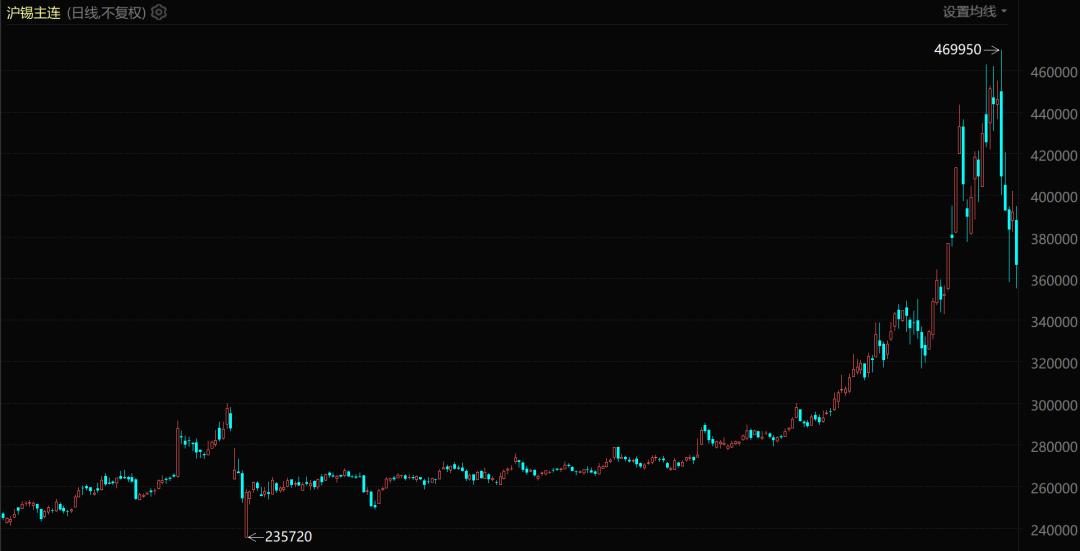
Report Industry Investment Rating - Not provided in the content Core Viewpoints - In January 2026, the Shanghai tin futures market rose rapidly under the boost of capital, with the long - term structural improvement in demand and macro - liquidity easing as the main driving forces. The price broke through the historical high and continued to strengthen, and is currently fluctuating widely at a high level [59]. - In 2026, the tight supply of tin ore will gradually ease, showing a pattern of tight supply in the first half and loose in the second half. The operating rate of smelters will improve after the holiday. The processing fee, which has been at a low level, increased in January and has room for further growth. However, the secondary tin smelting industry still faces problems such as an inefficient waste recycling system and uncertain recycling policies [59]. - In terms of demand, the tin solder sector, which performed well in 2025, is expected to continue its good growth trend in 2026, benefiting from the rapid development of the semiconductor industry due to computing power demand. In addition, the external demand in the traditional tin - plated sheet field is expanding, offsetting some of the negative impact of the decline in domestic demand. The future development of Sino - US trade frictions remains the biggest uncertainty [59]. - In 2026, the global interest - rate cut cycle will continue, and the non - ferrous metal sector will cyclically improve. The supply side is likely to gradually loosen, while the downstream demand also has some bright spots. The supply and demand of tin are likely to remain in a tight - balanced situation. It is expected that tin prices will remain strong in 2026, with the Shanghai tin futures price mainly ranging between 350,000 - 450,000 and the LME tin price mainly between 45,000 - 60,000 [59]. Summary by Directory Part I: Market Review and Macroeconomic Impact - **Market Review**: In January 2026, the Shanghai tin futures market accelerated its upward rush, and the overall center of gravity shifted significantly. The main driving forces were the long - term structural improvement in demand and macro - liquidity easing, while the impact of the current fundamentals was relatively weak [8]. - **Macroeconomic Situation**: Geopolitical situations are complex and changeable. The EU is considering imposing tariffs on US goods worth 93 billion euros and restricting US companies from entering the EU market. The US will impose a 10% tariff on goods imported from eight European countries starting February 1, 2026, and the tariff rate will increase to 25% starting June 1. The Fed kept interest rates unchanged in January, and the candidate for the new Fed chair is undetermined. Since January, the US dollar index first rose and then fell, putting pressure on the non - ferrous metal sector [11]. Part II: Tin Supply - Side Analysis - **Tin Ore Supply**: China's tin ore production has been declining in recent years due to over - exploitation, low - grade reserves, and limited new resource discoveries. In 2025, the production of tin concentrates in China showed a slight increase. In December 2025, the import volume of tin concentrates in China increased significantly month - on - month. With the gradual increase in tin ore exports from the Wa State in Myanmar, the import volume is expected to increase in 2026 [17]. - **Refined Tin Production**: In 2025, the price of tin concentrates showed an upward trend, and the processing fee was weak. In 2026, with a slight improvement in ore supply, the processing fee was raised. In December 2025, the output of refined tin by domestic sample enterprises increased both month - on - month and year - on - year. It is expected that in 2026, the supply growth rate of refined tin will be slightly higher than that in 2025, but the output in January may decrease month - on - month [20]. - **Refined Tin Import and Export**: In 2026, there is a trend of opening the refined tin import window. In December 2025, both imports and exports of refined tin increased. In 2025, China's net exports of refined tin were nearly 3,500 tons [23]. Part III: Tin Demand - Side Analysis - **Tin - Plated Sheet**: In 2024, China's tin - plated sheet production increased steadily. However, in 2025, due to the substitution of chrome - plated sheets and the decline in domestic demand, the production decreased significantly. In 2025, the export of tin - plated sheets increased, but the future export situation is affected by the Sino - US trade war [29]. - **Lead - Acid Batteries**: The production of lead - acid batteries has been growing in recent years, but the growth rate has slowed down. In 2025, the export of lead - acid batteries decreased year - on - year due to the impact of the trade war [30]. - **Electronic Products**: The growth cycle of electronic products is approaching the end. In 2025, the production growth rate of electronic products turned negative. It is expected that the production and sales of computers and mobile phones will decline in 2026 [35]. - **Integrated Circuits**: Since 2024, China's integrated circuit production has increased significantly. With the recovery of the global semiconductor industry, it is expected that the production and sales of integrated circuits will continue to grow rapidly in the medium and long term [36]. - **PVC and Glass**: The production of PVC has been increasing, while the production of glass has been decreasing. Each ton of glass consumes about 22 grams of tin [41]. - **Photovoltaic Industry**: The photovoltaic industry is transforming from a high - speed development stage. In 2025, there was a rush to install photovoltaic capacity. In 2026, the industry will face resource integration, and the global new photovoltaic installation is expected to reach 665GW. The new tin demand in the global photovoltaic industry is expected to reach 43,000 tons, and about 20,000 tons in China [44]. - **New Energy Vehicles**: In 2025, the production and sales of new energy vehicles continued to grow, but the growth rate slowed down. It is expected that the growth rate in 2026 will be between 15% - 20% [48]. - **Inventory and Supply - Demand Balance**: As of December 1, 2025, the combined inventory of tin in the two major exchanges was at a relatively high - middle level. The global tin market has been in a supply - shortage situation for most months since 2018. In 2025 and 2026, the supply and demand are expected to remain in a tight - balanced situation [51][55]. - **Seasonal Analysis**: Historically, tin prices are weakest in June, and the probability of decline is high in March and October. The probability of increase is high in January, April, July, and December, and the increase is relatively significant. The probability of decline in August is slightly higher than that of increase, while the probability of increase in November is higher [57]. - **Related Stocks**: The stocks of related tin industries have shown significant increases in both monthly and annual terms, such as Tin Industry Co., Ltd., Xingye Co., Ltd., etc. [58]


华锡有色跌停,华安基金旗下1只基金重仓,持有101.5万股浮亏损失574.49万元
Xin Lang Cai Jing· 2026-02-02 01:51
Group 1 - The core point of the news is that Guangxi Huaxi Nonferrous Metals Co., Ltd. experienced a significant drop in stock price, reaching a limit down at 50.95 yuan per share, with a total market capitalization of 32.229 billion yuan [1] - The company was established on June 15, 1998, and listed on July 12, 2000, primarily engaged in the exploration, mining, and processing of nonferrous metals such as tin, zinc, lead, and antimony [1] - The main revenue composition of the company includes 91.82% from nonferrous metal products, 4.61% from deep processing of nonferrous metals, 2.43% from engineering supervision and other services, 0.89% from other supplementary services, and 0.25% from surveying, design, and consulting services [1] Group 2 - From the perspective of fund holdings, Huaxi Nonferrous is a significant position in the Huaxin Fund, with the Huaxin Advantage Leading Mixed A Fund holding 1.015 million shares, accounting for 2.03% of the fund's net value, making it the fourth-largest holding [2] - The estimated floating loss for the fund today is approximately 5.7449 million yuan [2] - The Huaxin Advantage Leading Mixed A Fund was established on October 31, 2025, with a current scale of 723 million yuan and a year-to-date return of 7.03%, ranking 3205 out of 9000 in its category [2]
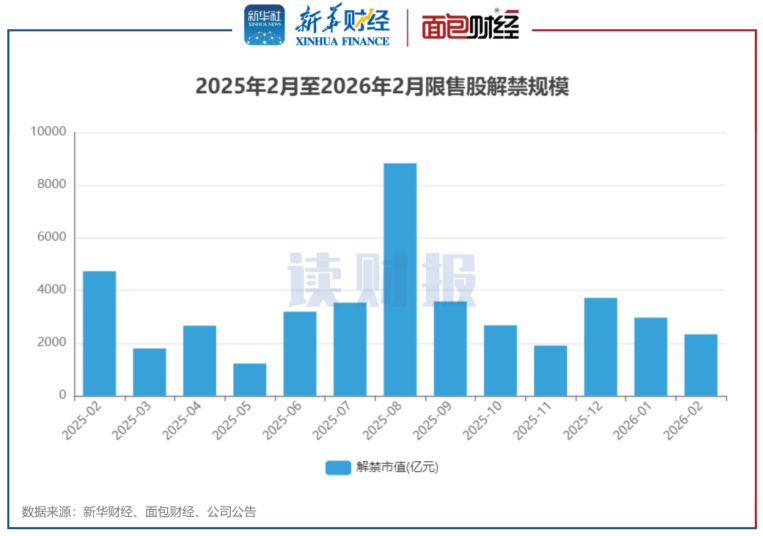
【读财报】A股2月逾2300亿元解禁 信达证券、湖南裕能解禁规模居前
Zhong Guo Jin Rong Xin Xi Wang· 2026-02-01 23:21
Summary of Key Points Core Viewpoint - In February 2026, a total of 111 companies in the A-share market will face the unlocking of restricted shares, with a total unlocking volume of approximately 12.902 billion shares and an unlocking scale of 233.584 billion yuan, representing a month-on-month decrease of about 21.32% and a year-on-year decrease of about 50.63% [1][3]. Group 1: Unlocking Scale and Key Companies - The largest unlocking scale is attributed to Xinda Securities, with an unlocking market value exceeding 40 billion yuan [1][3]. - Five stocks will have an unlocking market value exceeding 10 billion yuan, with Xinda Securities, Hunan YN, and Huaxi Nonferrous Metals leading the list [3][4]. - Xinda Securities will unlock 2.5514 billion shares on February 2, with an unlocking market value of approximately 44.93 billion yuan, accounting for 78.67% of its total share capital [3][4]. Group 2: Industry Distribution - The industries with the highest unlocking market values are non-bank financials, electronics, and power equipment [1][9]. - In the non-bank financial sector, Xinda Securities has a significant unlocking scale, while in the electronics sector, Zhongwei Semiconductor has a notable unlocking scale [9][10]. Group 3: Additional Notable Unlockings - Hunan YN will unlock 374 million shares on February 9, with an unlocking market value of approximately 24.179 billion yuan, accounting for 49.13% of its total share capital [7][9]. - Huaxi Nonferrous Metals will have an unlocking volume of 357 million shares, representing 56.47% of its total share capital, with an unlocking market value of approximately 22.47 billion yuan [7][9]. - Honghai Technology will have its anniversary unlocking in February, with an unlocking volume of approximately 137 million shares and a market value of about 1.955 billion yuan [9][10].