ZHONGJIN GOLD(600489)

Search documents
有色金属行业周报:国内电铜库存开始去化,价格或走强
Huaxin Securities· 2026-02-03 00:24
Investment Rating - The report maintains a "Recommended" investment rating for the gold, copper, aluminum, tin, and antimony industries [11]. Core Insights - The domestic copper inventory is beginning to decrease, which may lead to stronger prices [6]. - The gold market is expected to stabilize and rise further due to the anticipated interest rate cuts by the Federal Reserve [5]. - The aluminum supply remains rigid, supporting the investment outlook for the aluminum sector [11]. - Tin prices are expected to be supported by tight supply conditions [11]. - Antimony prices are rebounding after a six-month decline, indicating potential investment opportunities [11]. Summary by Sections Industry Performance - The non-ferrous metals sector (Shenwan) has shown significant performance with a 1-month increase of 22.6%, a 3-month increase of 35.7%, and a 12-month increase of 128.5% [3]. Precious Metals - Gold prices reached $4981.85 per ounce, with a week-on-week increase of $35.60, or 0.72%. Silver prices were $103.19 per ounce, up $4.19, or 4.23% [4]. Copper and Aluminum - Copper prices closed at $13,440 per ton on the LME, up $460 per ton, or 3.54%. SHFE copper closed at ¥103,170 per ton, up ¥2,120, or 2.10% [6]. - Domestic aluminum prices were ¥24,640 per ton, with a week-on-week increase of ¥510 [7]. Tin and Antimony - Domestic refined tin prices were ¥423,630 per ton, down ¥110, or 0.03%. The supply and demand for tin are weak, leading to a price fluctuation around high levels [9]. - Antimony prices remain supported due to tight supply conditions, with current prices at ¥160,000 per ton [10]. Recommended Stocks - For the gold sector, recommended stocks include Zhongjin Gold, Shandong Gold, and China National Gold International. In the copper sector, recommended stocks include Zijin Mining and Western Mining. For aluminum, recommended stocks are Shenhuo Co., Yunnan Aluminum, and Tianshan Aluminum [12].





四大利空来袭!30只龙头股开盘直接跌停,无量跌停,谁在疯狂出逃?
Sou Hu Cai Jing· 2026-02-02 17:00
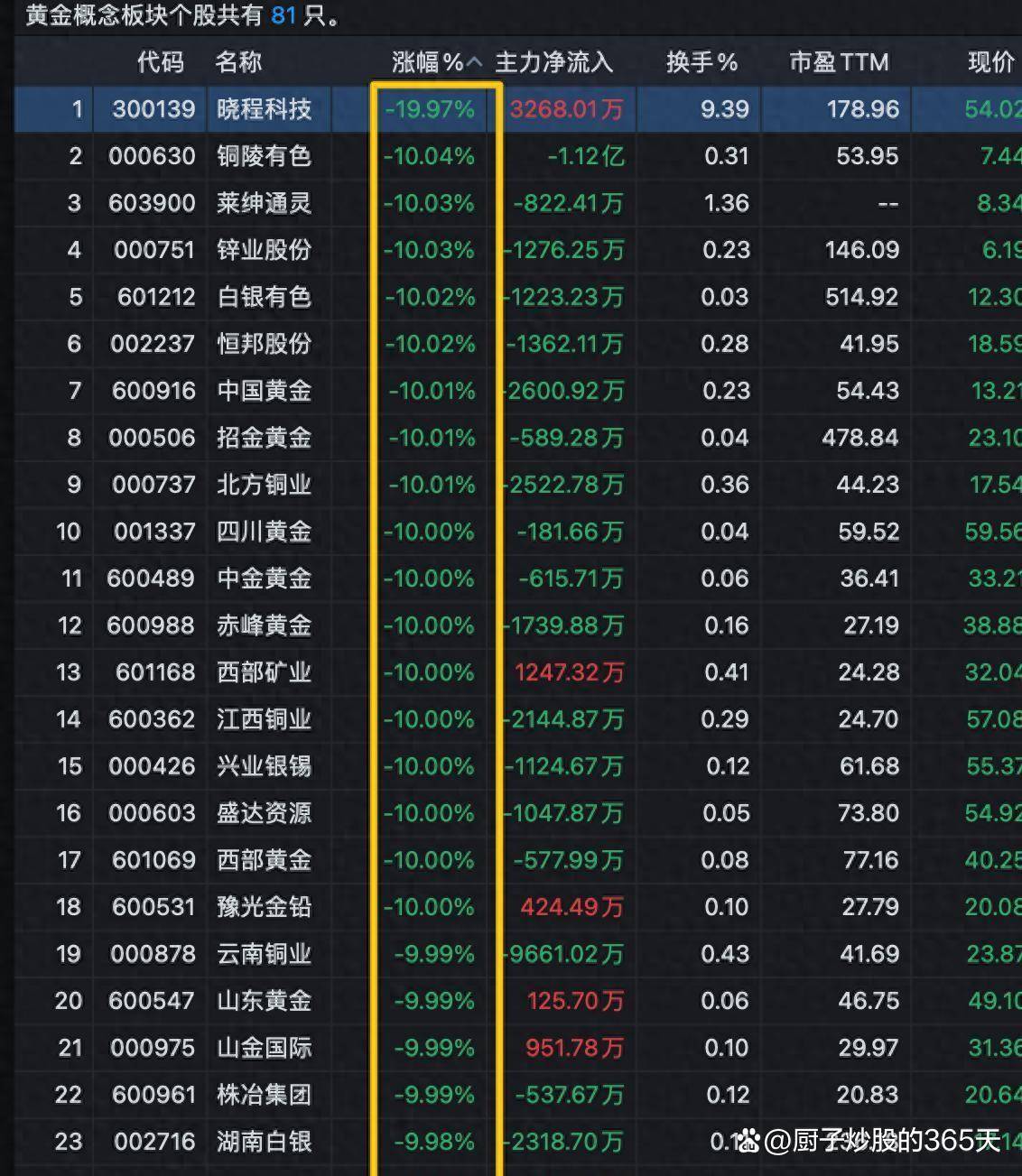
Core Viewpoint - The A-share market experienced a significant decline in the gold and non-ferrous metal sectors, with over 30 leading stocks hitting the daily limit down of -10% following a sharp drop in international gold prices [1][3][4]. Market Reaction - The gold concept sector saw 81 stocks, with notable declines including Xiaocheng Technology down 19.97% and Tongling Nonferrous Metals down 10.04% [2][3]. - The sell-off was characterized by a lack of buying interest, leading to a situation of "no volume limit down," indicating that investors were unable to sell their holdings, resulting in asset depreciation [3][4]. External Factors - The decline was triggered by a sudden drop in international gold prices, with London spot gold falling nearly 9% in a single day, marking the largest daily drop in years [3][4]. - The Federal Reserve's decision to maintain high interest rates and signals of prolonged high rates contributed to the bearish sentiment in the gold market, as higher rates increase the opportunity cost of holding non-yielding assets like gold [5][6]. Internal Market Dynamics - The gold sector had previously seen a significant increase of over 30% since the beginning of the year, attracting substantial short-term and leveraged funds, which led to an overbought condition [7][8]. - As the market sentiment shifted, a massive outflow of over 8.5 billion yuan from the gold sector occurred, leading to a panic sell-off [8][10]. Industry Challenges - Rising mining costs due to increased expenses for labor, energy, and equipment have raised concerns about profit margins for gold mining companies, despite high gold prices [10]. - The presence of "pseudo-gold stocks" in the sector, which lack solid fundamentals, has led to severe declines as funds exited these stocks when the market turned [10][11]. Broader Market Impact - The sharp decline in gold and silver prices negatively affected the overall commodity market and risk asset sentiment, with significant capital flows shifting towards defensive sectors and technology growth areas [12][21]. - The retail gold market also reflected this disparity, with physical gold prices remaining high while international prices plummeted, highlighting the disconnect between market prices and consumer prices [12][13]. Investor Sentiment - The market reaction has led to a divide among analysts, with some viewing the decline as a healthy correction while others express caution about the long-term trend and potential further declines in gold prices [21][22].


有色及贵金属周报:流动性预期回摆,错杀品修复可期
Orient Securities· 2026-02-02 13:20
有色金属行业 行业研究 | 行业周报 流动性预期回摆,错杀品修复可期 ——有色及贵金属周报 核心观点 投资建议与投资标的 核心观点:流动性预期回摆,错杀品修复可期。近日特朗普提名沃什为下一任美联储主 席,短期贵金属乐观预期的回摆导致金属价格大幅波动,建议关注错杀品种的修复机 会。 投资标的: 相关标的:山东黄金(600547,未评级)、山金国际(000975,未评级)、中金黄金 (600489,未评级)、赤峰黄金(600988,买入)、紫金矿业(601899,买入)、洛阳钼业 (603993,未评级)、中国铝业(601600,未评级)、西部矿业(601168,未评级)、金诚 信(603979,未评级)。 风险提示 国家/地区 中国 行业 有色金属行业 报告发布日期 2026 年 02 月 02 日 看好维持 | 于嘉懿 | 执业证书编号:S0860525110005 | | --- | --- | | | yujiayi1@orientsec.com.cn | | | 021-63326320 | | 兰洋 | 执业证书编号:S0860525120002 | | | lanyang@orientsec.com ...


有色及贵金属周报:流动性预期回摆,错杀品修复可期-20260202
Orient Securities· 2026-02-02 12:42
有色金属行业 行业研究 | 行业周报 流动性预期回摆,错杀品修复可期 ——有色及贵金属周报 核心观点 投资建议与投资标的 核心观点:流动性预期回摆,错杀品修复可期。近日特朗普提名沃什为下一任美联储主 席,短期贵金属乐观预期的回摆导致金属价格大幅波动,建议关注错杀品种的修复机 会。 投资标的: 相关标的:山东黄金(600547,未评级)、山金国际(000975,未评级)、中金黄金 (600489,未评级)、赤峰黄金(600988,买入)、紫金矿业(601899,买入)、洛阳钼业 (603993,未评级)、中国铝业(601600,未评级)、西部矿业(601168,未评级)、金诚 信(603979,未评级)。 风险提示 下游需求弱于预期、供给端大量释放、美联储降息进程不及预期等。 国家/地区 中国 行业 有色金属行业 报告发布日期 2026 年 02 月 02 日 看好维持 | 于嘉懿 | 执业证书编号:S0860525110005 | | --- | --- | | | yujiayi1@orientsec.com.cn | | | 021-63326320 | | 兰洋 | 执业证书编号:S0860525120 ...
今日财经要闻TOP10|2026年2月2日
Xin Lang Cai Jing· 2026-02-02 12:32
Group 1: Geopolitical Developments - Serbian President Vucic predicts that Iran will face military strikes within 48 hours, linking the timing to Epstein-related documents [1] - Iranian officials deny plans for military exercises in the Strait of Hormuz, stating that reports of such drills are inaccurate [1] Group 2: U.S.-Iran Relations - U.S. President Trump expresses hope for an agreement with Iran, while Iranian Foreign Minister Zarif maintains confidence in reaching a nuclear deal [3][10] - Zarif indicates that Iran is working with regional partners to build trust with the U.S. for negotiations, which have shown some effectiveness [5][11] - Zarif emphasizes the importance of substance over form in negotiations, reiterating Iran's desire for the U.S. to lift long-standing sanctions and respect its rights to uranium enrichment [11] Group 3: Commodity Market Trends - The commodity market experiences a significant downturn, with gold, silver, crude oil, and industrial metals leading the decline due to hawkish expectations from the Fed and a strengthening dollar [12] - A large sell-off in the A-share market sees major indices drop over 2%, with significant losses in resource sectors and semiconductor stocks [12] - Silver and other precious metals face substantial selling pressure, with notable sell orders exceeding 66 billion for Silver [9] Group 4: Company Developments - Tesla announces the upcoming launch of its third-generation humanoid robot, designed to learn new skills by observing human behavior, with an expected annual production of one million units [13]


有色金属行业周报:国内电铜库存开始去化,价格或走强-20260202
Huaxin Securities· 2026-02-02 12:16
Investment Rating - The report maintains a "Recommended" investment rating for the gold, copper, aluminum, tin, and antimony industries [11]. Core Insights - The domestic copper inventory is beginning to decrease, which may lead to stronger prices [6]. - The gold market is expected to stabilize and rise further due to the anticipated interest rate cuts by the Federal Reserve [5]. - The aluminum supply remains rigid, supporting the investment outlook for the aluminum sector [11]. - Tin prices are expected to be supported by tight supply conditions [11]. - Antimony prices are rebounding after a six-month decline, indicating a positive outlook for the antimony sector [11]. Summary by Sections Industry Performance - The non-ferrous metals sector (Shenwan) has shown significant performance with a 1-month increase of 22.6%, a 3-month increase of 35.7%, and a 12-month increase of 128.5% [3]. Precious Metals - Gold prices reached $4981.85 per ounce, with a week-on-week increase of $35.60, or 0.72%. Silver prices were $103.19 per ounce, up $4.19, or 4.23% [4]. Copper and Aluminum - Copper prices closed at $13,440 per ton on the LME, up $460 per ton, or 3.54%. SHFE copper closed at ¥103,170 per ton, up ¥2,120, or 2.10% [6]. - Domestic aluminum prices were ¥24,640 per ton, with a week-on-week increase of ¥510 [7]. Tin and Antimony - Domestic refined tin prices were ¥423,630 per ton, down ¥110, or 0.03%. The supply and demand for tin are weak, leading to a price fluctuation around high levels [9]. - Antimony prices remain supported due to tight supply conditions, with current prices at ¥160,000 per ton [10]. Recommended Stocks - The report recommends specific stocks in various sectors, including Zhongjin Gold, Shandong Gold, Zijin Mining, and others across gold, copper, aluminum, tin, and antimony industries [12].


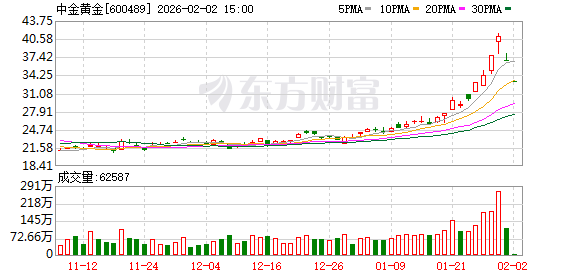
中金黄金:截至目前公司未有应披露而未披露的重大事项
Zheng Quan Ri Bao· 2026-02-02 11:43
(文章来源:证券日报) 证券日报网讯 2月2日,中金黄金在互动平台回答投资者提问时表示,截至目前,公司未有应披露而未 披露的重大事项。 ...
黄金股大面积跌停,阿里、哔哩哔哩、快手、百度集体下跌,国际油价跳水
Mei Ri Jing Ji Xin Wen· 2026-02-02 09:45
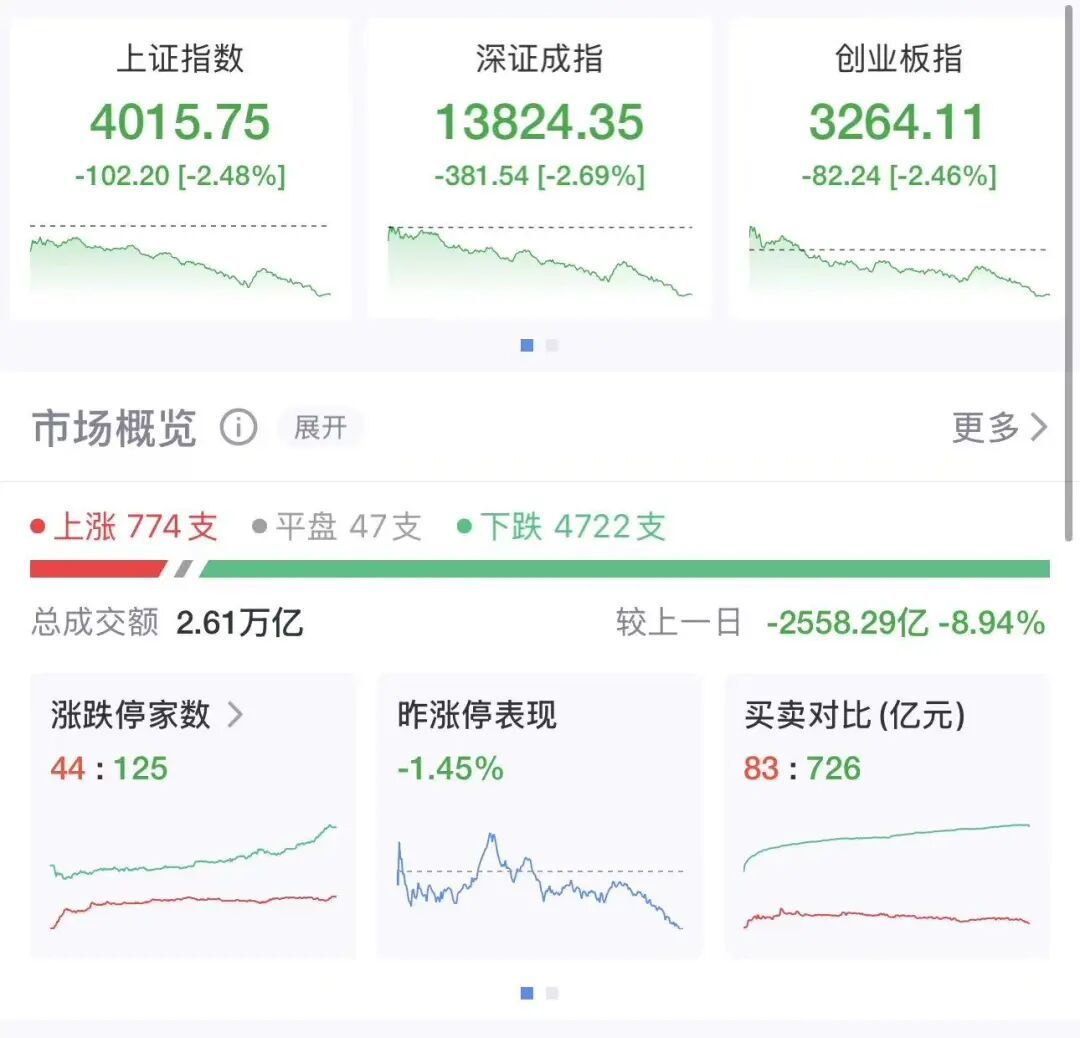
Market Overview - On February 2, the market experienced fluctuations with all three major indices falling over 2%, and the Sci-Tech 50 index dropping over 3%. The Shanghai Composite Index closed down 2.48%, the Shenzhen Component Index down 2.69%, and the ChiNext Index down 2.46% [1] - The total trading volume in A-shares was 2.61 trillion yuan, a decrease of 255.83 billion yuan compared to the previous trading day. Over 4,700 stocks in the market declined, with 125 stocks hitting the daily limit down [1] Sector Performance - The liquor sector showed resilience, with Huangtai Liquor achieving three consecutive trading limits, and Jinhuijiu hitting two limits in three days. Water Well Liquor also reached the daily limit up [3] - Conversely, the non-ferrous metals, oil and gas, chemicals, coal, and semiconductor sectors faced significant declines. The non-ferrous metals sector was particularly hard hit, with multiple gold stocks such as Zhaojin Gold and Sichuan Gold experiencing limit downs [3][5] - The oil and gas sector also suffered, with domestic crude oil and fuel futures contracts hitting the limit down, both dropping approximately 7%. Brent crude oil futures fell to $66 per barrel, down 4.67%, while WTI crude oil futures dropped below $62 per barrel, down 4.94% [5][6] Hong Kong Market - The Hong Kong stock market opened lower and continued to decline, with the Hang Seng Technology Index expanding its losses to 4% in the afternoon. The Hang Seng Index closed down 2.23%, and the Hang Seng Technology Index fell 3.36% [6][7] - The precious metals sector in Hong Kong also faced significant losses, with stocks like Shandong Gold and Chifeng Jilong Gold dropping over 12% [7] - The three major telecom operators in China collectively weakened, with China Unicom down over 6%, China Telecom down over 5%, and China Mobile down over 2%. This was influenced by an adjustment in the value-added tax rate for telecom services from 6% to 9%, which will impact the revenue and profits of these companies [7]


贵金属板块2月2日跌10.18%,晓程科技领跌,主力资金净流出10.39亿元
Zheng Xing Xing Ye Ri Bao· 2026-02-02 09:07
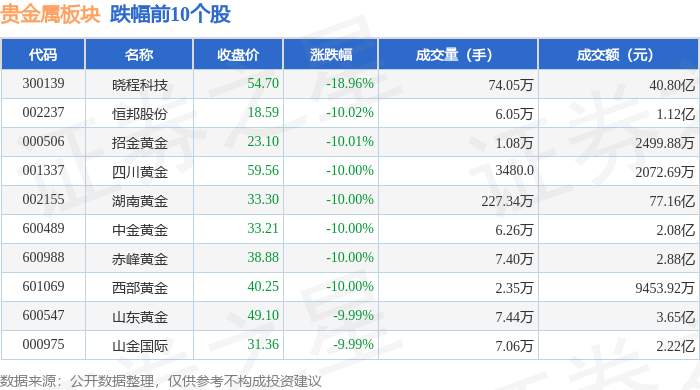
Market Overview - The precious metals sector experienced a significant decline of 10.18% compared to the previous trading day, with Xiaocheng Technology leading the drop [1] - The Shanghai Composite Index closed at 4015.75, down 2.48%, while the Shenzhen Component Index closed at 13824.35, down 2.69% [1] Individual Stock Performance - Xiaocheng Technology (300139) closed at 54.70, down 18.96% with a trading volume of 740,500 shares [1] - Hengbang Shares (002237) closed at 18.59, down 10.02% with a trading volume of 60,500 shares [1] - Zhao Jin Gold (000506) closed at 23.10, down 10.01% with a trading volume of 10,800 shares [1] - Sichuan Gold (001337) closed at 59.56, down 10.00% with a trading volume of 3,480 shares [1] - Hunan Gold (002155) closed at 33.30, down 10.00% with a trading volume of 2,273,400 shares [1] - Zhongjin Gold (600489) closed at 33.21, down 10.00% with a trading volume of 62,600 shares [1] - Chifeng Gold (6009888) closed at 38.88, down 10.00% with a trading volume of 74,000 shares [1] - Western Gold (eoloea) closed at 40.25, down 10.00% with a trading volume of 23,500 shares [1] - Shandong Gold (600547) closed at 49.10, down 9.99% with a trading volume of 74,400 shares [1] - Shanjin International (000975) closed at 31.36, down 9.99% with a trading volume of 70,600 shares [1] Capital Flow Analysis - The precious metals sector saw a net outflow of 1.039 billion yuan from institutional investors, while retail investors experienced a net inflow of 769 million yuan [1] - The following stocks had notable capital flows: - Shanjin International (000975) had a net inflow of 1.414 million yuan from retail investors, despite a net outflow of 10.571 million yuan from institutional investors [2] - Sichuan Gold (001337) saw a net outflow of 10.7625 million yuan from institutional investors, with a net inflow of 781.43 million yuan from retail investors [2] - Zhao Jin Gold (000506) had a net outflow of 16.9277 million yuan from institutional investors, while retail investors contributed a net inflow of 1.25826 million yuan [2] - Hengbang Shares (002237) experienced a net outflow of 22.7305 million yuan from institutional investors, with a net inflow of 1.82554 million yuan from retail investors [2] - Zhongjin Gold (600489) had a net outflow of 87.5449 million yuan from institutional investors, while retail investors contributed a net inflow of 5.4129 million yuan [2]


被砸懵了!亚太市场全线杀跌,A股4600股飘绿,超百股跌停!韩国股市跌超5%,触发熔断机制...
雪球· 2026-02-02 07:53
Market Overview - The capital market experienced a significant downturn, with major indices in the Asia-Pacific region, including the Hang Seng Index and A-shares, dropping over 2%. The South Korean stock market fell more than 5%, triggering a circuit breaker. The futures market saw widespread declines in commodity prices, with many contracts hitting their daily limit down [2]. Precious Metals Sector - The precious metals sector faced a dramatic decline, with over 30 stocks hitting the limit down. Key players such as Shandong Gold and Zhongjin Gold saw declines of 10% [5]. - Futures prices for silver, platinum, palladium, lithium carbonate, nickel, tin, copper, aluminum, and crude oil all fell sharply, with gold futures dropping over 15%. This followed a period of irrational price surges driven by factors like de-dollarization and geopolitical risks [7]. - Market institutions have mixed views on the future of precious metals. Citigroup warned that half of the current risk premium for gold may dissipate by late 2026, while other institutions like CITIC Securities maintain bullish forecasts, predicting gold could reach $6,000 per ounce by 2026 [8]. Semiconductor and AI Sector - The South Korean stock market's decline was largely attributed to the semiconductor and AI supply chain, with major companies like Samsung Electronics and SK Hynix experiencing significant drops of nearly 6% and over 8%, respectively. The A-share storage chip sector also saw substantial declines, with multiple stocks falling over 10% [10]. - Reports indicate that major manufacturers are tightening order reviews to mitigate market volatility caused by excessive orders from some clients [12]. Electric Grid Equipment Sector - The electric grid equipment sector performed well against the market trend, with companies like Baobian Electric and Hancable hitting the daily limit up, and TBEA rising over 4% [14]. - The global AI computing power construction is entering a rapid growth phase, with high-power and stable electricity supply becoming critical for computing clusters. Transformer factories are reportedly operating at full capacity, with some orders extending to 2027 [16]. - The State Grid announced a fixed asset investment of 4 trillion yuan during the 14th Five-Year Plan period, a 40% increase from the previous plan, indicating a historical high in investment [17].