SCSF(600779)

Search documents
2025白酒年度事件大盘点:告别高增长,行业挑战下的变革与新机
Sou Hu Cai Jing· 2025-12-31 14:12
Core Insights - The Chinese liquor industry is entering an adjustment phase in 2025, facing challenges such as the "ban on alcohol," rising inventory pressure, and declining profits, yet opportunities for growth are emerging through innovation and market expansion [2][4]. Policy Impact - A strict "ban on alcohol" policy was introduced, prohibiting public officials from consuming alcohol during workdays and even at home gatherings, with severe penalties for violations [2][4]. - This policy aims to curb corruption and address public health concerns related to alcohol consumption [4]. Digital Transformation - Leading liquor companies are advancing their digital transformation from isolated upgrades to comprehensive collaborative development, with initiatives like the first "lighthouse factory" by Luzhou Laojiao and 5G-connected factories by Shede [5]. - The Ministry of Industry and Information Technology has released guidelines for digital transformation in the liquor industry, with companies actively contributing to industry mapping [5]. ESG Practices - ESG efforts among listed liquor companies have shifted from compliance to value creation, with companies like Zhenjiu Li Du setting ambitious carbon neutrality goals and achieving high water recycling rates [7]. - Companies are integrating ESG principles into performance assessments and utilizing blockchain for product traceability [7]. Market Dynamics - The liquor market is experiencing severe inventory issues, with major companies implementing supply control measures and channel reforms to reshape pricing structures [8][10]. - In the first three quarters of 2025, liquor exports reached $704 million, a 5.3% increase year-on-year, indicating a growing international market [8][10]. Young Consumer Trends - The younger generation is increasingly favoring low-alcohol and flavored beverages, with participation rates among Gen Z rising from 66% in 2023 to 73% in 2025 [12]. - Major companies are launching low-alcohol products to cater to this demographic, with Wuliangye and Luzhou Laojiao leading the way [12]. Personnel Changes - The liquor industry is undergoing significant personnel changes, with over 20 companies experiencing nearly 30 key position shifts, indicating a trend towards younger management [14][16]. - The new management is expected to focus on refined operations and innovation to navigate industry pressures [16]. Financial Performance - In the first nine months of 2025, only two companies, Kweichow Moutai and Shanxi Fenjiu, reported positive net profit growth, while the average profit of 20 liquor companies fell by 39.2% [18]. - The average inventory turnover days for these companies surged to 1456.29 days, marking a significant increase from the previous year [18]. Health-Oriented Products - The health-oriented liquor market is gaining traction, with sales of functional products like Jinjian's red label liquor increasing by 50% in the first half of the year [20]. - However, the market faces challenges such as product homogeneity and compliance risks, with a projected market size exceeding 58 billion yuan [22]. Price Fluctuations - Moutai's price fell below the official guidance price of 1499 yuan per bottle in December 2025, raising concerns about future price trends [22]. - Following a price drop, Moutai's wholesale prices rebounded due to supply control measures and increased market demand during the peak season [24].







白酒板块12月31日跌1.01%,*ST岩石领跌,主力资金净流出15.73亿元
Zheng Xing Xing Ye Ri Bao· 2025-12-31 08:59
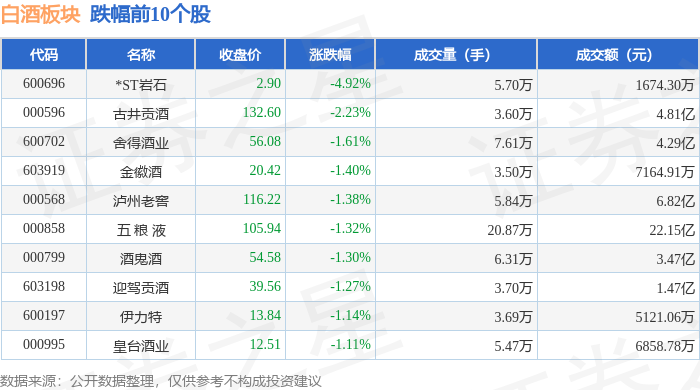
Core Viewpoint - The liquor sector experienced a decline of 1.01% on December 31, with *ST Yanshi leading the drop, while the overall market showed mixed results with the Shanghai Composite Index up by 0.09% and the Shenzhen Component Index down by 0.58% [1] Liquor Sector Performance - The closing prices and percentage changes for key liquor stocks are as follows: - *ST Yanshi: 2.90, -4.92% - Gujing Gongjiu: 132.60, -2.23% - Shede Manye: 56.08, -1.61% - Quanwei Jiu: 20.42, -1.40% - Luzhou Laojiao: 116.22, -1.38% - Wuliangye: 105.94, -1.32% - Zhisi Cha: 54.58, -1.30% - Yingjia Gongjiu: 39.56, -1.27% - Yilite: 13.84, -1.14% - Huangtai Jiuye: 12.51, -1.11% [1] Capital Flow Analysis - The liquor sector saw a net outflow of 1.573 billion yuan from main funds, while retail investors contributed a net inflow of 712 million yuan [1] - The detailed capital flow for selected stocks indicates: - Gujing Gongjiu: Main net inflow of 5.437 million yuan, retail net inflow of 2.302 million yuan - *ST Yanshi: Main net outflow of 4.866 million yuan, retail net inflow of 4.265 million yuan - Other stocks like Jinzhongzi Jiu and Kuozi Jiao experienced significant net outflows from main and retail funds [2]


水井坊“被收购”乌龙背后,白酒行业整合为何雷声大雨点小?
Guan Cha Zhe Wang· 2025-12-31 02:29
Core Viewpoint - The sudden surge in Water Jiufang's stock price, driven by unverified rumors of a potential acquisition by Jian Nan Chun, highlights the market's anxiety and desire for narratives amid the challenges faced by the liquor industry, including high inventory and cash flow issues [1][2]. Company Summary - Water Jiufang's stock experienced a dramatic increase, with a market value rise of nearly 4 billion RMB in a single day due to rumors of acquisition [1]. - The company later clarified that there were no plans or negotiations for acquisition, which led to a quick market correction [2]. - Water Jiufang's financial performance is under severe pressure, with a reported revenue of 2.348 billion RMB, a year-on-year decline of 38.01%, and a net profit drop of 71.02% to 326 million RMB [2]. - The company's cash flow situation is critical, with a net cash flow from operating activities of -867 million RMB, a decline of 212%, indicating liquidity issues [2]. Industry Summary - The liquor industry is undergoing a significant transformation, moving from a phase of expansion to one of value reconfiguration amid declining production and sales figures [7][8]. - The industry is facing its first comprehensive decline in production, sales revenue, and total profit in years, as reported by the China Alcoholic Drinks Association [7]. - Current strategies for industry consolidation include deep integration of existing assets and leveraging state-owned enterprises for strategic restructuring [10][11]. - Structural barriers hinder large-scale market consolidation, including regulatory restrictions on IPOs and mergers, as well as the reluctance of local governments to sell stakes in regional liquor brands [12][14][15]. - The market remains cautious, with the potential for further consolidation as second and third-tier brands face increasing survival pressures [17].

水井坊涨2.01%,成交额9983.92万元,主力资金净流入28.71万元
Xin Lang Zheng Quan· 2025-12-30 02:57
Core Viewpoint - Water Well's stock price has shown volatility, with a significant decline over the year but a recent uptick in the short term, indicating potential market interest despite overall poor performance in revenue and profit [1][2]. Group 1: Stock Performance - On December 30, Water Well's stock increased by 2.01%, reaching 39.50 yuan per share, with a trading volume of 99.84 million yuan and a turnover rate of 0.53% [1]. - Year-to-date, Water Well's stock has decreased by 24.84%, but it has risen by 9.57% over the last five trading days [1]. - The stock's performance over the last 20 days shows a slight decline of 0.85%, while it has dropped by 9.78% over the last 60 days [1]. Group 2: Financial Performance - For the period from January to September 2025, Water Well reported a revenue of 2.348 billion yuan, a year-on-year decrease of 38.01%, and a net profit attributable to shareholders of 326 million yuan, down 71.02% year-on-year [2]. - Cumulatively, since its A-share listing, Water Well has distributed a total of 5.378 billion yuan in dividends, with 1.280 billion yuan distributed over the last three years [3]. Group 3: Shareholder Information - As of September 30, 2025, Water Well had 80,500 shareholders, a decrease of 5.58% from the previous period, with an average of 6,053 circulating shares per shareholder, which is an increase of 5.91% [2]. - Among the top ten circulating shareholders, the China Securities White Wine Index A (161725) holds 17.7303 million shares, an increase of 1.6367 million shares from the previous period [3].
深化产城融合 与城市共成长
Xin Lang Cai Jing· 2025-12-29 19:18
Core Viewpoint - Water Jiufang aims to contribute to Chengdu's high-quality development by focusing on six key areas as it transitions into the "15th Five-Year Plan" period, aligning its growth strategy with the city's development goals [4]. Group 1: Industry Development - The "15th Five-Year Plan" emphasizes the optimization and enhancement of traditional industries, with Chengdu aiming to build a modern industrial system centered around advanced manufacturing [5]. - Water Jiufang, as a leading enterprise in Chengdu's liquor production, is strategically expanding its production bases, integrating traditional brewing techniques with modern technology, and investing over 6.8 billion yuan in its Qionglai production base [5]. - The company is creating a micro-ecosystem that covers the entire production chain, enhancing efficiency while preserving traditional craftsmanship [5]. Group 2: International Engagement - Water Jiufang is positioned as a key player in Chengdu's goal to become a national center for international exchanges, leveraging its unique advantages from foreign partnerships [6]. - Since its acquisition by Diageo in 2013, Water Jiufang has integrated international management practices, enhancing its global market presence and confidence among foreign investors [6]. Group 3: Consumer Trends - The company is responding to changing consumer preferences by focusing on quality upgrades and emotional consumption, aligning with Chengdu's goal of becoming a major international consumption center [7]. - Water Jiufang's dual-brand strategy, featuring the main brand and the high-end "Diyifang," caters to different consumer segments, reinforcing its market position [7][8]. Group 4: Cultural Integration - Water Jiufang is actively contributing to Chengdu's cultural development by transforming its historical heritage into a vibrant cultural brand, supported by its status as a national cultural heritage site [9]. - The company has launched a unique cultural tourism route that connects its museum with other city landmarks, enhancing public engagement with its heritage [9]. Group 5: Technological Innovation - The "15th Five-Year Plan" highlights the importance of technological innovation, which Water Jiufang is addressing through research collaborations focused on microbial communities in traditional brewing [10]. - The company is utilizing smart manufacturing technologies to enhance production processes, ensuring that traditional techniques are preserved while improving efficiency [10][11]. Group 6: Sustainability Initiatives - Water Jiufang has integrated sustainability into its core strategy, establishing a comprehensive ESG framework and setting quantifiable goals for carbon reduction and resource recycling [12][13]. - The Qionglai production base exemplifies the company's commitment to green practices, achieving significant energy savings and waste recycling, and receiving international green building certifications [12][13].
水井坊:公司将努力做强白酒主业
Zheng Quan Ri Bao Wang· 2025-12-29 14:10
证券日报网讯12月29日,水井坊(600779)在互动平台回答投资者提问时表示,公司将努力做强白酒主 业,不断提升公司治理水平,进一步夯实市场基础,适时推出适销对路的产品,积极落实"降本增效"举 措,以规范的公司治理、积极的投资者回报,切实履行上市公司的责任和义务。 ...
水井坊:截至2025年9月30日股东总数为80536户
Zheng Quan Ri Bao Wang· 2025-12-29 13:42
Group 1 - The company, Shui Jing Fang, reported that as of September 30, 2025, the total number of shareholders is 80,536 [1] - The company will disclose the total number of shareholders as of December 31, 2025, in its annual report, which will be available for review [1]
水井坊:目前公司资金安排总体可控
Zheng Quan Ri Bao Wang· 2025-12-29 13:42
Group 1 - The core point of the article is that the company, Shui Jing Fang, reported a decrease in cash funds compared to the beginning of the year, attributed to changes in operational cash flow and the planned payment of previous annual dividends [1] - The company stated that the overall management of funds is currently under control [1]
水井坊:二级市场股价受宏观环境等多因素影响
Zheng Quan Ri Bao Wang· 2025-12-29 12:41
证券日报网讯12月29日,水井坊(600779)在互动平台回答投资者提问时表示,二级市场股价受宏观环 境、行业情况、市场波动、公司经营情况等多方面因素影响。公司将努力做强白酒主业,不断提升公司 治理水平,进一步夯实市场基础。同时,公司积极落实"降本增效"举措,以规范的公司治理、积极的投 资者回报,切实履行上市公司的责任和义务。 ...
观酒 头部酒企集体押注低度化,白酒降度能让年轻人买账吗?
Nan Fang Du Shi Bao· 2025-12-29 07:29
Core Insights - The Chinese liquor industry is undergoing significant transformation in 2025, driven by high channel inventory and weak terminal sales, alongside new opportunities arising from changing policies, consumption patterns, and scenarios [1] - The trend towards "lower alcohol content" is becoming mainstream, with major liquor companies launching new low-alcohol products to attract younger consumers [3][4] Industry Trends - The low-alcohol wave in the liquor industry has evolved from sporadic attempts to a concentrated effort, with major brands like Wuliangye and Luzhou Laojiao leading the charge [4][10] - Wuliangye's launch of the 29-degree "Wuliangye·Yijianqingxin" has set a precedent, achieving over 100 million yuan in sales within two months [4] - Other companies, such as Shede and Gujing Gongjiu, are also introducing low-alcohol products targeting specific consumption scenarios, indicating a shift in marketing strategies [6][8] Consumer Behavior - The shift towards low-alcohol products is largely driven by generational changes in consumer behavior, with younger consumers preferring lighter, more comfortable drinking experiences [11][13] - The younger demographic, particularly those born between 1985 and 1994, now constitutes a significant portion of the liquor consumer base, leading to a demand for products that align with their lifestyle [11] Market Dynamics - The industry is facing challenges such as high inventory levels and sluggish sales, prompting companies to seek new growth avenues through low-alcohol offerings [13] - The trend towards lower alcohol content is also seen as a response to increasing health consciousness among consumers, who are more sensitive to the burdens of alcohol consumption [13][14] Strategic Implications - The low-alcohol trend is not merely about reducing alcohol content but involves a comprehensive restructuring of product offerings, including fruit wines and sparkling liquors [10][14] - Companies are exploring international markets for low-alcohol products, which may facilitate cultural export and align with global drinking preferences [14] Challenges Ahead - Despite the momentum, the industry faces the challenge of ensuring that lower alcohol products resonate with younger consumers, who may not be willing to pay for them if they lack flavor innovation [15][16] - The need for emotional connection and cultural relevance remains critical, as traditional liquor culture may alienate younger consumers [15][17]