YILI(600887)

Search documents
交银国际:“十五五”开局定调 1月研选股一览
智通财经网· 2026-01-02 04:01
Core Viewpoint - The report from CMB International indicates that the mainland market is entering a phase of policy validation and profit recovery as the "14th Five-Year Plan" begins. The evolution of pricing power structure is attracting long-term capital back to new core assets [1] Group 1: Key Variables for January - Three major variables to focus on in January include: 1) the first batch of major projects and revenue-increasing policy details under the "14th Five-Year Plan" [1] 2) overseas liquidity [1] 3) consumer data and seasonal liquidity before the Spring Festival holiday [1] Group 2: Investment Strategy - The company suggests focusing on "domestic demand reconstruction" and "resilience in overseas markets," balancing offensive and defensive strategies [1] - Selected stocks for January include: 1) Prosperity Industrial Trust (00778) [1] 2) NVIDIA (NVDA.US) [1] 3) Hesai Technology (02525) [1] 4) Sangfor Technologies (01530) [1] 5) Yili Group (600887.SH) [1] 6) GCL-Poly Energy (03800) [1]



经历2025年“结构性回暖”婴幼儿奶粉市场新一年增长点在哪
Sou Hu Cai Jing· 2026-01-01 23:12
Core Viewpoint - The Chinese milk powder market is experiencing a counter-cyclical recovery in 2025 despite ongoing pressure from declining newborn numbers, driven by strategic shifts in companies, policy support, and a focus on high-end products [4][9]. Group 1: Market Performance - The domestic milk powder market shows significant performance differentiation and overall recovery, with companies like Yili, Beingmate, and Ausnutria reporting revenue and profit growth in their infant formula segments [5]. - Yili's milk powder and dairy products revenue grew by 14.26% year-on-year, achieving a market share of 18.1%, making it the leading brand in China [5]. - Ausnutria reported a revenue of 3.887 billion yuan, a 5.6% increase year-on-year, with a net profit growth of 24.1% [5]. Group 2: Strategic Shifts - The recovery is attributed to strategic adjustments, product structure optimization, and deep channel cultivation rather than market expansion [7]. - Companies are focusing on high-end and differentiated products, with parents willing to pay a premium for clinically validated high-quality products [7]. - The acceptance of high-end milk powder in lower-tier cities is increasing, with sales growth in these areas surpassing that of first and second-tier cities [7]. Group 3: Policy Impact - Recent national policies, including a child-rearing subsidy of 3,600 yuan per eligible child and free preschool education, are expected to inject approximately 32.4 billion yuan into the milk powder market [8]. - These policies are designed to reduce family childcare costs and have led to a noticeable increase in stock prices for milk powder companies [8]. Group 4: Future Outlook - Experts suggest that while the industry shows signs of recovery, the low birth rate remains a concern, and companies must build diverse growth strategies for the long term [9]. - Short-term strategies should focus on policy adaptation and channel deepening, while product innovation should extend into specialized nutrition and all-age dietary needs [9]. - The industry is expected to see increased concentration, with leading companies gaining more advantages amid stricter regulations and rising costs [9].


食品饮料行业ESG披露率升至56.15% 茅台87%水循环利用率树立绿色实践标杆
Chang Jiang Shang Bao· 2025-12-30 23:22
登录新浪财经APP 搜索【信披】查看更多考评等级 对食品饮料行业而言,这五年更是ESG理念深度扎根、"双碳"目标从宏观口号转化为实践行动的关键时 期。作为ESG报告的支柱与灵魂,"双碳"相关披露已不再是边缘章节,而是贯穿环境(E)、社会 (S)、治理(G)的核心主线,通过标准化框架成为监管与投资者评价企业绿色转型决心的关键依 据。 按照同花顺数据库统计分类,目前A股市场共有130家食品饮料行业上市公司,主要涵盖白酒、啤酒、 肉制品、调味品、乳制品等多个细分领域。 如今,"双碳"目标提出已逾五载,在不断完善的顶层设计引领下,从能源绿色低碳转型、自然生态环境 治理到产业结构优化、绿色生活方式推广,绿色发展的底色愈发鲜明。 近年来,食品饮料行业上市公司可持续信息披露比例持续上升,整体水平高于全行业平均水平。据长江 商报资本战略研究院统计,2024年,A股食品饮料上市公司共有73家独立发布ESG报告(或社会责任报 告),披露率为56.15%,创下近六年新高。 此前的2019年至2023年,A股食品饮料行业上市公司的ESG报告披露率分别为29.29%、34.55%、 40.98%、48.44%、50.77%,呈现逐年上 ...

年度盘点|高端化与政策红利加持 2025奶粉市场逆势回暖
Nan Fang Du Shi Bao· 2025-12-30 09:57
Core Insights - The Chinese infant formula market in 2025 is characterized by a dual landscape of challenges and opportunities, with declining birth rates and intense competition on one side, and a recovery in performance for several leading dairy companies on the other [1] - The recovery in the infant formula sector is attributed to strategic adjustments by companies, product innovation, and supportive government policies, leading to a structural rebound after a period of deep adjustment [1] Company Performance - Major dairy companies like Yili, Ausnutria, and Beingmate have reported revenue and profit growth in the infant formula segment, reversing previous trends of slowing growth [2] - Yili's revenue from dairy products grew by 14.26% year-on-year, with infant formula retail sales achieving double-digit growth and a market share of 18.1%, making it the market leader in China [2] - Ausnutria's revenue reached 3.887 billion yuan, a 5.6% increase year-on-year, with net profit rising by 24.1% [2] - The performance of foreign brands like Danone and a2 Milk also showed positive growth, although some domestic brands faced challenges [3] Market Dynamics - The infant formula market is expected to see a retail market growth rate of around 5% in 2025, driven by a rebound in birth rates and supportive policies [3] - The shift in consumer preferences towards high-end products is evident, with the proportion of consumers purchasing formula priced above 300 yuan increasing from 21% to 26% [3] Strategic Adjustments - Companies are shifting focus from market share expansion to value creation, emphasizing product innovation and quality enhancement in response to a saturated market [4] - The competition has moved towards high-end and differentiated products, with companies like Ausnutria and Yili investing in specialized formulas and research [4] Market Expansion - The low-tier cities and rural markets are becoming significant growth areas, with increased acceptance of high-end infant formula products [5] - Companies are accelerating their channel penetration into these markets, with initiatives like Yili's "township station" plan and Mengniu's focus on maternal and infant stores [5] Policy Impact - Recent government policies, including a cash subsidy for families with infants and free preschool education, are expected to stimulate demand in the infant formula market [6] - The implementation of these policies is projected to release approximately 32.4 billion yuan annually for infant care, with a significant portion likely directed towards formula purchases [6] Future Trends - The industry is expected to transition from cyclical recovery to structural growth, with companies needing to develop diversified growth strategies [8] - Product innovation is anticipated to focus on specialized nutritional needs, with segments like adult nutrition and special formulas for children gaining traction [9] - Digital transformation and consumer engagement are becoming critical competitive advantages as younger parents increasingly prefer online research and purchasing [9] - The industry may see accelerated consolidation, with leading companies likely to expand their market share through mergers and acquisitions [9]
年度盘点|高端化与政策红利加持,2025奶粉市场逆势回暖
Sou Hu Cai Jing· 2025-12-30 09:52
Core Insights - The Chinese infant formula market in 2025 is characterized by a dual landscape of challenges and opportunities, with declining birth rates and intense competition on one side, and a recovery in performance for several leading dairy companies on the other [1] - The recovery in the infant formula sector is attributed to strategic adjustments by companies, product innovation, and the implementation of supportive national policies [1] Company Performance - Major dairy companies like Yili, Ausnutria, and Beingmate have reported revenue and profit growth in the infant formula segment, reversing previous trends of slowing growth [2][4] - Yili's infant formula and dairy product revenue increased by 14.26% year-on-year, achieving a market share of 18.1%, while Ausnutria's revenue grew by 5.6% with a net profit increase of 24.1% [2][4] - The performance of foreign brands such as Danone and a2 Milk also showed positive growth, although some leading companies faced pressure, indicating structural differentiation within the industry [6] Market Trends - The retail market for infant formula is expected to grow at around 5% in 2025, driven by a rebound in birth rates and supportive policies [6] - The proportion of consumers purchasing premium infant formula (over 300 yuan) increased from 21% to 26%, reflecting a trend towards higher quality products among younger parents [6] Strategic Shifts - The industry is shifting from a focus on market share expansion to value creation, with companies investing in high-end and functionally differentiated products [10] - Companies are enhancing their supply chains and digital efficiencies to improve profitability, with examples like Ausnutria's EBITDA growth of 29.7% [13] Policy Impact - New national policies, including a cash subsidy for families with infants and free preschool education, are expected to stimulate demand in the infant formula market [15][18] - The implementation of these policies is anticipated to lower childcare costs and boost consumer confidence, leading to increased sales for dairy companies [15][18] Future Outlook - The industry is expected to transition from cyclical recovery to structural growth, with companies needing to diversify their growth strategies [19][21] - Product innovation is crucial, with a focus on specialized nutrition for various age groups and health needs, as well as digital transformation to enhance consumer engagement [20][21] - The consolidation of the industry may accelerate, with larger companies likely to acquire smaller firms to expand their market share [20][21]
乳品行业深度报告:供需优化,提质拓新
Dongguan Securities· 2025-12-30 09:01
Investment Rating - The report maintains an "Overweight" rating for the food and beverage industry, specifically focusing on the dairy sector [1]. Core Insights - The dairy industry in China is experiencing a phase of market size adjustment, with the market growing from 388 billion CNY in 2012 to 686 billion CNY in 2022, reflecting a compound annual growth rate (CAGR) of 5.9%. However, a decline of 3.1% is expected in 2024, bringing the market size to 659 billion CNY [5][13]. - The competitive landscape is characterized by a "two super, many strong" structure, with leading companies like Yili and Mengniu holding approximately 45% market share, which creates brand barriers and enhances competitive advantages [5][31]. - The report emphasizes the importance of monitoring the supply-demand structure in the dairy market, as supply is expected to decrease marginally while demand shows signs of weak recovery [5][36]. Summary by Sections Market Size and Consumption - The dairy market in China is undergoing a phase of adjustment, with liquid milk being the primary consumption category, accounting for 44% of the market in 2024 [5][16]. - Per capita dairy consumption in China is significantly below global averages, with a projected consumption of 41.5 kg per year in 2024, which is about one-third of the global average [5][19]. Competitive Landscape - The dairy industry is structured into three tiers: national, regional, and local companies, with Yili and Mengniu as the leading national players [5][31]. - The competitive advantages of leading dairy companies are expected to improve due to enhanced brand influence and consumer recognition [5][33]. Supply and Demand Structure - The supply of dairy products is expected to decrease marginally, with a reported production of 26.85 million tons in the first eleven months of 2025, a decline of 1.2% year-on-year [5][36]. - The report highlights the need to focus on the supply-demand structure, as policy catalysts may improve dairy demand [5][27]. Low-Temperature Milk and Cheese Market - The low-temperature milk segment is growing faster than the overall industry, with a market size of 41.8 billion CNY in 2024, reflecting a year-on-year growth of 6.63% [5][44]. - The cheese market is also expanding, with production increasing from 127,000 tons in 2019 to 203,000 tons in 2023, although the self-sufficiency rate remains low at 12.3% [5][50]. Online and Retail Channels - The sales structure for dairy products is predominantly offline, with online and instant retail channels contributing to growth, showing year-on-year increases of 4.3% and 2.8% respectively [5][69]. - The report indicates that the dairy industry is increasingly leveraging online channels to enhance market competitiveness and reach consumers more effectively [5][71]. Investment Strategy - The report suggests maintaining an "Overweight" rating for the food and beverage sector, with a focus on companies like Yili (600887), New Dairy (002946), and Miaokelando (600882) as key investment targets [5][73].



中国必选消费品12月成本报告:下游需求偏弱,成本小幅波动
Haitong Securities International· 2025-12-30 09:00
Investment Rating - The report assigns an "Outperform" rating to multiple companies in the essential consumer goods sector, including Guizhou Moutai, Wuliangye, and Yili [1]. Core Insights - Downstream demand remains subdued, with modest fluctuations in costs across various consumer goods categories [1][34]. - The cost indices for six monitored consumer goods showed mixed trends, with soft drinks and instant noodles experiencing increases, while condiments, dairy products, frozen foods, and beer saw declines [34]. Cost Index Summary Beer - The spot cost index for beer decreased by 1.05% month-on-month, while the futures index increased by 0.88%. Year-to-date, the spot index has declined by 3.84% and the futures index by 7.87% [4][35]. - Glass prices fell by 1.9% month-on-month and 18.0% year-on-year, while aluminum prices showed mixed trends [12][35]. Condiments - The spot cost index for condiments dropped by 0.29% month-on-month, and the futures index fell by 0.47%. Year-to-date, the spot index has decreased by 3.95% and the futures index by 9.74% [16][36]. - Soybean prices showed a slight decrease in spot prices but an increase in futures prices [16][36]. Dairy Products - The spot cost index for dairy products decreased by 0.45% month-on-month, while the futures index increased by 0.39%. Year-to-date, the spot index has declined by 2.92% and the futures index by 4.19% [19][37]. - Raw milk prices remained stable at 3.03 yuan/kg, with supply pressures emerging due to cash flow issues in dairy farming [19][37]. Instant Noodles - The spot cost index for instant noodles rose by 0.49% month-on-month, while the futures index fell by 0.51%. Year-to-date, the spot index has decreased by 0.77% and the futures index by 7.05% [23][38]. - Palm oil prices showed a decline, impacting overall costs [23][38]. Frozen Foods - The spot cost index for frozen foods dropped by 0.54% month-on-month, and the futures index fell by 1.13%. Year-to-date, the spot index has decreased by 0.65% and the futures index by 2.42% [27][39]. - Vegetable prices experienced a month-on-month decline but a year-on-year increase, influenced by weather conditions affecting supply [27][39]. Soft Drinks - The spot cost index for soft drinks increased by 1.06% month-on-month, and the futures index rose by 0.99%. Year-to-date, the spot index has increased by 0.42% while the futures index has decreased by 10.18% [30][40]. - PET chip prices rose month-on-month, contributing to the cost increase in soft drinks [30][40].


中国必选消费品12月价格报告:白酒批价多数企稳,液态奶折扣显著增加
Haitong Securities International· 2025-12-30 08:54
Investment Rating - The report assigns an "Outperform" rating to multiple companies in the essential consumer goods sector, including Guizhou Moutai, Wuliangye, Luzhou Laojiao, and others, indicating a positive outlook for these stocks [1]. Core Insights - Wholesale prices of Baijiu have mostly stabilized, with specific brands showing varied price changes. For instance, the price of Feitian Moutai (case) is 1600 yuan, down by 50 yuan from last month, while the price of Wuliangye has increased by 20 yuan to 820 yuan [3][38]. - Discounts on liquid milk have significantly increased, while discounts on seasoning and soft drink products have narrowed compared to the end of November. The average discount rate for seasonings rose from 85.9% to 87.1%, and for soft drinks from 85.6% to 86.7% [5][17][35]. Summary by Sections Baijiu Pricing - The report details the wholesale prices of key Baijiu brands, noting that Feitian Moutai's prices have decreased by 640 yuan year-to-date compared to the previous year. Other brands like Wuliangye and Luzhou Laojiao have also shown price stability or slight increases [9][38]. Discount Trends - Discounts on liquid milk products have widened, with the average discount rate dropping from 66.0% to 62.8%. In contrast, discounts on convenience foods have decreased from 95.8% to 94.8% [19][21][36]. - The report highlights that infant formula and beer products have maintained stable discount rates, with slight changes observed [18][35]. Company Ratings - The report lists several companies rated as "Outperform," including Guizhou Moutai, Wuliangye, and others, indicating strong expected performance relative to the market [1].




美国人的消费是义务,中国人的消费是权利
3 6 Ke· 2025-12-30 01:58
Core Insights - The financial structure of American consumers is under significant strain, with 37% unable to handle a $400 emergency, indicating a precarious financial situation despite seemingly high incomes [2][8] - In contrast, Chinese consumers exhibit a more flexible spending structure, with a higher proportion of disposable income available for discretionary spending, leading to different consumption behaviors [7][13] Group 1: American Consumer Spending - In the U.S., consumer spending is largely driven by obligations, with essential expenses like housing, transportation, and healthcare consuming over 70% of income, leaving little room for discretionary spending [5][6] - The rising costs of healthcare are particularly burdensome, with average family insurance premiums reaching $26,993 annually, which can significantly impact disposable income [5][6] - The perception of strong consumer spending in the U.S. is misleading, as much of it is tied to rigid expenses rather than discretionary choices [6][8] Group 2: Chinese Consumer Spending - Chinese consumers have a more balanced spending structure, with only 50-55% of income tied to essential expenses, allowing for greater flexibility in discretionary spending [7][8] - Recent data shows that while physical goods consumption is weakening, service consumption is on the rise, indicating a shift in consumer priorities towards experiences rather than ownership [9][12] - The high savings rate in China, estimated at 32.4%, provides a buffer for consumers, allowing them to wait for compelling reasons to spend rather than being forced to spend due to obligations [8][15] Group 3: Investment Implications - Companies reliant on impulsive spending may face challenges as consumers become more budget-conscious, while those with stable cash flows and strong user engagement may be undervalued in the current market [10][11] - Certain sectors, such as experience-based consumption and value-driven products, are likely to benefit from the current consumer behavior shift, as consumers prioritize spending on experiences and affordable options [11][12] - The distinction between passive market declines and active consumer retrenchment is crucial for investment strategies, as the latter may indicate potential for recovery given the substantial savings available [9][13]





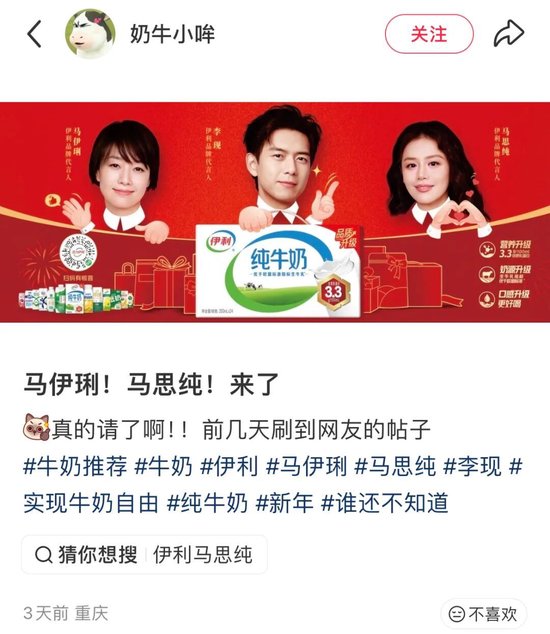
听劝王者,伊利真的去签马伊琍了!
Xin Lang Cai Jing· 2025-12-29 13:55
炒股就看金麒麟分析师研报,权威,专业,及时,全面,助您挖掘潜力主题机会! 来源:4A广告门 还记得前段时间我们说过: 后续来了: 伊利市场部真的去请人了! 网友向伊利提案"马年营销就找马伊琍"吗? 要不怎么说,这届网友都是咱互联网人脉呢! 论吃瓜,比官号还靠谱—— 那头官方还在评论区里上蹿下跳; 这头已有网友成功打入品牌内部: 图源:小红书@奶牛小哞 咱就是说,这第一视角的与会感,跟亲自在场有什么区别! 也不用管官方啥时候官宣了—— 海报都扒出来了,可见伊利真把网友的话当事儿办。 这波市场部上大分! 创意来源如图所示,问:网友为何感到兴奋? ▼ 图源:小红书@梭子蟹蟹 因为品牌和代言人契合度太高了啊! 高到仅仅是把两个名字相提并论,就能让人叹一句"天选"; 高到人人试想一下合作后的可能玩法,都能发现"自己是个天才"。 再瞅瞅这海报,内容不多,但传递的信息量极大—— 首先,它证明了伊利官方非常听劝。 这不仅指品牌听到了大众呼声,还指其听懂了网友兴奋点。 在这种全民颅内高潮的氛围下, 请马伊琍来代言,已经不再是给品牌自己找乐子,而是在满足全民情绪价值。 其次,它展现了品牌营销有自己的想法。 之前网友一直猜测伊利马 ...