Bank Of Jiangsu(600919)

Search documents
多个“全国第一”,彰显高质量发展硬实力
Xin Hua Ri Bao· 2026-01-22 05:09
Core Insights - Jiangsu Province has achieved significant financial development during the "14th Five-Year Plan" period, maintaining a leading position in social financing, loan growth, and the number of listed companies [1][2][3] Group 1: Financial Growth and Support for the Real Economy - Jiangsu's social financing increment averaged 3.35 trillion yuan annually from 2021 to 2024, with a total of 3.09 trillion yuan added in the first eleven months of 2025, ranking first in the country [2] - By the end of 2025, the total RMB loan balance in Jiangsu is projected to reach 28.25 trillion yuan, with an average annual growth rate of 12.8%, consistently outpacing the nominal GDP growth [2][3] - The balance of technology loans reached 5.2 trillion yuan, benefiting over 148,000 enterprises, while green loans and inclusive small and micro loans also saw substantial growth [2][3] Group 2: Capital Market Development - Jiangsu added 259 domestic listed companies during the "14th Five-Year Plan," leading the nation, with a total of 722 companies listed [5] - The province's capital market achieved direct financing of 6.97 trillion yuan, with bond financing amounting to 6.37 trillion yuan and public REITs raising 240 billion yuan [5] - The issuance of technology innovation bonds increased by 183% year-on-year, totaling 706 billion yuan [5] Group 3: Support for Private Enterprises - Jiangsu has implemented various policies to support the growth of private enterprises, including the establishment of 105 financial service points and nearly 300 specialized financial service events [6] - Over 8.9 trillion yuan in preferential loans were issued to nearly 100,000 small and micro enterprises during the "14th Five-Year Plan" [6] - The balance of inclusive small and micro loans exceeded 4 trillion yuan by the end of 2025 [6] Group 4: Insurance and Risk Management - The insurance sector in Jiangsu has seen cumulative payouts of 892.9 billion yuan, with over 7 trillion yuan in insurance capital entering the province [7] - The province has established a comprehensive government financing guarantee system, with a guarantee balance exceeding 1.16 trillion yuan [7] - Jiangsu has maintained a "zero default" record in the public bond market for 35 consecutive months, reflecting effective risk management [8] Group 5: Financial Ecosystem and Innovation - Jiangsu has developed a financial service system that supports enterprises throughout their lifecycle, enhancing innovation and industrial upgrading [4] - The province has launched over 200 innovative financial products in the Nanjing and Taizhou regions, contributing to a robust financial ecosystem [3][4] - Collaborative efforts with various financial institutions have led to the establishment of a supportive environment for technology innovation and industrial transformation [4][5]

数字人民币2.0:从M0到M1的质变
GF SECURITIES· 2026-01-22 05:07
Investment Rating - The report provides a "Buy" rating for all major banks analyzed, indicating a positive outlook for the banking sector [7]. Core Insights - The digital renminbi has entered its 2.0 era, transitioning from a central bank liability (M0) to a commercial bank liability (M1), allowing it to earn interest and be included in deposit insurance and reserve requirements [6][14]. - This transformation positions China as the first economy to offer interest on its central bank digital currency (CBDC), fundamentally altering its monetary attributes and creating a new financial paradigm in the digital economy [27]. - The digital renminbi's interest-bearing feature enhances user motivation to hold it, shifting its perception from a mere payment tool to a viable store of value, thus promoting its integration into everyday financial activities [27][28]. Summary by Sections 1. Digital Renminbi 2.0 Era - The digital renminbi (e-CNY) is now classified as a digital deposit currency, which can earn interest and is managed under a new regulatory framework [14]. - Major state-owned banks have begun offering interest on digital renminbi wallet balances, marking a significant shift in its utility and appeal [14][27]. 2. Development Progress and Application Status - The development of the digital renminbi began in 2014, with significant milestones including pilot tests in various cities and the establishment of a comprehensive operational framework by 2025 [32][33]. - As of November 2025, the digital renminbi has processed 34.8 billion transactions amounting to 16.7 trillion yuan, with extensive coverage across multiple provinces and cities [37]. 3. Global CBDC Development Trends - The report identifies three main trends in global CBDC development: active retail CBDC initiatives, innovation in payment systems, and cautious approaches in some countries like the U.S. [6]. - China's proactive stance in developing its CBDC positions it favorably in the global digital economy landscape, particularly in cross-border trade applications [30].




财政金融促内需一揽子政策点评:财政金融六项政策落地,关注结构调优和息差改善
Yin He Zheng Quan· 2026-01-22 02:47
Investment Rating - The report maintains a "Recommended" rating for the banking industry [1] Core Insights - The implementation of six fiscal and financial policies aims to stimulate domestic demand, focusing on structural optimization and interest margin improvement [3] - The fiscal interest subsidies, typically between 1-1.5 percentage points, are designed to lower overall financing costs, boost investment and consumption demand, and guide financial resources towards key areas such as technology innovation and support for small and micro enterprises [3] - The report highlights that the fiscal policies will positively support banks in optimizing their structures and stabilizing interest margins, with expectations of a narrowing decline in interest margins due to the upcoming maturity of high-interest fixed deposits in 2026 [3] - The establishment of a 500 billion yuan special guarantee plan for private investment and the optimization of risk-sharing mechanisms for corporate bonds are expected to enhance banks' asset quality and increase their willingness to issue long-term loans [3] - The report suggests that the collaborative fiscal and financial policies will directly benefit credit growth, structural optimization, and risk expectation improvement, while the stable interest margin guidance remains unchanged [3] Summary by Sections Banking Industry - The report emphasizes the positive impact of fiscal policies on credit growth and structural optimization, with a focus on improving risk expectations and stabilizing interest margins [3] - Specific recommendations for individual banks include Industrial and Commercial Bank of China, Agricultural Bank of China, Postal Savings Bank of China, Jiangsu Bank, Hangzhou Bank, and China Merchants Bank [3]




江苏银行多举措助推冬日美食消费新热潮
Jiang Nan Shi Bao· 2026-01-21 15:52
Group 1 - The core event "Winter Food Festival" and "I am Chef" series are actively taking place across thirteen cities in Jiangsu, promoting local culinary culture and boosting winter food consumption [1][2] - Jiangsu Bank is the exclusive sponsor of the event, leveraging financial empowerment, resource integration, and innovative scenarios to stimulate consumer spending [1][3] - Various activities are organized, including food markets, cooking competitions, and interactive experiences, enhancing community engagement and participation [1][2] Group 2 - The "I am Chef" regional competition features themed contests such as "Taihu Fresh," "Huaiyang Showdown," and "Chuhan Mountain Sea," showcasing culinary skills and creativity among chefs [2] - Jiangsu Bank has launched a dedicated section in its mobile banking app for the "I am Chef" event, facilitating food-related lottery activities that have attracted over 60,000 participants [2] - The bank is also running a promotional campaign offering cash discounts for uploaded restaurant invoices, with significant participation and rewards distributed [2]
银行行业今日净流出资金4.47亿元,农业银行等5股净流出资金超5000万元
Zheng Quan Shi Bao Wang· 2026-01-21 09:21
Market Overview - The Shanghai Composite Index rose by 0.08% on January 21, with 18 out of the 28 sectors experiencing gains. The top-performing sectors were non-ferrous metals and electronics, with increases of 2.79% and 2.62% respectively [1] - The banking and coal sectors were the worst performers, declining by 1.58% and 1.57% respectively, with the banking sector leading the decline [1] Capital Flow - The net inflow of capital in the two markets was 11.983 billion yuan, with 14 sectors seeing net inflows. The electronics sector had the highest net inflow of 16.369 billion yuan, while the non-ferrous metals sector followed with a net inflow of 7.289 billion yuan [1] - Conversely, 17 sectors experienced net outflows, with the power equipment sector seeing the largest outflow of 6.688 billion yuan, followed by the defense and military industry with a net outflow of 2.906 billion yuan [1] Banking Sector Performance - The banking sector saw a decline of 1.58% with a net outflow of 447 million yuan. Out of 42 stocks in this sector, only one stock rose while 41 stocks fell [2] - Among the stocks with net inflows, Hangzhou Bank led with an inflow of 153 million yuan, followed by China Transportation Bank and Jiangsu Bank with inflows of 106 million yuan and 96.849 million yuan respectively [2] - The stocks with the highest net outflows included Agricultural Bank of China, Industrial and Commercial Bank of China, and Bank of China, with outflows of 555.7 million yuan, 227.4 million yuan, and 167.4 million yuan respectively [2] Detailed Banking Sector Data - A detailed table of banking stocks shows various performance metrics, including daily price changes and turnover rates. For instance, Agricultural Bank of China decreased by 2.93% with a turnover rate of 0.17% and a net outflow of 55.707 million yuan [3] - Other notable declines included Industrial and Commercial Bank of China at -2.52% and Bank of China at -2.02%, with respective net outflows of 22.740 million yuan and 16.737 million yuan [3]

城商行板块1月21日跌0.55%,重庆银行领跌,主力资金净流入5.08亿元
Zheng Xing Xing Ye Ri Bao· 2026-01-21 08:54
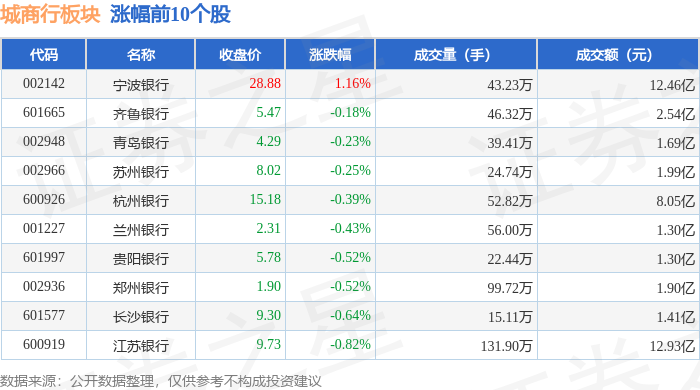
Market Overview - The city commercial bank sector experienced a decline of 0.55% on January 21, with Chongqing Bank leading the drop [1] - The Shanghai Composite Index closed at 4116.94, up 0.08%, while the Shenzhen Component Index closed at 14255.12, up 0.7% [1] Individual Stock Performance - Ningbo Bank closed at 28.88, with an increase of 1.16% and a trading volume of 432,300 shares, amounting to a transaction value of 1.246 billion [1] - Chongqing Bank closed at 10.25, down 1.82%, with a trading volume of 106,800 shares and a transaction value of 110 million [2] - Other notable performers include Xiamen Bank, which closed at 7.13, down 1.66%, and Chengdu Bank, which closed at 15.72, down 1.38% [2] Capital Flow Analysis - The city commercial bank sector saw a net inflow of 508 million from institutional investors, while retail investors experienced a net outflow of 566 million [2] - The capital flow for individual stocks indicates that Hangzhou Bank had a net inflow of 158 million from institutional investors, while it faced a net outflow of 86.5 million from retail investors [3] - Shanghai Bank also saw a net inflow of 107 million from institutional investors, with a net outflow of 121 million from retail investors [3]


江苏银行盐城分行:向海、向绿、向新 助推盐城高质量发展
Yang Zi Wan Bao Wang· 2026-01-21 06:33
Core Viewpoint - Jiangsu Bank (600919) emphasizes its commitment to financial functionality and regional economic development through strategic partnerships, particularly with the Yancheng municipal government, aiming for high-quality growth and compliance with policies and regulations [1] Group 1: Financial Support and Development Initiatives - Jiangsu Bank has signed a strategic cooperation agreement with the Yancheng municipal government to enhance regional economic development and has been recognized for its performance, being rated first in comprehensive assessments for six consecutive years [1] - By the end of 2025, the bank's total loan balance is projected to reach 141.12 billion yuan, with an increase of 29.58 billion yuan from the beginning of the year, focusing on manufacturing and green loans [1] - The bank supports 12 enterprises in the marine industry with a loan balance of 1.11 billion yuan, demonstrating its commitment to the blue economy [3] Group 2: Innovative Financial Products - Jiangsu Bank has developed a comprehensive product system tailored for marine enterprises, offering various financial products for different stages of business development, including "Su Incubation Loan" for startups and "Specialized and New Loan" for mature enterprises [4] - The bank has introduced differentiated pricing policies, providing a 70 basis points discount for blue credit and an 80 basis points discount for clean energy loans, to support the transformation of blue industries [5] Group 3: Green Finance Initiatives - Jiangsu Bank has signed a strategic cooperation agreement to support the construction of a green low-carbon development demonstration zone in Yancheng, with green loan balances expected to reach 38.09 billion yuan by the end of 2025, an increase of 12.80 billion yuan from the start of the year [7] - The bank has created the first green specialized branch in Yancheng and received the first "Carbon Neutral Certificate" from Jiangsu Province, highlighting its leadership in green finance [7] Group 4: Support for Modern Agriculture and Manufacturing - The bank has provided 17.76 billion yuan in loans to the manufacturing sector, with an increase of 2.75 billion yuan from the beginning of the year, positioning itself as a leader in the local market [9] - Jiangsu Bank has implemented various initiatives to enhance service quality for manufacturing, including the launch of innovative financial products and participation in provincial policies to support manufacturing upgrades [11] Group 5: Collaborative Financial Services - The bank has established partnerships with local enterprises and financial institutions to enhance direct financing support, including debt and equity financing, and has organized various events to promote financial services for listed and prospective companies [12] - Jiangsu Bank aims to empower local economic development through innovative financial solutions and strategic collaborations, ensuring a robust support system for enterprises in Yancheng [12]
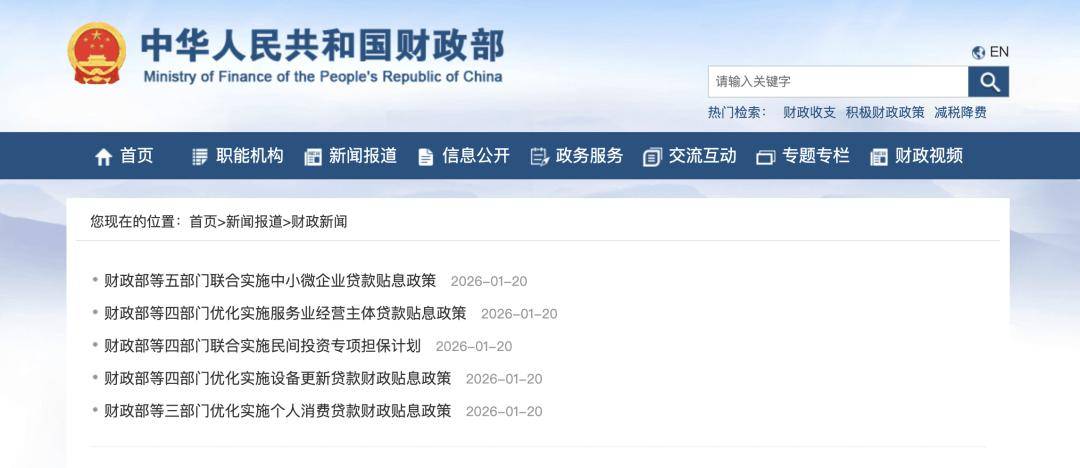
中小微企业贷款贴息、民间投资专项担保……财政部连发五项重要政策
Sou Hu Cai Jing· 2026-01-21 03:12
Group 1 - The Ministry of Finance and other departments have released five policy documents aimed at optimizing financial support for personal consumption loans, equipment updates, private investment guarantees, service industry loans, and small and micro enterprise loans [1][9][29] - The personal consumption loan subsidy policy has been extended until December 31, 2026, with adjustments to the subsidy standards and an expanded range of supported financial institutions [4][5][6] - The equipment update loan subsidy policy includes a 1.5% subsidy on fixed asset loans for equipment updates, applicable for up to two years, and has been expanded to include various sectors such as construction, aviation, and digital technology [10][11][12] Group 2 - The private investment guarantee plan has a total quota of 500 billion yuan, to be implemented over two years, focusing on supporting small and micro enterprises in various sectors including technology upgrades and service industry enhancements [17][18] - The plan includes a risk-sharing mechanism where banks will bear at least 20% of the loan risk, while the government guarantee fund will cover up to 80% [19] - The government will also reduce guarantee fees and increase the compensation limit for the guarantee fund to enhance support for private investments [20] Group 3 - The service industry loan subsidy policy has been extended to December 31, 2026, with an increased subsidy cap of 10 million yuan per loan and a 1% annual subsidy rate [23][24] - The policy now includes additional sectors such as digital, green, and retail industries, expanding the scope of financial support [24][25] - The implementation of these policies will involve streamlined processes for fund allocation and enhanced collaboration among financial institutions and regulatory bodies [26][28]




信用卡分期纳入贴息支持范围,年贴息比例1%
2 1 Shi Ji Jing Ji Bao Dao· 2026-01-20 12:00
Core Viewpoint - The recent upgrades to multiple loan interest subsidy policies signal a shift in government strategy from relying solely on large-scale infrastructure investment to a more balanced approach that encourages consumer spending and reduces financing costs for micro and small enterprises [1][4]. Group 1: Policy Upgrades - The Ministry of Finance has optimized existing interest subsidy policies for personal consumption loans, service industry loans, and equipment upgrade loans, extending their terms to the end of 2026 [1]. - The personal consumption loan subsidy now includes credit card installment payments, with an annual subsidy rate of 1% [3]. - The subsidy cap for new service industry loans has increased from 1 million to 10 million yuan per borrower [6]. Group 2: Support for Micro and Small Enterprises - A new interest subsidy policy for micro and small enterprises has been introduced, targeting key industry chains and their upstream and downstream sectors [11]. - The subsidy for eligible fixed asset loans for micro and small enterprises will be 1.5% annually, with a maximum loan amount of 50 million yuan per borrower [12]. Group 3: Expanded Coverage and Financial Institutions - The range of financial institutions eligible to provide these subsidies has been expanded to include city commercial banks, rural cooperative financial institutions, foreign banks, and consumer finance companies [4][7]. - The policy aims to enhance the accessibility of financial services in rural and grassroots markets, thereby stimulating consumption [4]. Group 4: Specific Sector Support - The updated policies now include support for digital, green, and retail sectors, alongside the previously established eight categories [6][7]. - The equipment upgrade loan subsidy has been raised to 1.5%, covering a wider range of sectors including high-end, intelligent, and green technologies [8].



财政部连发多份重要文件,事关贷款贴息、民间投资贷款担保等 一揽子政策全文公布
Sou Hu Cai Jing· 2026-01-20 09:03
Group 1 - The core viewpoint of the news is the implementation of a financial subsidy policy for equipment renewal loans to support businesses in reducing financing costs and promoting effective investment [3][4][5] - The policy includes a 1.5% interest subsidy on fixed asset loans for equipment renewal projects, applicable for a maximum of two years, and is effective until December 31, 2026 [3][4] - The scope of support has been expanded to include various sectors such as construction, aviation, digital technology, and green energy, emphasizing high-end, intelligent, and digital equipment updates [4][6] Group 2 - A total of 26 banks are designated as eligible for processing the interest subsidy loans, including major national banks and several regional banks [4][5] - The subsidy process has been optimized to include a "pre-allocation + settlement" method, streamlining the application and approval process for banks and provincial financial departments [5][6] - The policy aims to enhance the experience of businesses by ensuring timely communication regarding subsidy payments through modern technology [6][7] Group 3 - The policy for small and micro enterprises includes a 1.5% interest subsidy on fixed asset loans, with a maximum loan amount of 50 million yuan, effective from January 1, 2026 [8][9] - The targeted sectors for this subsidy include new energy vehicles, medical equipment, and various service industries, aiming to stimulate investment and production [9][10] - The operational mechanism involves a "total-to-total" model for coordination between financial institutions and fiscal departments to ensure efficient processing of subsidy funds [11][12] Group 4 - The service industry loan subsidy policy has been extended until December 31, 2026, with an increased maximum loan amount of 10 million yuan and a 1% interest subsidy for one year [16][17] - New sectors such as digital, green, and retail have been added to the support scope, enhancing the policy's relevance to current economic trends [17][18] - The funding allocation process has been refined to improve efficiency and reduce redundancy in the approval process [18][19] Group 5 - A special guarantee plan for private investment has been introduced with a total quota of 500 billion yuan over two years, aimed at supporting small and micro enterprises [22][24] - The plan includes risk-sharing mechanisms where banks bear at least 20% of the loan risk, while the government guarantee fund covers up to 80% [24][25] - The initiative encourages innovative financing models and aims to enhance the capital strength of the government guarantee fund to support private investments effectively [26][27]