Bank Of Jiangsu(600919)

Search documents
城商行板块1月8日跌0.89%,重庆银行领跌,主力资金净流入673.97万元
Zheng Xing Xing Ye Ri Bao· 2026-01-08 08:56
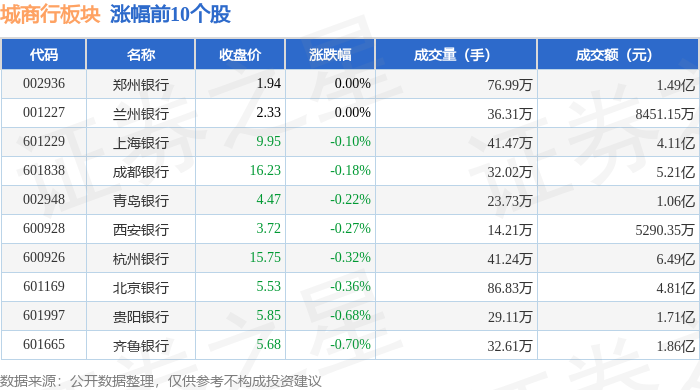
Market Overview - The city commercial bank sector experienced a decline of 0.89% on January 8, with Chongqing Bank leading the drop [1] - The Shanghai Composite Index closed at 4082.98, down 0.07%, while the Shenzhen Component Index closed at 13959.48, down 0.51% [1] Individual Stock Performance - Zhengzhou Bank closed at 1.94 with no change, while Lanzhou Bank also remained unchanged at 2.33 [1] - Shanghai Bank closed at 9.95, down 0.10%, and Chengdu Bank closed at 16.23, down 0.18% [1] - Chongqing Bank saw a significant decline of 2.70%, closing at 10.45, with a trading volume of 99,000 shares [2] Trading Volume and Turnover - The trading volume for Zhengzhou Bank was 769,900 shares with a turnover of 149 million yuan, while Lanzhou Bank had a trading volume of 363,100 shares and a turnover of 84.51 million yuan [1] - The highest turnover was recorded for Nanjing Bank at 1.342 billion yuan with a trading volume of 1,217,000 shares [2] Capital Flow Analysis - The city commercial bank sector saw a net inflow of 6.7397 million yuan from institutional investors, while retail investors experienced a net outflow of 70.5351 million yuan [2] - Chengdu Bank had a net inflow of 87.0825 million yuan from institutional investors, but a net outflow of 46.0321 million yuan from retail investors [3] Summary of Capital Flows - Institutional investors showed a positive net flow for several banks, including Hangzhou Bank with 77.8301 million yuan and Qingdao Bank with 8.4480 million yuan [3] - Conversely, Chongqing Bank had a negative net flow of 535,600 yuan from institutional investors, indicating a lack of confidence [3]

传2026年“苏超”赞助超2亿元, 官方回应
Xin Lang Cai Jing· 2026-01-08 08:12
Core Insights - The sponsorship amount for the 2026 season of the "Su Super League" is reported to be 202 million yuan, but this information is currently deemed inaccurate as the sponsors have not yet been announced [1] - The 2026 season is expected to see an increase in the number of matches from 85 to 91, with the season set to kick off in April [1] Group 1: Sponsorship Details - The sponsorship for the 2026 season is anticipated to include a continuation of support from Jiangsu Bank at 45 million yuan, along with new sponsorship from Suhao Group at 30 million yuan [1] - The total sponsorship amount for the new season is projected to reach 202 million yuan, with the sponsorship recruitment nearing completion [1] Group 2: Growth and Popularity - The "Su Super League" has rapidly gained popularity since its inception in 2025, driven by a model of "mass participation + cultural tourism integration," leading to a total cultural and tourism consumption of over 120 billion yuan during the event [1] - The number of sponsors increased from 6 to 41 in the 2025 season, with individual sponsorship fees rising from hundreds of thousands to 3 million yuan, indicating high demand [1][2] - The league has set a new benchmark for amateur sports events in China, with an average attendance of 28,000 per match and a peak of 62,000 for the finals, alongside over 2 billion online views [2] Group 3: Future Plans - The Jiangsu Provincial Sports Bureau has confirmed that the 2026 Jiangsu City Football League will continue, with plans for optimizing player selection rules to enhance the league's characteristics and quality [2]



江苏银行:2025年半年度权益分派实施公告
Zheng Quan Ri Bao· 2026-01-07 14:18
Core Viewpoint - Jiangsu Bank announced its profit distribution plan for the first half of 2025, detailing a cash dividend of 0.3309 yuan per share (tax included) for A-shares, with a total payout of 6.072 billion yuan [2] Summary by Categories - **Dividend Details** - The cash dividend per share is set at 0.3309 yuan, including tax [2] - The total amount of dividends to be distributed is 6.072 billion yuan [2] - **Key Dates** - The record date for shareholders is January 13, 2026 [2] - The ex-dividend date and the date of dividend payment are both scheduled for January 14, 2026 [2]
江苏金租:关于为项目公司提供担保的公告
Zheng Quan Ri Bao· 2026-01-07 13:15
Core Viewpoint - Jiangsu Jinzhong announced the signing of guarantee contracts with China Minsheng Bank and Jiangsu Bank to provide financing guarantees for its wholly-owned subsidiaries, Huiheng Leasing and Huiyun Leasing, which are engaged in cross-border ship leasing business in bonded areas [2] Group 1 - Jiangsu Jinzhong has established wholly-owned project companies, Huiheng Leasing and Huiyun Leasing, in domestic bonded areas [2] - The guarantee contracts were signed with China Minsheng Bank Nanjing Branch and Jiangsu Bank Nanjing Branch [2] - The subsidiaries are approved by the China Banking and Insurance Regulatory Commission Jiangsu Regulatory Bureau for cross-border ship leasing operations [2]


按揭、信用卡、消费贷与经营贷深度:深度银行四大零售资产的风险分析框架
ZHONGTAI SECURITIES· 2026-01-07 11:17
Investment Rating - The report maintains an "Overweight" rating for the banking sector [2] Core Insights - The four categories of retail loans (mortgages, credit cards, consumer loans, and business loans) collectively constitute household liabilities, each with distinct collateral types, duration structures, and policy influences. The report aims to establish a risk framework for these retail assets and assess their impact on banking operations in the future [2][4] - Under stress testing, the non-performing loan (NPL) ratios for mortgages, credit cards, and consumer loans are projected to increase by 11, 12, and 20 basis points respectively in 2026, while the growth in non-performing amounts remains manageable. The overall quality of corporate assets is expected to continue improving, indicating a stable banking sector [2][4] - Retail asset risks are deemed controllable, with policies expected to maintain stability in the near term [2] Summary by Sections Retail Asset Analysis Framework: Collateral Types + Duration Structure + Policy Impact - The overall NPL ratio for retail loans of listed banks is estimated at 1.27% in the first half of 2025, slightly above the corporate NPL ratio of 1.26%, but the increase in NPL ratios is stabilizing. The composition of existing NPLs is 63% corporate and 37% retail, with business loans and mortgages showing higher proportions of both existing and newly added NPLs [2][12] - The report establishes a risk analysis framework for retail assets, highlighting the differences in collateral types, duration structures, and policy impacts among the four categories of retail loans [2][4] Consumer Loans: "High-Risk" Assets - The relationship between consumer loans and consumption trends is closely aligned, with notable deviations occurring during strict property purchase restrictions and regulatory cycles for online loans. The market structure for consumer credit (excluding credit cards and mortgages) shows that listed banks hold over 51.5% of the market, while non-listed banks account for 17% and other players for 31% [2][4] - The risk logic for consumer credit indicates that risk pricing is primarily determined by interest rates, which can be categorized into four tiers based on risk levels. The report estimates that 4.4% of consumer loans fall into the "high-risk" category, with commercial banks' high-risk consumer loans representing only 0.6% of their total consumer loans [2][4] Mortgage Loans: Risk Sources and International Comparisons - The primary sources of mortgage risk include negative cash flow and high loan-to-value (LTV) ratios, with 1.2% of respondents reporting monthly incomes below their mortgage payments. The report anticipates that the current high LTV portion, which constitutes 2.9% of total mortgage balances, will not necessarily lead to increased NPLs [2][4] - International comparisons indicate that mortgage NPL ratios in most countries remain below 2%, suggesting that the risks in the domestic market are manageable [2][4] Business Loans: High-Risk Assets - The report estimates that approximately 2 trillion yuan of high-risk business loans were outstanding at the end of 2021, with nearly one-third of these high-risk assets already exposed. The peak of risk exposure is expected in 2024 and the first half of 2025, with NPL ratios projected to rise by 18 basis points to 1.96% under stress testing conditions [2][4] Credit Cards: Early NPL Exposure - Credit cards have historically shown early exposure to NPLs, with the NPL ratio at 2.44% in the first half of 2025. The report notes that the net increase in credit card NPLs has significantly decreased, indicating that credit cards are not currently a major pressure point for banks [2][4] Investment Recommendations - The report suggests two main investment lines for bank stocks: focusing on regional banks with strong certainty and advantages, particularly in areas like Jiangsu, Shanghai, Chengdu, Shandong, and Fujian, and recommending large banks with high dividend yields such as Agricultural Bank, Construction Bank, and Industrial and Commercial Bank [2][4]




江苏银行(600919.SH)2025年半年度权益分派:每股派利0.3309元
Ge Long Hui A P P· 2026-01-07 10:50
Core Viewpoint - Jiangsu Bank (600919.SH) announced a cash dividend distribution plan for the first half of 2025, distributing a total of 6.072 billion yuan in cash dividends to shareholders [1] Group 1: Dividend Distribution Details - The cash dividend per share is set at 0.3309 yuan (including tax) based on the total share capital of 18,351,324,463 shares prior to the distribution [1] - The record date for the dividend distribution is January 13, 2026, and the ex-dividend date is January 14, 2026 [1]
江苏银行(600919) - 江苏银行2025年半年度权益分派实施公告
2026-01-07 10:45
证券代码:600919 证券简称:江苏银行 公告编号:2026-003 优先股代码:360026 优先股简称:苏银优 1 江苏银行股份有限公司 2025年半年度权益分派实施公告 本公司董事会及全体董事保证本公告内容不存在任何虚假记载、误 导性陈述或者重大遗漏,并对其内容的真实性、准确性和完整性承担 法律责任。 重要内容提示: 每股分配比例 A 股每股现金红利0.3309元 相关日期 | 股份类别 | 股权登记日 | 最后交易日 | 除权(息)日 | 现金红利发放日 | | --- | --- | --- | --- | --- | | A股 | 2026/1/13 | - | 2026/1/14 | 2026/1/14 | 差异化分红送转: 否 2.分派对象: 截至股权登记日下午上海证券交易所收市后,在中国证券登记结 算有限责任公司上海分公司(以下简称"中国结算上海分公司")登记 在册的本公司全体普通股股东。 3.分配方案: 本次利润分配以方案实施前的公司总股本18,351,324,463股为基 数,每股派发现金红利0.3309元(含税),共计派发现金红利60.72亿 元。 四、分配实施办法 1. 实施办法 ...
城商行板块1月7日涨0%,杭州银行领涨,主力资金净流出1.7亿元
Zheng Xing Xing Ye Ri Bao· 2026-01-07 08:58
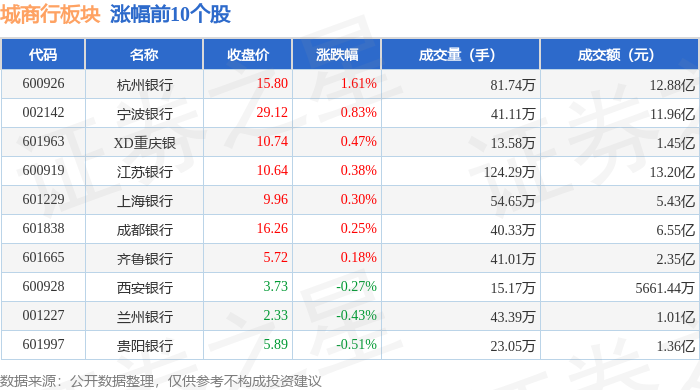
Market Performance - The city commercial bank sector experienced a slight increase of 0.0% on January 7, with Hangzhou Bank leading the gains [1] - The Shanghai Composite Index closed at 4085.77, up 0.05%, while the Shenzhen Component Index closed at 14030.56, up 0.06% [1] Individual Stock Performance - Hangzhou Bank (600926) closed at 15.80, with a rise of 1.61% and a trading volume of 817,400 shares [1] - Ningbo Bank (002142) closed at 29.12, up 0.83%, with a trading volume of 411,100 shares [1] - Other notable performances include Jiangsu Bank (601963) at 10.64 (+0.38%) and Shanghai Bank (601229) at 9.96 (+0.30%) [1] Capital Flow Analysis - The city commercial bank sector saw a net outflow of 170 million yuan from institutional investors, while retail investors contributed a net inflow of 188 million yuan [2] - The overall capital flow indicates a mixed sentiment, with institutional investors withdrawing funds while retail investors increased their positions [2] Detailed Capital Flow by Bank - Jiangsu Bank had a net inflow of 123 million yuan from institutional investors, while retail investors saw a net outflow of 27 million yuan [3] - Hangzhou Bank experienced a net inflow of 84 million yuan from institutional investors, but retail investors had a significant outflow of 132 million yuan [3] - Chengdu Bank recorded a net inflow of 55 million yuan from institutional investors, with retail investors also experiencing a net outflow [3]



联合研究:组合推荐:金融制造行业 1月投资观点及金股推荐-20260107
Changjiang Securities· 2026-01-07 08:54
Investment Rating - The report provides a "Buy" rating for several key stocks in the financial and manufacturing sectors, including China Resources Land and Nanjing Bank, among others [12][19][53]. Core Insights - The report highlights the financial and manufacturing industries' investment outlook for January 2026, emphasizing the need to focus on companies with strong fundamentals and growth potential amid economic pressures [6][8][10]. - It identifies specific sectors such as real estate, non-bank financials, banking, new energy, machinery, military industry, light industry, and environmental protection as areas of interest for investment [8][10][21][32][36][43]. Summary by Sector Real Estate - The real estate sector faces increasing downward pressure, necessitating policy easing. Key companies like China Resources Land are highlighted for their strong operational capabilities and cash flow stability [11][12][53]. Non-Bank Financials - The non-bank financial sector is expected to benefit from policy support and high market trading volumes, with companies like New China Life Insurance showing strong growth potential [16][17][53]. Banking - The banking sector is viewed positively, with a focus on large banks and city commercial banks, particularly Jiangsu Bank, which is noted for its attractive valuation and growth prospects [18][19][53]. New Energy - The new energy sector is at a turning point, with companies like Sungrow Power Supply and Slin Smart Drive recommended for their growth potential in solar and energy storage technologies [21][23][53]. Machinery - The machinery sector is encouraged to focus on AI and robotics, with companies like Hengli Hydraulic and Ding Tai High-Tech identified for their growth opportunities in traditional and emerging markets [25][30][31][53]. Military Industry - The military sector is expected to see growth from military-to-civilian transitions and military trade, with AVIC Xi'an Aircraft Industry Company highlighted for its potential in the domestic and international markets [32][34][53]. Light Industry - The light industry is advised to focus on overseas manufacturing and new consumer opportunities, with companies like Yingke Medical and Meiyin Sen noted for their growth in international markets [36][40][53]. Environmental Protection - The environmental sector is poised for growth through overseas expansion and rising metal prices, with companies like Weiming Environmental and Ice Wheel Environment recommended for their strong market positions [43][48][51][53].




银行业 2026 年经营展望:资产负债篇到期存款流向是资负格局的关键
Guoxin Securities· 2026-01-07 07:12
Investment Rating - The report maintains an "Outperform the Market" rating for the banking sector [4][5]. Core Insights - The banking industry is expected to see a reasonable M2 growth target of approximately 7.5%, with credit growth around 6.0% and social financing growth at about 8.0% for 2026. This aligns with the anticipated nominal GDP growth of about 5.0% and actual GDP growth of approximately 4.9% [1][15][21]. - The report highlights that the flow of deposits will be a key factor affecting the asset-liability structure of banks in 2026, with a significant amount of term deposits maturing, estimated at around 57 trillion yuan [3][49]. - The credit allocation is expected to show strong support for corporate lending, contributing approximately 80% to 85% of new loans, while retail lending is projected to improve marginally, contributing about 10% to 15% [2][36]. Summary by Sections M2 and Credit Growth - The M2 growth target for 2026 is set at approximately 7.5%, with an expected M2 increment of about 25.4 trillion yuan, driven by fiscal net injection of around 12.0 trillion yuan and bank credit issuance of about 16.8 trillion yuan [1][21][22]. - The anticipated credit growth for 2026 is around 6.0%, with new social financing expected to reach approximately 35.3 trillion yuan, reflecting an 8.0% growth rate [21][26][30]. Deposit Flow and Asset-Liability Structure - The report indicates that the flow of deposits from large banks to smaller banks will be a critical factor in determining the marginal changes in the asset-liability gap for large banks in 2026. The pressure from deposit migration is expected to ease somewhat [2][41][54]. - The maturing term deposits for the six major banks are estimated to be between 27 trillion and 32 trillion yuan, with a significant portion being long-term deposits [3][49][50]. Investment Recommendations - The report suggests focusing on two main lines for investment in 2026: high-quality companies with improving fundamentals, such as Ningbo Bank and Changshu Bank, and stable high-dividend stocks like China Merchants Bank and Industrial and Commercial Bank of China [3][4].