BOB(601169)

Search documents
雪浪环境(300385.SZ):收到北京银行无锡分行《全部收贷通知书》
Ge Long Hui A P P· 2026-01-08 09:19
Core Viewpoint - The company, Xuelang Environment, is facing a significant financial challenge due to a loan default, which has led to immediate repayment demands from Beijing Bank, affecting its financial stability and operations [1] Group 1: Loan Default and Financial Impact - The company signed a comprehensive credit contract with Beijing Bank on March 6, 2024, which has now resulted in a loan default situation [1] - Beijing Bank has demanded immediate repayment of overdue principal amounting to 4,122,287.03 yuan and an early repayment of 30,918,498.76 yuan, totaling 14.59% of the company's latest audited net assets [1] - The company is at risk of legal actions, including potential lawsuits, account freezes, and asset seizures due to the default [1] Group 2: Company Response and Future Actions - The company plans to actively negotiate with the bank to reach a resolution regarding the loan default [1] - There is an emphasis on enhancing accounts receivable collection efforts and improving cash flow management to address the overdue loan issues [1]


城商行板块1月8日跌0.89%,重庆银行领跌,主力资金净流入673.97万元
Zheng Xing Xing Ye Ri Bao· 2026-01-08 08:56
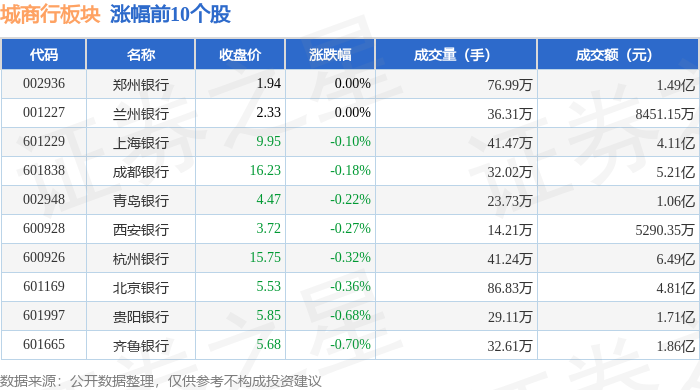
Market Overview - The city commercial bank sector experienced a decline of 0.89% on January 8, with Chongqing Bank leading the drop [1] - The Shanghai Composite Index closed at 4082.98, down 0.07%, while the Shenzhen Component Index closed at 13959.48, down 0.51% [1] Individual Stock Performance - Zhengzhou Bank closed at 1.94 with no change, while Lanzhou Bank also remained unchanged at 2.33 [1] - Shanghai Bank closed at 9.95, down 0.10%, and Chengdu Bank closed at 16.23, down 0.18% [1] - Chongqing Bank saw a significant decline of 2.70%, closing at 10.45, with a trading volume of 99,000 shares [2] Trading Volume and Turnover - The trading volume for Zhengzhou Bank was 769,900 shares with a turnover of 149 million yuan, while Lanzhou Bank had a trading volume of 363,100 shares and a turnover of 84.51 million yuan [1] - The highest turnover was recorded for Nanjing Bank at 1.342 billion yuan with a trading volume of 1,217,000 shares [2] Capital Flow Analysis - The city commercial bank sector saw a net inflow of 6.7397 million yuan from institutional investors, while retail investors experienced a net outflow of 70.5351 million yuan [2] - Chengdu Bank had a net inflow of 87.0825 million yuan from institutional investors, but a net outflow of 46.0321 million yuan from retail investors [3] Summary of Capital Flows - Institutional investors showed a positive net flow for several banks, including Hangzhou Bank with 77.8301 million yuan and Qingdao Bank with 8.4480 million yuan [3] - Conversely, Chongqing Bank had a negative net flow of 535,600 yuan from institutional investors, indicating a lack of confidence [3]

北京银行:砥砺奋进三十载 书写金融高质量发展的“京行答卷”
Ren Min Wang· 2026-01-08 01:15
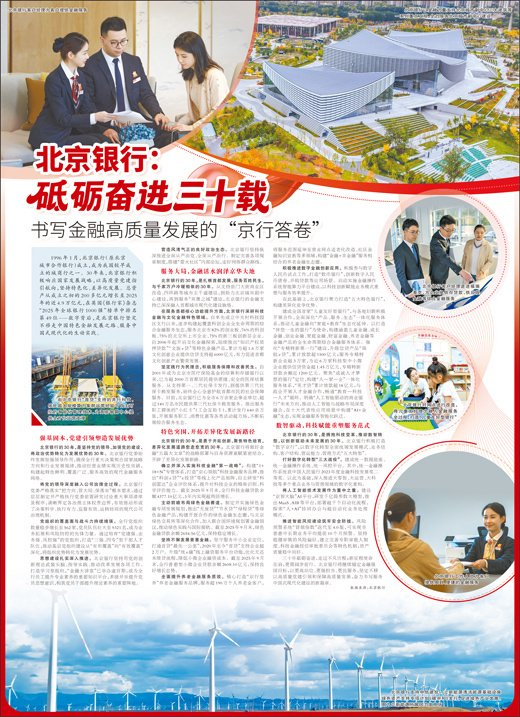
Core Viewpoint - Beijing Bank has achieved significant growth and development over its 30-year history, emphasizing the integration of party leadership into its governance and operations, while focusing on differentiated and innovative financial services to support China's modernization efforts [3][4][6][12]. Group 1: Historical Growth and Achievements - Established in January 1996, Beijing Bank has grown its total assets from over 20 billion yuan to nearly 4.9 trillion yuan by 2025, ranking 49th in the "2025 Global Bank 1000" list by The Banker magazine [3]. - The bank has expanded its party organization to 562 branches with 9,321 members, enhancing its operational capabilities in business development and risk management [5]. Group 2: Governance and Leadership - The bank's party committee plays a crucial role in ensuring that major decisions align with national strategies and industry trends, fostering a modern governance mechanism [4]. - The bank has implemented a comprehensive governance structure that clearly defines responsibilities and promotes effective decision-making and execution [4]. Group 3: Financial Services and Community Impact - Beijing Bank has actively supported urban development projects in Beijing, including the renovation of commercial areas and infrastructure, integrating financial support into the city's modernization [6]. - The bank has provided over 600 billion yuan in credit support to more than 16,000 cultural and creative enterprises, significantly contributing to the growth of the cultural industry in the capital [6]. Group 4: Differentiated Development Strategies - The bank has established a "first strategy" in technology finance, achieving a loan balance of 437.71 billion yuan by September 2025, reflecting a twofold increase over three years [8]. - It has also developed a range of green financial products, with a loan balance of 265.46 billion yuan in green finance, maintaining steady growth [8]. Group 5: Inclusive and Digital Finance - Beijing Bank has focused on inclusive finance, supporting over 20,000 small and micro enterprises since 2020, with a loan balance of 260.81 billion yuan for inclusive small and micro enterprises by September 2025 [9]. - The bank is actively participating in digital currency pilot programs and has initiated the construction of a financial operating system to enhance service efficiency [10][12]. Group 6: Future Directions and Innovations - The bank aims to build a "five distinctive banks" model, focusing on comprehensive financial services across various life stages, including children's finance and elderly care [11]. - It is committed to advancing digital transformation and AI integration, with initiatives like the "京智大脑" AI platform and a robust risk management system to ensure operational safety [12].
金融为民 相伴成长
Bei Jing Ri Bao Ke Hu Duan· 2026-01-07 22:46
Core Viewpoint - Beijing Bank, established in 1996, has evolved over 30 years into a significant financial force in the capital, focusing on supporting small and medium-sized enterprises, serving the real economy, and improving people's livelihoods [1][6][20] Group 1: Development and Achievements - Beijing Bank has established a clear market positioning to serve the capital's economy, small and medium enterprises, and improve livelihoods since its inception [6] - The bank has pioneered in technology finance, being the first to set up various specialized branches and services in the Zhongguancun area, supporting the development of high-tech industries [7][8] - It has provided over 1.45 trillion yuan in credit to nearly 60,000 technology-based SMEs, serving more than 30,000 specialized and innovative enterprises [9] Group 2: Cultural and Social Contributions - Beijing Bank has been a leader in cultural finance since 2006, providing integrated services to cultural enterprises and supporting over 16,000 cultural businesses with more than 600 billion yuan in credit [10] - The bank has actively participated in urban development projects, including significant renovations and cultural initiatives, demonstrating its commitment to sustainable urban growth [10] Group 3: Inclusive Finance and Community Support - The bank has implemented inclusive finance initiatives, providing healthcare and social security services to over 20 million residents and supporting small businesses with tailored financing solutions [13] - It has launched specialized services for the elderly and children, including the "Jingxing Youyang" brand for elderly care and the "Jingying Plan" for children's financial services [14] Group 4: Digital Transformation and Innovation - Beijing Bank is committed to digital transformation, aiming to become a leading digital bank by leveraging AI and comprehensive digital strategies to enhance customer service [18] - The bank has developed various digital platforms and applications to streamline financing for small and medium enterprises, achieving significant engagement and loan disbursement [18] Group 5: Risk Management and Governance - The bank emphasizes risk prevention and compliance as essential to its high-quality development, implementing a robust risk management framework [19] - It integrates party leadership into its governance structure, ensuring alignment with national financial policies and enhancing operational effectiveness [20]

北京银行落地并购新规发布后市场首批业务
Xin Lang Cai Jing· 2026-01-07 12:49
Core Viewpoint - The new regulations for merger and acquisition (M&A) loans have been officially implemented, allowing for a broader application of financing in the market, particularly for equity stakes in companies, which is expected to enhance the quality of M&A activities and support industrial transformation and modernization [1][2][5]. Group 1: Implementation of New Regulations - The "Commercial Bank M&A Loan Management Measures" was officially released on December 31, 2025, with Beijing Bank promptly implementing it [1][4]. - On January 4, 2026, Beijing Bank's Shanghai branch successfully executed the first M&A loan under the new regulations, providing financing of 21 million yuan for a 35% equity stake in a private listed technology company [1][4]. - The financing ratio for this loan was 60%, with a term of 3 years, marking a significant innovation in the market following the new regulations [1][4]. Group 2: Strategic Importance of M&A - The acquiring company is an innovative biopharmaceutical firm with a comprehensive industry chain, focusing on oncology and autoimmune diseases, and has undertaken several major national scientific innovation projects [1][4]. - The target company specializes in disruptive diagnostic solutions for neurodegenerative diseases, possessing unique advantages in drug development and clinical translation [1][4]. - The transaction is expected to create strategic synergies, enabling the acquiring company to fill gaps in the neurodegenerative disease sector and extend its strategic capabilities across the entire "R&D-production-marketing" chain [1][4]. Group 3: Future Outlook and Strategic Goals - The new regulations are anticipated to enhance the adaptability of financial supply to market demand, increasing support for M&A funding and promoting high-quality development in the M&A market [2][5]. - Beijing Bank aims to deepen the implementation of M&A loan policies, focusing on the integration of technology companies, breakthroughs in key technologies, and layout in emerging fields [3][6]. - The bank plans to provide more flexible, professional, and comprehensive M&A financial services, contributing to the cultivation of new productive forces and the high-quality development of the technology industry [3][6].
城商行板块1月7日涨0%,杭州银行领涨,主力资金净流出1.7亿元
Zheng Xing Xing Ye Ri Bao· 2026-01-07 08:58
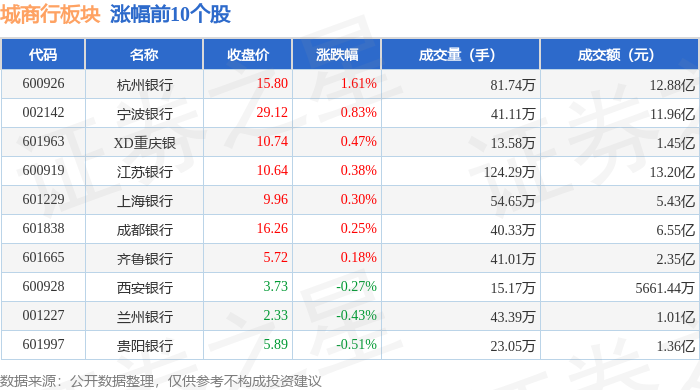
Market Performance - The city commercial bank sector experienced a slight increase of 0.0% on January 7, with Hangzhou Bank leading the gains [1] - The Shanghai Composite Index closed at 4085.77, up 0.05%, while the Shenzhen Component Index closed at 14030.56, up 0.06% [1] Individual Stock Performance - Hangzhou Bank (600926) closed at 15.80, with a rise of 1.61% and a trading volume of 817,400 shares [1] - Ningbo Bank (002142) closed at 29.12, up 0.83%, with a trading volume of 411,100 shares [1] - Other notable performances include Jiangsu Bank (601963) at 10.64 (+0.38%) and Shanghai Bank (601229) at 9.96 (+0.30%) [1] Capital Flow Analysis - The city commercial bank sector saw a net outflow of 170 million yuan from institutional investors, while retail investors contributed a net inflow of 188 million yuan [2] - The overall capital flow indicates a mixed sentiment, with institutional investors withdrawing funds while retail investors increased their positions [2] Detailed Capital Flow by Bank - Jiangsu Bank had a net inflow of 123 million yuan from institutional investors, while retail investors saw a net outflow of 27 million yuan [3] - Hangzhou Bank experienced a net inflow of 84 million yuan from institutional investors, but retail investors had a significant outflow of 132 million yuan [3] - Chengdu Bank recorded a net inflow of 55 million yuan from institutional investors, with retail investors also experiencing a net outflow [3]



2025年银行CIO盘点:建行、中行CIO离任,多家中小银行行外引进CIO
Xin Lang Cai Jing· 2026-01-07 03:33
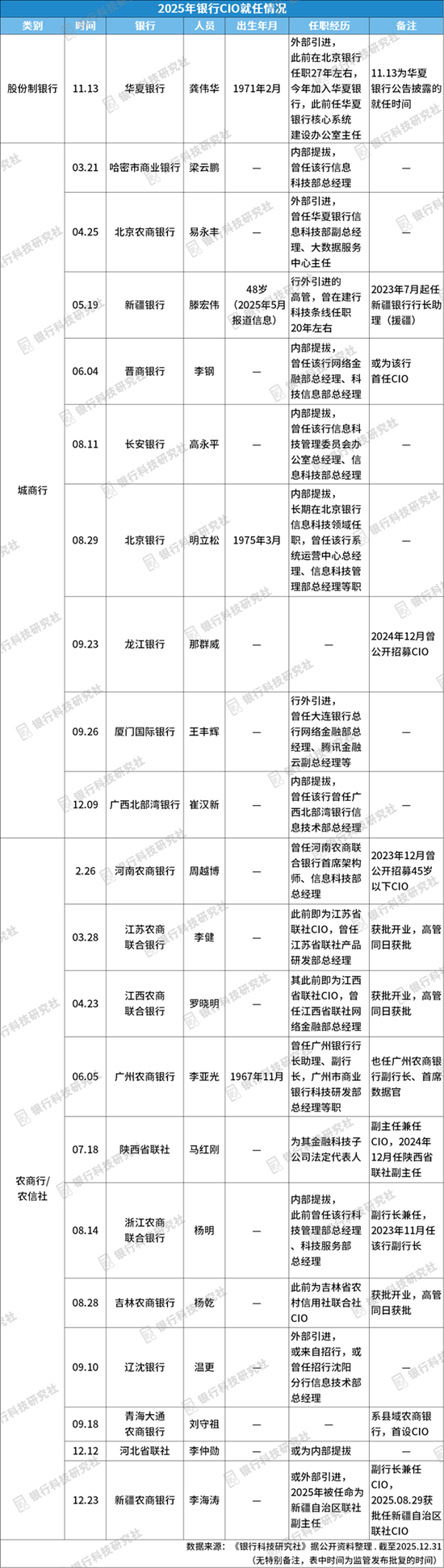
Core Insights - The digital transformation is crucial for the banking industry, with a significant focus on the restructuring of digital talent, particularly the Chief Information Officers (CIOs) [1][2] Group 1: Changes in CIO Positions - In 2025, several major banks experienced changes in their technology leadership, with the CIOs of China Construction Bank (CCB) and Bank of China (BOC) resigning [2][4] - CCB's former CIO, Jin Panshi, resigned due to age reasons after serving for four years [2][3] - BOC's former CIO, Meng Qian, also resigned for age reasons after a 38-year tenure, during which she held multiple senior positions [4][6] - The Industrial and Commercial Bank of China (ICBC) also saw its technology leader, CTO Lv Zhongtao, leave at the end of 2025 [7][8] Group 2: New Appointments and Trends - In 2025, 21 new CIOs were appointed, primarily in small and medium-sized banks, with many being external hires [10][11] - Notable new CIOs include Gong Weihua at Huaxia Bank and Wang Fenghui at Xiamen International Bank, both of whom were brought in from outside the banking sector [11][12] - The trend indicates a shift towards external recruitment for CIO positions, with 48% of the new appointments being external hires [16] Group 3: Recruitment Trends in Smaller Banks - Many small and medium-sized banks have publicly announced CIO recruitment in 2025, including Xiamen International Bank and Zhengzhou Bank [18][19] - Recruitment criteria often include age limits and specific experience requirements, such as a minimum of six years in information technology and four years in senior management roles [18][20] - The trend reflects a growing emphasis on digital leadership within smaller banks, as they seek to enhance their technological capabilities [18][19]
2025年A股银行板块涨幅放缓 个股分化显著 机构看好2026年上市银行营收利润增速改善
Xin Lang Cai Jing· 2026-01-06 23:23
Core Viewpoint - The A-share banking sector is expected to achieve a market value breakthrough in 2025, but the overall growth rate is slowing and underperforming compared to the broader market, with significant individual stock differentiation [1][7]. Market Performance - As of December 31, 2025, the Wind Banking Index reached 7180.68 points, with an annual growth of 12.04%, lower than the previous year's 43.56%. The total market value of the sector at year-end was 15.71 trillion yuan, an increase of over 15% from the beginning of the year, having briefly surpassed 16 trillion yuan [1][7]. - The banking sector exhibited a clear phase differentiation throughout the year, with a mild increase in Q1, a significant rise in Q2, a deep correction in Q3, and a recovery in Q4 [2][8]. Individual Stock Performance - In 2025, 35 out of 42 A-share listed banks saw their stock prices rise, accounting for over 83%. Among the six banks with over 20% growth, Agricultural Bank led with a 52.66% increase, followed by Xiamen Bank, Shanghai Pudong Development Bank, Chongqing Bank, Industrial and Commercial Bank, and Ningbo Bank with growth rates ranging from 20.68% to 35.78% [3][9]. - Conversely, seven banks experienced declines, with Huaxia Bank at the bottom with a 9.82% drop, and Zhengzhou Bank, Beijing Bank, and China Everbright Bank all declining by over 5% [3][9]. Future Outlook - Multiple brokerage firms predict an improvement in revenue and profit growth for listed banks in 2026, with expected revenue growth rates of +2.5% and +3.6% for 2026 and 2027, respectively, and net profit growth rates of +1.9% and +2.6% [4][10]. - The improvement in revenue and profit growth is attributed to several factors, including a reduction in net interest margin pressure, a shift towards quality in credit issuance, and a stabilization in fee income growth [4][10]. Investment Strategy - In light of the different characteristics of new inflows, the equity market in 2025 is characterized by increased stable return strategy products, enhanced structural trends, and greater individual stock volatility. For 2026, it is recommended to prioritize stable stocks and adopt a bottom-fishing strategy, while also considering elastic stocks for rotation trading [6][12].




城农商行2025年收罚单超千张、罚没金额8.75亿元,信贷与反洗钱成违规“重灾区”
Xin Lang Cai Jing· 2026-01-06 11:17
Core Viewpoint - In 2025, a total of 6,521 fines were issued to 1,097 banking institutions in China, with a total penalty amount of 2.641 billion yuan, indicating a continued trend of stricter regulatory oversight in the financial sector [2][12]. Group 1: Penalty Statistics - Agricultural commercial banks received the highest number of fines, totaling 738, with Shenzhen Rural Commercial Bank receiving the largest fine among them [2][12]. - City commercial banks were issued 276 fines, with Shanghai Bank leading in the amount of fines [2][12]. - The total number of fines for both agricultural and city commercial banks accounted for 15.55% of the total fines, amounting to 875 million yuan [2][12]. Group 2: Reasons for Penalties - The top three reasons for penalties included violations in credit business (1,209 fines), inadequate internal control systems (752 fines), and violations of anti-money laundering regulations (697 fines) [2][12]. - Other reasons for penalties included violations in payment settlement, data reporting and governance, and inadequate employee behavior management [2][12]. Group 3: Major Fines in City Commercial Banks - Among 80 city commercial banks, Shanghai Bank, Beijing Bank, and Chongqing Three Gorges Bank had the highest penalty amounts, with fines of 37.31 million yuan, 35.40 million yuan, and 14.49 million yuan respectively [3][13]. - Shanghai Bank was penalized for multiple violations, including account management and anti-money laundering regulations, resulting in a total fine of 28.748 million yuan [4][14]. - Beijing Bank faced penalties for similar violations, with a total fine of 25.2685 million yuan [5][15]. Group 4: Major Fines in Agricultural Commercial Banks - In the agricultural commercial bank sector, Shenzhen Rural Commercial Bank, Chongqing Rural Commercial Bank, and Beijing Rural Commercial Bank received the largest fines, amounting to 12.84 million yuan, 11.65 million yuan, and 10.87 million yuan respectively [6][16]. - Shenzhen Rural Commercial Bank was fined for failing to comply with customer identity verification regulations and other violations, leading to a fine of 12.844 million yuan [7][17]. - Other banks, such as Foshan Rural Commercial Bank, also faced significant penalties for various violations, with fines reaching up to 8.8 million yuan [8][18]. Group 5: Regulatory Implications - The increasing number of fines highlights the need for city and agricultural commercial banks to strengthen internal management and compliance awareness to avoid future violations [9][19]. - Regulatory authorities are demonstrating a firm commitment to enhancing financial safety through stringent oversight [9][19].
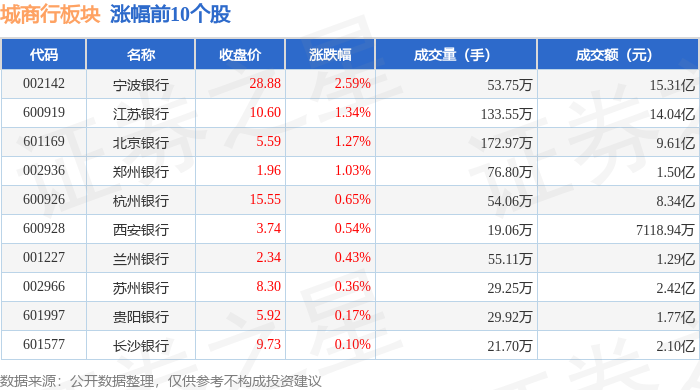
城商行板块1月6日涨0.63%,宁波银行领涨,主力资金净流入3.84亿元
Zheng Xing Xing Ye Ri Bao· 2026-01-06 09:00
证券之星消息,1月6日城商行板块较上一交易日上涨0.63%,宁波银行领涨。当日上证指数报收于 4083.67,上涨1.5%。深证成指报收于14022.55,上涨1.4%。城商行板块个股涨跌见下表: 以上内容为证券之星据公开信息整理,由AI算法生成(网信算备310104345710301240019号),不构成投资建议。 | 代码 | 名称 | 收盘价 | 涨跌幅 | 成交量(手) | 成交额(元) | | --- | --- | --- | --- | --- | --- | | 002142 | 宁波银行 | 28.88 | 2.59% | 53.75万 | 15.31亿 | | 616009 | 江苏银行 | 10.60 | 1.34% | 133.55万 | 14.04亿 | | 601169 | 北京银行 | 5.59 | 1.27% | 172.97万 | 9.61亿 | | 002936 | 郑州银行 | 1.96 | 1.03% | 76.80万 | 1.50亿 | | 600926 | 杭州银行 | 15.55 | 0.65% | 54.06万 | 8.34亿 | | 600928 | 西安银 ...