
KJS(601579)

Search documents
非白酒板块11月20日跌0.59%,会稽山领跌,主力资金净流出7488.33万元
Zheng Xing Xing Ye Ri Bao· 2025-11-20 09:09
Core Points - The non-liquor sector experienced a decline of 0.59% on the trading day, with Kuaijishan leading the drop [1] - The Shanghai Composite Index closed at 3931.05, down 0.4%, while the Shenzhen Component Index closed at 12980.82, down 0.76% [1] Non-Liquor Sector Summary - Kuaijishan (601579) closed at 22.27, down 2.15%, with a trading volume of 99,600 shares and a transaction value of 222 million yuan [2] - Other notable declines include ST Xifa (000752) down 2.00% and ST Yedao (600238) down 1.49% [2] - The overall net capital flow for the non-liquor sector showed a net outflow of 74.88 million yuan from main funds, while retail investors saw a net inflow of 78.72 million yuan [2]


非白酒板块11月19日跌0.33%,*ST椰岛领跌,主力资金净流出1298.75万元
Zheng Xing Xing Ye Ri Bao· 2025-11-19 08:52
Market Overview - The non-liquor sector experienced a decline of 0.33% on the previous trading day, with *ST Yedao leading the drop [1] - The Shanghai Composite Index closed at 3946.74, up 0.18%, while the Shenzhen Component Index closed at 13080.09, unchanged [1] Stock Performance - Key stocks in the non-liquor sector showed varied performance, with Kuaijishan (601579) rising by 1.47% to a closing price of 22.76, while *ST Yedao (600238) fell by 3.60% to 6.69 [1][2] - Other notable movements included ST Xifa (000752) increasing by 1.22% and Zhangyu A (000869) rising by 0.28% [1] Trading Volume and Value - Kuaijishan recorded a trading volume of 174,100 shares, with a transaction value of approximately 3.95 million yuan [1] - The total net outflow of main funds in the non-liquor sector was 12.99 million yuan, while retail investors saw a net inflow of 9.51 million yuan [2][3] Fund Flow Analysis - Main funds showed a net outflow in several stocks, including Kuaijishan with a net outflow of 23.57 million yuan, while Zhangyu A had a net inflow of 7.98 million yuan [3] - Retail investors contributed positively to the fund flow in stocks like 百润股份 (002568), which saw a net inflow of 20.47 million yuan despite a main fund outflow [3]


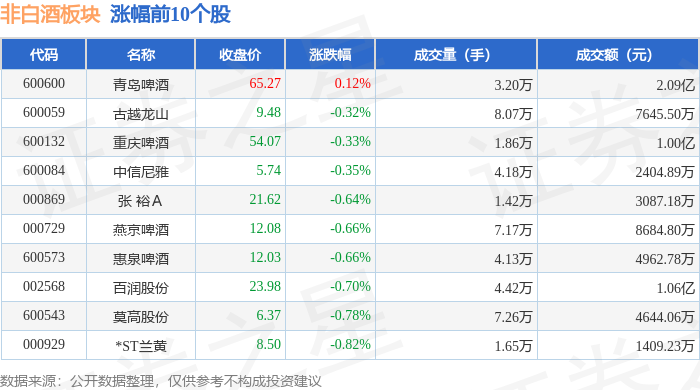
非白酒板块11月18日跌0.95%,燕京啤酒领跌,主力资金净流出1.09亿元
Zheng Xing Xing Ye Ri Bao· 2025-11-18 08:04
Market Overview - The non-liquor sector experienced a decline of 0.95% on November 18, with Yanjing Beer leading the drop [1] - The Shanghai Composite Index closed at 3939.81, down 0.81%, while the Shenzhen Component Index closed at 13080.49, down 0.92% [1] Stock Performance - Key stocks in the non-liquor sector showed varied performance, with ST Xifa closing at 12.32, up 0.49%, while other notable declines included Caijing Beer down 2.41% to 12.14 and Huichuan Beer down 2.41% to 12.15 [2] - The trading volume and turnover for selected stocks indicated significant activity, with Chongqing Beer recording a turnover of 1.33 billion and ST Xifa at 47.48 million [1][2] Capital Flow - The non-liquor sector saw a net outflow of 109 million from major funds, while retail investors contributed a net inflow of 115 million [2] - Detailed capital flow data showed that ST Xifa had a net inflow of 671,900 from major funds, while other stocks like ST Yedao experienced significant outflows [3]


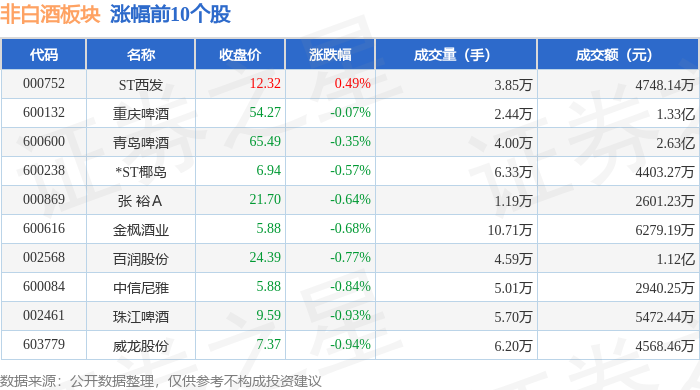
非白酒板块11月17日跌0.64%,会稽山领跌,主力资金净流出1.55亿元
Zheng Xing Xing Ye Ri Bao· 2025-11-17 08:49
Market Overview - The non-baijiu sector experienced a decline of 0.64% on the trading day, with Kuaijishan leading the drop [1] - The Shanghai Composite Index closed at 3972.03, down 0.46%, while the Shenzhen Component Index closed at 13202.0, down 0.11% [1] Stock Performance - Notable gainers included: - *ST Yedao: Closed at 6.98, up 3.25% with a trading volume of 101,700 shares and a turnover of 70.11 million yuan [1] - Huichuan Beer: Closed at 12.45, up 1.30% with a trading volume of 57,300 shares and a turnover of 70.97 million yuan [1] - Significant decliners included: - Kuaijishan: Closed at 22.89, down 1.97% with a trading volume of 148,900 shares and a turnover of 342 million yuan [2] - Fick Beer: Closed at 12.44, down 1.74% with a trading volume of 198,400 shares and a turnover of 248 million yuan [2] Capital Flow - The non-baijiu sector saw a net outflow of 155 million yuan from institutional investors, while retail investors contributed a net inflow of 163 million yuan [2] - The capital flow for specific stocks showed: - *ST Lanhua: Net inflow from retail investors was 121,770 yuan, while institutional investors had a net outflow of 292,560 yuan [3] - Kuaijishan: Retail investors had a net inflow of 725,900 yuan, while institutional investors faced a net outflow of 216,510 yuan [3]

从三季报看中国经济:新消费潜力迸发
Jing Ji Ri Bao· 2025-11-17 00:03
Core Viewpoint - The third-quarter reports of listed companies reflect the resilience and vitality of China's consumer market, indicating a structural adjustment period in the consumption sector with both challenges and opportunities [1] Overall Recovery - The consumer sector shows a steady recovery overall, but there is uneven performance across different segments. Essential consumption remains stable, while discretionary consumption is experiencing a divide [2] - Essential consumption sectors like food and beverages are performing well due to their necessity, with leading companies showing stable revenue and profit growth [2] - The liquor industry, representing traditional high-end consumption, is under pressure, with major companies like Wuliangye and Luzhou Laojiao reporting significant declines in revenue and profit [2] - In contrast, the new energy vehicle industry is thriving, benefiting from policy support and product upgrades, becoming a key growth driver in the consumer sector [2] Channel Transformation - Traditional retail companies are accelerating their online transformation, integrating online and offline channels to capture market changes, with those embracing digitalization seeing growth [3] Cost Pressures - Global commodity prices remain high, putting pressure on raw material and logistics costs, which challenges the gross margins of mid-to-low-end consumer companies [4] - Companies that optimize product structures and improve supply chain efficiency are demonstrating stronger profitability and market competitiveness [4] Structural Highlights - A number of structural highlights are emerging, driving high-quality development in consumer-related listed companies through innovation in technology, business models, and consumer scenarios [5] - In the smart home sector, companies like Ecovacs and Haier are experiencing significant profit growth, with Ecovacs reporting a 131% increase in net profit [5] - The traditional consumption sector is exploring new business models, with companies like Kweichow Moutai and Mercury Home Textiles achieving double-digit growth through innovative product offerings [6] New Consumption Scenarios - Companies are actively transforming to capture new consumption trends, with firms like Golden Dragon Fish and Miaokelando reporting substantial profit increases due to cost improvements and channel optimization [8] - The consumer market is becoming increasingly segmented, with new brands focusing on specific demographics and scenarios, such as new-style tea drinks and pet economy products [8] - Domestic brands are gaining market share and showing strong performance in sectors like sportswear and beauty products, driven by cultural confidence and supply chain advantages [8] Market Dynamics - The consumer market is undergoing structural upgrades, with recovery being uneven due to factors like income expectations and regional disparities [9] - Companies with strong brand barriers and unique market advantages are favored by capital, while those embracing new trends and product iterations can still find growth opportunities [9] - The competition is shifting from traditional versus new consumption to the operational efficiency and strategic vision of different companies within the same industry [9] High-Quality Development - The recovery trend in China's consumer market is moving from total growth to structural optimization, with companies encouraged to focus on high-quality development through innovation [10]





食品饮料行业周报:10月餐饮受益双节效应,板块情绪回暖-20251116
Huaxin Securities· 2025-11-16 10:03
Investment Rating - The report maintains a "Recommended" investment rating for the food and beverage & commercial sectors [10][61]. Core Insights - The October data indicates a recovery in the restaurant sector, benefiting from the dual holiday effect, leading to improved sentiment in the sector [6][60]. - The liquor sector is experiencing a positive market sentiment, with companies showing resilience despite ongoing performance adjustments [6][59]. - The overall consumer sector is showing signs of improvement, with October retail sales reaching 46,291 billion yuan, a year-on-year increase of 2.9% [7][60]. Summary by Sections Industry News - In October, liquor consumption prices decreased by 2% year-on-year, while retail sales of tobacco and alcohol increased by 4.1% [5][19]. - JD Supermarket reported an 18% year-on-year growth in liquor sales during the Double Eleven shopping festival [5][19]. Investment Views - The liquor sector is benefiting from positive consumer sentiment, with a shift towards recovery in valuations after a prolonged period of suppression [6][59]. - Recommendations include high-dividend leaders such as Kweichow Moutai, Wuliangye, and Luzhou Laojiao, as well as flexible stocks like Jiu Gui Jiu and She De Jiu Ye [6][59]. Key Company Feedback - The report highlights the performance of key companies, with notable increases in stock prices for She De Jiu Ye and Jiu Gui Jiu, reflecting positive market trends [30][31]. - The liquor industry's revenue for 2024 is projected to be 796.4 billion yuan, showing a year-on-year growth of 5.3% [34]. Core Data Trends - The cumulative production of liquor in 2024 is expected to be 4.145 million tons, a decrease of 7.72% year-on-year [34]. - The report emphasizes the importance of product innovation and strategic adjustments among leading companies to navigate the competitive landscape [60].



会稽山:关于增选公司第六届董事会独立董事的公告
Zheng Quan Ri Bao· 2025-11-14 13:11
Core Points - The company announced the convening of the 19th meeting of the sixth board of directors on November 14, 2025 [2] - The board approved the proposal to elect Jin Xuejun as an independent director candidate for the sixth board of directors [2] - The term for the newly elected independent director will last until the end of the sixth board's term, starting from the date of approval at the first extraordinary general meeting of shareholders in 2025 [2]
会稽山(601579) - 会稽山绍兴酒股份有限公司信息披露暂缓与豁免业务内部管理制度(2025年11月修订版)
2025-11-14 10:16
第一章 总 则 会稽山绍兴酒股份有限公司 信息披露暂缓与豁免业务内部管理制度 (2025年11月修订版) 第一条 为规范会稽山绍兴酒股份有限公司(以下简称公司)和其他信息 披露义务人信息披露暂缓、豁免行为,加强信息披露监管,保护投资者合法权 益,维护公司及其他利益相关人的合法权益,根据《中华人民共和国公司法》 《中华人民共和国保守国家秘密法》《中华人民共和国证券法》(以下简称 《证券法》)、《上市公司信息披露管理办法》《上市公司信息披露暂缓与豁 免管理规定》《上海证券交易所股票上市规则》等法律、行政法规和规章,制 定本制度。 第二章 暂缓、豁免信息的范围及审批 第二条 公司和其他信息披露义务人暂缓、豁免披露临时报告,在定期报 告、临时报告中豁免披露中国证券监督管理委员会(以下简称中国证监会)和 上海证券交易所规定或者要求披露的内容,适用本规定。 第三条 公司和其他信息披露义务人应当真实、准确、完整、及时、公平 地披露信息,不得滥用暂缓或者豁免披露规避信息披露义务、误导投资者,不 得实施内幕交易、操纵市场等违法行为。 第四条 公司和其他信息披露义务人应当审慎确定信息披露暂缓、豁免事 项,履行内部审核程序后实施。 ...
会稽山(601579) - 会稽山绍兴酒股份有限公司董事、高级管理人员薪酬管理制度(2025年11月制定)
2025-11-14 10:16
会稽山绍兴酒股份有限公司 董事、高级管理人员薪酬管理制度 (2025 年 11 月制定) 第一章 总 则 第一条 为进一步完善会稽山绍兴酒股份有限公司(以下简称公司)的薪酬 管理,建立与现代企业制度相适应的激励约束机制,充分调动公司董事、高级管 理人员的积极性和创造性,促进公司稳定、持续、高速发展,根据《中华人民共 和国公司法》《上市公司治理准则》《会稽山绍兴酒股份有限公司章程》(以下 简称《公司章程》)等规定,并结合公司实际情况,制定本制度。 第二章 适用对象 第二条 本制度适用于公司董事及高级管理人员。 第三条 本制度所称董事,是指本制度执行期间公司董事会的全部在职成员, 包括非独立董事、独立董事、职工代表董事。 第五条 薪酬与考核委员会负责制定董事、高级管理人员的的考核标准并进 行考核,制定、审查董事、高级管理人员的薪酬决定机制、决策流程、支付与止 付追索安排等薪酬政策与方案,并就董事、高级管理人员的薪酬向董事会提出建 议。公司人力资源部与财务部配合薪酬与考核委员会对本制度进行具体的组织实 施。 第六条 公司董事会负责审议批准高级管理人员的年度薪酬方案。公司股东 会负责审议批准董事的年度薪酬方案。在董事 ...
会稽山(601579) - 会稽山绍兴酒股份有限公司董事会议事规则(2025年11月修订版)
2025-11-14 10:16
会稽山绍兴酒股份有限公司 董事会议事规则 (2025 年 11 月修订版) 第一章 总 则 第一条 为进一步规范会稽山绍兴酒股份有限公司(以下简称公司)董事会 的议事方式和决策程序,促使董事和董事会有效地履行其职责,提高董事会规范 运作和科学决策水平,根据《中华人民共和国公司法》《中华人民共和国证券法》 《上市公司治理准则》《上海证券交易所股票上市规则》《上海证券交易所上市 公司自律监管指引第 1 号—规范运作》《上市公司独立董事管理办法》等有关法 律、法规、规范性文件的规定及《会稽山绍兴酒股份有限公司章程》(以下简称 《公司章程》)有关规定,制定本议事规则。 第二条 公司设董事会,董事会对股东会负责,在《公司章程》和股东会赋 予的职权范围内行使职权。 第三条 公司董事会设置审计委员会,行使《公司法》规定的监事会的职权, 设置战略委员会、提名委员会、薪酬与考核委员会等相关专门委员会。专门委员 会对董事会负责,依照公司章程和董事会授权履行职责,提案应当提交董事会审 议决定。 第四条 公司设董事会。董事会由 11 名董事组成,其中非独立董事 7 名(包 括由职工代表担任董事 1 名),独立董事 4 名。董事会设董 ...