
Nanhua Futures(603093)

Search documents
南华期货:连续三年以《白皮书》贡献期货智慧,助力行业高质量发展
Xin Lang Cai Jing· 2025-12-18 05:22
Core Insights - The futures industry is focusing on serving the real economy through innovative business expansion and enhancing service efficiency, with Nanhua Futures actively responding to national strategies by publishing the "White Paper on Serving the Real Economy" for three consecutive years [1][2][3] Group 1: White Paper Development - The first "White Paper on Serving the Real Economy" was released in August 2023, systematically summarizing the theoretical foundations and practical pathways of futures services to the real economy, providing replicable "futures solutions" through case studies [2] - The 2024 edition of the white paper was fully optimized and upgraded, summarizing and promoting experiences and practical results in serving the real economy, while responding to new policy environments and requirements [2][3] - The 2025 white paper marks a strategic leap, focusing on the financial "five major articles" and showcasing Nanhua Futures' practices in various financial sectors, contributing to the high-quality development of the industry [3][4] Group 2: Financial "Five Major Articles" - The financial "five major articles" were first proposed at the Central Financial Work Conference in October 2023, aiming to promote high-quality financial development and support national modernization efforts [4][5] - The implementation of these articles is emphasized by the China Securities Regulatory Commission and the State Council, highlighting the importance of the futures market in achieving these goals [4][5] Group 3: Practical Innovations - Nanhua Futures has integrated technology finance, actively pursued green finance to support carbon neutrality goals, and implemented inclusive finance strategies to serve small and micro enterprises and promote rural revitalization [6][7] - Specific examples include tailored financial service packages for high-end composite material companies and training for lithium carbonate recovery enterprises to utilize futures markets effectively [7][8] - In inclusive finance, Nanhua Futures has innovated a "insurance + futures" model to mitigate risks in livestock farming, and in pension finance, it has launched products linked to commodity indices to fulfill the mission of financial inclusivity [8][9] Group 4: Future Outlook - Nanhua Futures plans to continue deepening the practice of the financial "five major articles," optimizing service models, expanding product matrices, and enhancing collaboration within the industry [9][10] - The company aims to provide a multi-layered, widely covered futures service system, contributing significantly to high-quality economic development and the modernization of China [10]

南华期货:连续三年以《白皮书》贡献期货智慧 助力行业高质量发展
Zheng Quan Shi Bao Wang· 2025-12-18 05:13
Core Insights - The core focus of the articles is on Nanhua Futures' commitment to serving the real economy through innovative business practices and strategic alignment with national policies, particularly in the context of the "Five Major Financial Articles" initiative [1][3][4]. Group 1: White Paper Development - Nanhua Futures has published the first "Service the Real Economy White Paper" in August 2023, which systematically summarizes the theoretical foundations and practical pathways for futures services to the real economy [2]. - The 2024 edition of the white paper has been optimized to focus on industry upgrades and rural revitalization, while the 2025 edition aims to align closely with the "Five Major Financial Articles" [2][3]. Group 2: Strategic Alignment with National Policies - The "Five Major Financial Articles" were introduced at the Central Financial Work Conference in October 2023, emphasizing the need for high-quality financial development to support China's modernization efforts [3][4]. - The white paper outlines how the futures industry can enhance its service capabilities to the real economy, promote internationalization, and optimize market structure in line with national strategic goals [4]. Group 3: Practical Innovations and Case Studies - Nanhua Futures has implemented innovative projects such as "Insurance + Futures" to provide risk management solutions for farmers, particularly in the livestock sector [5][6]. - In the area of green finance, Nanhua Futures has supported a lithium carbonate recycling company by offering tailored financial services, including training on futures market operations [5][6]. - The company has also developed digital financial tools, such as customized weather forecasting reports, to assist agricultural cooperatives in risk management [7]. Group 4: Future Outlook - Nanhua Futures plans to continue deepening its practices related to the "Five Major Financial Articles," optimizing service models, and expanding its product offerings to better serve the real economy [8]. - The company emphasizes the importance of collaboration within the industry to build a comprehensive futures service system that contributes to high-quality economic development [8].
南华期货(603093):深度研究:多元协同驱动成长,境外业务领航
East Money Securities· 2025-12-17 11:37
Investment Rating - The report assigns an "Accumulate" rating for the company, marking its first coverage [6] Core Insights - The company has established a diversified business model that is showing strong operational performance compared to industry averages, with a focus on overseas financial services driving growth [14][21] - The overseas business has become the primary revenue source, contributing approximately 55% of total revenue in the first half of 2025, with a significant increase in margin from 2% in 2021 to 90% in 2024 [4][44] - The company has a robust overseas licensing system, having obtained 16 memberships from major global exchanges, which provides a competitive edge in the market [36][38] Summary by Relevant Sections Business Overview - The company has developed a comprehensive derivatives service platform, leveraging its historical background and expanding into overseas markets since 2006 [14][17] - The company has achieved a compound annual growth rate (CAGR) of over 40% in net profit over the past five years, with a notable increase in profitability [4][21] Revenue Structure - In 2024, the company generated revenues of 1.32 billion yuan, with net profits of 458 million yuan, indicating a strong performance despite industry challenges [4][21] - The overseas financial services segment is the largest contributor to gross profit, accounting for approximately 90% in 2024, while domestic brokerage and risk management also play significant roles [22][44] Growth Drivers - The overseas business is expected to continue its rapid growth, driven by increasing demand for risk management and the expansion of customer deposits, which rose from 3.67 billion yuan in 2021 to 10.20 billion yuan in 2024 [4][44] - The company has successfully diversified its product offerings, including the development of innovative financial products and expanding its wealth management services, which saw significant growth in assets under management [5][42] Financial Projections - The company forecasts revenues of 1.47 billion yuan for 2025, with net profits expected to reach 493 million yuan, reflecting a growth trajectory despite a projected decline in revenue due to accounting changes [6][7] - The price-to-earnings (P/E) ratio is projected to decrease from 23.69 in 2025 to 17.38 by 2027, indicating potential for value appreciation [6][7]
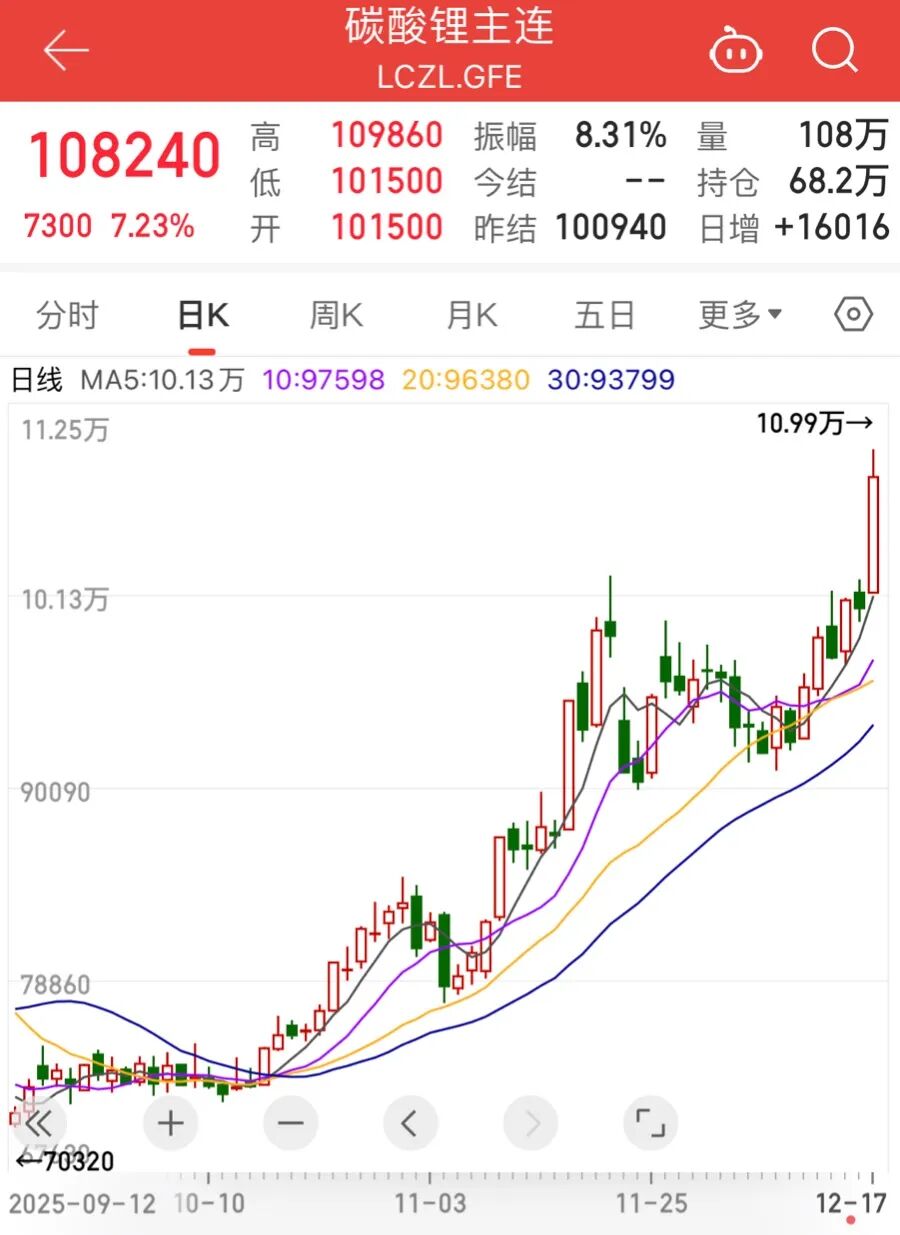
一则消息引爆,碳酸锂大涨8%逼近11万
2 1 Shi Ji Jing Ji Bao Dao· 2025-12-17 08:44
Group 1 - The domestic lithium carbonate market experienced a strong surge on December 17, with futures prices rising over 8% to reach a peak of 109,860 yuan/ton, marking a new high since May 2024 and a cumulative increase of over 40% for the year [1] - The strong performance in the futures market translated to the stock market, with the A-share lithium mining sector seeing significant gains, as the lithium index rose over 6% and stocks like Shengxin Lithium Energy and Rongjie Co. hit their daily limits [1] Group 2 - Yichun, known as the "Lithium Capital of Asia," plans to cancel 27 mining rights, which has raised concerns about supply disruptions; however, experts indicate that the price increase is primarily driven by optimistic demand forecasts for next year rather than the cancellation itself [2][3] - The 27 mining rights set for cancellation have mostly been expired since 2010 to 2019, with some even before 2010, indicating that they do not significantly impact current lithium carbonate supply [3] Group 3 - Current prices for battery-grade lithium carbonate have risen to a range of 94,600 to 99,500 yuan/ton, while industrial-grade lithium carbonate is priced between 93,300 and 95,600 yuan/ton, reflecting increases of 1,200 yuan/ton and 1,100 yuan/ton respectively [3] - The demand for lithium carbonate is supported by the strong performance of the new energy heavy truck market and rapid development in the energy storage sector, alongside supportive national policies [3] Group 4 - Analysts expect the upward price trend for lithium carbonate to continue, although it may not be smooth; price movements are anticipated to be wave-like due to various factors including supply-demand dynamics and policy changes [4] - Long-term forecasts suggest that by 2026, the lithium market will experience a peak in production, with a tight balance expected in both global and Chinese markets, leading to potential price fluctuations within the range of 80,000 to 120,000 yuan/ton [4]




招股两日认购寡淡,南华期货怎么了?
智通财经网· 2025-12-16 00:56
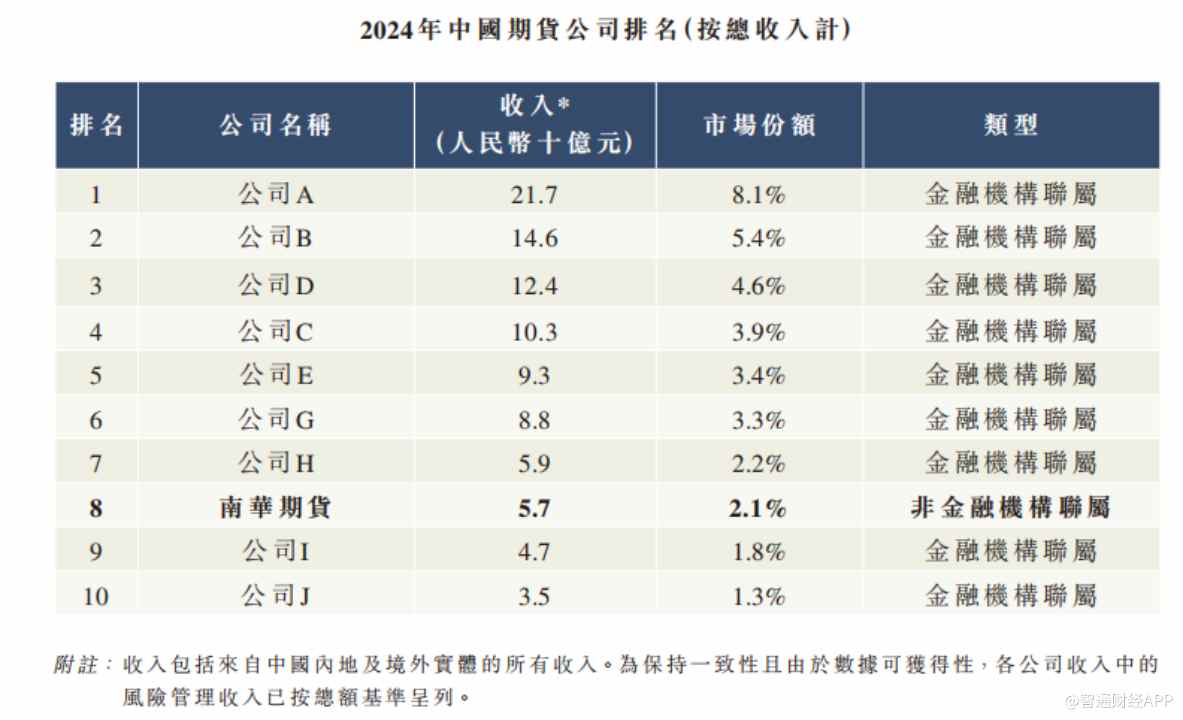
年末港交所打新市场迎来收官冲刺。 招股书显示,南华期货成立于1996年,是中国期货行业首批成立的公司之一。2019年8月登陆上交所成为国内首家A股上市期货公司。此次港股上市,南华 期货将成为继弘业期货之后第二家实现"A+H"双上市的期货公司。 据弗若斯特沙利文报告,按2024年总收入计,公司在国内所有期货公司中排名第八,在非金融机构相关期货公司中排名第一。 | 排名 | 公司名稱 | 收入* | 市場份額 | 類型 | | --- | --- | --- | --- | --- | | | | (人民幣十億元) | | | | I | 公司A | 21.7 | 8.1% | 金融機構聯屬 | | 2 | 公司B | 14.6 | 5.4% | 金融機構聯屬 | | 3 | 公司D | 12.4 | 4.6% | 金融機構聯屬 | | ব | 公司C | 10.3 | 3.9% | 金融機構聯屬 | | ર | 公司E | 9.3 | 3.4% | 金融機構聯屬 | | 6 | 公司G | 8.8 | 3.3% | 金融機構聯屬 | | 7 | 公司H | 5.9 | 2.2% | 金融機構聯屬 | | 8 | ...
招股两日认购寡淡,南华期货(02691)怎么了?
智通财经网· 2025-12-16 00:55
Core Viewpoint - The cold reception of Nanhua Futures' IPO in the Hong Kong market contrasts sharply with the high subscription rates of other companies, indicating a significant divergence in investor sentiment and highlighting concerns over the company's growth potential and valuation [1][12]. Company Overview - Nanhua Futures, established in 1996, is one of the first companies in China's futures industry and became the first A-share listed futures company in August 2019. The upcoming Hong Kong listing will make it the second futures company to achieve a dual listing in both A and H shares [2]. Financial Performance - Nanhua Futures ranked eighth among all futures companies in China by total revenue in 2024, with a revenue of 5.7 billion RMB, representing a market share of 2.1% among non-financial institution-related futures companies [3][2]. - The company's operating income is projected to grow from 9.54 billion RMB in 2022 to 13.55 billion RMB in 2024, but the growth rate is expected to slow significantly from 35.5% in 2023 to 4.8% in 2024 [5][6]. Revenue Structure - The decline in revenue growth is attributed to a decrease in commission rates for domestic futures brokerage services, with net commission and fee income expected to drop by 11.3% to 542 million RMB in 2024 [7]. - The average brokerage commission rate for domestic futures brokerage services fell from 0.334 basis points in 2023 to 0.158 basis points in the first half of 2025, leading to a decrease in operating profit margin from 18.6% to 6.2% [7]. Market Positioning - The pricing and terms of Nanhua Futures' IPO have dampened investor enthusiasm, with the offering price range set at 12-16 HKD, which represents a discount of approximately 33.7% compared to its A-share price [8]. - Compared to its peer Hongyi Futures, which has a much lower H/A ratio, Nanhua's offering does not present a compelling valuation advantage for investors seeking arbitrage opportunities [9]. IPO Mechanism - The IPO employs a fixed proportion and no reallocation mechanism, resulting in a lower expected allocation for retail investors, which diminishes their participation interest [10]. - The absence of cornerstone investors in the IPO increases market uncertainty, as there is no long-term capital to stabilize the stock price post-listing [10]. Market Sentiment - The overall cold reception of Nanhua Futures' IPO reflects a broader trend in the Hong Kong market, where investors are favoring companies with high growth potential and reasonable valuations, while remaining cautious towards those with short-term concerns [12].
南华期货尿素产业周报:期货研究-20251215
Nan Hua Qi Huo· 2025-12-15 03:00
上周磷肥政策的改变,带来化肥板块投机性压制,尿素现货成交转弱。在政策保供与生产利润修复的支撑 下,尿素日产预计将维持高位,高供应对价格构成显著压力。然而出口政策的适时、连续调节,持续为基本 面泄压,从而削弱了价格的下行驱动强度。在出口政策调控背景下,短期现货价格受到明显压制,业内情绪 有减弱,短线国内尿素行情走低。由于目前东北地区已经连续补库两周,复合肥工厂及贸易商追高意愿逐步 减弱,但尿素显性库存连续去库,基本面对价格形成支撑。总体而言,尿素市场处于基本面与政策的区间 内。短期其下行空间受到有力支撑,但上方同样承压,01预计将延续震荡走势。 ∗ 近端交易逻辑 南华期货尿素产业周报 ——期现回归 2025/12/14 联系人 张博(投资咨询证号:Z0021070) 投资咨询业务资格:证监许可【2011】1290号 第一章 核心矛盾及策略建议 1.1 核心矛盾 尿素现货日产销与尿素期货收盘价 元/吨 尿素平均产销(右轴) 尿素期货主力合约收盘价 1 2 3 1600 1800 2000 2200 2400 尿素山东产销季节性 2023 2024 2025 0 2 4 6 | | | 虽然尿素增设了交割库,但最便 ...
期货策略周报:估值接近极限-20251215
Nan Hua Qi Huo· 2025-12-15 02:21
Report Industry Investment Rating - Not provided in the given content Core Viewpoints of the Report - The recent continuous differentiation and decline in the market are mainly due to the price reduction of coal chemical products following the coal price drop. These products have an oversupply situation, and market funds have pushed the bearish sentiment to the extreme, leading to a collective decline of coal chemical related varieties. However, the valuation of coal chemical products is low, and there is a possibility of a rebound at any time. Although the coking coal price has been falling recently, the contradiction cycles are different. Coal supply guarantee is a short - term logical driver, while anti - involution is a long - term logic. Low - valued long - term positions can be considered [2][5]. Summary by Related Catalogs Weekly Market Condition Review - The commodity market continued the differentiation trend of last week. Non - ferrous metals and precious metals remained strong, while black and chemical varieties were weak, with the 01 contract being pushed to the extreme. Copper, aluminum, and silver showed a strong upward trend due to supply shortages, but the gold trend deviated and requires caution. Agricultural products showed a回调 trend. Regarding soybeans, short - term selling pressure may exist as China's annual purchase of 1.2 billion tons cannot fundamentally change the global supply - demand pattern. After the domestic soybean meal adjustment is in place, low - buying opportunities can be sought. For palm oil, the high inventory in Malaysia has put pressure on it. In the energy and chemical sector, the continuous decline of domestic coal prices under the winter - spring supply guarantee policy has brought selling pressure to coal chemical products. However, the valuation of chemical products has reached the limit, and the cost - effectiveness of short - selling is not high, with a possible rebound at any time. In the black sector, under the background of coal supply guarantee, coking coal and coke led the overall valuation of the black sector to decline. The market priced in the news of export control on some steel products on Friday night, which is slightly bearish overall. But it is believed that coking coal is unlikely to return to the price level in early July [4]. Market Data Tables - **Plate Capital Flow**: The total capital flow is - 0.86 billion. Precious metals have a capital inflow of 2.781 billion (34.4%), non - ferrous metals 0.987 billion (11.5%), black metals - 2.224 billion (- 49.6%), energy and chemicals - 0.823 billion (- 25.6%), feed and breeding - 1.335 billion (- 64.1%), oils and fats - 0.241 billion (- 5.4%), and soft commodities 0.598 billion (36.0%) [9]. - **Black and Non - ferrous Weekly Data**: It includes price, inventory, valuation, position, open interest change, and annualized basis data for various black and non - ferrous varieties such as iron ore, rebar, hot - rolled coil, coking coal, etc. For example, the price percentile of iron ore is 20.0%, inventory percentile is 98.5%, and valuation percentile is 0.0% [9]. - **Energy and Chemical Weekly Data**: Similar to the above, it provides data for energy and chemical products like fuel oil, low - sulfur oil, asphalt, etc. For instance, the price percentile of fuel oil is 0.0%, inventory percentile is 95.1%, and valuation percentile is 32.9% [11]. - **Agricultural Product Weekly Data**: It contains data for agricultural products such as soybean meal, rapeseed meal, soybean oil, etc. For example, the price percentile of soybean meal is 9.9%, inventory percentile is 100.0%, and valuation percentile is 63.2% [12].
南华期货早评-20251215
Nan Hua Qi Huo· 2025-12-15 02:07
宏观:关注国内经济数据发布 【市场资讯】1)习近平在中央经济工作会议上谈科技创新成果:实践证明,对我们"卡脖 子"是卡不住的。2)中国 11 月新增社融 2.49 万亿元,新增人民币贷款 3900 亿元,M2- M1 剪刀差扩大。3)何立峰:2026 年要严防"爆雷"。4)韩文秀:明年将根据形势变化出 台实施增量政策,促进居民收入增长和经济增长同步,既要扩大出口也要增加进口。5)中 国多部委响应中央经济工作会议,央行:灵活高效运用降准降息等多种货币政策工具;发 改委:提振消费要出实招出新招,综合整治"内卷式"竞争和培育发展新动能;商务部等三 部门:加强商务和金融协同,更大力度提振消费;财政部:用好用足各类政府债券资金, 发行超长期特别国债,推动投资止跌回稳。6)特朗普:倾向于让沃什或哈塞特担任美联储 主席,希望一年后利率 1%或更低,自称应当在与美联储讨论利率方面发挥作用。7)摩根 大通 CEO 戴蒙据称支持沃什,警告哈赛特出任损害美联储独立性;戴蒙支持后,预测市场 对沃什出任的概率一度激增 24 个百分点。哈塞特:希望沃什和他无论谁出任都与特朗普 对话,特朗普可向联储提供建议,但无权设定其行动。8)"新美联 ...
南华期货工业硅产业周报:下方空间有限,时间换空间-20251214
Nan Hua Qi Huo· 2025-12-14 13:54
1. Report Industry Investment Rating No information provided in the report. 2. Core Viewpoints of the Report - In the short - term, there is no driving force, and the market shows a weak and volatile pattern. However, it is necessary to be vigilant about environmental protection speculation in winter. In the medium - to - long - term, the downside space for industrial silicon prices is limited, and it is cost - effective to buy long - term contracts during peak seasons at low prices. The price trend of industrial silicon is also closely related to the price fluctuations of related products such as polysilicon and coking coal [2]. 3. Summary by Relevant Catalogs 3.1 Core Contradictions and Strategy Suggestions 3.1.1 Core Contradictions - The core driving factors for the future price trend of industrial silicon futures include the progress of eliminating backward production capacity under the "anti - involution" background of the industry, production cuts on the supply side due to environmental protection constraints or rising costs, and the expected production cuts on the demand side due to weak terminal sales. The industry has expectations for eliminating backward production capacity, but due to the large number of private enterprises and scattered layout in the industrial silicon industry, there is a lack of confidence in effective capacity clearance through industry self - regulation. - Electricity costs account for 30% of the production cost of industrial silicon, and coal price fluctuations affect electricity costs and then industrial silicon prices. In December, the operating rate of industrial silicon producers is expected to decline. Downstream, the polysilicon industry is reducing production, the silicone monomer plants have maintenance plans, and only the aluminum alloy industry maintains a stable operating rate [1]. 3.1.2 Trading Logic - Near - term trading logic (before the end of 2025): Environmental protection disturbances, and expected production cuts on both the supply and demand sides. - Long - term trading logic (after early 2026): The progress of eliminating backward production capacity under the "anti - involution" background of the industry, and continuous attention to demand [4]. 3.1.3 Industrial Operation Suggestions - Sales management: For enterprises planning to produce industrial silicon in the future and worried about price drops during sales, they can sell corresponding futures contracts and use a combined options strategy (buy put options and sell call options) with a recommended hedging ratio of 20%. - Procurement management: For enterprises planning to produce polysilicon, silicone, or aluminum alloy in the future, if the finished product price is not correlated, they can buy corresponding futures contracts with a recommended hedging ratio of 30% and use a combined options strategy (sell put options and buy call options) with a ratio of 10%. If the finished product price is correlated, they can sell corresponding futures contracts and use a combined options strategy (buy put options and sell call options) with a ratio of 20%. - Inventory management: For enterprises with high industrial silicon inventory and worried about inventory depreciation due to price drops, they can short futures contracts and use a combined options strategy (sell call options and buy put options) with recommended hedging ratios of 20% and 10% respectively [5]. 3.2 Important Information and Events to Watch 3.2.1 This Week's Important Information Review - On December 8, Jianghan New Materials announced that a 60,000 - ton/year trichlorosilane plant was put into trial operation in October this year, 10,000 tons of silane production capacity is planned to be put into trial operation in December, and another 10,000 tons each will be put into trial operation in mid - and late - next year. In 2027, optical fiber - grade silicon tetrachloride and electronic - grade tetraethyl orthosilicate plants will be gradually built. - On December 8, GCL Technology announced that its subsidiaries and other parties signed a partnership agreement to establish a limited partnership, which plans to acquire a 42.469% stake in Inner Mongolia Xinyuan Silicon Materials Technology Co., Ltd. from Hongyuan Green Energy and Tibet Ruihua for a total consideration of RMB 2.01 billion [6]. 3.2.2 Next Week's Events to Watch No events to watch were mentioned in the report [7]. 3.3 Disk Interpretation 3.3.1 Price, Volume, and Capital Analysis - The closing price of the industrial silicon weighted index contract on Friday was 8,412 yuan/ton, a week - on - week decrease of 4.66%. The trading volume was 619,800 lots, a week - on - week increase of 113.65%, and the open interest was 460,100 lots, an increase of 19,000 lots week - on - week. The monthly spread between SI2601 and SI2605 was in a back structure, with a week - on - week increase of 90 yuan/ton. The number of warehouse receipts was 8,619 lots, an increase of 1,331 lots week - on - week. - The industrial silicon weighted futures price quickly fell below the 5 - day moving average this week. The disk showed the characteristic of "short - position increase and price decline". The current price quickly fell below the lower track of the Bollinger Band, and the Bollinger Bandwidth showed signs of widening. It is necessary to focus on the support level of 8,000 yuan/ton, and from Thursday to Friday, there was a characteristic of "short - position exit and price stabilization" [10][11]. 3.3.2 Option Analysis - The 20 - day historical volatility of industrial silicon has been strengthening in the past week, indicating that the actual price fluctuation range has been gradually expanding. The implied volatility of at - the - money options has also been strengthening. The PCR of option open interest has been rising, indicating an increasing bearish sentiment in the market [13]. 3.3.3 Term Structure Analysis - The term structure of industrial silicon futures shows a back structure, which is relatively stable. The basis of the main industrial silicon contract is at a relatively high level [17][19]. 3.3.4 Spot Data of the Silicon Industry Chain - The prices of different grades of industrial silicon in various regions have shown different degrees of decline. The prices of industrial silicon powder have also decreased. The price of trichlorosilane and polysilicon N - type price index remained unchanged, the price of silicone DMC was stable, and the price of aluminum alloy ADC12 increased slightly [22]. 3.4 Valuation and Profit - Since hitting the profit low in May, the average profit of the industrial silicon industry has been in a continuous recovery channel. The profit of the polysilicon industry is currently stable, providing important support for the demand of industrial silicon. The profit of the aluminum alloy industry is showing a weakening trend, while the profit of the silicone industry is recovering [23]. 3.5 Fundamental Analysis 3.5.1 Upstream - Industrial Silicon - The weekly production and operating rates of industrial silicon from different data sources showed different trends. The weekly production of some data sources increased, while others decreased. The operating rates also showed mixed trends [30]. - The inventory data of industrial silicon in different regions and warehouses showed different changes [47][48][50]. 3.5.2 Downstream - Polysilicon - The weekly production of domestic polysilicon decreased, and the operating rate also declined. The total inventory of polysilicon increased slightly, with different changes in the inventory of production enterprises, silicon wafer enterprises, and warehouse receipts [51][52][54]. 3.5.3 Downstream - Aluminum Alloy - The operating rates of primary and secondary aluminum alloys decreased slightly, and the inventory of primary aluminum alloy decreased, while the inventory of secondary aluminum alloy decreased significantly [58][59]. 3.5.4 Downstream - Organic Silicon - The weekly production of organic silicon DMC decreased, with a week - on - week decrease of 6.12% [64]. 3.5.5 Terminal - The report shows the data trends of China's commercial housing sales area, automobile monthly production, and photovoltaic monthly new installed capacity [67].