
Tsingtao Brewery(600600)

Search documents
加速出清行业寻底,预期先行板块启动
East Money Securities· 2025-11-19 06:56
Investment Highlights - The report indicates a clear turning point for the food and beverage industry following accelerated clearance, with expectations for leading sectors to initiate recovery [2][7] - The overall revenue for the food and beverage sector showed a slight increase of 0.2% year-on-year, while net profit decreased by 4.6% in the first three quarters of 2025 [18][20] - In Q3 2025, the sector experienced a significant decline, with revenues and net profits dropping by 4.9% and 14.6% respectively [18][20] Sector Review 1. Overall Review - The food and beverage sector faced continuous pressure and adjustments, with traditional consumption accelerating clearance while new consumption trends continued to grow [18][20] - The white liquor segment saw a revenue decline of 18.4% and a net profit decline of 22.2% in Q3 2025, indicating significant pressure on the sector [20][22] - In contrast, sectors like snacks and beverages maintained double-digit growth due to product and channel innovations [20][21] 2. White Liquor - The white liquor industry is undergoing accelerated clearance, with varying rhythms among companies. The demand has weakened, leading to noticeable declines in revenue and net profit for most companies [22][25] - High-end liquor maintained some growth, with Moutai achieving a revenue increase of 0.3% in Q3 2025, while other brands like Wuliangye saw declines exceeding 50% [23][25] - The report emphasizes the importance of supply-demand balance and pricing as key indicators for the industry's recovery [22][23] 3. Low-Alcohol Beverages and Drinks - The beer segment showed stable performance with a revenue increase of 2.0% and a net profit increase of 11.8% in the first three quarters of 2025 [21][22] - The report highlights the potential for recovery in demand for low-alcohol beverages and drinks, driven by health trends and product innovation [22][23] 4. Consumer Goods - The dairy sector is gradually stabilizing, with upstream supply clearing and downstream processing demand increasing, leading to a potential balance in the raw milk cycle [31][33] - The snack sector, particularly the konjac and oat categories, is expected to maintain high growth rates, supported by the expansion of new retail channels [31][36] - The report notes that the overall demand for dining remains weak, but specific segments like Western-style condiments and frozen baking show structural opportunities [31][33] Investment Recommendations - The report suggests focusing on companies that are early in their clearance processes and have strong brand momentum, such as Gujing Gongjiu and Luzhou Laojiao [11][12] - For low-alcohol beverages, attention is drawn to leading companies like Kweichow Moutai and Tsingtao Brewery, which are expected to benefit from demand recovery [11][12] - In the consumer goods sector, companies with strong performance and cost advantages, such as Yili and Modern Dairy, are recommended for investment [11][12]



青岛啤酒回应终止收购即墨黄酒:仍会考虑新并购
Xi Niu Cai Jing· 2025-11-19 06:40
Core Viewpoint - The acquisition plan of Jimo Yellow Wine by Qingdao Beer has failed, raising concerns about the company's diversification strategy and future growth opportunities [2][4]. Company Strategy - Qingdao Beer had high hopes for the acquisition of Jimo Yellow Wine, as it would provide seasonal product complementarity, with beer consumption peaking in summer and yellow wine in autumn and winter [2]. - Despite the failed acquisition, Qingdao Beer’s chairman stated that the company's diversification strategy remains unchanged, and they will consider new acquisition opportunities in the future [2]. Financial Performance - Qingdao Beer reported a revenue of 32.138 billion yuan in 2024, a decrease of 5.3% year-on-year, marking the first decline in both revenue and sales since the pandemic [4]. - For the first three quarters, the company achieved a revenue of 29.366 billion yuan, with a year-on-year growth of 1.41%, and a net profit attributable to shareholders of 5.274 billion yuan, up 5.7% year-on-year [4]. - However, in the third quarter, revenue saw a slight decline of 0.17%, and the growth rate of net profit attributable to shareholders dropped to 1.62% [4]. Market Context - The beer industry is entering a phase of stock competition, making it imperative for Qingdao Beer to find new growth avenues beyond its core business [4]. - The failure of the Jimo Yellow Wine acquisition highlights the challenges faced by Qingdao Beer in its pursuit of diversification and growth [4].

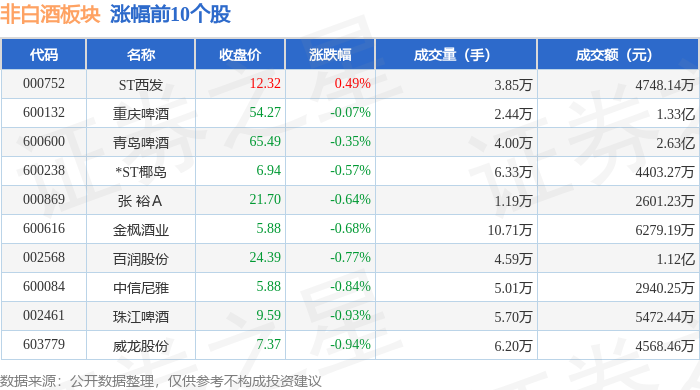
非白酒板块11月18日跌0.95%,燕京啤酒领跌,主力资金净流出1.09亿元
Zheng Xing Xing Ye Ri Bao· 2025-11-18 08:04
Market Overview - The non-liquor sector experienced a decline of 0.95% on November 18, with Yanjing Beer leading the drop [1] - The Shanghai Composite Index closed at 3939.81, down 0.81%, while the Shenzhen Component Index closed at 13080.49, down 0.92% [1] Stock Performance - Key stocks in the non-liquor sector showed varied performance, with ST Xifa closing at 12.32, up 0.49%, while other notable declines included Caijing Beer down 2.41% to 12.14 and Huichuan Beer down 2.41% to 12.15 [2] - The trading volume and turnover for selected stocks indicated significant activity, with Chongqing Beer recording a turnover of 1.33 billion and ST Xifa at 47.48 million [1][2] Capital Flow - The non-liquor sector saw a net outflow of 109 million from major funds, while retail investors contributed a net inflow of 115 million [2] - Detailed capital flow data showed that ST Xifa had a net inflow of 671,900 from major funds, while other stocks like ST Yedao experienced significant outflows [3]


青岛啤酒2025年第三季度业绩说明会问答实录
Quan Jing Wang· 2025-11-18 05:41
Core Viewpoint - Qingdao Beer is committed to maintaining its diversified development strategy despite the termination of the acquisition of Jimo Huangjiu, and will continue to explore new project opportunities in the future [2] Group 1: Company Strategy and Performance - The company is actively integrating the beverage business acquired from Qingdao Beverage Group, focusing on operational synergy with its beer business [2] - The company has implemented a market value management system to enhance overall market capitalization, including stock buybacks and increased cash dividends [2] - In the first three quarters of 2025, the company achieved a revenue of RMB 29.37 billion and a net profit of RMB 5.27 billion, indicating good growth in various operational metrics [5] Group 2: Market Conditions and Challenges - The beer industry is facing challenges with "difficult profit growth" despite a slow recovery in market demand, prompting the company to optimize product structure and enhance operational management [2] - The company has successfully positioned itself as the top-selling beer brand during the recent Double 11 shopping festival, indicating strong market performance [3] Group 3: Future Outlook - The company is optimistic about its overall performance for 2025, focusing on high-quality development and market expansion [4][5] - The company is actively investing in online channels, particularly in instant retail, to capitalize on emerging sales opportunities [3]
从“量大”到“质强” 中国啤酒行业如何实现破局?
Jing Ji Ri Bao· 2025-11-18 05:38
Core Insights - The Chinese beer industry has evolved significantly over the past century, transitioning from traditional brewing to industrial production, and has been the world's largest producer and consumer of beer since 2002 [1][2][3] - The industry is now facing a period of stock competition, with a need for innovation and quality improvement to maintain international competitiveness [1][4] Historical Development - The first Chinese brewery was established in Harbin in 1900, followed by others in major cities, leading to the emergence of local brands [2] - The beer industry saw rapid growth post-1949, with significant expansion in production and variety, particularly after the implementation of the "beer special project" in 1985 [2][3] - By 1993, China surpassed Germany in beer production, and by 2002, it became the world's largest beer producer with a total output of 24.03 million tons [2][3] Market Dynamics - The industry has entered a phase of stock competition since 2013, with a decline in traditional beer demand due to demographic shifts and changing consumer preferences towards healthier options [3][4] - The proportion of consumers aged 60 and above has increased, while the main consumer group (ages 20-40) has decreased, leading to a natural decline in beer production [3] Competitive Landscape - The market is highly concentrated, with major brands like China Resources, Tsingtao, and Yanjing holding over 70% of the market share [4] - Companies are shifting focus from expansion to high-quality development, adapting to new consumer trends and demands [4][5] Consumer Trends - There is a noticeable shift in consumer preferences towards high-end, refined, and diversified beer products, prompting companies to innovate in flavors and marketing strategies [5][6][9] - The rise of craft beer reflects a growing consumer desire for unique flavors and experiences, with many new entrants in the market [12][13] Pricing and Revenue - The average selling price of beer has become a key driver for revenue growth, with companies targeting the premium market segment [8] - Major brands have reported significant growth in mid-to-high-end product sales, indicating a successful transition towards premiumization [8] Sustainability and Innovation - The industry is increasingly focusing on sustainability, with initiatives aimed at reducing carbon emissions and improving water efficiency [21][22][23] - Companies are investing in advanced technologies and practices to enhance production efficiency and environmental responsibility [25][26] Supply Chain Challenges - The beer industry faces challenges related to raw material supply, particularly barley and hops, which are heavily imported [30][35][36] - Efforts are being made to improve domestic production and quality of these essential ingredients to ensure supply chain security [35][36] Future Outlook - The industry is expected to continue evolving with a focus on innovation, quality, and sustainability, aiming to enhance its global competitiveness [37][38] - There is a strong emphasis on cultural branding and international market penetration to elevate the global presence of Chinese beer brands [38]


啤酒业破局
Jing Ji Ri Bao· 2025-11-17 22:10
Core Viewpoint - The Chinese beer industry is transitioning from a phase of rapid growth to one of quality improvement and brand building, driven by changing consumer preferences and market dynamics [3][5][6]. Industry Development - The Chinese beer industry has evolved significantly over the past century, becoming the world's largest producer and consumer of beer since 2002, with a peak production of 50.62 million tons in 2013 [2][4]. - The industry has seen a shift from traditional brewing to industrial production, with major policy support since the 1980s leading to a rapid increase in production capacity and the emergence of numerous regional brands [4][5]. Market Dynamics - The beer market is now characterized by intense competition and a focus on quality over quantity, as traditional beer consumption declines and health-conscious trends rise among consumers [5][6]. - By 2023, the proportion of the population aged 60 and above reached 21.1%, while the main consumer demographic (ages 20-40) decreased from 35% to 28%, indicating a shift in market dynamics [5]. Consumer Trends - There is a growing demand for high-end, diverse, and premium beer products, with companies focusing on innovation and brand differentiation to meet these evolving consumer preferences [10][11][12]. - The rise of craft beer reflects a broader trend towards product differentiation and unique consumer experiences, with major brands entering the craft beer space [14][15]. Strategic Initiatives - Major beer companies are implementing high-end strategies, with products priced above 10 yuan gaining traction, and some brands even entering the ultra-premium market [10]. - Companies are also focusing on product diversification to cater to different consumer segments, with a notable increase in the variety of beer offerings [11][12]. Technological Advancements - The industry is leveraging digital and smart manufacturing technologies to enhance production efficiency and reduce carbon emissions, with companies like Qingdao Beer leading the way in smart factory initiatives [30][31]. - The adoption of instant retail models is reshaping sales channels, allowing for rapid delivery and increased consumer engagement [16][17]. Sustainability Efforts - The beer industry is increasingly focused on achieving carbon neutrality and sustainable practices, with initiatives aimed at reducing water and energy consumption throughout the production process [21][22][23]. - Companies are collaborating with upstream and downstream partners to promote green practices across the entire value chain, including the use of low-carbon packaging and transportation methods [26]. Challenges and Opportunities - The industry faces challenges related to raw material dependency, particularly for barley and hops, which are largely imported, impacting supply chain security [34][35]. - There is a need for innovation in product development to create globally recognized Chinese beer brands, emphasizing the importance of cultural elements in marketing strategies [36][37][38].

增利难增收?5家头部啤酒企业掌门人揭秘破局关键
Mei Ri Jing Ji Xin Wen· 2025-11-17 14:37
Core Insights - The beer industry is experiencing a slowdown in overall growth, with companies facing challenges in increasing profits while revenues remain stagnant [2][8] - The recent "Double 11" shopping festival saw significant online sales for major beer brands, but the competitive landscape is shifting towards high-end products and diverse consumption scenarios [2][6] Group 1: Market Trends - Major beer brands like Tsingtao, Budweiser, and Yanjing dominated online sales during "Double 11," with Tsingtao's exclusive 211ml small white beer seeing a nearly 4-fold increase in sales [2] - The beer market is transitioning from a speed competition to a focus on high-end products and diverse consumption scenarios, indicating a need for innovation and adaptation [2][8] Group 2: Product Innovation - Companies are focusing on product innovation to meet changing consumer demands, with new categories like non-alcoholic and low-calorie beers gaining traction [3][9] - Carlsberg China emphasizes the importance of high-end products and fine management, while Budweiser Asia Pacific highlights the need for technological advancements in brewing processes [4][5] Group 3: Consumption Scenarios - The traditional consumption scenarios for beer are weakening, prompting companies to explore new experiences such as outdoor activities and urban street culture [6][7] - Tsingtao Beer is creating experiential venues like museums and beer gardens to enhance consumer engagement, while Carlsberg is aligning its brands with specific dining experiences [6][7] Group 4: Industry Outlook - Despite the current challenges, the long-term growth potential of the Chinese beer market remains strong, with a focus on quality and innovation [8][9] - Industry leaders stress the importance of collaboration and shared efforts to drive innovation and quality improvements across the sector [9]

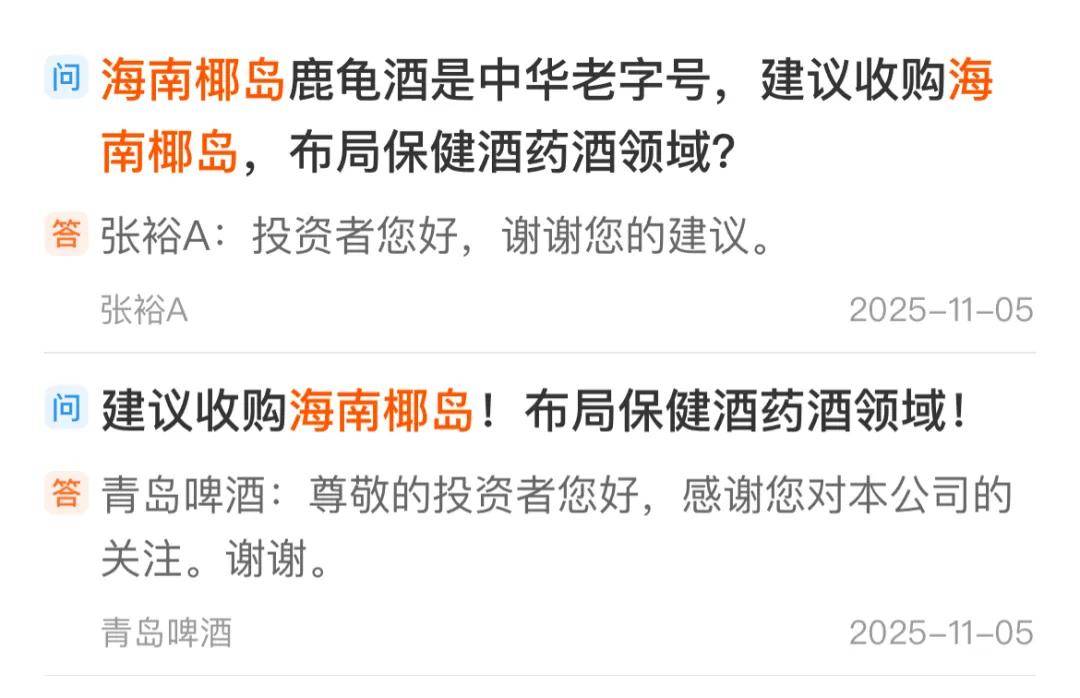
张裕收购海南椰岛?
Sou Hu Cai Jing· 2025-11-17 14:20
Core Viewpoint - The potential acquisition of Hainan Yedao by Zhangyu has sparked interest in the beverage industry, with investors suggesting this move to expand into the health wine sector. However, Zhangyu's secretary did not provide a direct response to the suggestion, indicating a cautious approach [1][3]. Group 1: Hainan Yedao's Business Performance - Hainan Yedao has seen a revenue increase, achieving 178 million yuan in total revenue for the first three quarters of 2025, a year-on-year growth of 8.75%. The sales revenue for its core products, the Deer Tortoise Wine series and the Sea King Wine series, reached 36.84 million yuan and 91.84 million yuan, with growth rates of 248.13% and 24.81% respectively [3][6]. - The health wine sector has gained popularity among younger consumers, with over 9 million new users aged 18-30 for health wines in the past year, indicating a significant expansion of the young consumer base [5][6]. Group 2: Zhangyu and Qingdao Beer’s Performance - Zhangyu reported a revenue of 2.116 billion yuan for the first three quarters of 2025, a decline of 3.70% year-on-year, with a net profit attributable to shareholders of only 1.917 million yuan, down 30.96% [11][12]. - Qingdao Beer experienced a revenue of 29.367 billion yuan for the first three quarters of 2025, with a modest growth of 1.41%. However, its total revenue for 2024 showed a decline of 5.30%, indicating pressure on its main beer business [7][8]. - Both companies are facing significant performance pressures, with Zhangyu's core wine products seeing a sales decline of 10.28% and Qingdao Beer experiencing a "volume and price drop" in its beer business [10][12]. Group 3: Strategic Considerations - The fragmented shareholding structure of Hainan Yedao lowers acquisition barriers and funding costs, making it an attractive target for companies like Zhangyu and Qingdao Beer, which are seeking growth opportunities [6][7]. - Zhangyu is looking to develop new markets and diversify its product offerings, which could align well with the health wine segment, providing a complementary strategy to mitigate risks associated with its core wine business [12][13].


“双11”线上赚吆喝,啤酒业却仍“增利难增收”?5家头部酒企掌门人揭秘破局关键
Mei Ri Jing Ji Xin Wen· 2025-11-17 10:40
Core Insights - The recent "Double 11" shopping festival saw significant sales growth in the beer market, with brands like Tsingtao, Budweiser, and Yanjing leading in sales on platforms like JD.com and Tmall [1][2] - Despite the online sales boom, the overall growth rate of beer manufacturers is slowing down, indicating a challenging environment for profit growth amidst fierce competition [1][5] - Industry leaders are focusing on product innovation and exploring new consumption scenarios to adapt to changing consumer demands and market dynamics [2][3][4] Industry Trends - The beer market is experiencing new growth characteristics influenced by economic conditions, demographic changes, and evolving consumer habits, particularly among Gen Z, single-person households, and the elderly [2][5] - Companies are launching regional specialty products and expanding their product lines to include non-beer beverages, aiming to capture new growth opportunities [2][4] - The shift towards high-end products remains a key focus, with companies like Carlsberg China emphasizing refined management and long-term strategies to meet consumer expectations for quality [3][6] Market Challenges - The beer industry faces pressures from overcapacity, demand slowdown, and price declines, leading to a competitive landscape where traditional consumption scenarios are weakening [5][7] - Companies are urged to innovate and adapt to new consumption environments, such as outdoor and urban settings, to remain relevant [5][6] - Financial reports indicate that major A-share beer companies experienced a total revenue of approximately 61.5 billion yuan and a net profit of about 9.3 billion yuan in the first three quarters, with some companies facing revenue declines [6][7] Future Outlook - Despite current challenges, the Chinese beer market is still viewed as having significant long-term growth potential, being the largest beer market globally [6][7] - Industry leaders stress the importance of collaboration and long-term investment in product innovation, quality enhancement, and consumer education to navigate the evolving market landscape [7]
2026年食品饮料行业投资策略:黎明前夕,曙光将至
Shenwan Hongyuan Securities· 2025-11-17 10:12
Summary of Key Points Group 1: Overall Industry Analysis - The report indicates a systemic recovery opportunity for the food and beverage industry in 2026 after a five-year adjustment period from 2021 to 2025, with key external indicators being the Consumer Price Index (CPI) and a focus on cyclical attributes in the liquor and catering supply chain [4][19]. - The liquor sector is expected to see a fundamental turning point in Q3 2026, following a significant decline in sales and prices in Q3 2025, with a projected stabilization and recovery in prices as inventory clears and demand rebounds [4][7][19]. - The report emphasizes that if the fundamentals recover as anticipated, a dual boost in valuation and performance is expected by the end of 2026 and into 2027, marking a strategic allocation period for quality companies [4][7][19]. Group 2: Liquor Investment Strategy - The liquor sector has experienced a significant decline in sales, with Q3 2025 showing a 50% year-on-year drop compared to Q3 2023, and high-end liquor prices continuing to fall as the market seeks a balance between volume and price [4][7][8]. - Key recommended companies in the liquor sector include Luzhou Laojiao, Shanxi Fenjiu, Kweichow Moutai, and Wuliangye, with a focus on strategic positioning for quality firms as the market stabilizes [4][7][8]. - Historical performance analysis from 2012 to 2015 suggests that stock price turning points often precede fundamental turning points, indicating a potential recovery in Q3 2026 [4][7][23]. Group 3: Consumer Goods Investment Strategy - The report identifies systemic opportunities in the consumer goods sector, with CPI as a core observation indicator, predicting gradual improvement in food CPI due to structural demand changes and a shift from price competition to quality competition among companies [4][19]. - Recommended companies in the consumer goods sector include Yili Group, Qingdao Beer, Anjuke Food, and Tianwei Food, with a focus on firms that possess pricing power and are positioned for systematic recovery if CPI continues to improve [4][19]. - The report highlights that if CPI improves consistently, leading companies in various sub-sectors will also experience systematic recovery [4][19].




