QILU BANK(601665)

Search documents
多家上市银行大股东或高管增持落地 或迎来估值修复
Zheng Quan Ri Bao· 2026-01-14 00:08
Core Viewpoint - The recent increase in shareholding by major shareholders and executives in several banks indicates confidence in the banking sector's development and potential valuation recovery [1][2][3]. Group 1: Shareholder Actions - Yunnan Rural Commercial Bank announced that six core executives collectively increased their holdings, buying 192,000 shares at prices between RMB 6.36 and RMB 6.42 per share [2]. - Nanjing Bank's major shareholder, Zijin Group, increased its stake by 123,472,060 shares, representing 1.00% of the total share capital [2]. - Qilu Bank's executives exceeded their planned share purchase, acquiring 771,000 shares for a total of RMB 4.48 million, surpassing the initial target of RMB 3.5 million [2]. Group 2: Market Signals - Analysts suggest that the increase in shareholding sends three key signals: it enhances the capital of listed banks, reflects shareholder confidence in future development, and may serve as a catalyst for valuation recovery [3]. - The actions of insurance companies, such as Ping An Life increasing their holdings in Agricultural Bank and China Merchants Bank, highlight a trend of insurance capital increasing their investments in bank stocks [4]. Group 3: Investment Outlook - The insurance sector is expected to inject over RMB 2 trillion into the market in 2026, with a growing demand for dividend-yielding assets, particularly state-owned banks offering over 4% dividend yields [4]. - Analysts from Galaxy Securities predict that the trend of long-term funds, represented by insurance capital, will continue to favor bank stocks due to their dividend characteristics and stable cash flow [5]. - Overall, the valuation of bank stocks remains low, suggesting potential for further appreciation in the sector [5].



多家上市银行大股东或高管增持落地
Zheng Quan Ri Bao· 2026-01-13 16:51
Core Viewpoint - The recent increase in shareholding by major shareholders and executives in several banks indicates confidence in the banking sector's development and potential for valuation recovery [1][3]. Group 1: Shareholder Actions - Yunnan Rural Commercial Bank announced that six core executives collectively increased their holdings by purchasing 192,000 shares at prices ranging from RMB 6.36 to 6.42 per share [2]. - Nanjing Bank reported that its major shareholder, Zijin Group, increased its stake by 123,472,060 shares, representing 1.00% of the total share capital [2]. - Qilu Bank's executives exceeded their planned share purchase, acquiring 771,000 shares for a total of RMB 4.48 million, surpassing the initial target of RMB 3.5 million [2]. Group 2: Market Signals - Analysts suggest that the increase in shareholding by major shareholders sends three key signals: it enhances the capital of listed banks, reflects confidence in future development and stock performance, and may serve as a catalyst for valuation recovery [3]. - The actions of insurance companies, such as Ping An Life, to increase holdings in major banks highlight a trend of institutional investment in the banking sector, driven by the attractive dividend yields of over 4% [4]. Group 3: Investment Outlook - The insurance sector is expected to inject over RMB 2 trillion into the market in 2026, with a growing demand for high-dividend assets, making state-owned banks attractive long-term investment targets [4]. - Analysts from Galaxy Securities maintain a positive outlook on the banking sector, anticipating continued interest from long-term funds, particularly from insurance capital [5]. - Industry insiders believe that the valuation of bank stocks remains low, suggesting potential for further appreciation [6].
齐鲁银行打造科创金融“齐鲁样本”
Zhong Guo Jin Rong Xin Xi Wang· 2026-01-13 10:21
Core Viewpoint - The development of technology finance is essential for banking institutions, and Qilu Bank has made significant strides in this area by enhancing its top-level design, institutional construction, and product innovation to support technology-driven enterprises [1][3]. Group 1: Technology Loans and Support - As of November 2025, Qilu Bank's technology loan balance reached 51.8 billion yuan, serving over 10,000 technology-based enterprises, including 66% of specialized and innovative enterprises and 86% of "little giant" companies in Jinan [1]. - Qilu Bank issued a 2 billion yuan technology innovation bond with a 5-year term and a coupon rate of 1.84%, achieving a subscription multiple of 4.37 times, reflecting strong market confidence in the bank's performance [2]. Group 2: Financial Service System - Qilu Bank has established a multi-level, specialized financial service system for technology innovation, incorporating technology finance into its three-year development plan and focusing on a "three specialization" strategy: specialized business, industry focus, and professional personnel [3]. - The bank has created a full lifecycle service plan with innovative products tailored to the development characteristics of technology enterprises, including research loans and various financial solutions recognized as exemplary practices by the People's Bank of China [3]. Group 3: Ecosystem and Comprehensive Services - Qilu Bank has developed an ecosystem service system beyond traditional finance, forming alliances to provide a one-stop service for technology enterprises, including asset evaluation, loan guarantees, and equity investments [4]. - The bank's comprehensive services have empowered over 600 technology enterprises, enhancing their growth ecosystem and positioning the bank to continue innovating in the integration of technology and finance [5].
城商行板块1月13日涨1.55%,宁波银行领涨,主力资金净流入2.38亿元
Zheng Xing Xing Ye Ri Bao· 2026-01-13 09:06
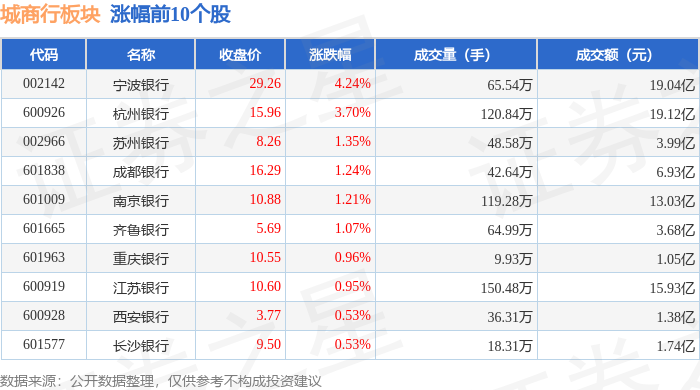
Core Insights - The city commercial bank sector experienced a rise of 1.55% on January 13, with Ningbo Bank leading the gains [1] - The Shanghai Composite Index closed at 4138.76, down 0.64%, while the Shenzhen Component Index closed at 14169.4, down 1.37% [1] Stock Performance - Ningbo Bank (002142) closed at 29.26, up 4.24%, with a trading volume of 655,400 shares and a transaction value of 1.904 billion [1] - Hangzhou Bank (600926) closed at 15.96, up 3.70%, with a trading volume of 1,208,400 shares and a transaction value of 1.912 billion [1] - Suzhou Bank (002966) closed at 8.26, up 1.35%, with a trading volume of 485,800 shares [1] - Chengdu Bank (601838) closed at 16.29, up 1.24%, with a trading volume of 426,400 shares and a transaction value of 693 million [1] - Nanjing Bank (600109) closed at 10.88, up 1.21%, with a trading volume of 1,192,800 shares and a transaction value of 1.303 billion [1] - Qilu Bank (601665) closed at 5.69, up 1.07%, with a trading volume of 649,900 shares and a transaction value of 368 million [1] - Chongqing Bank (601963) closed at 10.55, up 0.96%, with a trading volume of 99,300 shares and a transaction value of 10.5 million [1] - Jiangsu Bank (616009) closed at 10.60, up 0.95%, with a trading volume of 1,504,800 shares and a transaction value of 1.593 billion [1] - Xi'an Bank (600928) closed at 3.77, up 0.53%, with a trading volume of 363,100 shares and a transaction value of 13.8 million [1] - Changsha Bank (601577) closed at 9.50, up 0.53%, with a trading volume of 183,100 shares and a transaction value of 174 million [1] Capital Flow - The city commercial bank sector saw a net inflow of 238 million from institutional investors, while retail investors contributed a net inflow of 199 million [2] - The sector experienced a net outflow of 437 million from speculative funds [2] Individual Stock Capital Flow - Hangzhou Bank (600926) had a net inflow of 70.42 million from institutional investors, while it faced a net outflow of 12.4 million from speculative funds [3] - Shanghai Bank (601229) saw a net inflow of 66.71 million from institutional investors, with a net outflow of 33.15 million from speculative funds [3] - Ningbo Bank (002142) had a net inflow of 37.18 million from institutional investors, with a net outflow of 1.4 million from speculative funds [3] - Suzhou Bank (002966) experienced a net inflow of 34.87 million from institutional investors, while facing a net outflow of 24.25 million from speculative funds [3] - Jiangsu Bank (601577) had a net inflow of 20.83 million from institutional investors, with a net outflow of 15.24 million from speculative funds [3]





研报掘金丨长江证券:齐鲁银行长期重点推荐,维持“买入”评级
Ge Long Hui A P P· 2026-01-13 08:58
Core Viewpoint - Qilu Bank's stock price valuation has been significantly adjusted due to market trading factors since the third quarter of 2025, indicating a potential undervaluation of its long-term growth value [1] Group 1: Market Impact and Valuation - The stock price of Qilu Bank has been influenced by market trading factors, leading to a sufficient adjustment in its valuation [1] - The management team has recently completed a new round of stock buybacks, reinforcing the belief that the bank's long-term growth value is underestimated by the market [1] Group 2: Future Projections - Qilu Bank is set to enter a new three-year planning cycle in 2026, which may provide further growth opportunities [1] - Profit growth projections suggest that the dividend yield for 2025 and 2026 will be 4.65% and 5.20%, respectively, aligning with the needs of long-term investment funds [1] Group 3: Investment Recommendation - The bank is recommended as a long-term investment, maintaining a "buy" rating [1]
违规发放无实际用途贷款、虚增存贷款规模,齐鲁银行潍坊分行被罚
Qi Lu Wan Bao· 2026-01-13 07:35
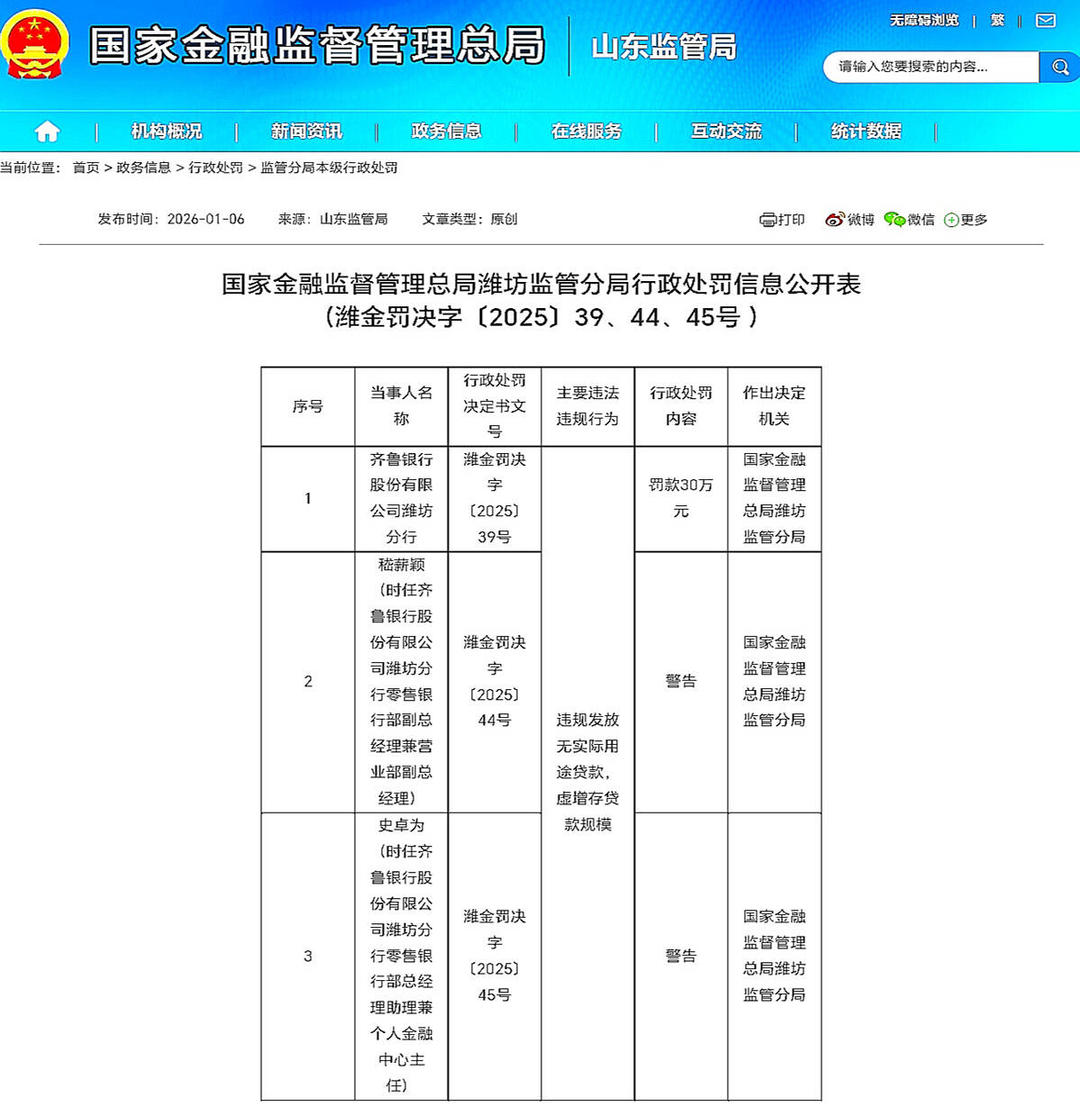
齐鲁晚报·齐鲁壹点 李国栋 近日,国家金融监督管理总局潍坊监管分局行政处罚信息公开表(潍金罚决字〔2025〕39、44、45号 )发布,齐鲁银行(601665)股份有限公司潍坊分 行因违规发放无实际用途贷款,虚增存贷款规模被罚30万元,同时,时任齐鲁银行股份有限公司潍坊分行零售银行部副总经理兼营业部副总经理,时任齐 鲁银行股份有限公司潍坊分行零售银行部总经理助理兼个人金融中心主任双双被警告。 | | 当事人名 | 行政处罚 | 主要违法 | 行政处罚 | 作出决定 | | --- | --- | --- | --- | --- | --- | | 序号 | 称 | 决定书文 | 违规行为 | 内容 | 机关 | | | | יס | | | | | | 齐鲁银行 | 潍金罚决 | | | 国家金融 | | 1 | 股份有限 | 字 | | 罚款30万 | 监督管理 | | | 公司潍坊 | (2025) | | 元 | 总局潍坊 | | | 分行 花 折颖 | 39름 | | | 监管分局 | | | (时任务 鲁银行股 | | | | | | | 份有限公 | 潍金罚决 | | | 国家金融 | | | 司 ...
齐鲁银行(601665):新三年的成长展望
Changjiang Securities· 2026-01-12 13:13
Investment Rating - The investment rating for Qilu Bank is "Buy" and is maintained [8] Core Views - Qilu Bank's stock price has undergone sufficient valuation adjustment since Q3 2025, influenced by market trading factors. The bank is entering a new three-year planning cycle in 2026, with management focusing on stable and sustainable growth. In the current macroeconomic environment, high-quality city commercial banks with stable growth capabilities are considered scarce assets. The bank is expected to achieve a trillion-scale asset size in the new three-year plan [5][11] - Loan growth is projected to be between 13% and 15% from 2025 to 2027, with a continuous increase in loan market share. Net interest income is expected to drive revenue growth. The long-term growth path is clear, and there is room for valuation recovery in PB-ROE [11][20] - The bank's dividend yield is expected to be 4.65% in 2025 and 5.20% in 2026, meeting the needs of long-term investors [11] Summary by Sections Company Overview - Qilu Bank has a long-standing management philosophy focused on stable and sustainable growth. The bank's asset scale has achieved an annual compound growth rate of 16.2% over the past three years, with profit growth at 16.9%, ranking among the top in the banking sector. The bank aims to reach a trillion in assets by 2027, requiring an annual growth rate of at least 12.2% over the next two years [11][20] Loan and Revenue Growth - The bank's loan growth is expected to be between 13% and 15% from 2025 to 2027. As of mid-2025, Qilu Bank's loan market share in Shandong province is 2.3%, indicating significant room for improvement compared to other leading city commercial banks. The bank's credit structure is primarily focused on state-owned enterprises, with retail loan demand remaining weak [11][20] Asset Quality - Qilu Bank's asset quality is at its best since its listing, with a continuous decline in non-performing loan (NPL) ratios and a net NPL generation rate dropping to a historical low of 0.31% (annualized) in the first half of 2025. The bank's credit cost is expected to decrease further, allowing for double-digit profit growth in 2026 [11][20] Valuation and Dividend - The bank's PB valuation is projected to be 0.71x in 2025 and 0.65x in 2026, indicating undervaluation relative to a 12% ROE. The bank may slightly increase its dividend payout ratio in 2025 to offset the dilution effect of convertible bonds, with expected dividend yields of 4.65% and 5.20% for 2025 and 2026, respectively [11][20]
银行业周度追踪2026年第1周:如何理解银行股开年调整?-20260112
Changjiang Securities· 2026-01-12 04:41
Investment Rating - The investment rating for the banking sector is "Positive" and is maintained [12]. Core Insights - In the first week of 2026, the banking sector continued to adjust, with a cumulative decline of 1.9% in the banking index, significantly underperforming the CSI 300 and ChiNext indices by -4.7% and -5.8% respectively. Despite this, the fundamental expectations for the sector remain unchanged, and the market's risk appetite has notably increased [2][6][19]. - The main banks are expected to maintain stable growth in performance throughout 2026. Following recent adjustments, the PB-ROE valuation attractiveness of bank stocks has further increased, suggesting a favorable timing for allocation [2][6][19]. Summary by Sections Market Performance - The banking sector's performance in the first week of 2026 showed a cumulative decline of 1.9%, with significant negative excess returns compared to the CSI 300 and ChiNext indices [6][19]. - Individual stocks such as Chongqing Rural Commercial Bank saw price recovery after management uncertainties were resolved, while stable performers like Hangzhou Bank led the city commercial bank sector [2][6][19]. Fundamental Analysis - The banking sector's performance has been influenced by structural concerns, particularly regarding real estate and retail asset quality. Despite these concerns, overall performance remains stable with steady growth [8][37]. - The LTV (Loan-to-Value) ratios for major banks are stable at 40%-50%, providing a safety margin despite rising asset quality pressures in mortgage loans [8][37]. Trading Dynamics - The increase in market risk appetite has continued to suppress bank stock valuations. Historically, January has seen excess returns for bank stocks, but this year, the rapid recovery in market sentiment has led to underperformance [9][38]. - The report recommends focusing on high-quality city commercial banks such as Hangzhou Bank, Nanjing Bank, and Jiangsu Bank, as well as dividend-oriented assets like Bank of Communications and China Merchants Bank [9][38]. Convertible Bonds - The prices of convertible bonds linked to bank stocks have generally followed the sector's adjustment, with the distance to mandatory conversion prices widening. The report highlights potential trading opportunities in convertible bonds for banks like Changshu Bank and Shanghai Bank, which have stable fundamental performance expectations [7][32].

齐鲁银行威海分行被罚 流动资金贷款贷后管理不到位
Zhong Guo Jing Ji Wang· 2026-01-09 07:24
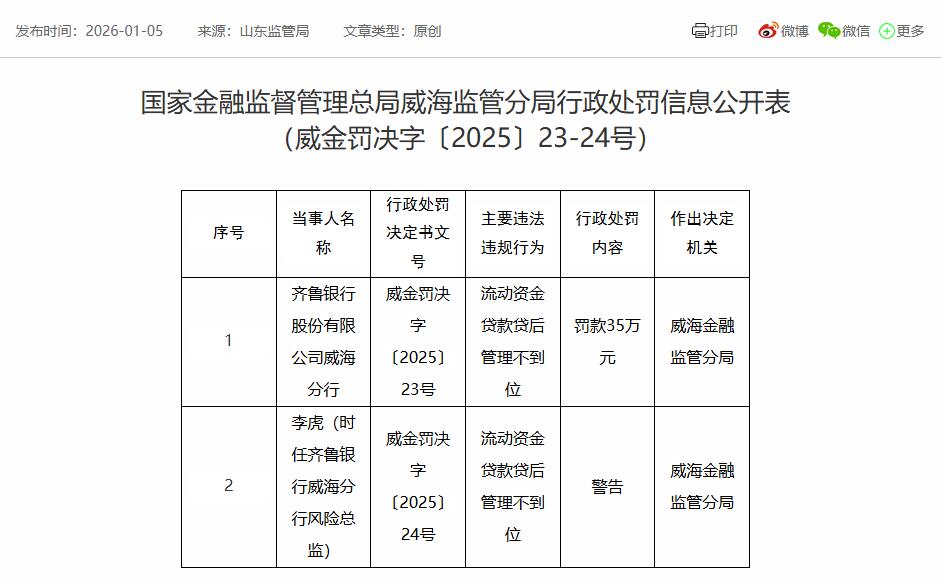
Group 1 - The core viewpoint of the article is that Qilu Bank's Weihai branch has been penalized for inadequate post-loan management of working capital loans, resulting in a fine of 350,000 yuan [1][2] - The administrative penalty decision indicates that the financial regulatory authority in Weihai has taken action against Qilu Bank for its failure to manage loans properly [1][2] - Li Hu, the risk director of Qilu Bank's Weihai branch at the time, received a warning due to the same issue of inadequate loan management [1][2]
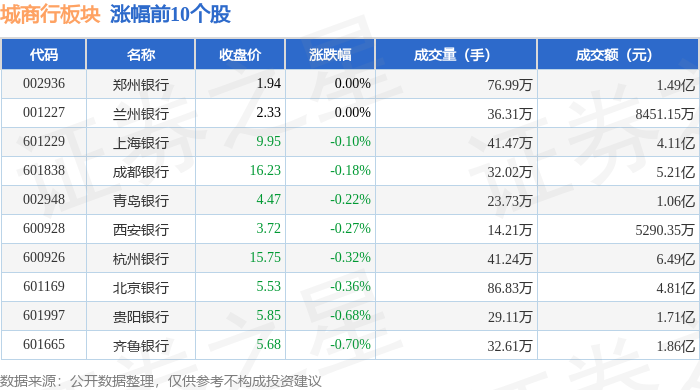
城商行板块1月8日跌0.89%,重庆银行领跌,主力资金净流入673.97万元
Zheng Xing Xing Ye Ri Bao· 2026-01-08 08:56
Market Overview - The city commercial bank sector experienced a decline of 0.89% on January 8, with Chongqing Bank leading the drop [1] - The Shanghai Composite Index closed at 4082.98, down 0.07%, while the Shenzhen Component Index closed at 13959.48, down 0.51% [1] Individual Stock Performance - Zhengzhou Bank closed at 1.94 with no change, while Lanzhou Bank also remained unchanged at 2.33 [1] - Shanghai Bank closed at 9.95, down 0.10%, and Chengdu Bank closed at 16.23, down 0.18% [1] - Chongqing Bank saw a significant decline of 2.70%, closing at 10.45, with a trading volume of 99,000 shares [2] Trading Volume and Turnover - The trading volume for Zhengzhou Bank was 769,900 shares with a turnover of 149 million yuan, while Lanzhou Bank had a trading volume of 363,100 shares and a turnover of 84.51 million yuan [1] - The highest turnover was recorded for Nanjing Bank at 1.342 billion yuan with a trading volume of 1,217,000 shares [2] Capital Flow Analysis - The city commercial bank sector saw a net inflow of 6.7397 million yuan from institutional investors, while retail investors experienced a net outflow of 70.5351 million yuan [2] - Chengdu Bank had a net inflow of 87.0825 million yuan from institutional investors, but a net outflow of 46.0321 million yuan from retail investors [3] Summary of Capital Flows - Institutional investors showed a positive net flow for several banks, including Hangzhou Bank with 77.8301 million yuan and Qingdao Bank with 8.4480 million yuan [3] - Conversely, Chongqing Bank had a negative net flow of 535,600 yuan from institutional investors, indicating a lack of confidence [3]