QILU BANK(601665)

Search documents
齐鲁银行业绩快报:2025年度归母净利润57.13亿元,同比增长14.58%
Ge Long Hui· 2026-02-04 10:05
格隆汇2月4日丨齐鲁银行(601665.SH)公布2025年度业绩快报,报告期内,本行实现营业收入131.35亿 元,同比增长5.12%;其中净息差1.53%,同比提高2BP,量价齐升带动利息净收入实现105.19亿元,同 比增长16.48%;归属于上市公司股东的净利润57.13亿元,同比增长14.58%。资产利润率0.76%,保持平 稳;加权平均净资产收益率12.17%,同比下降0.35个百分点;基本每股收益1.00元,同比增长3.09%。 ...
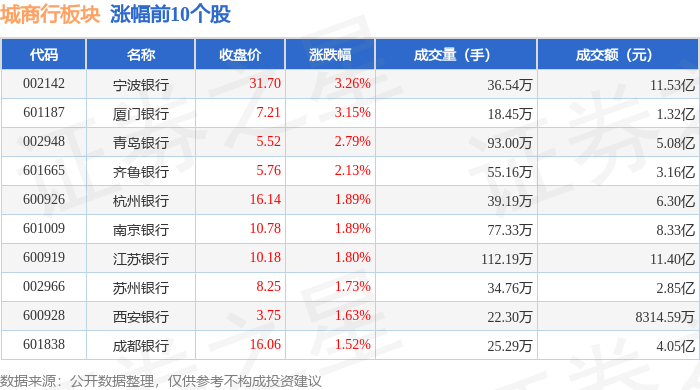
城商行板块2月4日涨1.9%,宁波银行领涨,主力资金净流入1.28亿元
Zheng Xing Xing Ye Ri Bao· 2026-02-04 08:56
Group 1 - The city commercial bank sector increased by 1.9% on February 4, with Ningbo Bank leading the gains [1] - The Shanghai Composite Index closed at 4102.2, up 0.85%, while the Shenzhen Component Index closed at 14156.27, up 0.21% [1] - Key individual stock performances included Ningbo Bank at 31.70 with a rise of 3.26%, Xiamen Bank at 7.21 with a rise of 3.15%, and Qingdao Bank at 5.52 with a rise of 2.79% [1] Group 2 - The net inflow of main funds in the city commercial bank sector was 128 million yuan, while retail funds saw a net inflow of 67.65 million yuan [1] - The table of fund flows indicated that Ningbo Bank had a main fund net inflow of 1.15 billion yuan, while retail funds experienced a net outflow of 1.34 billion yuan [2] - Jiangsu Bank had a main fund net inflow of 38.95 million yuan, but retail funds saw a net outflow of 73.94 million yuan [2]



A股银行股集体上涨,渝农商行涨超2%
Ge Long Hui A P P· 2026-02-04 01:57
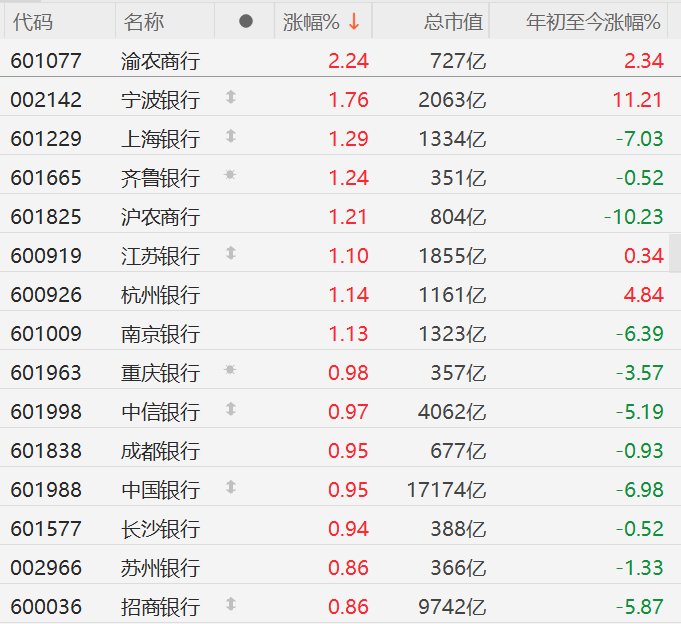
Group 1 - A-shares of bank stocks collectively rose, with notable increases in stocks such as Chongqing Rural Commercial Bank, which rose over 2%, and several others including Ningbo Bank, Shanghai Bank, and Qilu Bank, which rose over 1% [1] - Specific stock performance includes Chongqing Rural Commercial Bank increasing by 2.24% with a total market value of 72.7 billion, and Ningbo Bank rising by 1.76% with a market value of 206.3 billion [2] - The year-to-date performance shows significant variations, with Ningbo Bank up 11.21%, while Shanghai Bank down 7.03%, and Hu'nong Commercial Bank down 10.23% [2] Group 2 - The MACD golden cross signal has formed, indicating a positive trend for these bank stocks [2]


黄金白银继续暴跌 轮到银行股机会了?
Di Yi Cai Jing· 2026-02-04 01:02
Core Viewpoint - The A-share market experienced significant declines in various sectors, particularly in metals and banks, with a notable focus on bank stocks as a safe haven amid volatility in precious metals prices [1][3][4]. Group 1: Market Performance - On February 2, A-share non-ferrous metals led the decline with a drop of 7.62%, while steel, chemicals, coal, and oil and gas sectors also fell over 5% [1]. - The Shanghai Composite Index closed down 2.48%, with over 4,600 stocks declining and a trading volume of approximately 2.61 trillion yuan, a decrease of nearly 250 billion yuan from the previous trading day [3][4]. - The banking sector showed resilience, with certain banks like Citic Bank and Shanghai Bank posting gains of 2.64% and 1.62%, respectively, amidst the overall market downturn [4]. Group 2: Bank Sector Analysis - The banking sector has seen a significant correction, with the China Securities Bank Index dropping 6.76% as of January 30, with major banks like Pudong Development Bank and Agricultural Bank of China experiencing declines of 19.29% and 12.5%, respectively [4][5]. - Analysts believe that the peak of fund outflows from the banking sector has passed, with the sector's valuation becoming more attractive, as the median price-to-book (PB) ratio is around 0.57 and the median dividend yield has risen to over 4.5% [5][6]. - Recent reports indicate that passive fund outflows have been a major factor in the banking sector's recent adjustments, but the selling pressure is expected to diminish, allowing for potential recovery in bank stock prices [6][7]. Group 3: Institutional Insights - Institutions are starting to show interest in bank stocks, with reports indicating that active funds had reduced their holdings in bank stocks by 1.3 billion shares by the end of the fourth quarter [7]. - Several regional banks have announced stock buyback plans, which have been positively received by the market, reinforcing confidence in the banking sector's fundamentals [7].




泰山榜|山东银行版图透视:法人机构219家,一二级分行总数达420家
Xin Lang Cai Jing· 2026-02-03 23:55
Core Viewpoint - Shandong Province aims to reform and restructure rural commercial banks and village banks while deepening internal control and risk management actions in urban commercial banks, highlighting the importance of a well-distributed financial service network for regional economic vitality and development potential [2]. Financial Institutions Overview - As of now, Shandong Province has a total of 219 banking legal entities, including 170 first-level branches and 250 second-level branches, with a total of 639 headquarters and branches, supported by 14,700 other outlets [2]. - The core components of Shandong's banking industry include joint-stock banks, urban commercial banks, and rural commercial banks, which work collaboratively to outline a clear regional banking landscape [2]. Joint-Stock Banks - Joint-stock banks play a pivotal role in Shandong's banking sector, characterized by a "leading head, focused core, and precise efforts" strategy, connecting national financial markets with local economies [3][4]. - As of September 2025, Hengfeng Bank, the only national joint-stock commercial bank with independent legal status in Shandong, has total assets of 1.568726 trillion yuan, nearing the 1.6 trillion yuan mark [4]. - National joint-stock banks have established 25 first-level branches and 119 second-level branches in Shandong, with a notable presence in Jinan, Qingdao, and Yantai [4]. Urban Commercial Banks - Urban commercial banks are essential local financial institutions in Shandong, leveraging geographical and service advantages to empower local economies and improve livelihoods [5][6]. - Shandong has 14 local urban commercial banks, including Qilu Bank and Qingdao Bank, along with branches from three non-local urban commercial banks, forming a comprehensive service matrix across the province [5]. Rural Commercial Banks - Rural commercial banks are the most numerous banking entities in Shandong, with 110 institutions focused on serving rural areas and supporting agricultural development [7][8]. - These banks provide a full range of financial services, effectively addressing issues of financing difficulties in rural regions [7]. - Additionally, 91 village banks complement rural commercial banks by extending financial services to remote areas, creating a multi-layered and comprehensive rural financial service system [8]. Future Outlook - Despite facing challenges such as smaller scales and weaker risk resistance, rural commercial banks in Shandong are deepening reforms and enhancing service capabilities, with asset quality steadily improving [8]. - Experts suggest that the three banking groups—joint-stock banks, urban commercial banks, and rural commercial banks—should continue to leverage their strengths and address development challenges to support high-quality economic growth and rural revitalization in Shandong [8].




丈量地方性银行(2):浙江163家区域性银行全梳理-20260203
GF SECURITIES· 2026-02-03 13:31
Investment Rating - The industry investment rating is "Buy" [2] Core Insights - The report provides a comprehensive analysis of 163 regional banks in Zhejiang Province, highlighting their asset and liability structures, profitability, and asset quality [6][20] - The asset growth rate for major city commercial banks in Zhejiang is 9.4%, which is lower than the 14.2% growth rate of listed city commercial banks, while major rural commercial banks show an asset growth rate of 8.0%, exceeding the 6.7% growth rate of listed rural commercial banks [6][25] - The report indicates that the loan-to-asset ratio for city commercial banks is projected to reach 55.5% in 2024, an increase of 95 basis points year-on-year, while rural commercial banks will see a decrease to 59.3%, down 19 basis points [31] - Profitability metrics show that the average Return on Assets (ROA) for city commercial banks in Zhejiang is 0.78%, slightly above the average of listed city commercial banks, while rural commercial banks have an average ROA of 0.82%, which is below the average of listed rural commercial banks [6][31] - The asset quality of regional banks in Zhejiang is reported to be better than that of listed banks, with non-performing loan ratios lower by 16 basis points for city commercial banks and 9 basis points for rural commercial banks compared to their listed counterparts [6][31] Summary by Sections Section 1: Economic Structure of Zhejiang Province - Zhejiang Province is focused on high-quality development and aims to become a model for common prosperity [13] - The province's GDP is heavily concentrated in cities like Hangzhou, Ningbo, and Wenzhou, with Hangzhou accounting for 24.3% of the total GDP in 2025 [15] Section 2: Overview of 163 Regional Banks - The report categorizes the banks into city commercial banks, rural banks, and others, with a total of 163 banks in the region [20] - The distribution of registered capital among these banks is relatively balanced, with 63 banks having over 500 million yuan in registered capital [22] Section 3: Asset and Liability Structure - The asset growth of major city and rural commercial banks has been declining since 2019, with city banks showing a growth rate of 9.4% in the first half of 2025 [25] - The liability structure indicates that customer deposits account for 77.5% of liabilities for city commercial banks, which is higher than the 66.2% for listed city banks [44] Section 4: Profitability and Asset Quality - The average ROE for city commercial banks in Zhejiang is 11.98%, slightly lower than the average of listed city banks [6][31] - The report highlights that the non-performing loan ratio for city commercial banks is lower than that of listed banks, indicating better asset quality [6][31]


机构1月调研动向曝光!银行业调研热度上升
证券时报· 2026-02-03 10:52
Group 1 - In January 2026, over 600 A-share listed companies were surveyed by institutions, indicating a high level of interest in investment opportunities in the A-share market [1][3] - The sectors that attracted the most attention included electronics, machinery, pharmaceuticals, power equipment, and computers, with a notable increase in the banking sector's activity [1][8] - Jiemai Technology was the most frequently surveyed company, with over 10 surveys conducted in January, highlighting the interest from various types of institutions including public funds, private funds, and foreign capital [3][4] Group 2 - Ice Wheel Environment and Taihe New Materials also received significant attention, each with over 10 surveys, discussing their product developments and market strategies [4][5] - The banking sector saw a marked increase in survey activity, with institutions like Hu Nong Commercial Bank and Suzhou Bank outlining their credit strategies and growth plans for 2026 [7][9] - Hu Nong Commercial Bank emphasized a balanced approach to risk while setting aggressive credit targets, focusing on major projects and green transformation initiatives [9][10]


积极布局民营经济新路径
Qi Lu Wan Bao· 2026-02-03 09:28
Core Insights - Qilu Bank has demonstrated strong performance in its 2025 mid-year results, focusing on creating a comprehensive financial service ecosystem to support private enterprises in overcoming financing challenges [1] - The bank aims to be a key player in serving the private economy by innovating the "industry service circle" to eliminate invisible financing barriers, thus enabling private enterprises to operate with greater confidence [1] Group 1: Financial Innovations and Support - Qilu Bank has launched a "blue cold chain industry chain financial solution" to address funding bottlenecks in the cold chain logistics sector, particularly for a leading enterprise in the region [3][4] - The bank provided 50 million yuan in online trade financing to a supply chain management company, specifically for expanding procurement of high-demand seafood, reducing financing costs by 1.5 percentage points and saving 750,000 yuan annually [3] - The bank has approved a total of 140 million yuan in trade financing for five compliant and high-growth seafood processing companies, significantly increasing the utilization rate of cold storage facilities [4] Group 2: Technology and Innovation Financing - Qilu Bank has introduced the "Science and Technology Loan" product to support technology-driven enterprises, successfully providing 3 million yuan to a company with a new order exceeding 90 million yuan [5][6] - The bank has developed a credit evaluation system based on big data for technology enterprises, allowing for a comprehensive assessment of their capabilities and potential, thus transforming their technological strengths into tangible assets [6] - As of June, the balance of technology loans at Qilu Bank's Liaocheng branch reached 2.18 billion yuan, reflecting a 30% increase since the beginning of the year [6] Group 3: Accounts Receivable Financing - Qilu Bank has launched the "No Recourse Domestic Factoring (Quanxin Chain)" service to provide easier financing options for small and micro enterprises facing challenges with accounts receivable [7] - The bank facilitated over 500,000 yuan in financing for two private medical technology companies to help them manage cash flow issues related to delayed receivables [7][8] - The "Quanxin Chain" product has issued loans exceeding 760 million yuan to over 170 private enterprises, effectively addressing the financing difficulties associated with accounts receivable [8]
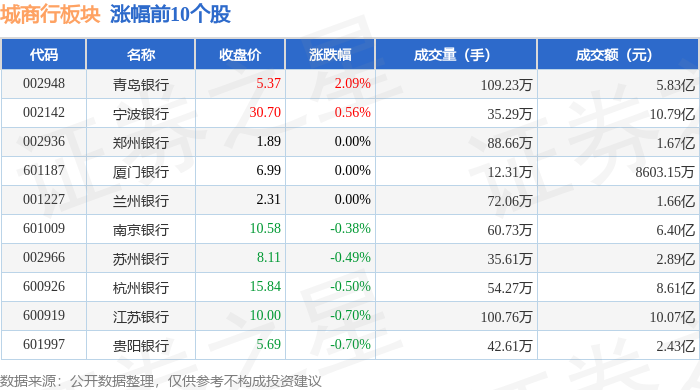
城商行板块2月3日跌0.59%,重庆银行领跌,主力资金净流入1.74亿元
Zheng Xing Xing Ye Ri Bao· 2026-02-03 09:03
| 代码 | 名称 | 收盘价 | 涨跌幅 | 成交量(手) | 成交额(元) | | --- | --- | --- | --- | --- | --- | | 601963 | 重庆银行 | 10.18 | -1.83% | 12.29万 | 1.25亿 | | 601838 | 成都银行 | 15.82 | -1.62% | 44.70万 | 7.10亿 | | 601665 | 齐鲁银行 | 5.64 | -1.57% | 74.37万 | 4.21亿 | | 601169 | 北京银行 | 5.28 | -1.31% | 196.28万 | 10.39亿 | | 601229 | 上海银行 | 9.27 | -1.28% | 53.77万 | 4.98亿 | | 601577 | 长沙银行 | 9.56 | -0.93% | 19.60万 | 1.87亿 | | 600928 | 西安银行 | 3.69 | -0.81% | 24.44万 | 9033.50万 | | 601997 | 贵阳银行 | 5.69 | -0.70% | 42.61万 | 2.43亿 | | 616009 | 江苏银行 | ...
机构扎堆调研上市银行 信贷投放、净息差等为“最关注”
Xin Lang Cai Jing· 2026-02-02 22:57
Core Viewpoint - The article highlights the ongoing institutional research on listed banks in January, focusing on credit issuance, net interest margin, asset quality trends, and bond investment strategies during the peak marketing season [1][2][7]. Group 1: Institutional Research and Credit Issuance - A total of 373 institutions conducted research on 11 A-share listed banks, with 49 research instances recorded by January 31 [1][7]. - The banks under review include Nanjing Bank, Ningbo Bank, Shanghai Bank, and others, with Nanjing Bank being the most favored, receiving 76 institutional inquiries [2][8]. - Institutions are particularly focused on credit issuance during the marketing peak, with many banks reporting better performance compared to the same period in 2025 [2][8]. - Key areas for credit issuance include manufacturing, infrastructure construction, and green low-carbon transformation projects [3][9]. Group 2: Net Interest Margin Stability - Net interest margin (NIM) is a critical indicator of banking performance, with banks focusing on stabilizing NIM through asset and liability management [4][11]. - Shanghai Bank anticipates a slight decline in NIM due to the expected decrease in loan market quotation rates (LPR) and competitive pressures on deposit pricing [11][12]. - Qilu Bank is optimizing its asset portfolio and enhancing low-cost deposit acquisition to stabilize NIM [11][12]. Group 3: Bond Investment Strategies - The bond market has been volatile since 2025, affecting the bond investment returns of regional small and medium-sized banks [6][12]. - Shanghai Bank expects bond rates to remain in a fluctuating range in 2026, with limited potential for a trend reversal [6][13]. - Hu Nong Bank plans to focus on bond investment for asset allocation while employing risk management strategies, including the use of derivatives [6][13]. Group 4: Asset Quality Management - Banks are implementing measures to maintain stable asset quality, including improving the quality of new loans and increasing efforts to manage non-performing loans [6][13].