
QILU BANK(601665)

Search documents
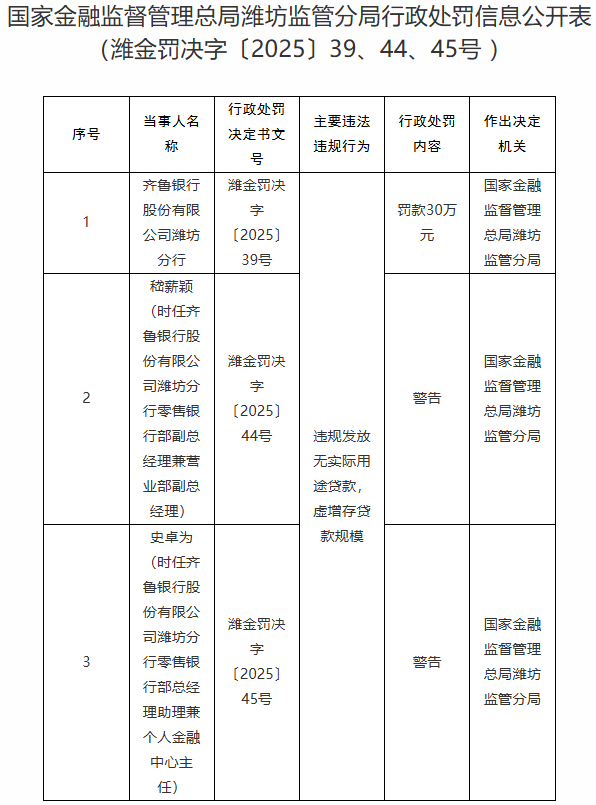
齐鲁银行潍坊分行被罚 违规发放无实际用途贷款等
Zhong Guo Jing Ji Wang· 2026-01-08 06:36
Core Viewpoint - The Weifang branch of Qilu Bank has been penalized for issuing loans without actual purpose and inflating its deposit and loan scale, resulting in a fine and warnings for key personnel [1][2]. Group 1: Regulatory Actions - The Weifang Regulatory Bureau of the National Financial Supervision Administration imposed a fine of 300,000 yuan on Qilu Bank's Weifang branch for regulatory violations [1]. - Warnings were issued to two key personnel: Ji Xinying, the Deputy General Manager of the Retail Banking Department, and Shi Zhaowei, the Assistant General Manager of the Retail Banking Department [1][2]. Group 2: Violations - The main violation involved the issuance of loans that had no actual purpose, which contributed to the inflation of the bank's deposit and loan figures [1][2].

按揭、信用卡、消费贷与经营贷深度:深度银行四大零售资产的风险分析框架
ZHONGTAI SECURITIES· 2026-01-07 11:17
Investment Rating - The report maintains an "Overweight" rating for the banking sector [2] Core Insights - The four categories of retail loans (mortgages, credit cards, consumer loans, and business loans) collectively constitute household liabilities, each with distinct collateral types, duration structures, and policy influences. The report aims to establish a risk framework for these retail assets and assess their impact on banking operations in the future [2][4] - Under stress testing, the non-performing loan (NPL) ratios for mortgages, credit cards, and consumer loans are projected to increase by 11, 12, and 20 basis points respectively in 2026, while the growth in non-performing amounts remains manageable. The overall quality of corporate assets is expected to continue improving, indicating a stable banking sector [2][4] - Retail asset risks are deemed controllable, with policies expected to maintain stability in the near term [2] Summary by Sections Retail Asset Analysis Framework: Collateral Types + Duration Structure + Policy Impact - The overall NPL ratio for retail loans of listed banks is estimated at 1.27% in the first half of 2025, slightly above the corporate NPL ratio of 1.26%, but the increase in NPL ratios is stabilizing. The composition of existing NPLs is 63% corporate and 37% retail, with business loans and mortgages showing higher proportions of both existing and newly added NPLs [2][12] - The report establishes a risk analysis framework for retail assets, highlighting the differences in collateral types, duration structures, and policy impacts among the four categories of retail loans [2][4] Consumer Loans: "High-Risk" Assets - The relationship between consumer loans and consumption trends is closely aligned, with notable deviations occurring during strict property purchase restrictions and regulatory cycles for online loans. The market structure for consumer credit (excluding credit cards and mortgages) shows that listed banks hold over 51.5% of the market, while non-listed banks account for 17% and other players for 31% [2][4] - The risk logic for consumer credit indicates that risk pricing is primarily determined by interest rates, which can be categorized into four tiers based on risk levels. The report estimates that 4.4% of consumer loans fall into the "high-risk" category, with commercial banks' high-risk consumer loans representing only 0.6% of their total consumer loans [2][4] Mortgage Loans: Risk Sources and International Comparisons - The primary sources of mortgage risk include negative cash flow and high loan-to-value (LTV) ratios, with 1.2% of respondents reporting monthly incomes below their mortgage payments. The report anticipates that the current high LTV portion, which constitutes 2.9% of total mortgage balances, will not necessarily lead to increased NPLs [2][4] - International comparisons indicate that mortgage NPL ratios in most countries remain below 2%, suggesting that the risks in the domestic market are manageable [2][4] Business Loans: High-Risk Assets - The report estimates that approximately 2 trillion yuan of high-risk business loans were outstanding at the end of 2021, with nearly one-third of these high-risk assets already exposed. The peak of risk exposure is expected in 2024 and the first half of 2025, with NPL ratios projected to rise by 18 basis points to 1.96% under stress testing conditions [2][4] Credit Cards: Early NPL Exposure - Credit cards have historically shown early exposure to NPLs, with the NPL ratio at 2.44% in the first half of 2025. The report notes that the net increase in credit card NPLs has significantly decreased, indicating that credit cards are not currently a major pressure point for banks [2][4] Investment Recommendations - The report suggests two main investment lines for bank stocks: focusing on regional banks with strong certainty and advantages, particularly in areas like Jiangsu, Shanghai, Chengdu, Shandong, and Fujian, and recommending large banks with high dividend yields such as Agricultural Bank, Construction Bank, and Industrial and Commercial Bank [2][4]




城商行板块1月7日涨0%,杭州银行领涨,主力资金净流出1.7亿元
Zheng Xing Xing Ye Ri Bao· 2026-01-07 08:58
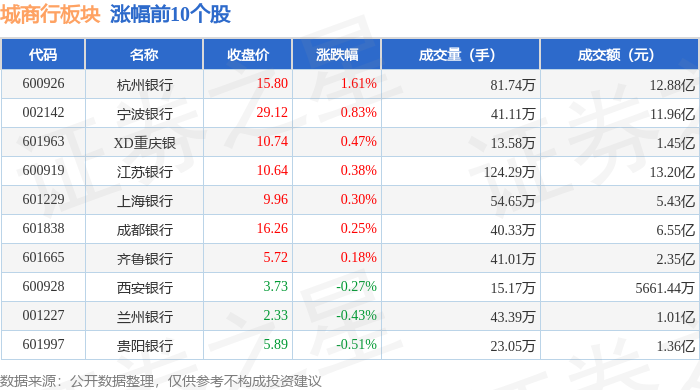
Market Performance - The city commercial bank sector experienced a slight increase of 0.0% on January 7, with Hangzhou Bank leading the gains [1] - The Shanghai Composite Index closed at 4085.77, up 0.05%, while the Shenzhen Component Index closed at 14030.56, up 0.06% [1] Individual Stock Performance - Hangzhou Bank (600926) closed at 15.80, with a rise of 1.61% and a trading volume of 817,400 shares [1] - Ningbo Bank (002142) closed at 29.12, up 0.83%, with a trading volume of 411,100 shares [1] - Other notable performances include Jiangsu Bank (601963) at 10.64 (+0.38%) and Shanghai Bank (601229) at 9.96 (+0.30%) [1] Capital Flow Analysis - The city commercial bank sector saw a net outflow of 170 million yuan from institutional investors, while retail investors contributed a net inflow of 188 million yuan [2] - The overall capital flow indicates a mixed sentiment, with institutional investors withdrawing funds while retail investors increased their positions [2] Detailed Capital Flow by Bank - Jiangsu Bank had a net inflow of 123 million yuan from institutional investors, while retail investors saw a net outflow of 27 million yuan [3] - Hangzhou Bank experienced a net inflow of 84 million yuan from institutional investors, but retail investors had a significant outflow of 132 million yuan [3] - Chengdu Bank recorded a net inflow of 55 million yuan from institutional investors, with retail investors also experiencing a net outflow [3]



齐鲁银行注册资本增至61.5亿元
Zheng Quan Ri Bao Wang· 2026-01-06 13:53
Core Viewpoint - Qilu Bank has recently increased its registered capital from approximately 4.71 billion to about 6.15 billion yuan, indicating a significant capital expansion [1] Group 1 - The registered capital of Qilu Bank has been raised by approximately 29.2% [1] - The new registered capital stands at around 6.15 billion yuan [1] - The previous registered capital was approximately 4.71 billion yuan [1]
银行业2026年度策略:新起点下的结构性机遇
China Post Securities· 2026-01-06 08:23
Core Insights - The report maintains a strong market rating for the banking sector, highlighting structural opportunities amid a new economic starting point in 2026 [3][5] - The macroeconomic environment is expected to support credit growth, with fiscal policies becoming more proactive and monetary policies remaining moderately accommodative [3][4] - The banking sector is anticipated to experience a stabilization in net interest margins, with a narrowing space of less than 5 basis points expected in 2026 [4][40] Macroeconomic Fundamentals - The GDP growth target for 2026 is projected to remain stable at around 5%, supported by structural improvements in financing demand from enterprises and households [12][14] - The fiscal deficit rate is expected to increase from 4% in 2025, with proactive fiscal policies aimed at stabilizing growth and expectations [14][16] - Monetary policy will continue to be moderately accommodative, with social financing growth expected to maintain above 8% [16][17] Industry Core Policy Guidance - Regulatory bodies are focusing on protecting net interest margins, with measures in place to guide banks in pricing management and alleviate margin pressures [25][26] - New supportive policies, including interest subsidies for personal consumption loans, are expected to create favorable asset deployment scenarios for banks [27][28] - Capital supplementation policies are being optimized to enhance banks' credit expansion capabilities and risk resilience [28][29] 2026 Profitability Outlook - Corporate loan growth is expected to be a key driver of credit expansion, while retail credit improvements will depend on policy support for income and consumption [4][34] - The net interest margin is projected to stabilize, with a potential bottoming out in 2026, supported by regulatory measures and market conditions [40][41] - Fee income is anticipated to recover, particularly for city commercial banks, as market sentiment improves [42][43] 2026 Asset Quality Outlook - The overall asset quality of the banking sector is expected to stabilize, with non-performing loan ratios remaining low for corporate lines, while retail lines may still face risks [4][20] - The trend of provisioning coverage is expected to improve, providing banks with more flexibility in managing their asset quality [20][21] 2026 Industry Landscape Outlook - Differentiation among banks is likely to become a dominant theme, with larger banks expected to see more stable revenue growth compared to smaller banks facing complex operating environments [4][5] - Regional economic vitality will significantly influence the performance of local banks, with areas of strong economic growth presenting better investment opportunities [5][6] Investment Recommendations - The insurance sector is projected to see over 2 trillion yuan in new market funds in 2026, increasing demand for high-dividend assets [5] - Focus on state-owned banks with stable operations, such as Industrial and Commercial Bank of China and China Construction Bank, as attractive investment targets [5] - Attention should be given to regional banks in economically vibrant areas, such as Jiangsu Bank and Chongqing Bank, which are expected to perform well [5][6]



齐鲁银行股份有限公司 关于董事、监事、高级管理人员等自愿增持股份计划实施完毕的公告
Zhong Guo Zheng Quan Bao - Zhong Zheng Wang· 2026-01-06 07:58
Core Viewpoint - The company announces a share buyback plan by certain directors, supervisors, and senior management, which has been successfully completed with a total investment exceeding the initial target [2][5]. Group 1: Buyback Plan Overview - The buyback plan is set to occur from September 16, 2025, to December 31, 2025, with a minimum investment of RMB 3.5 million [2][4]. - The buyback is conducted through the Shanghai Stock Exchange using a centralized bidding method [4]. Group 2: Implementation Results - As of December 31, 2025, the buyback resulted in the acquisition of 771,000 shares, totaling an investment of RMB 4.4822 million, which is 128% of the planned amount [5]. - Post-implementation, the total shares held by the buyback participants increased to 2.2113 million, representing 0.04% of the company's total share capital [5]. Group 3: Participants' Background - The buyback participants include certain directors, supervisors, senior management, and key personnel from the head office and branches [3]. - Before the buyback, these participants collectively held 1.4403 million shares, accounting for 0.02% of the company's total share capital [3]. Group 4: Compliance and Regulations - The implementation of the buyback plan complies with relevant laws, regulations, and the rules of the Shanghai Stock Exchange [6].
2026年银行业投资策略:净息差周期拐点与银行业资产配置价值重估
HUAXI Securities· 2026-01-06 07:50
Group 1 - The banking sector is expected to see a stabilization in net interest margins in 2026, driven by a peak in deposit re-pricing and a favorable loan rate environment [6][70][75] - The overall banking index increased by 7% in 2025, with H-shares and state-owned banks leading the gains, although the banking index underperformed the Shanghai Composite Index by 11 percentage points [3][10][12] - Insurance capital has significantly increased its allocation to bank stocks, with a net increase of approximately 570 billion yuan in 2025, indicating strong future demand for bank equities [4][23][26] Group 2 - The growth of interest-earning assets is a key stabilizer for bank performance, contributing to an 8%-11% increase in earnings, while the negative impact of interest margins has been narrowing [5][45] - The profitability of banks is improving, with a notable recovery in fee income and investment returns, which have become significant growth drivers [41][45] - The performance of city commercial banks and state-owned banks has been particularly strong, with city commercial banks showing the highest profit growth due to reduced credit impairment provisions [48][49] Group 3 - The report highlights a favorable outlook for bank stock investments, focusing on high dividend yields and growth potential, with specific banks like Shanghai Pudong Development Bank and China Merchants Bank identified as beneficiaries [7] - Regulatory policies are evolving to enhance risk management and promote digital finance, which is expected to support the banking sector's stability and growth [51][54] - The macroeconomic environment is characterized by a weak recovery, with credit growth expected to slow down, impacting overall banking performance [6][63]

齐鲁银行:获部分董监高等增持主体累计增持77.10万股股份
Bei Jing Shang Bao· 2026-01-05 13:01
Group 1 - Qilu Bank announced a plan for certain directors, supervisors, senior management, and key personnel to increase their shareholding from September 16, 2025, to December 31, 2025, with a total investment of no less than RMB 3.5 million [1] - By December 31, 2025, the stakeholders had cumulatively increased their holdings by 771,000 shares, amounting to RMB 4.4822 million, which is 128% of the planned investment [1]
齐鲁银行:部分董事、监事、高级管理人员和总行部门、分行主要负责人等累计增持77.10万股公司股份
Xin Lang Cai Jing· 2026-01-05 09:42
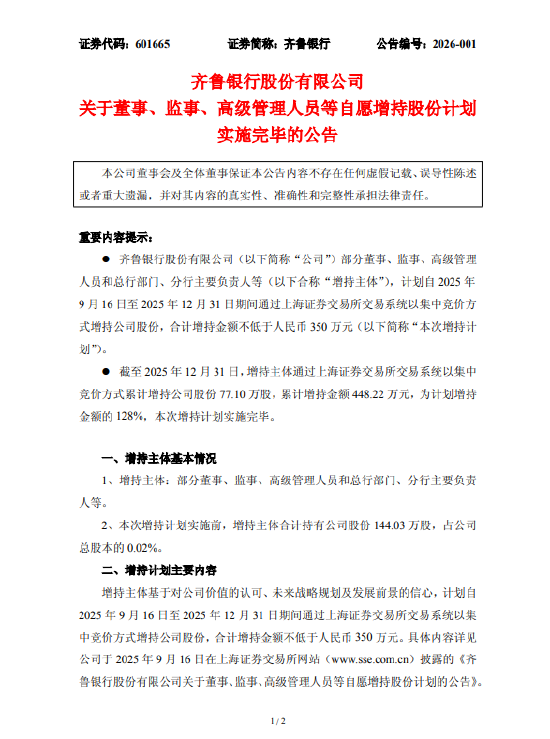
1月5日金融一线消息,齐鲁银行发布公告称,公司部分董事、监事、高级管理人员和总行部门、分行主 要负责人等计划自2025年9月16日至2025年12月31日期间通过上海证券交易所交易系统以集中竞价方式 增持公司股份,合计增持金额不低于人民币350万元。 截至2025年12月31日,公司部分董事、监事、高级管理人员和总行部门、分行主要负责人等通过上海证 券交易所交易系统以集中竞价方式累计增持公司股份77.10万股,累计增持金额448.22万元,为计划增持 金额的128%,本次增持计划实施完毕。 1月5日金融一线消息,齐鲁银行发布公告称,公司部分董事、监事、高级管理人员和总行部门、分行主 要负责人等计划自2025年9月16日至2025年12月31日期间通过上海证券交易所交易系统以集中竞价方式 增持公司股份,合计增持金额不低于人民币350万元。 截至2025年12月31日,公司部分董事、监事、高级管理人员和总行部门、分行主要负责人等通过上海证 券交易所交易系统以集中竞价方式累计增持公司股份77.10万股,累计增持金额448.22万元,为计划增持 金额的128%,本次增持计划实施完毕。 责任编辑:秦艺 责任编辑:秦艺 ...
齐鲁银行(601665.SH):部分董事、监事、高级管理人员和总行部门、分行主要负责人等累计增持77.10万股公司股份
Ge Long Hui A P P· 2026-01-05 09:41
截至2025年12月31日,公司部分董事、监事、高级管理人员和总行部门、分行主要负责人等通过上海证 券交易所交易系统以集中竞价方式累计增持公司股份77.10万股,累计增持金额448.22万元,为计划增持 金额的128%,本次增持计划实施完毕。 格隆汇1月5日丨齐鲁银行(601665.SH)公布,公司部分董事、监事、高级管理人员和总行部门、分行主 要负责人等计划自2025年9月16日至2025年12月31日期间通过上海证券交易所交易系统以集中竞价方式 增持公司股份,合计增持金额不低于人民币350万元。 ...