
QILU BANK(601665)

Search documents
这些上市银行获增持
Sou Hu Cai Jing· 2025-11-12 08:18
Core Insights - Multiple A-share listed banks have seen significant share purchases by executives and major shareholders since 2025, indicating confidence in the banking sector's long-term value [1][5] - Recent quarterly reports show that most city commercial banks have stabilized and improved their net interest margins compared to the end of the first half of the year [1] Group 1: Shareholder Activity - Over 10 banks have received share purchases from shareholders or executives, including Xiamen Bank, Suzhou Bank, Chengdu Bank, Chongqing Bank, Shanghai Bank, Everbright Bank, Lanzhou Bank, Postal Savings Bank, and Wuxi Bank, with city commercial banks being the majority [1] - On November 7, Qilu Bank reported that its directors, supervisors, and senior executives had collectively increased their holdings by approximately 3.15 million yuan, accounting for 90% of the planned increase [3] - Qingdao Bank's major shareholder, Guoxin Chanin Holdings, increased its stake through the Hong Kong Stock Connect, raising its total shareholding to 15.42%, making it the largest shareholder [5] Group 2: Financial Performance - Among the 42 listed banks, 35 reported a year-on-year increase in net profit for the first three quarters, with seven banks achieving double-digit growth, including Qingdao Bank, Qilu Bank, Hangzhou Bank, Jiangyin Bank, Changshu Bank, Shanghai Pudong Development Bank, and Chongqing Bank [5] - The recent quarterly reports reflect a positive performance for banks this year, contributing to market confidence [5]

逆市上涨!农业银行涨超2%,逼近前高!双百亿银行ETF(512800)站稳所有均线,资金寻求“当下确定性”
Xin Lang Ji Jin· 2025-11-11 11:59
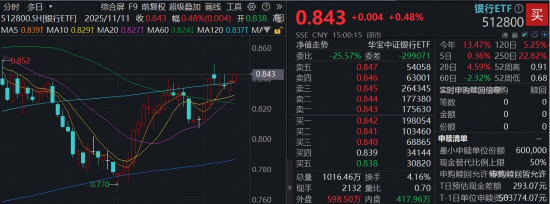
Core Viewpoint - The banking sector is experiencing a resurgence, with the bank ETF (512800) showing positive performance amidst market volatility, indicating strong buying interest and a favorable medium to long-term outlook [1][4]. Group 1: Market Performance - The bank ETF (512800) closed up 0.48% today, with intraday premium trading reflecting positive buying sentiment [1]. - The ETF has shown a two-day consecutive increase and is positioned above all moving averages, suggesting an optimistic medium to long-term trend [1]. - The ETF's latest scale exceeds 20.4 billion, with an average daily trading volume of over 800 million this year, making it the largest and most liquid bank ETF in A-shares [4]. Group 2: Stock Performance - Individual bank stocks are mostly performing well, with Xi'an Bank rising nearly 3%, Agricultural Bank up over 2%, and several others, including Qingdao Bank and China Merchants Bank, also showing gains [2][3]. - Over 10 listed banks have seen significant share purchases by shareholders or executives this year, indicating strong market confidence [3]. Group 3: Investment Sentiment - The current market environment has led to a shift towards stable cash flow and high-dividend sectors, with banks expected to attract more investment due to their stable and high dividend characteristics [3]. - The banking sector is perceived as being in a high cost-performance zone, with the bank ETF tracking a price-to-book ratio of only 0.72, indicating a mid-low range compared to the past decade [4]. - The dividend yield of the index tracked by the bank ETF is 4.02%, significantly exceeding the risk-free rate of 1.8%, highlighting its "quasi-fixed income" nature [4].

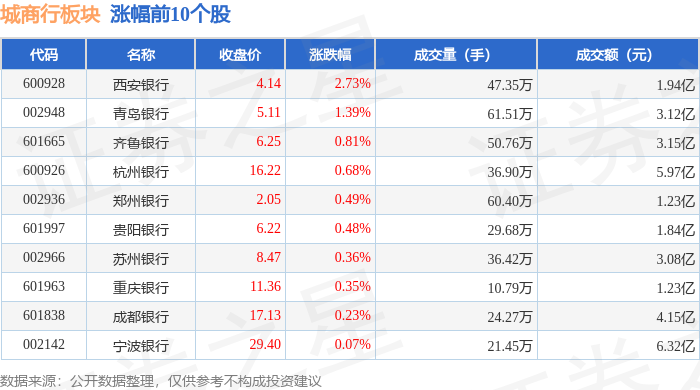
城商行板块11月11日跌0%,上海银行领跌,主力资金净流入2.41亿元
Zheng Xing Xing Ye Ri Bao· 2025-11-11 08:46
Market Overview - The city commercial bank sector experienced a slight decline of 0.0% on November 11, with Shanghai Bank leading the drop [1] - The Shanghai Composite Index closed at 4002.76, down 0.39%, while the Shenzhen Component Index closed at 13289.0, down 1.03% [1] Individual Bank Performance - Xi'an Bank saw the highest increase in share price, closing at 4.14 with a rise of 2.73% [1] - Qingdao Bank and Qilu Bank also reported positive performance, with increases of 1.39% and 0.81% respectively [1] - Shanghai Bank, on the other hand, closed at 10.13, down 0.98%, indicating a significant decline in its stock price [2] Trading Volume and Capital Flow - The city commercial bank sector recorded a net inflow of 241 million yuan from institutional investors, while retail investors saw a net outflow of 290 million yuan [2] - Jiangsu Bank attracted the highest net inflow from institutional investors at 113 million yuan, representing 11.75% of its trading volume [3] - In contrast, Zhengzhou Bank experienced a net outflow of 421,280 yuan from institutional investors, indicating a negative sentiment towards its stock [3]




真金白银!年内十余家上市银行获股东、高管增持,银行“防御性板块”角色要变?
Xin Lang Cai Jing· 2025-11-10 12:57
Core Viewpoint - The recent surge in share buybacks by various banks, including Qilu Bank and Qingdao Bank, reflects strong confidence in the long-term value of the banking sector, with over 10 listed banks participating in this trend [1][9][10]. Group 1: Share Buybacks - Qilu Bank announced that its directors, supervisors, and senior executives have collectively increased their holdings by 3.15 million yuan, accounting for 90% of the planned buyback amount [1]. - Qingdao Bank's major shareholder, Qingdao Guoxin Financial Holdings, increased its holdings by 957 million yuan, raising its stake to 15.42%, making it the largest shareholder [4]. - Xiamen Bank's executives completed a buyback plan exceeding the minimum target, with total contributions reaching 1.6857 million yuan [5]. Group 2: Market Sentiment - The buyback activities are interpreted as a recognition of the banking sector's valuation, with a current price-to-book ratio of 0.72 and a dividend yield of 3.99%, attracting long-term capital [10][12]. - The banking sector has seen a collective "self-purchase" phenomenon, with various regional banks also engaging in buybacks, indicating a broader trend across the industry [6][8]. Group 3: Performance and Valuation - Despite a slight decline in revenue and net profit for 42 A-share listed banks in the first quarter, 24 banks reported growth in both metrics, particularly city and rural commercial banks [10]. - The net interest margin for listed banks is projected to stabilize, with a simulated net interest margin of 1.32% for Q3 2025, marking a potential turning point after four years of decline [12]. - Long-term capital, particularly from insurance funds, has been increasingly allocated to the banking sector, with a reported increase of 8.36 billion shares held by insurance funds in Q3 2025 [12][13].




真金白银出手!这些上市银行获增持
证券时报· 2025-11-10 09:31
Core Viewpoint - Multiple A-share listed banks have recently seen significant share purchases by their directors, supervisors, and major shareholders, indicating confidence in the banks' long-term value and stability in market sentiment [1][5]. Group 1: Shareholder and Management Purchases - Qilu Bank announced on November 7 that its directors and executives have collectively increased their holdings by approximately 3.15 million yuan, achieving 90% of their planned purchase amount [1][3]. - Qingdao Bank reported that its major shareholder, Guoxin Chanin Holdings, increased its stake to 15.42% through the Hong Kong Stock Connect, becoming the largest shareholder [1][4]. - Since 2025, over 10 banks, including Xiamen Bank and Suzhou Bank, have experienced similar increases in shareholdings by management or major shareholders, predominantly among city commercial banks [1][3]. Group 2: Financial Performance and Trends - The third-quarter reports of listed banks show positive performance, with 35 out of 42 banks reporting year-on-year profit growth, and seven banks achieving double-digit growth [7]. - Qingdao Bank and Qilu Bank led the profit growth among listed banks, with increases of 15.54% and 15.14% respectively [7]. - The overall revenue of A-share listed banks grew by 0.9% year-on-year, while net profit increased by 1.5%, driven by stable expansion and improved net interest margins [7][8]. Group 3: Net Interest Margin Stability - The net interest margin (NIM) of many listed banks has shown signs of stabilization, particularly among city commercial banks, with 19 banks reporting an increase compared to the first half of 2025 [8]. - Notable increases in NIM were observed in banks such as Xi'an Bank and Nanjing Bank, with rises of 11 basis points and 7 basis points respectively [8]. - Analysts expect continued improvement in NIM due to the optimization of funding costs, with city commercial banks maintaining good growth potential [8][9].

城商行板块11月10日涨0.96%,厦门银行领涨,主力资金净流入7750.91万元
Zheng Xing Xing Ye Ri Bao· 2025-11-10 08:48
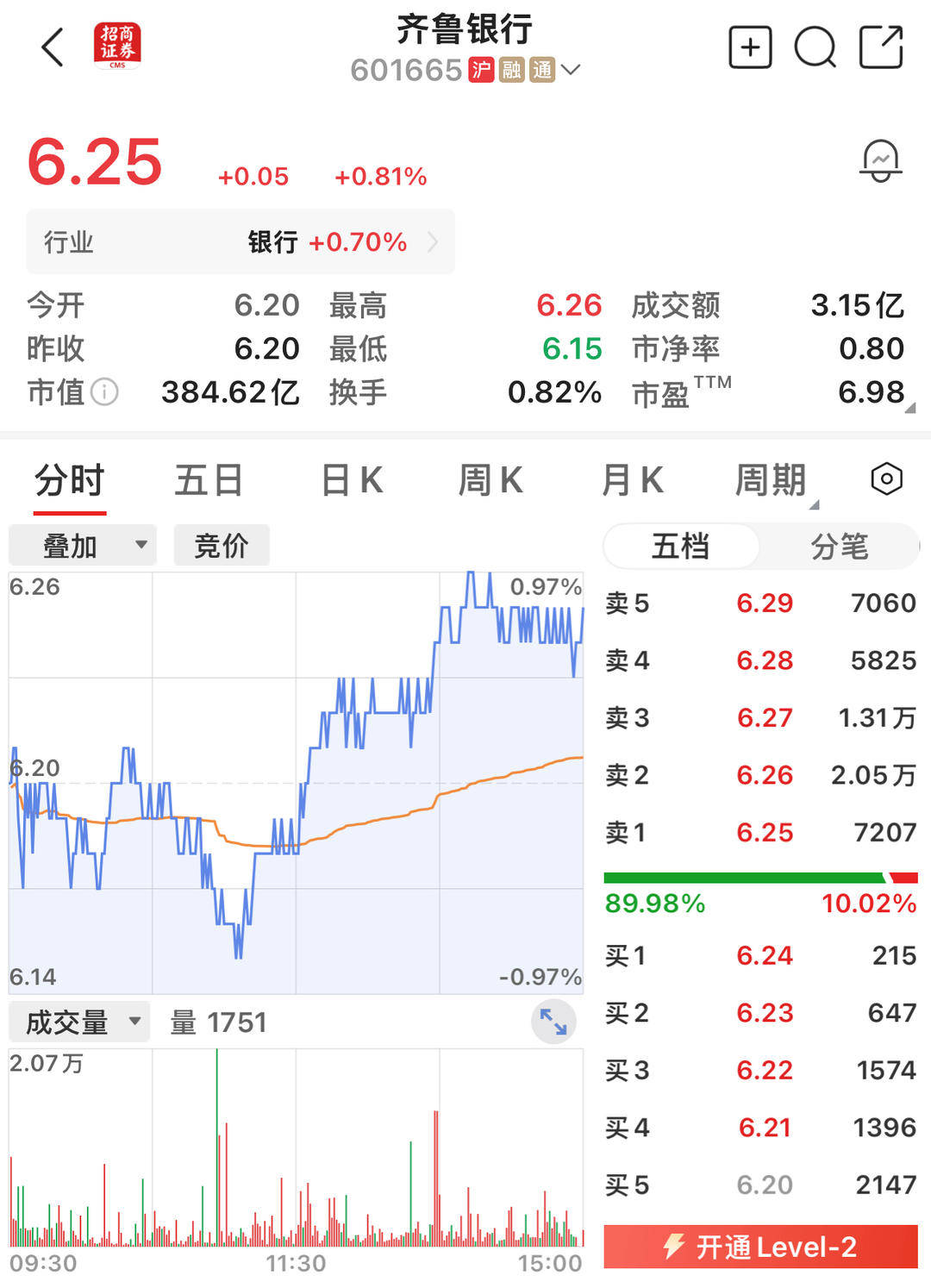
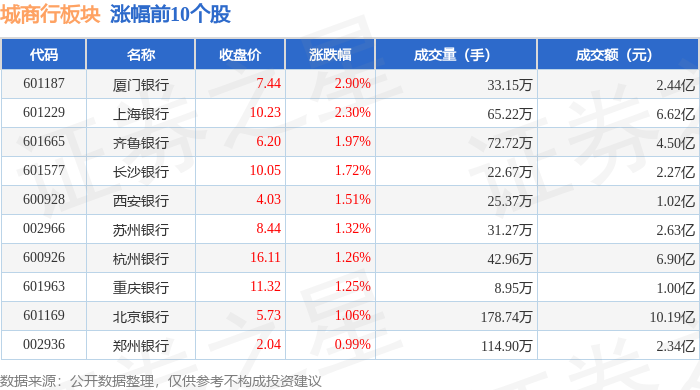
Market Performance - The city commercial bank sector increased by 0.96% on November 10, with Xiamen Bank leading the gains [1] - The Shanghai Composite Index closed at 4018.6, up 0.53%, while the Shenzhen Component Index closed at 13427.61, up 0.18% [1] Individual Bank Performance - Xiamen Bank's closing price was 7.44, with a rise of 2.90% and a trading volume of 331,500 shares, amounting to 2.44 billion yuan [1] - Shanghai Bank closed at 10.23, up 2.30%, with a trading volume of 652,200 shares and a transaction value of 660 million yuan [1] - Qilu Bank saw a closing price of 6.20, increasing by 1.97%, with a trading volume of 727,200 shares and a transaction value of 450 million yuan [1] - Other notable banks include Changsha Bank, Xi'an Bank, and Suzhou Bank, with respective increases of 1.72%, 1.51%, and 1.32% [1] Capital Flow Analysis - The city commercial bank sector experienced a net inflow of 77.51 million yuan from institutional investors, while retail investors saw a net outflow of 10.29 million yuan [1] - Beijing Bank had a significant net inflow of 1.35 billion yuan from institutional investors, but a net outflow of 582.22 million yuan from retail investors [2] - Jiangsu Bank also reported a net inflow of 103 million yuan from institutional investors, with retail investors experiencing a net outflow of 91.58 million yuan [2]
真金白银出手,这些上市银行获增持
Zheng Quan Shi Bao· 2025-11-10 07:29
Core Viewpoint - Several A-share listed banks have recently seen significant share purchases by their directors, supervisors, and major shareholders, indicating confidence in the banks' long-term value and stability in market sentiment [1][4]. Group 1: Shareholder and Management Purchases - Qilu Bank announced on November 7 that its directors and executives have completed 90% of their share purchase plan, amounting to approximately 3.15 million yuan, with a total planned investment of at least 3.5 million yuan [2][3]. - Qingdao Bank reported that its major shareholder, Guoxin Chanin Holdings, increased its stake to 15.42%, becoming the largest shareholder after purchasing 243 million H-shares for a total of 9.57 billion yuan [2][3]. - Over 10 banks have experienced similar share purchases since 2025, with a majority being city commercial banks [1][2]. Group 2: Financial Performance and Trends - The recent quarterly reports indicate a positive performance among listed banks, with 35 out of 42 banks reporting year-on-year profit increases, and seven banks achieving double-digit growth [5][6]. - Qilu Bank and Qingdao Bank led the profit growth among listed banks, with increases of 15.54% and 15.14%, respectively [6]. - The overall revenue of 42 A-share listed banks grew by 0.9% year-on-year, while net profit increased by 1.5%, driven by stable expansion and a narrowing decline in net interest margins [6][7]. Group 3: Net Interest Margin and Market Outlook - The net interest margin for many listed banks has shown signs of stabilization, with 19 banks reporting an increase compared to the first half of 2025 [6][7]. - City commercial banks have particularly benefited from improved profit growth and stable loan growth, contrasting with weaker performance in other bank types [7]. - Analysts predict a continued positive trend in net interest margins and overall profitability for the banking sector in 2026, despite potential pressures on asset quality, especially in retail [7].
从增量扩面到提质控险 银行业普惠金融迈向差异化精准服务
2 1 Shi Ji Jing Ji Bao Dao· 2025-11-10 04:21
Core Insights - The report highlights the significant growth and development of inclusive finance in China, particularly focusing on small and micro enterprises and rural areas, with a notable annual growth rate of over 20% in inclusive micro loans during the 14th Five-Year Plan period [1][2] - As of June 2025, the balance of inclusive micro loans reached 36 trillion yuan, which is 2.3 times that of the end of the 13th Five-Year Plan, with a decrease in interest rates by 2 percentage points [1][2] - The average interest rate for newly issued inclusive micro loans was 3.48% as of June 2025, reflecting a decrease of 66 basis points year-on-year [1][2] Group 1: Digital Empowerment - Digital technology has been a key driver for the development of inclusive finance, with banks utilizing big data and AI to enhance loan approval efficiency and reduce financing costs [2][7] - The market structure among banks is changing, with large commercial banks holding a 45.11% share of inclusive micro loans, while rural financial institutions have seen a decline in their market share [2][3] - The average growth rate of inclusive micro loans has been slowing down, with a decrease from 30.9% in 2020 to 12.3% by mid-2025 [2][3] Group 2: Performance of Listed Banks - Among listed banks, Agricultural Bank of China, Industrial and Commercial Bank of China, and Beijing Bank reported the highest growth rates in inclusive micro loans at 18.50%, 17.30%, and 17.27% respectively [3][4] - In contrast, some banks, including Shanghai Bank and Zhengzhou Bank, experienced negative growth rates of -3.97% and -2.06% [3][4] - The performance of different banks varies significantly, with state-owned banks generally showing stronger growth in inclusive micro loans compared to smaller banks [3][4] Group 3: Interest Rates and Risk Management - The interest rates for newly issued inclusive micro loans have decreased across various banks, with the highest rate at 4.20% and the lowest at 2.94% [7][8] - The gap in interest rates between large and small banks is narrowing, with some large banks' rates aligning closely with those of smaller banks [8][9] - The report emphasizes the importance of risk management in the inclusive finance sector, with several banks focusing on improving asset quality and managing non-performing loans [9][10]

齐鲁银行将在11月12日对个人手机银行提前还款流程进行优化升级
Jin Tou Wang· 2025-11-10 04:19
Core Viewpoint - Qilu Bank is enhancing its personal mortgage loan services by optimizing the early repayment process through its mobile banking platform, effective November 12, 2025 [1] Group 1: Service Optimization - The early repayment process for personal mortgage loans will be moved to the "Loan" - "My" - "Mortgage Service" - "Early Repayment" section in the mobile banking app [1] - A new "Early Repayment Calculation" service will be introduced to assist customers in estimating their repayment amounts [1] Group 2: Repayment Terms - Customers can apply for early repayment after making regular payments for 180 days, with the option to apply for early repayment once every six months [1] - Each early repayment must be no less than 10,000 yuan [1] Group 3: Customer Support - Customers are encouraged to ensure sufficient funds in their repayment accounts to facilitate smooth processing [1] - For inquiries, customers can contact their account managers or call Qilu Bank's customer service [1]
齐鲁银行股份有限公司 关于董事、监事、高级管理人员等 增持股份的进展公告
Zhong Guo Zheng Quan Bao - Zhong Zheng Wang· 2025-11-08 00:08
Group 1 - The core point of the announcement is that Qilu Bank's board members, supervisors, and senior management plan to increase their shareholding in the company, with a total investment of no less than RMB 3.5 million from September 16, 2025, to December 31, 2025 [2][4] Group 2 - As of the date of the announcement, the implementation period of the shareholding increase plan is over half, with the total amount increased by the stakeholders approximately RMB 3.15 million, accounting for 90% of the planned increase amount [3] Group 3 - The shareholding increase plan complies with relevant laws and regulations, and the funds required for the increase will come from the stakeholders' own funds, eliminating the risk of insufficient funds affecting the implementation of the plan [4]