
HUA XIA BANK(600015)

Search documents
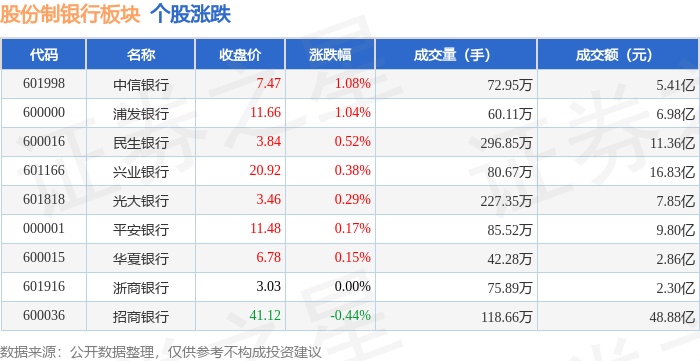
股份制银行板块1月12日涨0.26%,中信银行领涨,主力资金净流出10.83亿元
Zheng Xing Xing Ye Ri Bao· 2026-01-12 09:04
Group 1 - The banking sector saw a slight increase of 0.26% on January 12, with CITIC Bank leading the gains [1] - The Shanghai Composite Index closed at 4165.29, up 1.09%, while the Shenzhen Component Index closed at 14366.91, up 1.75% [1] - The trading volume and turnover for major banks were significant, with CITIC Bank's closing price at 7.47, reflecting a 1.08% increase and a turnover of 541 million yuan [1] Group 2 - The net outflow of main funds from the banking sector was 1.083 billion yuan, while retail investors saw a net inflow of 579 million yuan [1] - CITIC Bank had a net inflow of 53.24 million yuan from main funds, despite a net outflow from retail investors [1] - The overall fund flow indicated a mixed sentiment, with some banks experiencing significant net outflows from main funds, such as Industrial Bank with a net outflow of 75.54 million yuan [1]






南京地区发行量共160万枚(张) 马年贺岁币钞下周二晚开启预约
Nan Jing Ri Bao· 2026-01-11 01:40
Core Viewpoint - The People's Bank of China Jiangsu Branch announced the launch of the 2026 Year of the Horse commemorative coin and banknote, with reservations starting on January 13, 2026, and ending on January 14, 2026 [1] Group 1: Reservation Details - The reservation for the 2026 Year of the Horse commemorative coin will start at 22:00 on January 13, 2026, and for the commemorative banknote at 22:30 on the same day [1] - The issuance volume for the commemorative coin and banknote in Nanjing is set at 800,000 pieces and 800,000 notes, respectively [1] - A total of 23 bank branches in Nanjing will handle the reservation and exchange, including specific branches like Gulou Square Branch and Longpan South Road Branch [1] Group 2: Exchange Process - The exchange period for the reserved commemorative coin and banknote will run from January 20 to January 26, 2026 [2] - Individuals who successfully reserved must present their valid ID at the designated bank branch to complete the exchange [2] - After the exchange period ends, the branches will cease all exchange activities [2]



过渡期收官在即,银行业首席合规官密集就位,如何推进从“被动遵循”到“主动治理”?
Mei Ri Jing Ji Xin Wen· 2026-01-09 10:51
Core Viewpoint - The tightening of regulatory rules and the complexity of the risk environment are driving a restructuring wave in the banking industry's risk and compliance systems [1][7]. Group 1: Appointment Trends - A surge in appointments for Chief Risk Officers (CROs) and Chief Compliance Officers (CCOs) is expected from late 2025 to early 2026, with nearly 10 banks increasing related personnel configurations in the past month [1][7]. - Since the beginning of 2025, over 20 banks and branches have had relevant qualifications approved by regulators [1][7]. - The trend is influenced by the impending expiration of a one-year transition period set by the "Financial Institutions Compliance Management Measures," which requires financial institutions to establish a CCO at their headquarters [1][7]. Group 2: Governance Models - The banking sector exhibits two governance models for CCOs and CROs: "one person holding both positions" and "independent separation" [2][9]. - The "one person holding both positions" model is prevalent, particularly in smaller banks, allowing for unified decision-making in risk and compliance management [2][9]. - Conversely, the "independent separation" model is more common in larger banks, enhancing professional checks and balances within the risk control system [3][10]. Group 3: Talent Acquisition and Challenges - The demand for composite talents is rising, with banks favoring candidates with extensive experience in finance or legal compliance [11][12]. - Some banks are adopting market-based recruitment methods for CCOs, breaking traditional selection models [11]. - Salary levels for CCO positions are increasing, with some banks offering monthly salaries between 100,000 to 130,000 yuan [11]. Group 4: Compliance Management Evolution - Effective compliance management is evolving from a "cost center" to a "value guardian," playing a crucial role in mitigating credit, market, and liquidity risks [12][13]. - The future of compliance governance in the banking industry is expected to become more institutionalized and refined, with clearer responsibilities and a focus on composite compliance talents [12][13]. - The core competencies for CCOs are expected to include deep business insight, precise regulatory interpretation, efficient execution, and strong cross-departmental collaboration [13].



华夏银行临沂分行:以金融担当赋能高质量发展
Zhong Guo Jin Rong Xin Xi Wang· 2026-01-09 02:40
Core Insights - Huaxia Bank's Linyi Branch has integrated its development into the local economic and social construction over the past 14 years, focusing on serving the real economy and aligning with urban development and enterprise growth [1][2] Group 1: Financial Support for Industry - The branch has targeted local industrial layouts and increased financial support in key areas, forming an integrated service matrix of "commercial bank + investment bank" [1] - It has provided comprehensive services including financing, settlement, and financial management, aiding the transformation of traditional industries towards high-end, intelligent, and green development [1] - The bank has injected over 50 billion yuan into Linyi's real economy, serving more than 4,000 enterprise clients and supporting the elevation of industrial capabilities in Linyi [1] Group 2: Support for Small and Micro Enterprises - The branch has implemented innovative measures to address the financing challenges faced by small and micro enterprises, focusing on reducing costs and improving access to finance [2] - Utilizing digital inclusive finance, it has developed an online service for application, approval, and quick disbursement, along with products like "Huaxia Long Business Loan" [2] - By the end of 2025, the balance of inclusive loans for small and micro enterprises is expected to grow over 20 times since the branch's inception, serving more than 2,000 small micro clients [2] Group 3: Future Development Plans - Moving forward, Huaxia Bank's Linyi Branch aims to continue its commitment to the region by offering more innovative financial products and efficient services [2] - The bank plans to deepen its alignment with Linyi's new productive capacity cultivation planning, injecting stronger financial momentum into local development [2]

China saw 75,000 blockchain firms founded in a year
Yahoo Finance· 2026-01-08 16:46
Group 1 - In 2025, nearly 75,000 new Chinese blockchain startups emerged, bringing the total to just under 290,000, marking the highest growth rate since 2021 [1] - The growth of blockchain startups is largely driven by government initiatives, with special blockchain zones established in various cities to support these ventures [2] - South China accounted for 32.5% of the newly registered blockchain companies, indicating a regional concentration of growth in the sector [3] Group 2 - The blockchain industry in China is projected to nearly double in size by 2027, reaching a total value of $1.4 billion [4] - Chinese firms are increasingly applying blockchain technology across various sectors, including food, supply chain financing, and legal services, with implications for AI expansion as well [5] - Traditional financial institutions in China, such as Huaxia Bank, are utilizing blockchain for digital currency transactions, exemplified by the issuance of over $637 million in bonds to digital yuan investors [5]
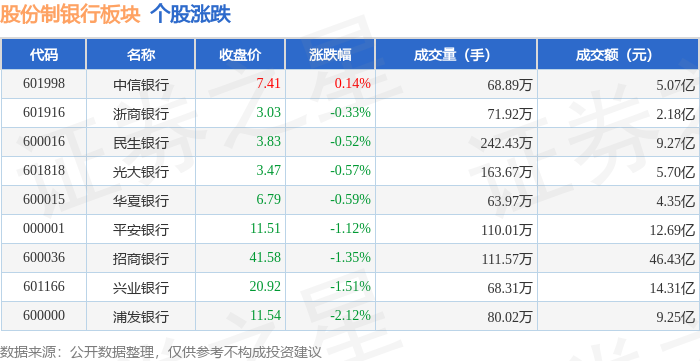
股份制银行板块1月8日跌1.16%,浦发银行领跌,主力资金净流出6.74亿元
Zheng Xing Xing Ye Ri Bao· 2026-01-08 08:56
Market Performance - The banking sector saw a decline of 1.16% on January 8, with Pudong Development Bank leading the drop [1] - The Shanghai Composite Index closed at 4082.98, down 0.07%, while the Shenzhen Component Index closed at 13959.48, down 0.51% [1] Individual Bank Performance - CITIC Bank closed at 7.41, with a slight increase of 0.14%, while other banks like Zhejiang Commercial Bank and Minsheng Bank experienced declines of 0.33% and 0.52% respectively [1] - The largest decline was seen in Pudong Development Bank, which fell by 2.12% to close at 11.54 [1] Trading Volume and Capital Flow - The banking sector experienced a net outflow of 674 million yuan from main funds, while retail investors saw a net inflow of 313 million yuan [1] - The trading volume for CITIC Bank was 688,900 shares, with a transaction value of 507 million yuan, while the total transaction value for the banking sector was significant [1] Capital Inflow Analysis - Industrial Bank had a net inflow of 67.52 million yuan from main funds, but also saw a net outflow from retail investors of 63.06 million yuan [2] - Huaxia Bank experienced a substantial net outflow of 89.46 million yuan from main funds, despite a net inflow of 66.32 million yuan from speculative funds [2]

银行积存金投资门槛大摸底
Bei Jing Shang Bao· 2026-01-08 06:43
Core Viewpoint - The recent announcement by Industrial and Commercial Bank of China (ICBC) to raise the risk acceptance level for personal gold accumulation business to C3 (balanced) and above has triggered significant changes in the precious metals investment market, reflecting a broader industry trend towards stricter risk management in response to increased market volatility and rising gold prices [1][6]. Group 1: Industry Trends - Major banks have collectively raised the entry-level risk tolerance for gold accumulation products to at least a balanced level (C3), with some banks even setting it to aggressive levels, indicating a comprehensive industry-wide upgrade in risk control measures [1][3][4]. - The international gold price has surpassed $4,400 per ounce, prompting banks to filter out investors with lower risk tolerance to prevent significant losses due to market volatility [6][7]. Group 2: Bank-Specific Requirements - ICBC requires personal clients to achieve a C3 (balanced) risk assessment result to engage in gold accumulation business, a shift from the previous requirement of C1 (conservative) [3][4]. - Other banks, such as Postal Savings Bank and Shanghai Rural Commercial Bank, have also raised their risk assessment standards, with some requiring a minimum of C3 or higher for participation in gold accumulation products [4][6]. - Banks like China CITIC Bank and Ningbo Bank have announced future adjustments to their risk assessment requirements, aligning with the trend of increasing risk thresholds for gold investment [6][7]. Group 3: Investor Behavior and Risks - There is a growing concern about investors attempting to misrepresent their risk tolerance in order to qualify for gold accumulation products, which undermines the integrity of the risk assessment process [8][9]. - The industry is urged to enhance investor education and awareness regarding the risks associated with gold investments, especially in a volatile market environment [8][9].



2025年金融机构被罚没31亿元,反洗钱和数据相关罚单大增
2 1 Shi Ji Jing Ji Bao Dao· 2026-01-07 10:47
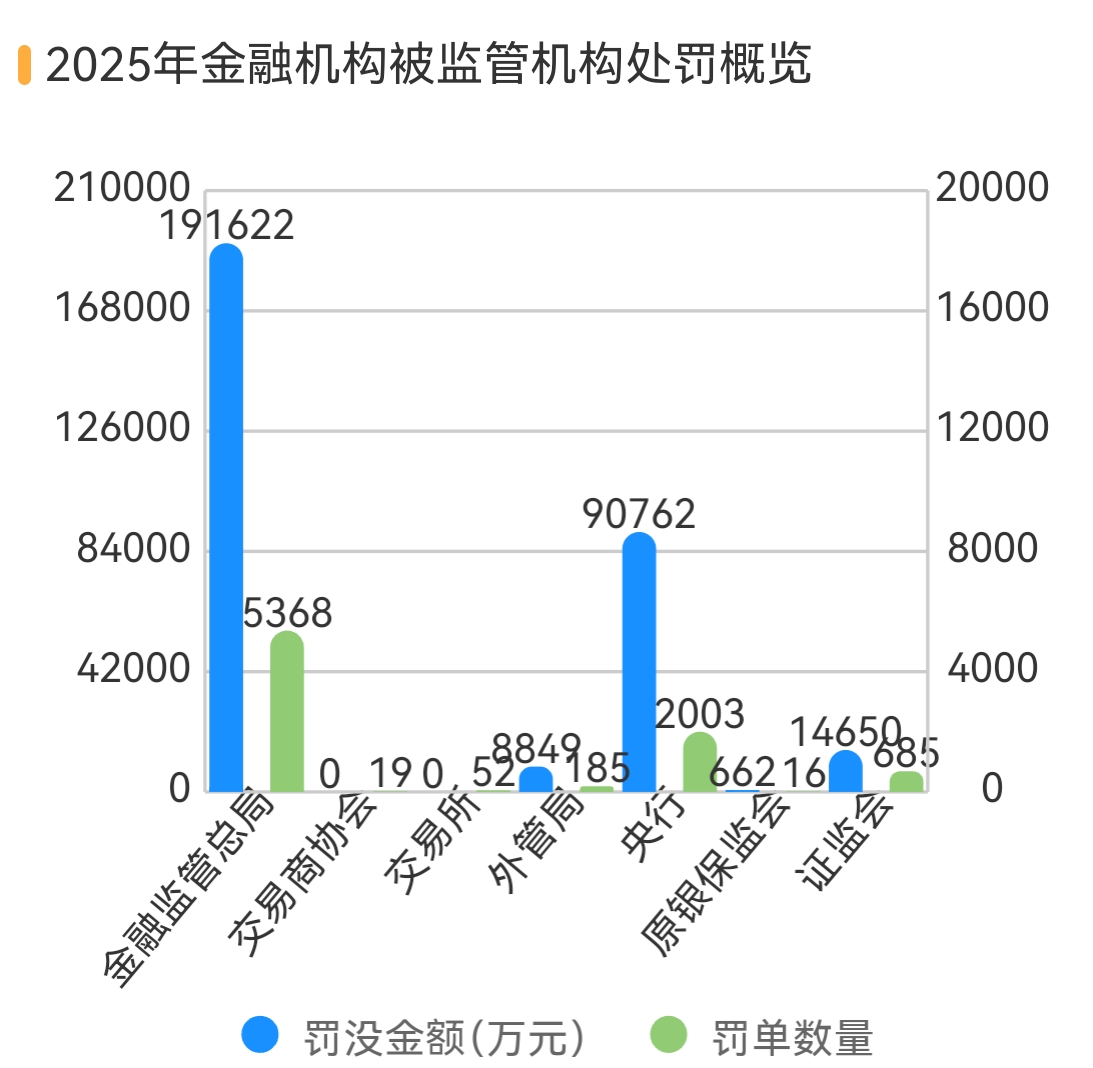
Core Insights - In 2025, financial institutions received a total of 8,328 fines, a year-on-year decrease of 8.41%, while the total amount of fines reached 3.065 billion yuan, an increase of 27.55% [1][2] Group 1: Penalty Overview - The National Financial Supervision Administration issued 5,368 fines totaling 1.916 billion yuan, the central bank issued 2,003 fines totaling 908 million yuan, the Securities Regulatory Commission issued 685 fines totaling 146 million yuan, and the State Administration of Foreign Exchange issued 185 fines totaling 88.49 million yuan [2] - Monthly distribution shows peaks in December, January, and July for the number of fines, with September and December having higher total fine amounts [4] Group 2: Institution-Specific Penalties - Banks received 5,313 fines in 2025, a decrease of 8.88% year-on-year, with total fines amounting to 2.461 billion yuan, an increase of 40.63% [7] - Insurance institutions received 2,166 fines, a decrease of 5.5%, with total fines of 325 million yuan, a decrease of 3.56% [7] - Securities firms received 195 fines, a significant decrease of 42.98%, but the total fines increased by 56.69% [7] Group 3: Major Penalty Cases - In 2025, there were 8 fines exceeding 50 million yuan, with the largest fine of 97.9 million yuan issued for issues related to company governance, loans, and asset quality management [13] - A village bank in Dalian had its financial license revoked due to multiple severe violations, marking a significant regulatory action [14] - A bank president was sentenced to death with a two-year reprieve for illegal lending and bribery, highlighting severe consequences for financial misconduct [15][16] Group 4: Compliance Characteristics - The main areas of violations for banks in 2025 were in credit business, anti-money laundering, and inadequate internal controls [22] - Insurance companies faced penalties primarily for untrue financial/business data and misleading sales practices [23] - Securities firms' violations were concentrated in personnel misconduct, investment banking, and internal control issues [24][25] Group 5: Anti-Money Laundering Violations - There was a significant increase of 188.25% in penalties related to anti-money laundering violations, with 1,349 fines issued [26] - Common violations included failure to identify customer identities and improper transaction reporting [26] Group 6: Data-Related Violations - Penalties related to data violations increased by 44.65%, with 554 fines issued, primarily affecting banks and insurance companies [27] Group 7: Penalty Rankings - Among non-banking institutions, Donghai Securities faced the highest fines at 60 million yuan, followed by China People's Property Insurance and China Pacific Property Insurance [30]
2025年银行CIO盘点:建行、中行CIO离任,多家中小银行行外引进CIO
Xin Lang Cai Jing· 2026-01-07 03:33
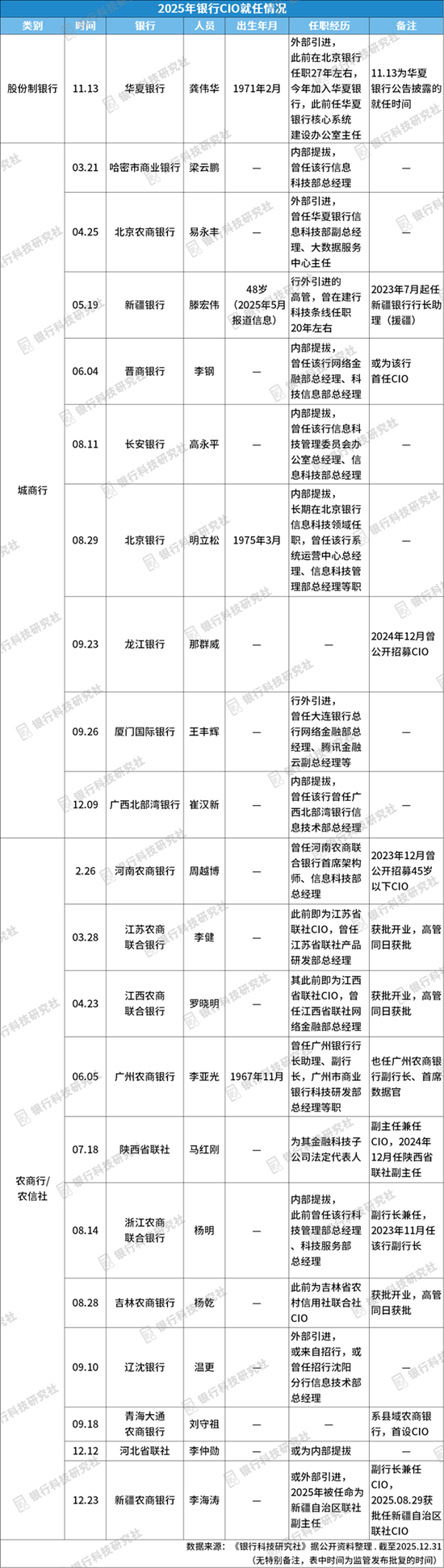
Core Insights - The digital transformation is crucial for the banking industry, with a significant focus on the restructuring of digital talent, particularly the Chief Information Officers (CIOs) [1][2] Group 1: Changes in CIO Positions - In 2025, several major banks experienced changes in their technology leadership, with the CIOs of China Construction Bank (CCB) and Bank of China (BOC) resigning [2][4] - CCB's former CIO, Jin Panshi, resigned due to age reasons after serving for four years [2][3] - BOC's former CIO, Meng Qian, also resigned for age reasons after a 38-year tenure, during which she held multiple senior positions [4][6] - The Industrial and Commercial Bank of China (ICBC) also saw its technology leader, CTO Lv Zhongtao, leave at the end of 2025 [7][8] Group 2: New Appointments and Trends - In 2025, 21 new CIOs were appointed, primarily in small and medium-sized banks, with many being external hires [10][11] - Notable new CIOs include Gong Weihua at Huaxia Bank and Wang Fenghui at Xiamen International Bank, both of whom were brought in from outside the banking sector [11][12] - The trend indicates a shift towards external recruitment for CIO positions, with 48% of the new appointments being external hires [16] Group 3: Recruitment Trends in Smaller Banks - Many small and medium-sized banks have publicly announced CIO recruitment in 2025, including Xiamen International Bank and Zhengzhou Bank [18][19] - Recruitment criteria often include age limits and specific experience requirements, such as a minimum of six years in information technology and four years in senior management roles [18][20] - The trend reflects a growing emphasis on digital leadership within smaller banks, as they seek to enhance their technological capabilities [18][19]
已有十余家银行聘任首席合规官
Jin Rong Shi Bao· 2026-01-07 02:52
Core Viewpoint - The appointment of Chief Compliance Officers (CCOs) in banks is a response to increasing regulatory demands, aiming to enhance compliance management and integrate it into business processes [1][2]. Group 1: Appointment of Chief Compliance Officers - Zhangjiagang Rural Commercial Bank appointed Wu Kai as its Chief Compliance Officer, marking a trend where over ten banks have made similar appointments [1]. - In December 2025 alone, several banks, including Ping An Bank and Industrial Bank, approved the hiring of CCOs [1]. - The rapid appointment of CCOs aligns with the implementation of the "Financial Institutions Compliance Management Measures," which mandates the establishment of CCO positions at the headquarters of financial institutions [2]. Group 2: Responsibilities and Challenges - CCOs are expected to take on more responsibilities, including the formulation and supervision of compliance policies, ensuring that all business activities adhere to regulatory frameworks [5]. - There is a concern that an increase in executive positions may burden banks, particularly smaller financial institutions [2]. - Many currently appointed CCOs are existing senior executives, which helps mitigate potential operational burdens [3]. Group 3: Recruitment Trends - Some banks, such as Jiangxi Bank and Shangrao Bank, have publicly announced recruitment for CCO positions, indicating a proactive approach to compliance management [4].