
PDH(600048)

Search documents
地产债情绪修复到哪里?
Guolian Minsheng Securities· 2026-02-03 06:10
Report Industry Investment Rating - Not provided in the given content Core Views of the Report - In 2026, real estate policies remain "stable". Policies for the resident sector focus on "burden - reduction", while those for real - estate enterprises prioritize risk prevention. The phasing - out of the "Three Red Lines" policy and other measures may have contributed to a certain repair of the trading sentiment of real - estate entities [5][10][12]. - Although real - estate bonds have increased in trading volume and average trading duration, the high - valuation ratio remains above 60%. It is recommended to trade real - estate entities cautiously and choose short - duration state - owned enterprises within 1Y [20]. - The credit bond market is active this week. Considering the possible stable and loose funds and the allocation demand of amortized debt funds, the spreads of each term are likely to remain low and may narrow further. Investment strategies include basic allocation of short - term credit products and enhancing returns by considering 5 - 10Y secondary perpetual bonds or 5Y urban investment and industrial bonds [27]. - Different regions' urban investment platforms have different investment logics. For example, "economic powerhouses" can appropriately extend the duration to 5 years, regions with debt - resolution policies can consider a duration of less than 3 years, and prefecture - level cities with strong industrial bases can choose a 3 - 5Y duration [41][42][43]. Summary by Relevant Catalogs 1. This Week's Real - Estate Hot Events 1.1 The Gradual Exit of the "Three Red Lines" Policy - On January 28, 2026, regulatory authorities no longer required real - estate enterprises to report "Three Red Lines" indicators monthly. The "Three Red Lines" policy was introduced in August 2020, which set standards for real - estate financing and implemented differentiated debt - scale management based on enterprises' "line - crossing" situations [5][8]. 1.2 A Review of Real - Estate - Related Policies Since 2026 - For the resident sector, policies since January 1, 2026, include VAT adjustments for housing sales, tax - refund policies for home - replacement, and interest - rate cuts for existing housing loans. For real - estate enterprises, policies focus on risk prevention, such as loan extensions for projects on the "white list" and the implementation of project - company systems and host - bank systems [10][12]. 2. How Far Has the Sentiment of Real - Estate Bonds Recovered? 2.1 Recent Trading Conditions in the Real - Estate Bond Market - In January 2026, the trading volume of industrial urban investment real - estate bonds gradually increased, while that of urban investment real - estate bonds fluctuated. The high - valuation trading ratio of both industrial and urban investment real - estate entities remained between 60 - 70%. The daily peak trading volume of industrial real - estate bonds was 9.332 billion yuan on January 26, and that of urban investment real - estate bonds was 5.344 billion yuan on January 13. The trading activity of industrial real - estate entities increased significantly within the month [14]. 2.2 How Far Has the Trading Sentiment of Popular Industrial Real - Estate Entities Recovered? - Except for Vanke, the average YTM of popular industrial real - estate entities increased in January 2026. Some entities showed a phenomenon of trading pulling up the duration, which may explain the increase in average trading YTM. However, entities like Cinda Investment and Huafa Co., Ltd. had significant increases in trading yields without a significant increase in average duration at the end of the month, and their trading deviated significantly from the valuation, indicating that there may still be a large number of sell - offs [19][20]. 3. Investment Strategies - The credit bond market is active this week, with the trading volume increasing to about 1.74 trillion yuan. The average trading duration of urban investment bonds and industrial bonds in the secondary market has increased. In the primary market, the issuance of urban investment financial bonds has decreased. Considering the possible stable and loose funds and the allocation demand of amortized debt funds, the spreads of each term are likely to remain low and may narrow further [27]. - Allocation plans include basic allocation of short - term credit products with relatively controllable credit risks and enhancing returns by considering 5 - 10Y secondary perpetual bonds or 5Y urban investment and industrial bonds. Some 5 - 10Y secondary perpetual bonds still show certain relative value, and attention can also be paid to 5Y securities company subordinated bonds and 10Y secondary capital bonds [27][31]. - For urban investment platforms in different regions, different investment logics are proposed. For "economic powerhouses" such as Guangdong, Jiangsu, etc., the duration can be appropriately extended to 5 years; for regions with significant debt - resolution policies, a duration of less than 3 years can be considered; for prefecture - level cities with strong industrial bases, a 3 - 5Y duration is recommended [41][42][43]. 4. Primary Market Tracking - Relevant figures are provided, including this week's credit bond issuance, financial bond issuance, credit bond exchange review and registration, and credit bond association registration completion, but specific data analysis is not elaborated in the summary part [56][59][63][66]. 5. Secondary Market Observation 5.1 The "Volume" of Secondary Market Transactions - Figures show this week's credit bond trading scale and quantity, urban investment bond trading scale by province, industrial bond trading scale by industry, and the weighted trading duration of urban investment and industrial bonds by province [68][72][79][80]. 5.2 The "Price" of Secondary Market Transactions - Figures show this week's urban investment bond yields by term and implied rating, industrial bond yields by enterprise type (state - owned and private enterprises), and financial bond yields by province and variety [81][82][83][84][85].


百强房企再洗牌:7家新面孔杀入
Feng Huang Wang· 2026-02-03 00:41
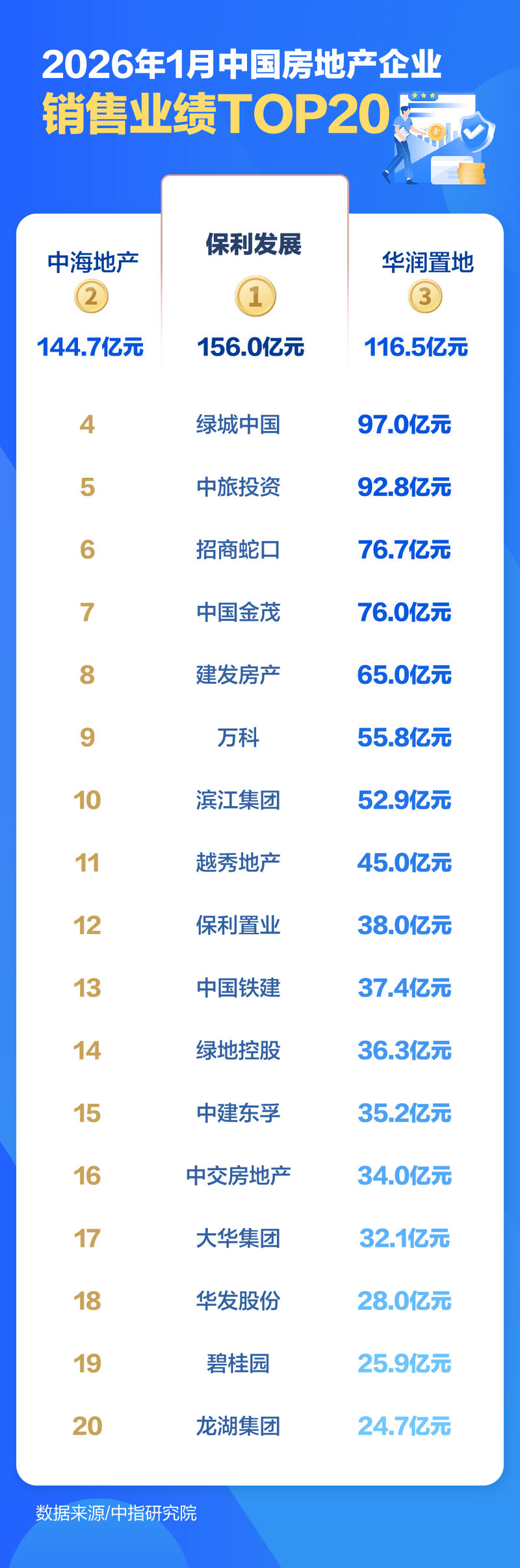
Core Viewpoint - The top 100 real estate companies in China are experiencing a significant reshuffling in their rankings as of January 2026, with a notable decline in overall sales figures compared to the previous year [2][3]. Group 1: Sales Performance - In January 2026, the total sales of the top 100 real estate companies reached 190.52 billion yuan, representing an 18.9% year-on-year decline [2]. - Only three companies achieved sales exceeding 10 billion yuan in January, a decrease of two compared to the same period last year [2]. - The number of companies with sales over 5 billion yuan increased to ten, up by two from the previous year [2]. Group 2: Ranking Changes - The top 10 rankings saw significant changes, with Poly Developments, China Overseas, and China Resources remaining in the top four, while Vanke dropped from fifth to ninth place [3]. - China Travel Investment emerged as a major dark horse, jumping from outside the top 40 to fifth place [3]. - China Jinmao rose from thirteenth to seventh, indicating intensified competition within the top tier [3]. Group 3: Performance of Private Enterprises - Among the 32 companies that experienced year-on-year growth in January, six private enterprises had growth rates exceeding 100% [3]. - Bangtai Group and China Construction Yipin entered the top 20 in sales, benefiting from strategic investments during market lows [3]. Group 4: New Entrants and Market Dynamics - Seven new companies entered the top 100 list in January, with four being small to medium-sized private enterprises [4]. - State-owned enterprises continue to dominate land acquisition, with companies like Yuexiu Property and China Resources maintaining strong investment levels [4]. Group 5: Policy and Market Outlook - The policy environment is shifting towards stabilizing expectations, with measures such as extended tax rebates and loan extensions being implemented [4]. - The market is expected to see a gradual release of demand in March, driven by promotional activities from real estate companies before the Spring Festival [5].




房企开年排位生变:“保中华”格局延续 最大黑马竟是它?
Xin Jing Bao· 2026-02-02 13:33
Core Viewpoint - In January 2026, the sales performance of the top 100 real estate companies in China showed a total sales amount of 190.5 billion yuan, reflecting a year-on-year decline of 18.9%, indicating a stable continuation of the downward trend observed in the previous year [5][10]. Group 1: Sales Performance - The total sales amount for the top 100 real estate companies in January 2026 was 190.5 billion yuan, which is a year-on-year decrease of 18.9%, consistent with the decline observed throughout the previous year [5][10]. - The top three companies in terms of total sales were Poly Developments (15.6 billion yuan), China Overseas Land & Investment (14.47 billion yuan), and China Resources Land (11.65 billion yuan) [5][10]. - The average sales amount for the top 10 companies was 9.33 billion yuan, down 11.6% year-on-year, while the average for companies ranked 11-30 was 2.6 billion yuan, down 25.6% [10]. Group 2: Market Dynamics - The decline in sales is attributed to a high base from January of the previous year, where core city markets were notably active [5][9]. - The new entrant, China Travel Investment, ranked 5th with a sales amount of 9.28 billion yuan, marking a significant rise from previous years [9]. - The sales performance of the top 10 companies remained relatively stable, with three companies showing year-on-year increases, while seven experienced declines [10]. Group 3: Future Outlook - Analysts expect that as the Chinese New Year approaches, real estate companies may increase marketing efforts, which could lead to a temporary boost in market activity [11]. - There is a need for coordinated policy efforts from both demand and supply sides to effectively restore market confidence [11].

商业不动产REITs点评:首批商业不动产REITs发行在即,存量盘活规模可期
Bank of China Securities· 2026-02-02 11:28
Investment Rating - The industry investment rating is "Outperform the Market," indicating that the industry index is expected to perform better than the benchmark index over the next 6-12 months [12]. Core Insights - The report highlights the imminent issuance of the first batch of commercial real estate REITs, with significant potential for revitalizing existing assets [1]. - The expansion of the public REITs market from infrastructure to commercial real estate marks a new phase in China's REITs development, with regulatory support aimed at enhancing issuance efficiency and encouraging asset integration [3]. - The report anticipates that commercial real estate REITs will accelerate in 2026, driven by policy support and the performance of initial projects, while emphasizing the importance of asset quality and operational capabilities for long-term success [3]. Summary by Sections Commercial Real Estate REITs Overview - The first batch of commercial real estate REITs is set to raise a total of approximately 314.7 billion yuan, covering various commercial formats such as hotels, office buildings, and shopping centers [3]. - The report details eight commercial real estate REITs that have been submitted for approval, with expected fundraising sizes ranging from 17.03 billion yuan to 74.7 billion yuan [5][6]. Specific REITs Details - **Huitianfu Shanghai Real Estate REIT**: Expected to raise 40.02 billion yuan, with underlying assets including two office buildings in Shanghai [5]. - **Huazhong Jinjiang REIT**: Expected to raise 17.03 billion yuan, focusing on 21 hotels across 18 cities [5]. - **CICC Vipshop REIT**: Expected to raise 74.7 billion yuan, with underlying assets in Zhengzhou and Harbin [5]. - **Huazhong Lujiazui REIT**: Expected to raise 28.10 billion yuan, with assets in Shanghai [6]. - **Huazhong Poly Development REIT**: Expected to raise 20.93 billion yuan, with assets in Guangzhou and Foshan [6]. - **Huazhong Yintai REIT**: Expected to raise 42.785 billion yuan, focusing on the Hefei Yintai Center [6]. - **Huazhong CapitaLand REIT**: Expected to raise 40.54 billion yuan, with assets in Shenzhen and Mianyang [6]. - **Guotai Haitong Sazhi Chuan REIT**: Expected to raise 50.64 billion yuan, focusing on the Sazhi Chuan outlet in Xi'an [6]. Market Potential and Future Outlook - The report emphasizes the substantial existing stock of commercial real estate in China, which provides a solid foundation for the development of commercial real estate REITs [3]. - The retail sector alone has over 9,000 concentrated commercial properties, while the hotel sector has approximately 1.764 million rooms, indicating a strong demand for asset revitalization through REITs [3]. - The report suggests that companies with mature and stable assets, such as Poly Development and Meiyue Commercial, are likely to have a competitive advantage in the REITs market [3].


上海新房淡季低位运行 高端项目成为抗跌主力
Zhong Guo Jin Rong Xin Xi Wang· 2026-02-02 08:05
Group 1 - The Shanghai new housing market entered a traditional sales off-season in January 2026, with both supply and demand showing a relatively weak performance. The total transaction area of commercial residential properties fell to 257,100 square meters, with 1,939 transactions, reflecting seasonal lows [1] - The land market also cooled down, with five residential land plots sold at the base price, indicating a more cautious investment strategy among real estate companies [1] - High-end projects in core areas showed resilience, highlighting a structural differentiation in the market despite the overall sluggishness [1] Group 2 - The top 30 real estate companies in Shanghai achieved a total sales revenue of 24.83 billion yuan in January 2026, with eight companies exceeding 1 billion yuan in sales. China Overseas Land & Investment led with 2.58 billion yuan, followed by China Merchants Shekou and Shanghai Xuhui City Investment [2] - In terms of sales area, eight companies sold over 20,000 square meters, with China Resources Land leading at 40,000 square meters. The top three in equity sales were China Overseas Land & Investment, Poly Developments, and China Resources Land [2] - High-end improvement projects became the absolute mainstay of the Shanghai new housing market, with the top 20 projects generating a total sales amount of 10.82 billion yuan. Anlan Shanghai topped the list with 2.18 billion yuan in sales [3] Group 3 - The land market showed a rational bottoming trend, with a total of 283,700 square meters of various land types launched in January, and 1.65 million square meters transacted. The residential land transaction area was 32,750 square meters, reflecting a cautious attitude among real estate companies in their investment decisions [3] - The market is expected to experience a "small spring" after the traditional off-season, as high-quality land parcels gradually enter the supply sequence. The focus will be on product value extraction in core locations [4]

房地产开发与服务26年第5周:坚定看好地产行情,商业不动产REITs首批挂牌
GF SECURITIES· 2026-02-02 06:53
Core Insights - The report maintains a bullish outlook on the real estate market, highlighting the significant debut of commercial real estate REITs, with the first batch of applications exceeding 32.1 billion RMB, accounting for 14% of the existing C-REITs market [5] - The cancellation of the "three red lines" policy marks a pivotal shift, indicating a return to orderly market development and improved financing channels for real estate companies [16][20] - The report notes a strong year-on-year increase in transaction volumes for both new and second-hand homes, with new home transactions in 50 cities up 3.3% week-on-week and 37.2% year-on-year [5][9] Group 1: Central Policies - The cancellation of the "three red lines" policy allows for a more market-oriented development of the real estate sector, which had previously constrained financing for weaker firms [16] - The central government is actively managing expectations and stabilizing the policy environment to facilitate a turning point in the real estate cycle [16] Group 2: Transaction Performance - New home transactions saw a week-on-week increase of 3.3% and a year-on-year increase of 37.2%, reflecting a recovery from last year's low base due to the Spring Festival [5][9] - Second-hand home transactions also showed significant growth, with a year-on-year increase of 154.9%, driven by a favorable comparison to last year's figures [9] Group 3: Market Dynamics - The report indicates that the new home supply has improved, with a week-on-week increase of 34.5%, which is unusual before the Spring Festival, suggesting increased developer confidence [5] - The second-hand market remains robust, with a year-on-year increase in visits and transactions, indicating sustained demand [5] Group 4: Land Market Performance - The land market showed weaker performance, with total land sales in 300 cities amounting to 12.7 billion RMB, down 20% week-on-week and 69% year-on-year [5] - The report highlights a supply of 7.93 million square meters, with a land absorption rate of 51%, indicating a dual weakness in supply and demand [5] Group 5: Company Performance and Recommendations - The report suggests that companies with strong investment fundamentals and low valuations, such as China Jinmao and China Overseas, are leading the sector [5] - The property management sector also performed well, with a 2.6% increase, outperforming the Hang Seng Index [5] Group 6: C-REITs Overview - The C-REITs composite return index rose by 0.36%, with 41 out of 78 REITs showing gains, particularly in the renewable energy and highway sectors [5]

2026年公募REITs市场1月报:首批商业不动产REITs集中亮相,盘点六大特征-20260202
Shenwan Hongyuan Securities· 2026-02-02 02:16
1. Report Industry Investment Rating No information provided in the report. 2. Core Viewpoints of the Report - In January 2026, the REITs market started the year strongly, with the CSI REITs Total Return Index rising 4.2%, outperforming the CSI 300. Various asset REITs indices generally increased, with IDC, consumption, industrial parks, utilities, and warehousing leading the gains. The liquidity of the market improved, and most asset valuations significantly increased, while the REITs dividend yield narrowed compared to long - term bonds [4]. - The first batch of 8 commercial real - estate REITs were declared, showing six characteristics: diverse asset types, wide geographical distribution, state - owned dominance with participation from private and foreign enterprises, large issuance scale, different valuation safety margins for different asset types, and differentiated operating performance [4]. - In January, there were no new REITs issuances in the primary market, but two REITs' additional issuance shares were listed. China Nuclear Clean Energy REIT will be listed on February 2nd, and the offline issuance part will be fully tradable on the listing day. Five infrastructure REITs projects were terminated, and Hua'an Waigaoqiao REIT announced a planned additional issuance [4]. 3. Summary by Relevant Catalogs 3.1 First Batch of Commercial Real - Estate REITs Accepted, Six Characteristics Reviewed - **Asset Types and Geographical Distribution**: The first batch of 8 commercial real - estate REITs involve various asset types such as office buildings, commercial retail, and hotels, with the first - time appearance of mixed - asset offerings in public REITs. The projects are located in first - tier, new first - tier, provincial capitals, and regional core cities, and Hua'an Jinjiang Commercial REIT's underlying assets are mainly in second - and third - tier cities [10]. - **Fund - raising Scale and Valuation**: The average planned fund - raising amount of the 8 REITs is 3.934 billion yuan, much higher than that of infrastructure REITs in the pipeline. The valuation safety margin of commercial retail is relatively high, while that of office buildings is low [13]. - **Operation Performance**: Commercial retail has a stable high occupancy rate, office buildings show regional differentiation, and the hotel business has large operating fluctuations [13]. - **Individual Project Analysis**: Analyze the characteristics, performance, and risks of 8 REITs projects such as CICC Vipshop Commercial REIT, Huaxia CapitaLand Commercial REIT, etc. [15][19][22] - **Listed Companies' Plans**: As of January 30, 2026, 3 A - share listed companies (Poly Developments, Maoye Commercial, and Everbright Jiabao) announced plans to apply for commercial real - estate REITs, and Poly Developments' project has been accepted by the Shanghai Stock Exchange [50]. 3.2 January Market Flourished, with Differentiated Gains under Performance Growth - **Overall Market Performance**: In January 2026, the equity market was mediocre, the CSI 300 Total Return Index rose 1.8%, and the CSI Dividend Total Return Index rose 3.8%. The CSI REITs Total Return Index rose 4.2%, outperforming the CSI 300 and the CSI Dividend Total Return Index. Long - term bond yields declined [58]. - **REITs Asset Performance**: All types of REITs assets rose in January. IDC, consumption, industrial parks, utilities, and warehousing had the top five gains. The gains of utilities and consumption REITs indices widened significantly compared to December 2025 [64]. - **Individual Bond Performance**: 96% of REITs bonds rose, and only 3 fell. Hua'an Bailian Consumption REIT led the gains and triggered a trading halt [69]. - **Liquidity**: The average daily turnover rate of Shanghai and Shenzhen REITs was 0.55%, up 0.15 pcts month - on - month. The liquidity of IDC and consumption REITs improved significantly, while that of rent - protected housing and energy improved limitedly, and the trading of transportation REITs was still dull [74]. - **Dividend Yield and Valuation**: As of January 30, 2026, the dividend yield of equity - type REITs was 4.46%, and that of concession - type REITs was 8.58%. The spread between equity - type REITs and 10 - year treasury bonds narrowed, while the spread with CSI Dividend stocks widened. The P/NAV of equity - type REITs was at the 87% quantile, and the P/FFO of concession - type REITs was at the 52% quantile [75][85][86]. - **Internal Rate of Return (IRR)**: The IRR of equity - type REITs was 3.8%, and that of concession - type REITs was 5.0%, both lower than the previous period [96]. 3.3 No New Issuance This Month, China Nuclear Clean Energy to Be Listed on February 2nd - **Primary Market and Additional Issuance**: In January 2026, there were no new REITs issuances in the primary market, and the additional issuance shares of Huaxia Fund China Resources Youchao REIT and AVIC Jingneng Photovoltaic REIT were listed [100]. - **New Listing**: China Nuclear Clean Energy REIT will be listed on February 2nd, and the offline issuance part will be fully tradable on the listing day [104]. - **Queuing Projects**: Two projects (China International Capital Corporation Xiamen Torch Industrial Park REIT and AVIC Beijing Changping Rent - protected Housing REIT) are under the first - round inquiry, and 5 projects are terminated [107]. - **Bidding Projects**: Hubei Cultural Tourism Group Co., Ltd. plans to issue public REITs for its cultural and tourism assets, and Huatai - PineBridge Fund won the bid for the public REIT project of Shanghai Real Estate (Group) Co., Ltd. [111] 3.4 JD Warehousing to Be Unlocked on February 8th, Hua'an Waigaoqiao Plans Additional Issuance - **Unlocking and Additional Issuance**: The strategic placement shares of Harvest JD Warehousing REIT will be unlocked on February 8th. Hua'an Waigaoqiao REIT plans to conduct an additional issuance and purchase two real - estate projects in Pudong New Area, Shanghai [116]. - **Market - making Services**: In the first half of January, Industrial Securities provided market - making services for some public REITs. Huaxia Nanjing Transportation Expressway REIT's original equity holder changed the use of the recovered funds [120].

房地产开发2026W4:本周新房成交同比-32.3%,关注春节假期对齐后的同比表现
国盛证券有限责任公司· 2026-02-02 01:24
Investment Rating - The report maintains an "Overweight" rating for the real estate industry [4][6] Core Insights - The report emphasizes the importance of monitoring the year-on-year performance of new and second-hand housing transactions aligned with the Spring Festival holiday, suggesting that the data may show significant changes in the coming weeks [11] - The real estate sector is viewed as an early economic indicator, making it a crucial area for investment as it reflects broader economic trends [4] - The competitive landscape in the industry is improving, with leading state-owned enterprises and select mixed-ownership and private companies expected to benefit more in the future [4] - The report suggests focusing on first-tier and select second- and third-tier cities for investment opportunities, as this combination has historically performed better during market rebounds [4] Summary by Sections New Housing Transactions - In the latest week, new housing transaction area in 30 cities was 136.9 million square meters, a month-on-month increase of 16.3% but a year-on-year decrease of 32.3% [23] - First-tier cities accounted for 40.3 million square meters, with a month-on-month increase of 6.7% and a year-on-year decrease of 20.0% [23] - Second-tier cities saw 64.9 million square meters, with a month-on-month increase of 24.4% and a year-on-year decrease of 29.8% [23] - Third-tier cities recorded 31.7 million square meters, with a month-on-month increase of 14.1% and a year-on-year decrease of 46.6% [23] Second-Hand Housing Transactions - The total area of second-hand housing transactions in 15 sample cities was 211.9 million square meters, a month-on-month decrease of 0.9% but a year-on-year increase of 15.0% [33] - First-tier cities contributed 93.8 million square meters, with a month-on-month decrease of 0.6% [33] - Second-tier cities had 82.6 million square meters, with a month-on-month decrease of 1.8% [33] - Third-tier cities recorded 35.5 million square meters, with a month-on-month increase of 0.2% [33] Credit Bonds - In the week from January 26 to February 1, eight credit bonds from real estate companies were issued, totaling 4.96 billion yuan, a decrease of 4.73 billion yuan from the previous week [3] - The total repayment amount was 8.93 billion yuan, a decrease of 7.49 billion yuan, resulting in a net financing amount of -3.97 billion yuan, which is an increase of 2.76 billion yuan from the previous week [3]



今年已有3位地产高管转投物企,地产板块的配套行业正成为房企核心人才的新赛场
Mei Ri Jing Ji Xin Wen· 2026-02-02 01:13
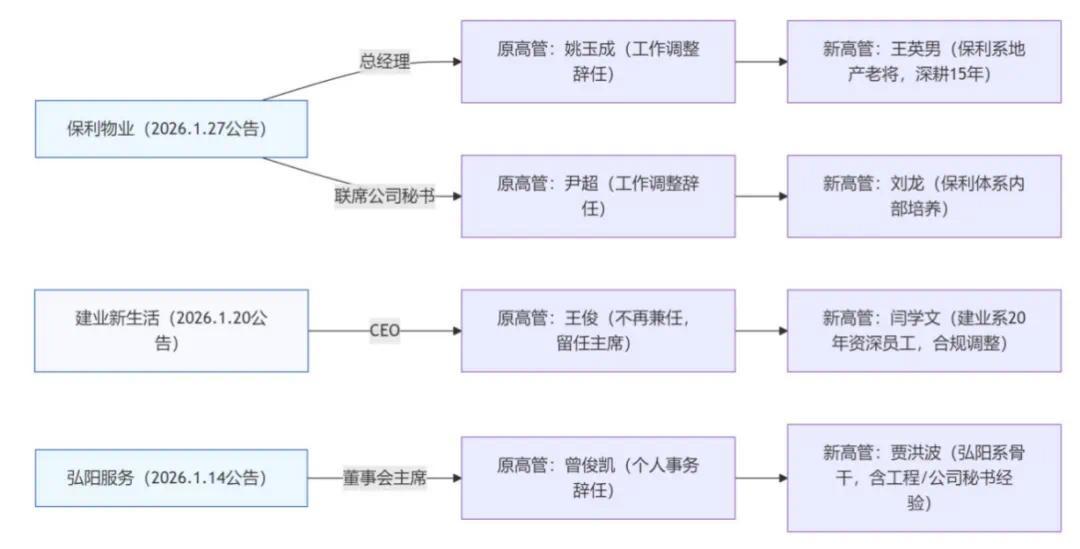
昔日地产板块的配套行业,正在成为房企核心人才的新赛场。 1月27日,保利物业的四条公告打破了物管行业的平静,这距离该公司上一次关键人事变动已过去三年。2023年1月,吴兰玉接任董事长,姚玉成空降出任 总经理。 而此次,因工作调整辞任总经理的姚玉成,其职位由47岁的王英男接棒,后者履历几乎贯穿地产开发全链条。 头部物企的人事变动并非行业孤例,随着地产行业的深度调整,拥有稳定现金流的物业板块反而成了"香饽饽",越来越多地产高管也开始转投物企。据 《每日经济新闻》记者(以下简称每经记者)统计,仅2026年以来,保利物业、建业新生活、弘阳服务已陆续迎来了地产背景高管。 地产大佬去物业 2026年开年,多位地产老将集体奔赴物管赛道。 1月27日,保利物业连发四条公告,官宣管理层换血,深耕地产领域15年的王英男接棒姚玉成出任总经理。 事实上,约半个月前,保利发展将运营管理中心与产品管理中心合并为不动产运营中心,集团架构调整的信号刚释放,王英男调任的消息便已传开。 中国企业资本联盟副理事长柏文喜向每经记者指出,保利发展这一架构调整,标志着集团层面已打破开发与运营的职能壁垒,物业板块引入地产高管,是 组织架构变革的自然延伸。 ...
首批8只商业不动产REITs正式上线
HUAXI Securities· 2026-02-02 01:08
1. Report Industry Investment Rating No relevant content provided. 2. Core Viewpoints of the Report - The China Securities REITs Total Return Index closed at 1052 points this week, up 0.47% week - on - week, but the market trading activity declined marginally. The total market capitalization of 78 listed REITs reached 228.7 billion yuan, with a circulating market capitalization of 124.7 billion yuan. The Huaxia Zhonghe Clean Energy REIT will be listed on February 2, 2026 [1][11]. - The first batch of 8 commercial real - estate REITs were accepted by the Shanghai Stock Exchange. With excellent occupancy rates and good locations, they are worthy of attention for their application progress and new - share subscription opportunities [2][20][21]. - In the secondary market, new - type facilities declined by 1.19%, while energy facilities led the gain by 1.54%. It is advisable to focus on hydropower assets with high stability or projects with high guarantee of distributable amounts [5][6][26]. 3. Summary by Relevant Catalogs 3.1 Primary Market: The First Batch of 8 Commercial Real - Estate REITs Accepted - In late 2025, the CSRC officially launched commercial real - estate REITs, focusing on commercial complexes, commercial retail, office, hotels and other commercial assets with clear ownership, mature operation models, and stable cash flows [2][17]. - From January 29 - 30, 2026, the first batch of 8 commercial real - estate REITs were accepted by the SSE. The total proposed fundraising scale is about 31.475 billion yuan, with the largest being CICC Vipshop Commercial Real - Estate REIT (7.47 billion yuan) and the smallest being Huaan Jinjiang Commercial Real - Estate REIT (1.703 billion yuan). The original equity holders include private enterprises, foreign - funded enterprises, Shanghai state - owned enterprises, and central enterprises [2][20]. - The occupancy rates of the first batch of 8 commercial real - estate REITs are excellent, and some are fully occupied. The average occupancy rate of 21 "Jinjiang Metropolo" hotels is about 61.58%. They are mainly located in core cities [3][21]. 3.2 Secondary Market: New - Type Facilities Corrected, Energy Facilities Led the Gain - Except for a 1.19% decline in new - type facilities, other asset types rose slightly, with energy facilities leading the gain at 1.54%, followed by municipal environmental protection (+0.52%) and transportation facilities (+0.41%) [5][26]. - The data center (IDC) sector had a significant pull - back this week. Runze Technology and万国 Data Center declined by 0.40% and 2.67% respectively. The two IDC REITs' dynamic distribution rates are close to the reference value, and opportunities from subsequent asset fluctuations can be monitored [5][29]. - Energy facilities had the largest increase this week. ICBC Inner Mongolia Energy Clean Energy REIT performed well, but it is recommended to give priority to hydropower assets with high stability or projects with high guarantee of distributable amounts due to the large performance fluctuations of energy - related projects in Q4 2025 [6][32][34]. - The industrial park sector rose 0.34% this week. It is recommended to pay attention to park REITs with stable fundamentals, income distribution adjustment mechanisms, and high distribution rates [37]. - The consumption infrastructure sector rose 0.22% this week. With the late Spring Festival this year, the consumption boom continues to support the Q1 performance of each project. Some projects with relatively high distribution rates are worth attention [39][40]. - The trading activity of REITs weakened marginally this week. In terms of sectors, except for municipal environmental protection, the turnover rates of each asset sector declined. Attention can be paid to the trading situation of the consumption sector [42][45][46].