KUAISHOU(01024)

Search documents
春晚广告位争夺战:四十年国民记忆与商业洪流
Xin Lang Cai Jing· 2026-02-19 07:21
Core Insights - The evolution of the CCTV Spring Festival Gala sponsorship reflects the transformation of Chinese society and economy over the past 40 years, showcasing the changing consumer demands and emerging industries [20][21]. Group 1: 1980s to Early 1990s - The Era of Scarcity - In the 1980s, as China transitioned from a planned economy to a market economy, consumer goods were scarce, leading to a high demand for basic commodities [22]. - The first brand to sponsor the Spring Festival Gala was Kambas watches in 1984, which used 3,000 quartz watches as payment, marking the beginning of brand sponsorship in the gala [22][23]. - Kambas became a household name, with production reaching 1.26 million units in 1987 and over 2 million by 1991, despite the high price of its watches relative to average incomes [23][24]. Group 2: Mid-1990s to Early 2000s - The Rise of Consumerism - The mid-1990s saw a shift in consumer spending from basic goods to electronics, with Shandong Kongfu Banquet Wine becoming the first "advertising king" by paying 30.79 million yuan for sponsorship in 1995 [26]. - The competition among liquor brands for sponsorship reflected the rise of "social consumption," where premium liquor became a status symbol for social gatherings [28]. - After winning the Spring Festival sponsorship, Qin Pool Wine's sales skyrocketed from 180 million yuan in 1995 to 950 million yuan in 1996, demonstrating the immediate impact of gala sponsorship [29]. Group 3: 2000s to Early 2010s - The Home Appliance Boom - The early 2000s marked a shift towards home appliances as the primary consumer focus, with Midea becoming the most frequent sponsor, securing 16 sponsorships from 2003 to 2019 [30]. - The cost of advertising during the gala increased significantly, with Midea's sponsorship fee rising from 6.8 million yuan in 2005 to 57.2 million yuan in 2011, an increase of 840% [30]. - Midea's revenue grew from 17.5 billion yuan in 2003 to over 140 billion yuan in 2014, reflecting the effectiveness of its gala sponsorship strategy [12][30]. Group 4: Mid-2010s to Present - The Digital Economy and Technological Innovation - The rise of internet companies has transformed the Spring Festival Gala into a platform for digital engagement, with WeChat's "red envelope war" in 2015 significantly boosting viewer interaction [15][35]. - The gala's advertising has evolved from one-way promotion to interactive engagement, with platforms like Douyin and Kuaishou participating in sponsorships [16][35]. - The presence of technology companies has increased, with innovations such as AI and robotics showcased during the gala, indicating a shift from traditional advertising to technology-driven marketing [19][37].




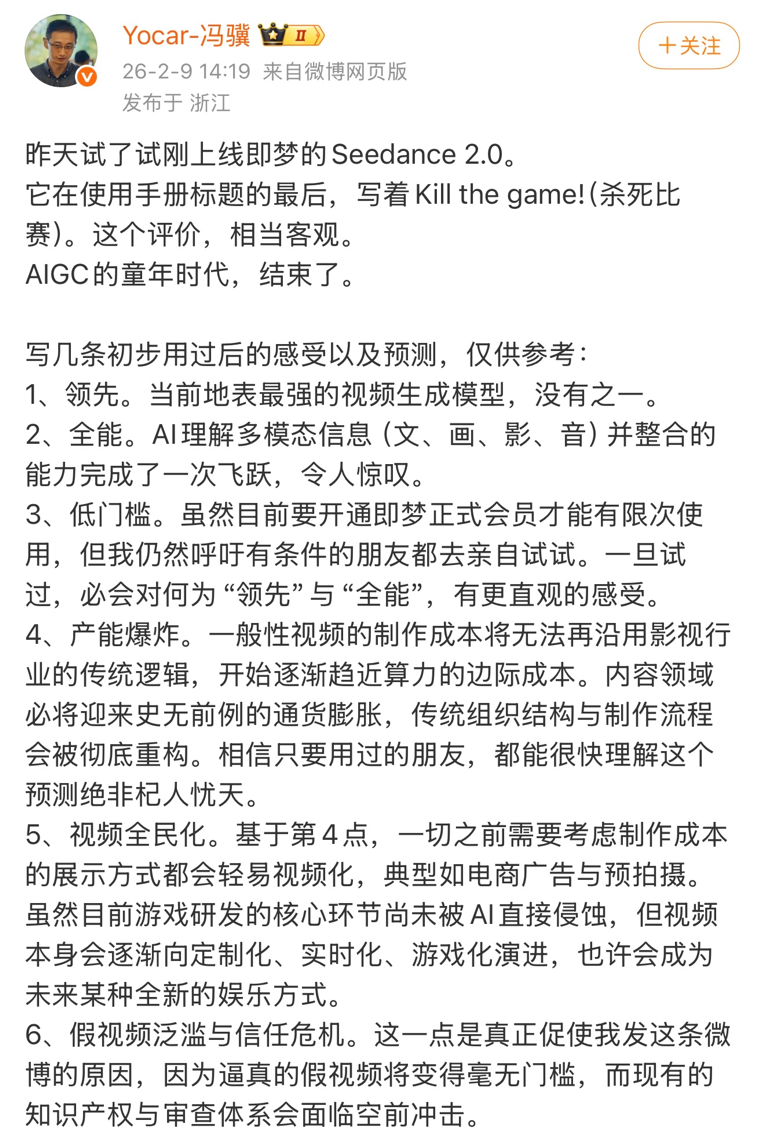
Seedance2.0爆火!马斯克感叹:发展速度太快!国产新模型逼近技术奇点
Xin Lang Cai Jing· 2026-02-18 23:36
Core Insights - The era of AIGC (Artificial Intelligence Generated Content) is transitioning, with significant advancements in video generation technology exemplified by the launch of Seedance 2.0 by ByteDance [1][4] - The rapid development of AI video models is leading to a potential explosion in the film and entertainment industry, with concerns about balancing innovation and regulatory oversight [1][4] Group 1: Seedance 2.0 Features and Impact - Seedance 2.0 utilizes a "dual-branch diffusion transformer architecture," allowing simultaneous generation of video and audio, resulting in synchronized and coherent outputs [2] - The model can generate up to 60 seconds of video from a single sentence or text input, significantly surpassing the industry standard of 15 seconds [2] - Seedance 2.0 is capable of producing multi-shot coherent videos with consistent character design and cinematic "montage" effects, making it suitable for various creative fields [2][3] Group 2: Industry Position and Competition - The success of Seedance 2.0 indicates that Chinese AI companies are no longer just followers but are competing on equal footing with global giants like OpenAI and Google [4] - Kuaishou's Keling AI also launched Keling Video 3.0 around the same time, indicating a competitive landscape in the AI video generation sector [4] Group 3: Market Response and Future Outlook - Reports suggest that the AI application sector is entering a growth phase, with opportunities expanding into subfields like AI comics and film IPs [5] - The stock market reacted positively to the news of Seedance 2.0, with several AI-related stocks experiencing significant gains [5] Group 4: Ethical Considerations and Challenges - Concerns about the proliferation of deepfake technology and the resulting trust crisis are emerging, as the ability to create realistic fake videos becomes more accessible [6][9] - The platform has restricted the use of real human images in the model to mitigate potential copyright issues and ensure a sustainable creative environment [8]
可灵不灵了?
创业邦· 2026-02-18 10:12
Core Viewpoint - The article discusses the rapid evolution of the AI video generation market, highlighting the competitive landscape where ByteDance's Seedance 2.0 has emerged as a significant player, potentially redefining the industry standards and challenging existing leaders like Kuaishou's Keling [4][5][6]. Market Dynamics - The AI video generation sector is transitioning from isolated breakthroughs to comprehensive competition, with various domestic models like Kuaishou's Keling, ByteDance's Jimeng, and Alibaba's Wanxiang leading the charge [8]. - The competition is intensifying as different companies adopt varied development strategies, with many models converging on basic capabilities while maintaining distinct features and technical specialties [8][12]. Keling's Position - Keling has been recognized as a leading video generation model since its launch in June 2024, achieving over 30 iterations and generating significant revenue, exceeding 700 million yuan by the third quarter of 2025 [11][20]. - Despite its early advantages, Keling faces pressure as its technological lead diminishes, with competitors rapidly advancing in areas like multi-shot narrative and complex content generation [15][20]. Seedance 2.0's Impact - Seedance 2.0 has introduced significant advancements, such as automatic multi-shot usage and improved narrative logic, outperforming competitors in efficiency and cost [13][19]. - The model's ability to generate 2K videos faster than competitors by 30% has raised the bar for the industry, prompting concerns for Keling's market position [13][19]. Competitive Strategies - ByteDance's Jiemeng AI integrates deeply with its Douyin platform, achieving rapid user growth, while Alibaba's Wanxiang adopts an open-source strategy to enhance its technological edge [12][20]. - Keling's strategy focuses on product innovation and commercialization, but it must navigate internal challenges and external competition to maintain its market share [10][21]. Future Outlook - The article suggests that Keling must differentiate itself beyond being a mere generation tool to avoid being marginalized in the competitive landscape [22]. - The future of competition will hinge on understanding creator needs, content ecosystem management, and innovative business models, indicating that both Seedance and Keling have significant challenges ahead [22].

春晚40年赞助商变迁史,从康巴丝到机器人见证中国经济跃迁
Sou Hu Cai Jing· 2026-02-18 02:17
Group 1 - The article discusses the evolution of sponsorship in the CCTV Spring Festival Gala over the past 40 years, reflecting changes in Chinese society and consumer behavior [2][3] - The first sponsor, 康巴丝 (Kambas), set a precedent in 1984 by using 3,000 quartz watches as payment, marking the beginning of brand sponsorship in the gala [6][8] - The transition from watches to bicycles as the next major sponsor in 1995 illustrates the shift in consumer goods that represented status during the era of material scarcity [10][12] Group 2 - The late 1990s saw a surge in consumer spending on new household appliances, with 山东孔府宴酒 (Shandong Confucius Banquet Wine) becoming the first "mark king" of the gala in 1995, paying 30.79 million yuan [10][12] - The rapid growth of the liquor industry during this period was fueled by "human consumption," where premium liquor became a social currency [12][14] - The article highlights the consequences of over-reliance on advertising without maintaining product quality, as seen in the case of 秦池酒 (Qin Pool Wine), which faced a significant drop in sales after quality issues emerged [14][15] Group 3 - From the early 2000s, the focus shifted to home appliances, with 美的 (Midea) becoming a prominent sponsor, securing 16 sponsorships from 2003 to 2019 [17][19] - The cost of advertising during the gala increased significantly, with Midea's sponsorship fee rising from 6.8 million yuan in 2005 to 57.2 million yuan in 2011, reflecting the growing viewership [17][19] - The brand storytelling approach adopted by companies like 海尔 (Haier) and 格力 (Gree) during this period indicates a shift towards building emotional connections with consumers [20] Group 4 - The rise of internet companies post-2010 transformed the gala's advertising landscape, with platforms like WeChat leveraging the event for massive user engagement through interactive features like the "red envelope battle" [21][23] - The article notes that the 2015 Spring Festival Gala saw WeChat's user engagement peak, with over 10.1 billion red envelopes sent, showcasing the event's potential as a digital marketing platform [21][23] - The involvement of tech giants in the gala reflects a broader trend of digital economy reshaping traditional advertising methods, with companies like 快手 (Kuaishou) and 抖音 (Douyin) entering the sponsorship arena [25][27] Group 5 - The article concludes by emphasizing the transition from showcasing products to highlighting technological advancements, as seen with the introduction of robots in recent galas [27] - This shift signifies a broader change in China's economic landscape, moving from manufacturing to innovation-driven growth, with a focus on high-tech industries [27] - The future of the Spring Festival Gala sponsorship landscape remains uncertain, raising questions about which industries will dominate the next decade [27]

春晚广告位争夺战:四十年国民记忆与商业暗流
创业邦· 2026-02-17 10:32
Core Viewpoint - The evolution of the Spring Festival Gala sponsorship reflects the changing landscape of China's economy and consumer behavior over the past 40 years, showcasing the transition from material scarcity to technological innovation and brand storytelling [4][24]. Group 1: 1980s to Early 1990s - The 1980s marked a period of material scarcity, where items like watches and radios were symbols of wealth and status, leading to the first brand sponsorship by 康巴丝 (Kangbasi) at the Spring Festival Gala [5][7]. - 康巴丝 sponsored the gala by trading 3,000 quartz watches for advertising, which significantly boosted its brand recognition and sales, reaching an annual production of 1.26 million watches by 1987 [8]. - The sponsorship model evolved, with 中华自行车 (Zhonghua Bicycle) taking over the sponsorship in 1995, reflecting the changing consumer demands and economic conditions [9][14]. Group 2: Mid-1990s to Early 2000s - The mid-1990s saw a surge in consumer spending, with the emergence of "标王" (advertising king) sponsorships, particularly in the liquor industry, exemplified by 山东孔府宴酒 (Shandong Confucius Feast Wine) and 秦池酒 (Qinchijiu) [11][12]. - 秦池酒's sponsorship led to a dramatic increase in sales from 1.8 billion yuan in 1995 to 9.5 billion yuan in 1996, highlighting the impact of gala sponsorship on brand visibility and sales [16]. - The era was characterized by a shift towards consumerism, with brands leveraging the gala to enhance their market presence, although some faced backlash due to quality issues [16]. Group 3: 2000s to Early 2010s - The early 2000s marked the rise of home appliance brands, with 美的 (Midea) becoming a prominent sponsor, securing 11 sponsorships from 2003 to 2014, reflecting the growing importance of brand trust [17][19]. - The cost of advertising skyrocketed, with Midea's sponsorship fee increasing from 6.8 million yuan in 2005 to 57.2 million yuan in 2011, indicating the gala's significant viewership and advertising value [21]. - Brands began to focus on storytelling and emotional connections with consumers, moving beyond mere product promotion to build brand loyalty [23]. Group 4: Mid-2010s to Present - The 2010s saw the rise of internet companies as key players in the advertising space, with platforms like WeChat revolutionizing audience engagement through interactive features like the "red envelope battle" during the gala [25][26]. - The digital transformation of the gala allowed for unprecedented levels of interaction, with WeChat reporting 10.1 billion red envelope transactions on New Year's Eve, significantly enhancing its user base [26]. - The emergence of technology companies in the gala sponsorship landscape reflects a broader shift towards innovation and digital engagement, with brands like Xiaomi and AI robotics showcasing advancements in technology [32].





“问豆包认孙子” AI春晚秀出新高潮 大厂打响新年跑“马”圈地第一战
智通财经网· 2026-02-16 23:41
Core Viewpoint - The 2026 Spring Festival Gala showcased significant AI marketing efforts from major tech companies, highlighting the integration of AI into entertainment and user interaction, with a focus on enhancing audience engagement through innovative technologies [1][3][10]. Group 1: AI Integration in Spring Festival Gala - The gala featured AI elements prominently, with the "Doubao" application playing a central role in various performances and interactions, demonstrating the capabilities of AI in enhancing live events [1][3]. - Doubao's technology supported multiple aspects of the gala, including stage art creation, intelligent robot interactions, and real-time audience engagement through features like live subtitles [3][5][10]. - The gala's use of AI technologies, such as the Seedance 2.0 model, allowed for high-quality visual presentations and complex artistic expressions, showcasing the potential of generative AI in creative fields [4][5]. Group 2: Major Tech Companies' Marketing Strategies - Major companies like ByteDance, Tencent, Alibaba, Baidu, Meituan, and JD.com engaged in extensive marketing campaigns during the Spring Festival, utilizing AI to enhance user experiences and drive engagement [1][6][10]. - Tencent initiated a significant marketing campaign with a 1 billion yuan red envelope giveaway, aiming to replicate the success of previous promotional strategies [6][10]. - Alibaba's "one sentence to order milk tea" campaign achieved rapid success, reflecting the effectiveness of AI in facilitating consumer transactions during the festive season [7][10]. Group 3: Future of AI Applications - The competition among tech giants in the AI space is expected to accelerate, with a focus on applications that deliver clear business value and enhance user experiences [10][11]. - Companies are exploring long-term value in their marketing strategies, aiming to integrate AI into daily life and consumer habits [10][11]. - The ongoing AI flow battle is seen as a critical first step in establishing a competitive landscape for AI applications leading up to 2026 [11].



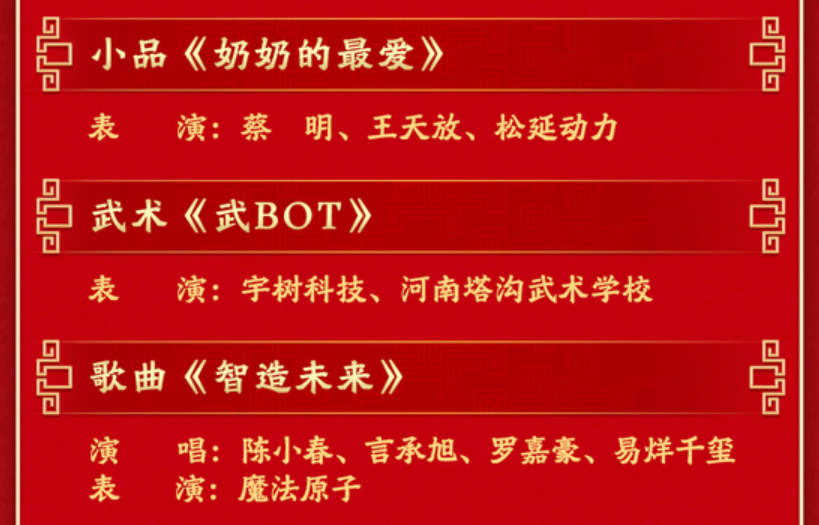
2026年央视春晚节目单发布,合作伙伴超20家知名公司,宇树机器人今年将表演武术
Jin Rong Jie· 2026-02-16 08:09
Group 1: Event Overview - The 2026 Spring Festival Gala will be broadcasted live on 10 TV channels, 9 radio frequencies, and 6 new media platforms, covering various genres including comprehensive, variety, and ultra-high-definition channels [1] - CGTN will collaborate with over 3,500 media outlets in more than 200 countries and regions to provide comprehensive coverage of the event in 85 languages [1] Group 2: Technology and Partnerships - The gala will feature significant technological elements, particularly in robotics and artificial intelligence, with confirmed partners including Yushutech, Volcano Engine, and Magic Atom [2] - Notable performances will include a martial arts display by Yushutech robots in collaboration with Henan Tagou Martial Arts School, and a skit by Songyan Power with celebrities [2] Group 3: Corporate Participation - Over 20 partners have been announced for the gala, spanning various sectors such as smart mobility, AI robotics, and the liquor industry, including companies like Huawei and Great Wall Motors [4] - At least 8 publicly listed companies are among the partners, representing industries such as liquor, automotive, and video platforms, including Wuliangye and Bilibili [5]




春晚节目单公布:一共3个小品,没有相声!沈腾、马丽不演小品演“贺岁微电影”,宇树科技机器人将表演武术节目!央视记者实探春晚后台
Mei Ri Jing Ji Xin Wen· 2026-02-16 08:01
Group 1 - The 2026 Spring Festival Gala will feature a total of 3 skits, 2 comedy short plays, and 1 dialogue program, with no traditional crosstalk performances [2][4] - Notable performances include a New Year's microfilm by Shen Teng and Ma Li titled "The Night I Can't Forget" [4][27] - The gala will showcase a variety of new faces, including actors from popular comedy shows appealing to younger audiences [5] Group 2 - The music segment will include performances by Wang Fei, who will sing "The Moment We Experienced Together," and a collaboration featuring international artists like John Legend and Westlife [6][9] - The stage design will incorporate advanced technology, including a dynamic art installation representing galloping horses, symbolizing vitality and auspiciousness [16][20] - The gala will utilize AI, AR, and XR technologies to create an immersive visual experience [20] Group 3 - Over 20 companies have been announced as partners for the gala, spanning various sectors such as smart mobility, artificial intelligence, and alcohol [24][27] - Notable partners include Huawei, which is collaborating on live streaming, and several robotics companies like Yushutech and Songyan Power [25][27] - Among the partners, 8 are publicly listed companies, including major players in the liquor and automotive industries [28]


今晚春晚节目单公布,20家合作公司曝光
21世纪经济报道· 2026-02-16 07:42
Core Viewpoint - The article discusses the official program list for the 2026 Spring Festival Gala, highlighting various performances and collaborations with companies across different sectors, including smart travel and artificial intelligence [1][9]. Group 1: Performance Highlights - The opening performance features "Miracles Are Coming" with artists such as Mi Xue and Xu Di [3]. - Notable performances include songs by Zhou Huimin and Liu Mintao, as well as a skit titled "Grandma's Favorite" featuring Cai Ming [3][4]. - The gala will showcase a variety of acts, including martial arts, dance, and comedy, with participation from various artists and groups [3][5][6]. Group 2: Corporate Collaborations - Over 20 partners have been officially announced for the gala, covering sectors like smart travel, artificial intelligence, and liquor [9]. - Eight of these partners are publicly listed companies, including Wuliangye, Yanghe, and Kuaishou [9]. - Specific collaborations include Jianghuai Automobile and Huawei for smart travel, and Magic Atom for intelligent robotics [10]. Group 3: Industry Impact - The gala's partnerships reflect a growing trend of integrating technology and entertainment, particularly in the fields of AI and smart travel [10]. - The involvement of major companies indicates a strategic move to enhance brand visibility during a high-profile event like the Spring Festival Gala [9][10].


春晚合作公司名单来了
新华网财经· 2026-02-16 06:53
Group 1 - The 2026 Spring Festival Gala has announced over 20 partners across various sectors, including smart mobility, artificial intelligence, and liquor [1] - Notable partners in the smart ecosystem include companies like ZhiMi Group and Huawei's Mate 80 series as strategic partners [2] - In the smart mobility sector, Jianghuai Automobile and Great Wall Motors are highlighted as key partners, with Jianghuai collaborating with Huawei on a flagship vehicle [2] Group 2 - The artificial intelligence and robotics sector features partnerships with companies such as Volcano Engine and Yushu Technology, emphasizing a strong technological presence at the gala [3] - Eight listed companies are among the partners, including Wuliangye, Yanghe, and Great Wall Motors, indicating significant market representation [3] - The gala's collaboration with ByteDance's Volcano Engine and the large model company Doubao showcases the integration of advanced AI technologies [3]