
TIANYOUDE(002646)

Search documents
白酒中报| 白酒企业逆势加大费用投放 水井坊销售费用率最高达到36.35%
Xin Lang Cai Jing· 2025-09-12 09:41
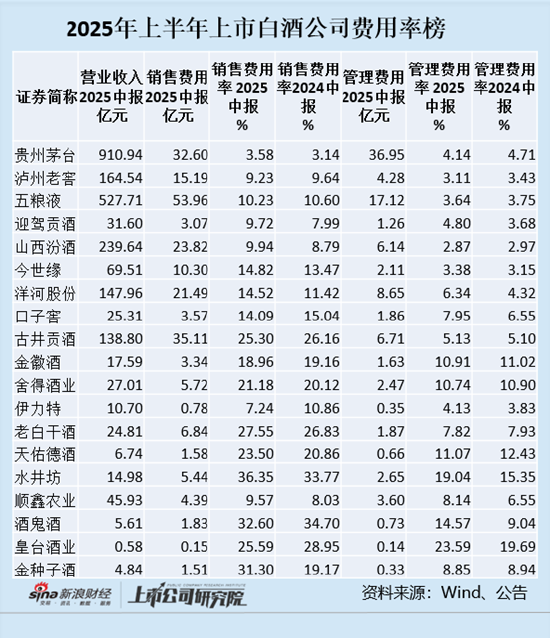
Core Insights - The Chinese liquor industry is entering a period of accelerated clearing, with a significant decline in production and profits in the first half of 2025 [1][2] - A majority of listed liquor companies are experiencing revenue declines, indicating a shift in the industry's growth logic from "volume reduction, price increase" to simultaneous declines in both volume and price [2][3] Industry Overview - In the first half of 2025, the total production of the liquor industry was 1.9159 million kiloliters, a year-on-year decrease of 5.8%, while sales revenue reached 330.42 billion yuan, a slight increase of 0.19%. Profits fell to 87.687 billion yuan, down 10.93% year-on-year [1] - 58.1% of distributors reported increased inventory levels, with over half facing price inversion issues. The average inventory turnover days for the liquor industry reached 900 days, an increase of 10% compared to the previous year [1] Company Performance - Among 19 listed liquor companies, 13 reported revenue declines, accounting for 68% of the total, with a significant slowdown in revenue growth compared to the previous year [2] - The market share is increasingly concentrated among leading companies, with the top six liquor firms accounting for 47% of revenue in 2024, up 13 percentage points from five years ago [2] - The median revenue growth rate for the top six liquor companies was 2.36%, while the median for companies below 10 billion yuan was -16.89% [2] Pricing Trends - The wholesale price index for liquor has been declining, with notable price drops for major brands such as Moutai and Wuliangye, indicating a broader trend of price reduction across the industry [2][3] Expense Management - Despite declining revenues, many liquor companies have increased their marketing expenditures. The median sales expense growth rate for 19 companies was -11.85%, while overall sales expenses remained stable compared to the previous year [4] - The highest sales expense ratio was recorded at 36.35% for Shui Jing Fang, with 58% of companies increasing their sales expense ratios [4][5] - Management expense ratios have also increased, with the highest being 23.59% for Huangtai Liquor, indicating pressure on profitability for smaller companies [5][6]






中高端产品承压,天佑德酒回应:将重点发力“县域化”
Xi Niu Cai Jing· 2025-09-12 02:19
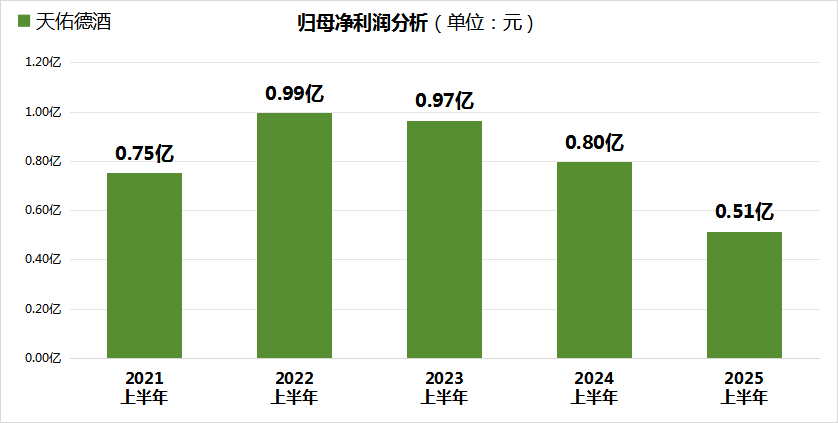
Core Insights - Tianyoude Liquor reported a revenue of 674 million yuan for the first half of 2025, a year-on-year decline of 11.24%, with a net profit attributable to shareholders of 51.46 million yuan, down 35.37% year-on-year [2] - The company is focusing on a strategic framework termed "Four Transformations" which includes county-level, international, youth-oriented, and terminal-focused strategies to adapt to changes in domestic consumption and competition in the liquor industry [3][5] Revenue Breakdown - Revenue from Qingke Baijiu decreased by 10.97% to 570 million yuan, with a gross margin of 68.10%, down 0.46 percentage points from the previous year [2] - Revenue from mid-to-high-end products priced at 100 yuan (inclusive) per 500ml fell by 10.19%, with a gross margin decrease of 1.08 percentage points [2] - Revenue from wine products was 4.64 million yuan, a decline of 6.89% year-on-year [2] Strategic Initiatives - The company plans to invest 160 million yuan in a cultural tourism winery project in Tibet, aiming to integrate unique cultural and ecological resources into a brand identity that is difficult to replicate [3] - Tianyoude Liquor is actively exploring new market growth points, particularly in developing youth-oriented products such as low-alcohol, fruit-flavored, and health-focused options [3][4] - The company is also enhancing its product offerings with innovative designs and packaging to accelerate its national expansion [3] Market Expansion - Key markets for expansion include Gansu and Sichuan, with strategies to integrate local markets and leverage tourism to promote products [4] - The company has introduced new products like a 28-degree lemon Qingke liquor and a snow pear flowing sand liquor to cater to emerging consumer preferences [4] Marketing Strategy - The "county-level" strategy is a crucial part of the company's "Four Transformations," focusing on the unique economic environment of county markets, which are less affected by economic pressures [5] - The company emphasizes the need for a flat marketing channel strategy, inspired by successful models in the U.S., to enhance efficiency and effectiveness in sales [5]
白酒板块9月11日涨0.3%,酒鬼酒领涨,主力资金净流出5223.93万元
Zheng Xing Xing Ye Ri Bao· 2025-09-11 08:43
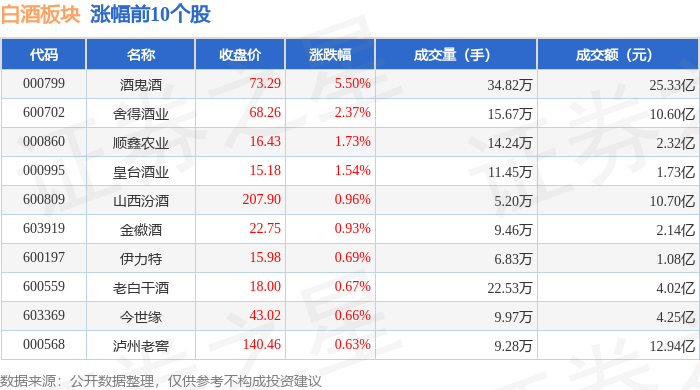
Core Viewpoint - The liquor sector experienced a slight increase of 0.3% on September 11, with strong performance from Jiu Gui Jiu, while the overall market indices also saw gains, indicating a positive sentiment in the market [1]. Group 1: Market Performance - The Shanghai Composite Index closed at 3875.31, up by 1.65% [1]. - The Shenzhen Component Index closed at 12979.89, up by 3.36% [1]. - The liquor sector's individual stock performance showed varied results, with notable gains from Ji Si Xing at 5.50% and She De Jiu Ye at 2.37% [1]. Group 2: Stock Data - Ji Si Xing (000799) closed at 73.29 with a trading volume of 348,200 shares and a transaction value of 2.533 billion [1]. - She De Jiu Ye (600702) closed at 68.26 with a trading volume of 156,700 shares and a transaction value of 1.060 billion [1]. - Guizhou Moutai (600519) closed at 1523.50 with a trading volume of 37,200 shares and a transaction value of 5.643 billion [2]. Group 3: Capital Flow - The liquor sector saw a net outflow of 52.239 million from institutional investors and 236 million from speculative funds, while retail investors contributed a net inflow of 289 million [2]. - Guizhou Moutai experienced a net inflow of 26,661, while Jiu Gui Jiu had a net outflow of 1.37 billion from institutional investors [3]. - The overall capital flow indicates a mixed sentiment, with retail investors showing interest despite the outflows from larger funds [2][3].


白酒板块9月10日涨0.53%,*ST岩石领涨,主力资金净流入8.96亿元
Zheng Xing Xing Ye Ri Bao· 2025-09-10 08:30
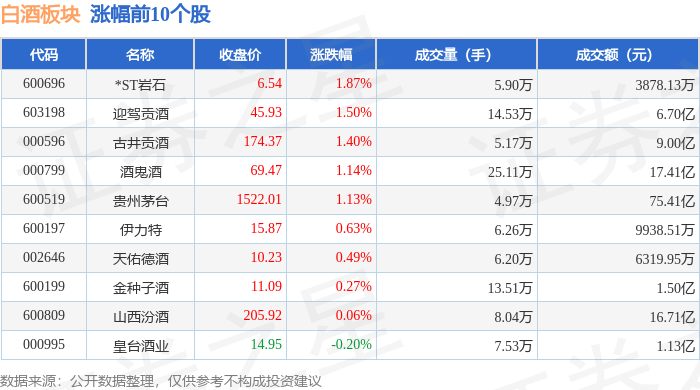
Core Insights - The liquor sector experienced a slight increase of 0.53% on September 10, with *ST Yanshi leading the gains [1] - The Shanghai Composite Index closed at 3812.22, up 0.13%, while the Shenzhen Component Index closed at 12557.68, up 0.38% [1] Liquor Sector Performance - The following companies showed notable performance: - *ST Yanshi: Closed at 6.54, up 1.87% with a trading volume of 59,000 shares and a transaction value of 38.78 million [1] - Yingjia Gongjiu: Closed at 45.93, up 1.50% with a trading volume of 145,300 shares and a transaction value of 670 million [1] - Gujing Gongjiu: Closed at 174.37, up 1.40% with a trading volume of 51,700 shares and a transaction value of 900 million [1] - Jiu Gui Jiu: Closed at 69.47, up 1.14% with a trading volume of 125,110 shares and a transaction value of 1.741 billion [1] - Kweichow Moutai: Closed at 1522.01, up 1.13% with a trading volume of 49,700 shares and a transaction value of 7.541 billion [1] Capital Flow Analysis - The liquor sector saw a net inflow of 896 million from main funds, while retail funds experienced a net outflow of 148 million [2] - The following companies had significant capital flow: - Kweichow Moutai: Main fund net inflow of 827 million, retail fund net outflow of 372,700 [3] - Jiu Gui Jiu: Main fund net inflow of 54.21 million, retail fund net outflow of 91.93 million [3] - Yingjia Gongjiu: Main fund net inflow of 31.79 million, retail fund net outflow of 31.19 million [3]


天佑德酒2025上半年归母净利润下降35.37%,毛利率创同期历史新低
Jin Rong Jie· 2025-09-10 03:05
Core Insights - Tianyoude Liquor reported a significant decline in both revenue and net profit for the first half of 2025, with revenue at 674 million yuan, down 11.24% year-on-year, and net profit at 51.46 million yuan, down 35.37% [1][3]. Revenue Breakdown - The core market of Qinghai Province saw a revenue decrease of 8.49%, while the out-of-province market experienced a larger decline of 17.18%, indicating challenges in the company's national expansion strategy [3]. - Revenue from the core product, barley liquor, was 570 million yuan, reflecting a 10.79% year-on-year decline. Revenue from products priced above 100 yuan/500ml and below 100 yuan/500ml fell by 10.19% and 11.44%, respectively [3]. Subsidiary Performance - The subsidiary Beijing Mutual Tianyoude Barley Liquor Sales Co., Ltd. reported an 85.52% decline in revenue, resulting in a net loss of 7.98 million yuan. The U.S. subsidiary, Oranos Group, Inc., also incurred a loss of 13.02 million yuan [3]. Financial Ratios - Key financial metrics such as net profit margin, gross profit margin, and return on equity (ROE) reached new lows. The net profit margin fell from 10.51% in the first half of 2024 to 7.65%, a decrease of 2.86 percentage points, marking three consecutive years of decline [4]. - The gross profit margin decreased from 59.45% in the first half of 2024 to 58.66%, a drop of 0.78 percentage points, the lowest since the mid-2011 report [4]. - The ROE for the first half of 2025 was 1.81%, down 0.97 percentage points, also reflecting three years of consecutive decline [4].
天佑德酒新战略难挽业绩颓势,鲁水龙能否打破全国化困局?
Xin Jing Bao· 2025-09-06 07:09
Core Viewpoint - The company, Qinghai Huzhu Tianyoude Barley Wine Co., Ltd., is experiencing a significant decline in revenue and net profit, continuing the downward trend from 2024, with its newly established "Four Modernizations" strategy yet to show results [1][2][4]. Group 1: Financial Performance - In the first half of 2025, the company's revenue decreased by 11.24% to 674 million yuan, and net profit fell by 35.37% to 51.46 million yuan [2][4]. - Revenue from barley wine priced above 100 yuan was 299 million yuan, down 10.19%, while revenue from barley wine below 100 yuan was 271 million yuan, down 11.44% [2]. - The company's main market in Qinghai generated 461 million yuan, a decrease of 8.49%, while revenue from outside Qinghai was 198 million yuan, down 17.18% [2]. Group 2: Strategic Initiatives - The company aims to solidify its core markets in Xining, Lanzhou, and Lhasa while accelerating development in Shanxi, Shaanxi, and Henan, as part of its "Four Modernizations" strategy [2][10]. - The strategy includes focusing on county-level markets, internationalization, youth engagement, and terminal market development, with an emphasis on introducing light bottle and 100-yuan boxed wine products [1][3][10]. - The appointment of veteran executive Lu Shuilong as vice president is intended to enhance market expansion beyond the Northwest region [5][6]. Group 3: Market Challenges - The company faces significant pressure from industry adjustments and competition, particularly in the context of a declining high-end product market [1][4]. - The "Four Modernizations" strategy is seen as practical but challenging, as the company struggles to leverage its unique barley wine characteristics to gain market share [1][4]. - The company’s expansion efforts have been hampered by a lack of brand recognition and operational experience in broader markets, particularly in the face of competition from established brands [10][14]. Group 4: Product Line and International Ventures - The company has been expanding its product line to include wines and whiskies aimed at younger consumers, but these segments have not yet proven profitable [11][12][13]. - The overseas subsidiary, OG, has consistently reported losses, raising questions about the viability of the international strategy [12][14]. - Despite the challenges, the company remains committed to its internationalization efforts, viewing them as a long-term strategic direction [13][14].
如何应对行业周期?白酒企业集体转向“三低”市场
Sou Hu Cai Jing· 2025-09-05 10:07
Core Insights - The Chinese liquor industry is undergoing a deep adjustment, with companies shifting their focus towards low-alcohol, low-priced products, and lower-tier markets due to macroeconomic pressures and changing consumer behaviors [1][6]. Group 1: Low-Alcohol Products - Several liquor companies have recently launched low-alcohol products targeting younger consumers, with notable releases including Gujing's 26-degree "Light Gu20," Wuliangye's 29-degree "Wuliangye Yijian Qingxin," and Shede's 29-degree "Shede Zizai" [2]. - The China Alcoholic Drinks Association predicts that the low-alcohol market will exceed 74 billion yuan by 2025, with a compound annual growth rate of 25% [3]. - Companies like Luzhou Laojiao are actively developing lower-alcohol products, with their 38-degree offerings now making up 50% of sales in the Guojiao 1573 series, which has surpassed 20 billion yuan in sales [3]. Group 2: Consumer Trends - The younger demographic, particularly those born in the 1980s and 1990s, along with young women, are emerging as key consumer groups, favoring personalized, low-alcohol, and aesthetically pleasing products for casual social settings [2]. - The shift in consumer preferences emphasizes a move from traditional social drinking to a focus on personal enjoyment and experience [3]. Group 3: Pricing and Market Dynamics - The demand for mid-range products is recovering slowly, while low-priced products are showing resilience, with some even experiencing growth [6]. - Wuliangye reported a production increase of 11.56% and sales growth of 12.75% for its products in the first half of 2025, driven by consumer preference for mid to low-priced options [7]. - The market is seeing a trend where high-end liquor prices are declining, and consumers are increasingly valuing cost-effectiveness, leading to a preference for lower-priced options [9]. Group 4: Market Competition and Strategy - The industry is facing intensified competition as major brands penetrate lower-priced segments, which could squeeze local brands out of their traditional markets [10][11]. - Local liquor companies are responding by launching competitively priced products, with some offering prices 20%-40% lower than similar premium products [11]. - Analysts suggest that local brands should leverage their regional advantages and focus on differentiation rather than competing on price with larger brands [11].


白酒板块9月5日涨0.81%,水井坊领涨,主力资金净流出7746.05万元
Zheng Xing Xing Ye Ri Bao· 2025-09-05 08:56
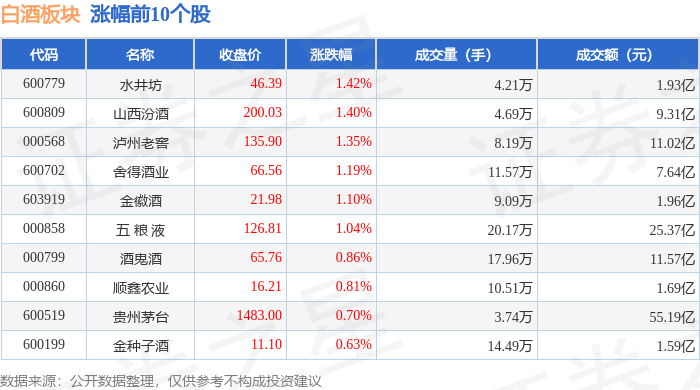
Group 1 - The liquor sector experienced a rise of 0.81% on September 5, with Shuijingfang leading the gains [1] - The Shanghai Composite Index closed at 3812.51, up 1.24%, while the Shenzhen Component Index closed at 12590.56, up 3.89% [1] - Key stocks in the liquor sector showed the following closing prices and percentage changes: Shuijingfang at 46.39 (+1.42%), Shanxi Fenjiu at 200.03 (+1.40%), and Luzhou Laojiao at 135.90 (+1.35%) [1] Group 2 - The liquor sector saw a net outflow of 77.46 million yuan from institutional investors, while retail investors experienced a net outflow of 67.44 million yuan [2] - Notable net inflows from speculative funds included Wuliangye with 12.8 million yuan, while it faced a net outflow of 101 million yuan from retail investors [2] - Other stocks like Shuijingfang and Luzhou Laojiao also experienced mixed fund flows, with Shuijingfang seeing a net inflow of 1.36 million yuan from institutional investors [2]


天佑德酒: 关于向美国子公司增加注册资本暨对外投资的进展公告
Zheng Quan Zhi Xing· 2025-09-05 04:09
Group 1 - The company has approved a capital increase of 4 million USD to its wholly-owned subsidiary, Oranos Group, Inc. (OG), to support its business development needs [1][2] - The capital increase will be implemented in multiple phases, with the recent injection of 600,000 USD (approximately 4,295,940 RMB), raising the total investment in OG to 16 million USD [1] - As of the date of the announcement, the entire capital increase of 4 million USD has been completed [2]
天佑德酒(002646) - 关于向美国子公司增加注册资本暨对外投资的进展公告
2025-09-05 03:44
证券代码:002646 证券简称:天佑德酒 公告编号:2025-056 青海互助天佑德青稞酒股份有限公司 关于向美国子公司增加注册资本暨对外投资的进展公告 本公司及董事会全体成员保证信息披露内容的真实、准确、完整,没有虚假记载、误导 性陈述或重大遗漏。 青海互助天佑德青稞酒股份有限公司(以下简称"公司")于 2024 年 7 月 12 日召开第五 届董事会第十一次会议(临时),审议通过《关于向美国子公司增加注册资本暨对外投资的议 案》。为了满足美国全资子公司 Oranos Group,Inc.(以下简称"OG")业务发展需要,决定向 OG 增加注册资本 400 万美元,本次增资事项分多次实施。 2024 年 8 月、2024 年 12 月、2025 年 6 月,公司分别完成了向 OG 注资 200 万美元、75 万美元和 65 万美元。详见公司于 2024 年 8 月 30 日、2024 年 12 月 28 日和 2025 年 6 月 10 日 在巨潮资讯网(http://www.cninfo.com.cn)、《证券时报》《中国证券报》《上海证券报》 《证券日报》披露的《关于向美国子公司增加注册资本暨对外投资 ...