
wanhua(600309)

Search documents
研判2025!中国甲基异丁基酮行业发展历程、产业链、产量、进出口、竞争格局和未来趋势分析:国内供应量增加,进口规模逐渐下降[图]
Chan Ye Xin Xi Wang· 2026-01-07 01:05
Core Viewpoint - The domestic market for methyl isobutyl ketone (MIBK) in China is experiencing significant growth due to technological advancements and increasing application demands, leading to a reduction in import dependency and an increase in production capacity and output [1][5]. Industry Overview - MIBK, also known as 4-methyl-2-pentanone, is a colorless liquid with a camphor-like odor, soluble in most organic solvents and slightly soluble in water. It has applications in organic synthesis, rubber manufacturing, and coatings [1]. - The production methods for MIBK include the acetone method and the isopropanol method, with the acetone method being more efficient for continuous production [2][3]. Production Capacity and Output - From 2016 to 2024, China's MIBK production capacity is projected to grow from 75,000 tons to 150,000 tons, while output is expected to increase from 54,000 tons to 120,000 tons [1][5]. - The industry is expected to continue its growth trend due to the intensive commissioning of MIBK projects in the future [1]. Import and Export Dynamics - In 2024, China's MIBK imports are expected to be 9,167.5 tons with an import value of $12.51 million, while exports are projected at 3,654.21 tons valued at $5.68 million. By 2025, exports are anticipated to significantly exceed imports [5][6]. Competitive Landscape - Major global producers of MIBK include South Africa's Sasol, Korea's Kumho Petrochemical, and Japan's Mitsui Chemicals. Domestically, companies like Juhua Chemical, Ruibai New Materials, and Wanhua Chemical are key players in the market [7]. - Wanhua Chemical is expanding its MIBK production capacity, with a new project in Yantai expected to enhance its market position [7][8]. Industry Development Trends 1. **Green Development**: The MIBK industry is moving towards sustainable practices, focusing on reducing waste and emissions through advanced catalyst systems and resource recycling [9]. 2. **High-end Product Demand**: There is a growing demand for high-purity MIBK in sectors like new energy vehicles and high-end electronics, prompting companies to invest in R&D for better quality products [10]. 3. **International Expansion**: The industry is looking to expand into international markets, particularly in Southeast Asia and the Middle East, to tap into the rising demand in manufacturing sectors [11].



沪指13连阳创十年新高 全市场成交额超2.8万亿元
Shang Hai Zheng Quan Bao· 2026-01-06 17:56
Core Viewpoint - The A-share market has reached a new record, with the Shanghai Composite Index closing at 4083.67 points, marking a 1.50% increase and breaking a ten-year high since July 2015, supported by a strong performance across various sectors and increased trading volume [1][2]. Market Performance - The A-share market exhibited a comprehensive upward trend, with significant contributions from the financial, materials, and technology sectors, driven by ongoing policy benefits and accelerated industrial trends [2]. - The financial sector, particularly securities and insurance, played a crucial role in supporting the Shanghai Composite Index above 4000 points, with companies like New China Life Insurance and China Pacific Insurance reaching new highs [2]. - The cyclical sector saw notable gains due to improved supply-demand dynamics, with the metals sector, including companies like Zijin Mining, experiencing significant price increases [2]. Emerging Trends - The technology and emerging industries continued to show structural growth, particularly in the brain-computer interface sector, which has become a hot topic, with companies like Beiyikang and Weisi Medical seeing substantial stock price increases [3]. - The brain-computer interface market in China is projected to exceed 120 billion yuan by 2040, with a compound annual growth rate of approximately 26%, indicating its potential as a key growth area in the global market [3]. Trading Volume and Capital Flow - The recent market rally is characterized by a significant increase in both trading volume and price, with the Shanghai Composite Index rising nearly 7% since December 17, 2025, and total market turnover increasing from 1.8 trillion yuan to 2.8 trillion yuan [4]. - Various funding sources, including foreign capital and margin trading, have contributed to this volume increase, with margin trading balances reaching a historical high of 25,606.48 billion yuan [4]. Institutional Outlook - Institutions are generally optimistic about the A-share market's future performance, attributing the current rally to a confluence of favorable policies, capital influx, and strong fundamentals [6]. - Analysts suggest that the ongoing "spring rally" has room for further development, with a focus on sectors benefiting from AI investments and global manufacturing recovery, such as industrial resources and equipment exports [7].



从0到310家!山东资本市场规模与质量双升、创新与价值共生
Sou Hu Cai Jing· 2026-01-06 16:31
Core Viewpoint - The development of the A-share market in Shandong has significantly contributed to the high-quality economic growth of the region, with a notable increase in both the number and market capitalization of listed companies over the past 32 years [1][7]. Group 1: Historical Development - The first A-share company in Shandong, Qingdao Beer, was listed in 1993, marking the beginning of a rapid expansion in the region's capital market [5]. - By the end of 1993, the market capitalization of Shandong listed companies was 9.6 billion yuan, which has grown to 4.79 trillion yuan by December 2025 [5][1]. - The number of A-share companies in Shandong reached 310 by 2023, with a market capitalization of 3.46 trillion yuan, reflecting a significant increase in both quantity and quality [7]. Group 2: Economic Contributions - In the first three quarters of 2025, Shandong A-share companies collectively achieved revenue of 2.30 trillion yuan, contributing to regional economic development [1][11]. - The total market capitalization of Shandong state-owned A-share companies reached 1.85 trillion yuan, accounting for nearly 40% of the overall market capitalization of the Shandong sector [10]. Group 3: Performance Metrics - In 2025, Shandong A-share companies reported a net profit of 737 billion yuan, representing 46% of the total net profit of the Shandong sector [10]. - Among the 310 listed companies, 251 were profitable, with 63 companies achieving profit growth year-on-year [11][10]. Group 4: Innovation and R&D - Shandong listed companies have increased their R&D investments, with 173 companies reporting a year-on-year increase in R&D expenses in 2025 [12]. - Notable companies such as Haier Smart Home and Weichai Power have significantly increased their R&D expenditures, with Haier reaching 10.74 billion yuan [13][14]. Group 5: Future Outlook - The continuous growth and innovation of Shandong listed companies are expected to drive further economic development and industrial upgrades in the region [15].




2026年度化工投资展望:周期伊始,破卷而立
Guotou Securities· 2026-01-06 13:35
Investment Rating - The report assigns a "Buy-A" rating for the chemical industry, indicating a positive outlook for investment opportunities in this sector [1]. Core Insights - The chemical industry is currently at the bottom of a four-year down cycle, with multiple indicators suggesting it has nearly bottomed out. The year 2026 is anticipated to be a turning point for the cycle [2]. - The China Chemical Product Price Index (CCPI) was reported at 3930 points on December 31, 2025, a 39% decrease from the peak in 2021, indicating the industry is in a historically low range [2]. - The basic chemical sector achieved a net profit of 112.7 billion yuan in the first three quarters of 2025, reflecting a year-on-year increase of 7.5%, suggesting initial stabilization [2]. - Capital expenditure in the industry has decreased by 18.3% year-on-year, marking seven consecutive quarters of negative growth since Q4 2023, indicating the end of the supply expansion phase [2]. Summary by Sections Chemical Cycle Turning Point - The report confirms the turning point of the chemical capacity cycle, with indicators showing that the industry is at the bottom of a down cycle and is expected to recover in 2026 [12]. - The capital expenditure to revenue ratio and the ratio of construction projects to fixed assets are both declining, further indicating the end of the supply expansion phase [12][10]. Changing Landscape of the Chemical Industry - The chemical landscape is shifting from West to East, with European chemical companies facing high energy costs and regulatory pressures leading to capacity reductions. For instance, Europe has shut down 11 million tons of ethylene capacity, nearly 10% of its total capacity [3]. - In contrast, Chinese companies are rapidly gaining market share due to their scale and cost advantages, with 60% of monitored chemical products showing high export volumes [3][20]. Upstream Resource Value Reassessment - The report highlights three categories of assets to focus on: cyclical assets (e.g., phosphorus, sulfur, chromium), value assets (e.g., potassium, titanium), and dividend assets (e.g., crude oil) [3][7]. - Phosphorus and sulfur are expected to see sustained demand due to their strategic importance in new energy and battery technologies [3]. New Cycle Observations - The report discusses the proactive and reactive measures in the industry to combat "involution," suggesting that sectors with high concentration and low profitability are more likely to see effective self-regulation [5][7]. - The focus on new productive forces is emphasized, with significant investment opportunities in green energy, advanced manufacturing, and consumption upgrades [6][7]. Key Companies to Watch - The report identifies several leading companies in the chemical sector that are positioned favorably due to their cost advantages and market positioning, including Wanhua Chemical, Hualu Hengsheng, and others [7][50].


【6日资金路线图】非银金融板块净流入逾186亿元居首 龙虎榜机构抢筹多股
证券时报· 2026-01-06 11:47
1月6日,A股市场整体上涨。 截至收盘,上证指数收报4083.67点,上涨1.5%,深证成指收报14022.55点,上涨1.4%,创业板指收报3319.29点,上涨0.75%,北证50 指数上涨1.82%。A股市场合计成交28324.97亿元,较上一交易日增加2650.87亿元。 1. A股市场全天主力资金净流出176.68亿元 今日A股市场主力资金开盘净流出147.71亿元,尾盘净流入18.05亿元,A股市场全天主力资金净流出176.68亿元。 | | | 沪深两市近五日主力资金流向情况(亿元) | | | | --- | --- | --- | --- | --- | | 日期 | | 净流入金额 开盘净流入 | | 尾盘净流入 超大单净买入 | | 2026-1-6 | -176. 68 | -147.71 | 18. 05 | 33. 67 | | 2026-1-5 | -62.98 | -54. 18 | 17. 34 | 90. 80 | | 2025-12-31 | -270. 79 | -129.42 | -36. 63 | -63.89 | | 2025-12-30 | -238.28 | ...





2026年格隆汇“下注中国”十大核心资产涨疯啦!
格隆汇APP· 2026-01-06 11:23
Core Viewpoint - The article emphasizes the strong performance of the "Betting on China" top ten core asset portfolio, which has significantly outperformed major indices, showcasing the effectiveness of the research institute's asset selection strategy [2][3]. Performance Summary - As of January 5, 2026, the "Betting on China" portfolio increased by 3.6%, outperforming the Shanghai Composite Index's 1.4% and the Hang Seng Index's 2.8% [3]. - Year-to-date, the portfolio has risen by 6.14%, surpassing the Shanghai Composite Index's 2.89% and the Hang Seng Index's 4.29% [3][4]. - Notable individual performances include Alibaba (+7.0%), China Ping An (+5.8%), and WuXi AppTec (+4.4%) from January 2 to 5, 2026 [3][4]. Asset Selection - The core assets selected include: - Zhongji Xuchuang (AI computing/advanced manufacturing) with a market cap of 6,778 million RMB - Tencent (AI applications) with a market cap of 49,160 million RMB - Alibaba (AI/cloud computing) with a market cap of 24,500 million RMB - China Ping An (finance) with a market cap of 12,400 million RMB - WuXi AppTec (pharmaceuticals) with a market cap of 15,151 million RMB [2]. Future Outlook - The strong performance at the beginning of the year is seen as just the start of the value release of the core assets, with the research institute committed to identifying quality targets in China's economic transformation [6].





PVC价格大涨!化工板块暴力拉升,化工ETF(516020)摸高3.83%,近5日吸金超3.5亿元!
Xin Lang Cai Jing· 2026-01-06 11:22
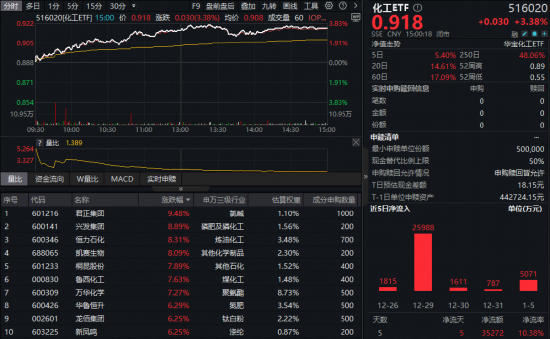
Group 1 - The chemical sector continues to show strong performance, with the Chemical ETF (516020) experiencing a maximum intraday increase of 3.83% and closing up 3.38% [1][8] - Key stocks in the sector include Junzheng Group, which surged by 9.48%, and other notable performers such as Xingfa Group and Hengli Petrochemical, both rising over 8% [1][8] - The basic chemical sector attracted significant capital inflow, with a net inflow of 12.4 billion yuan on the day, ranking second among 30 CITIC primary industries [11][12] Group 2 - The Chemical ETF (516020) has seen a total net subscription of 352 million yuan over the past five trading days, indicating strong investor interest [3][9] - PVC futures contracts rose over 3% in a single day, with a cumulative increase of over 15% since mid-December [10] - Analysts predict that by 2026, the petrochemical industry will undergo a supply-side clearing, leading to a recovery in demand for specific segments like PX and PTA [10] Group 3 - The valuation of the chemical sector remains reasonable, with the Chemical ETF's underlying index price-to-book ratio at 2.65, positioned at the 52.45 percentile over the past decade [10] - The chemical industry is currently at a cyclical bottom, with potential for recovery driven by demand stimulation policies and ongoing export growth [12] - The Chemical ETF (516020) provides an efficient way to invest in the sector, with nearly 50% of its holdings in large-cap leading stocks, allowing investors to capitalize on strong market trends [12]


基础化工行业资金流入榜:君正集团、万华化学等净流入资金居前
Zheng Quan Shi Bao· 2026-01-06 10:00
Market Overview - The Shanghai Composite Index rose by 1.50% on January 6, with 30 industries experiencing gains, led by non-ferrous metals and non-bank financials, which increased by 4.26% and 3.73% respectively [1] - The basic chemical industry ranked third in terms of daily gains [1] - The communication industry saw the largest decline, dropping by 0.77% [1] Capital Flow Analysis - The main capital flow showed a net outflow of 1.033 billion yuan across both markets, with 17 industries experiencing net inflows [1] - The non-bank financial sector had the highest net inflow of 6.961 billion yuan, coinciding with its 3.73% increase [1] - The non-ferrous metals sector followed with a net inflow of 5.885 billion yuan and a daily increase of 4.26% [1] - Conversely, 14 industries faced net outflows, with the communication sector leading at a net outflow of 10.507 billion yuan, followed by the media sector with 4.144 billion yuan [1] Basic Chemical Industry Performance - The basic chemical industry increased by 3.12% with a net inflow of 0.954 billion yuan, comprising 408 stocks, of which 314 rose and 82 fell [2] - Notably, 18 stocks hit the daily limit up, while 205 stocks experienced net inflows, with 10 stocks seeing inflows exceeding 0.1 billion yuan [2] - The top three stocks by net inflow were Junzheng Group (0.419 billion yuan), Wanhua Chemical (0.307 billion yuan), and Zhongtai Chemical (0.205 billion yuan) [2] Top Gainers in Basic Chemical Industry - Junzheng Group: +9.48%, turnover rate 4.89%, net inflow 41.861 million yuan [3] - Wanhua Chemical: +7.27%, turnover rate 1.87%, net inflow 30.681 million yuan [3] - Zhongtai Chemical: +9.94%, turnover rate 4.15%, net inflow 20.513 million yuan [3] Top Losers in Basic Chemical Industry - Yilong Shares: +4.49%, turnover rate 4.05%, net outflow -46.719 million yuan [4] - Dongcai Technology: -2.86%, turnover rate 9.07%, net outflow -38.330 million yuan [4] - Guofeng New Materials: +1.62%, turnover rate 23.78%, net outflow -18.762 million yuan [4]


化工板块热度升温,化工ETF、化工龙头ETF、化工ETF嘉实、化工ETF天弘、化工50ETF涨超3%
Ge Long Hui A P P· 2026-01-06 09:49
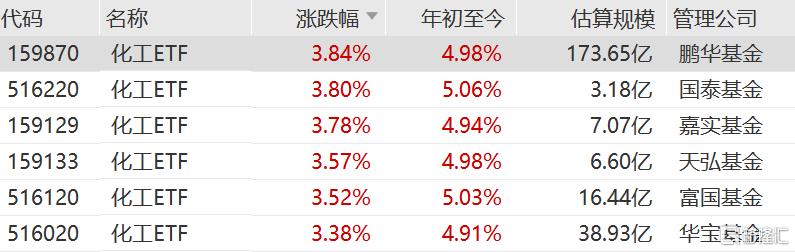
Group 1 - The chemical sector is experiencing active performance, with companies like Junzheng Group rising over 9%, Xingfa Group up 8.89%, and Hengli Petrochemical increasing by 8.31% [1] - Chemical ETFs, including Chemical Leader ETF and others, have risen over 3% [1] Group 2 - Various chemical ETFs have shown positive performance, with Chemical ETF by Penghua Fund up 3.84% year-to-date, and an estimated scale of 173.65 billion [2] - The ETFs track the CSI Sub-Industry Chemical Theme Index, covering multiple sub-sectors such as fluorine chemicals and fertilizers, and include leading stocks like Wanhua Chemical and Yalake [2] Group 3 - Prices of chemical products like TDI, MDI, PX, and sulfur have rebounded, driven by concentrated inventory replenishment demand before the Spring Festival [3] - Major companies like Wanhua Chemical and BASF have issued price increase notices, indicating a clearer signal of industry bottom reversal due to supply and demand dynamics [3] - Capital expenditure in the chemical industry is expected to decline in 2024, with a potential supply contraction due to the "anti-involution" trend and the clearing of outdated overseas capacity [3] Group 4 - The chemical industry is anticipated to face dual opportunities for cyclical recovery and industrial upgrading by 2026, with traditional demand expected to recover moderately [4] - The industry has been in a bottom range for three years, and new capacity releases are nearing an end, suggesting a potential acceleration of the cyclical turning point [4] - Global carbon reduction policies and the ongoing prosperity of the AI industry are expected to create new growth demands, providing opportunities for upgrading in the chemical materials sector [4]
基础化工行业资金流入榜:君正集团、万华化学等净流入资金居前
Zheng Quan Shi Bao Wang· 2026-01-06 09:29
Group 1 - The Shanghai Composite Index rose by 1.50% on January 6, with 30 industries experiencing gains, led by non-ferrous metals and non-bank financials, which increased by 4.26% and 3.73% respectively [1] - The basic chemical industry ranked third in terms of daily gains, rising by 3.12% with a net inflow of 9.54 billion yuan in main funds [2] - The telecommunications industry saw the largest net outflow of main funds, totaling 10.507 billion yuan, followed by the media industry with a net outflow of 4.144 billion yuan [1] Group 2 - In the basic chemical industry, 314 out of 408 stocks rose today, with 18 hitting the daily limit, while 82 stocks declined [2] - The top three stocks with the highest net inflow in the basic chemical sector were Junzheng Group, Wanhu Chemical, and Zhongtai Chemical, with net inflows of 4.19 billion yuan, 3.07 billion yuan, and 2.05 billion yuan respectively [2] - The stocks with the largest net outflows included Salt Lake Co., East Material Technology, and Guofeng New Materials, with net outflows of 4.67 billion yuan, 3.83 billion yuan, and 1.88 billion yuan respectively [3]